

Written by Andrew Marshall
UK parent of three sharing practical advice to help families enjoy camping, walking, garden play, and simple outdoor adventures across the UK.
Creator of Simple Days Outside.
You don’t need a huge garden, a trampoline the size of a small island, or a “Pinterest-perfect” setup to make outdoor time exciting.
Most kids don’t actually want expensive stuff — they want a place that feels like something is happening. A space with a few “zones” they can move between, a bit of imagination built in, and enough variety that they don’t get bored after ten minutes.
The good news: turning your garden into an adventure zone is mostly about layout, small reusable items, and a few simple routines that make outdoor play feel different from “just being outside”.
This guide is written like a parent who’s trying to keep kids happy without turning every afternoon into an event. It’s practical, UK-weather friendly, and designed to work in real gardens.
What “Adventure Zone” Actually Means (For Families)
When I say “adventure zone”, I don’t mean building a ninja warrior course or digging a moat (tempting though that sounds when you’re staring at a boring patch of grass).
For UK families, an adventure zone is simply:
- A garden that encourages movement (running, climbing, balancing, throwing, crawling)
- A garden that supports imagination (dens, bases, “missions”, pretend play)
- A garden that’s easy to reset (so you’re not tidying for 45 minutes afterwards)
- A garden that works even when the weather is a bit meh
The goal is to create a space where kids can bounce between activities without you having to invent new ideas every five minutes.
Step 1: Create “Zones” (Even If the Garden Is Small)
Kids play better when the garden feels like it has different areas.
You don’t need fences or anything permanent — just visual separation.
Think in 3–5 zones:
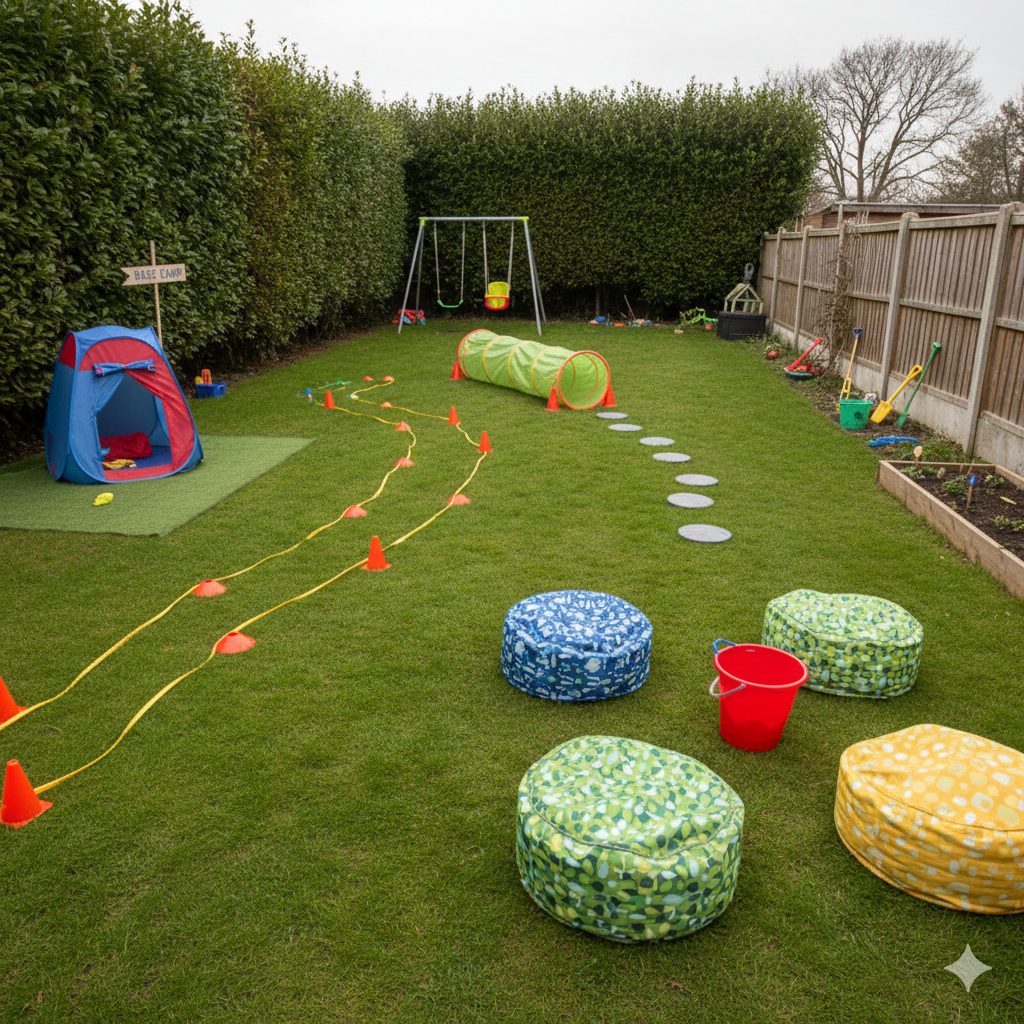
1) Base Camp Zone
This is where kids start, return to, and keep their stuff.
Options:
- A pop-up play tent or teepee
- A picnic blanket under a tree
- A corner with cushions on a waterproof mat
A pop-up play tent is brilliant for this because it instantly becomes “their place” — a base, a hideout, a shop, a secret club, whatever they decide. It also takes seconds to set up and pack away.
Parent bonus: Base camp is where snacks go. And snacks are basically the currency of outdoor happiness.
2) Movement Zone
This is the “run, jump, climb” area.
It can be simple:
- A clear strip of lawn
- A path between obstacles
- A space for races and challenges
If you don’t have much grass, you can still do this on a patio with jumping markers and balance games.
3) Challenge Zone
This is where you put the “missions” and mini obstacles.
It doesn’t need to be complicated:
- Cones for weaving
- Hoops or floor markers for jumping
- A tunnel for crawling
- Balance stepping stones
A cheap set of kids training cones is one of the easiest upgrades because it turns random running into organised games. You can create routes, slaloms, “don’t touch the cones” challenges, and time trials.
4) Creative / Nature Zone
This is the quieter area.
Ideas:
- Bug hunting corner
- Chalk drawing spot
- Mud kitchen zone
- “Nature collection” bucket and magnifying glass
This zone is important because kids don’t always want full-speed play the whole time. A calmer option keeps them outside longer.
5) Throwing / Target Zone
This is the “aim and score points” station.
Use:
- A washing basket
- Buckets
- Cardboard boxes
- Targets drawn with chalk
This is where bean bags or soft throwing bags are perfect. They’re safe, they don’t destroy your garden, and they work for all ages. Kids love target games because they feel like a challenge without needing loads of space.
Step 2: Choose “Reusable Adventure Pieces”
The best garden adventure setups aren’t built from scratch every day. They’re built from a few reusable pieces that can be rearranged.
Here’s the sweet spot:
The “Adventure Kit” (Simple and Reusable)
- Training cones (routes, drills, boundaries)
- Agility rings or floor markers (jump stations, “safe zones”)
- Balance stepping stones (balance missions, lava games)
- Pop-up tunnel (crawl section, secret passage)
- Bean bags (target games, “delivery missions”)
- Pop-up tent (base camp and den play)
You don’t need all of these, but even two or three turns your garden into something kids interact with rather than just stand in.
If you already have one thing: great. Add one new piece when you can, and it builds over time.
Step 3: Use “Story Missions” (This Is the Magic Part)
Here’s where the adventure feeling really kicks in:
Don’t tell kids to “go play in the garden.”
Give them a mission.
Kids love missions because it turns play into a purpose. It also keeps them going longer, because they’re not just running — they’re doing something important.
Simple Mission Ideas
- Rescue Mission: “Save the teddy from the tunnel and bring it to base camp.”
- Treasure Run: “Collect five ‘treasures’ and return them to the tent.”
- Lava Garden: “The grass is lava — you can only step on stones/hoops.”
- Delivery Service: “Deliver bean bags to target buckets without dropping them.”
- Spy Training: “Crawl through the tunnel, weave through cones, balance to the finish.”
A pop-up tunnel and stepping stones are the perfect “mission tools” because they instantly create obstacles that feel exciting to kids — even though to us it’s just… plastic stones and a collapsible tunnel.
Step 4: Build One “Main Route” Through the Garden
Kids love having a route.
It can be a loop or a straight line:
- Start at base camp
- Do the movement zone
- Complete a challenge
- Score points at the target zone
- Return to base camp
This structure makes outdoor play feel like an “activity” without you having to constantly direct.
Example Adventure Route (Works in Most Gardens)
- Start at the tent (base camp)
- Weave through cones (movement)
- Jump through hoops (challenge)
- Crawl through tunnel (challenge)
- Balance across stepping stones (challenge)
- Throw 3 bean bags into basket (target)
- Sprint back to base camp
It sounds simple because it is — but kids will run it ten times and change the rules themselves.
Step 5: Add “Levels” to Keep It Interesting
You don’t need to rebuild the setup to make it fresh.
Just add levels.
Level Ideas Kids Love
- Level 1: Normal run
- Level 2: Hop on one foot
- Level 3: Carry a teddy through the whole course
- Level 4: No talking allowed (they always break this within 6 seconds)
- Level 5: Backwards through the cones
Small changes keep it exciting. Kids love being timed, too — even if you’re clearly pretending to be “official” with your stopwatch.
Step 6: Make It UK-Weather Proof (Without Overcomplicating It)
You’ll never win against UK weather, but you can make outdoor play easier in it.
Damp Grass Days
- Put a blanket or waterproof mat inside the tent
- Move obstacle elements onto patio if needed
- Use a towel as a “dry zone” at base camp
Light Drizzle
A pop-up tent becomes surprisingly useful. It gives kids a sense of shelter and keeps them outside longer.
You don’t need to do full rain gear for a bit of drizzle, but having waterproof jackets and trousers available makes a massive difference on days where it’s not pouring but it’s not dry either.
Windy Days
- Peg down tents if possible
- Avoid ultra-light items blowing across the garden
- Put the base camp against a fence or hedge for shelter
Step 7: Let the Kids Build It Sometimes
This is one of the easiest ways to make the garden feel like an adventure zone without you doing everything.
Give them a simple challenge:
- “Design a course with 6 stations.”
- “Make a route that ends at base camp.”
- “Create a ‘lava garden’ path across the lawn.”
When kids design it, they’re far more invested — and they run it more, because it’s “their idea.”
You also get a quiet moment while they argue about whether the tunnel goes before or after the stepping stones. (You can pretend it’s not the most peaceful sound in the world.)
Step 8: Add One “Signature Feature” (Optional, But Powerful)
A signature feature is something that makes the garden memorable.
It could be:
- A permanent “base camp corner”
- A dedicated chalk zone
- A mud kitchen area
- A garden “finish line”
- A simple wooden balance beam
This isn’t about buying big gear. It’s about making the garden feel like a place where adventures happen.
Even something as simple as a set of stepping stones kept in the same area can become “the lava path” every time they play.
Step 9: Keep the Setup Easy to Reset
If the garden becomes a mess every time, you’ll avoid doing it.
So make it easy to reset:
- Keep cones and bean bags in a box by the back door
- Fold the tunnel and tent away neatly
- Put stepping stones in a stack by the shed
The easier it is to bring out, the more often you’ll use it.
Simple Product Ideas That Make a Real Difference (Without Turning It Into a Shopping Trip)
You don’t need a huge list of gear. But if you’re going to add a couple of things, these are the ones that genuinely earn their keep:
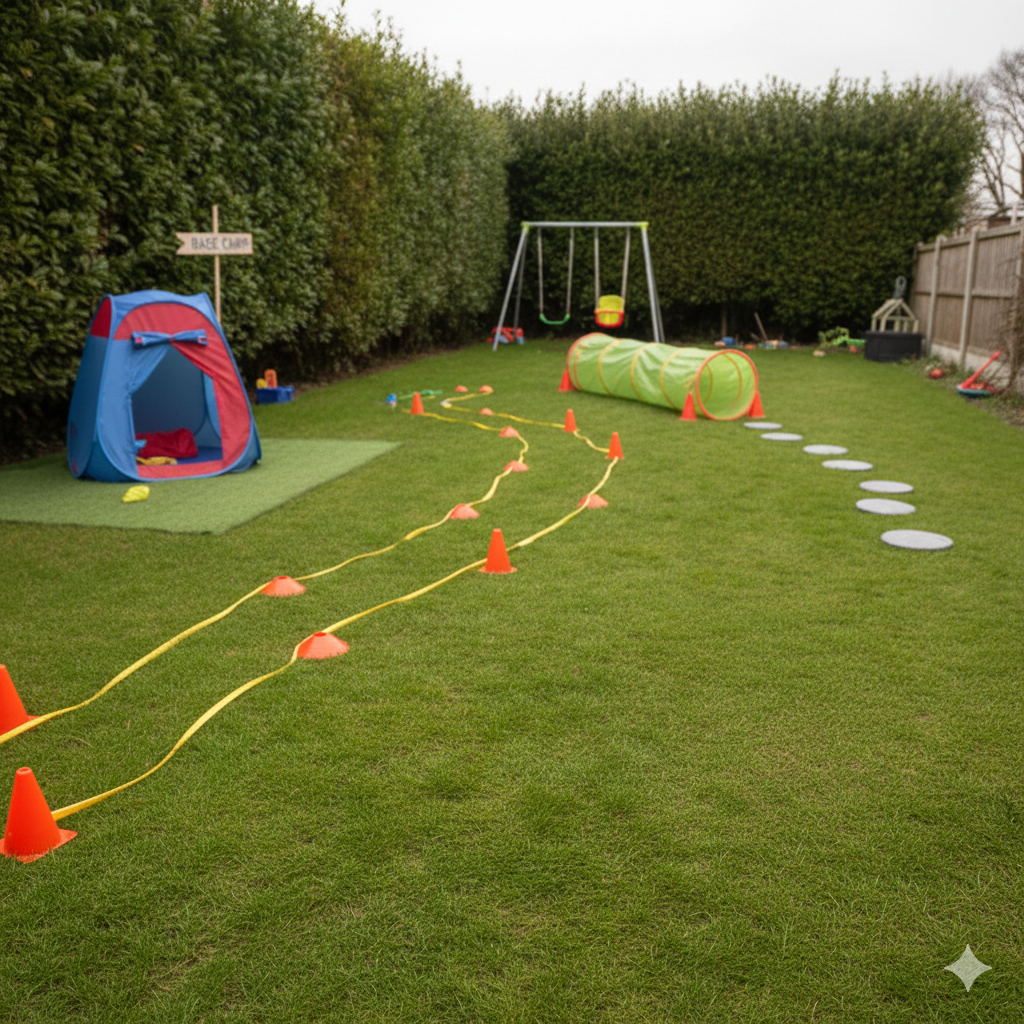
A pop-up play tent creates a base camp instantly.
A pop-up play tunnel adds movement and excitement with almost no effort.
Training cones make games and routes feel structured (kids love that).
Balance stepping stones are perfect for “lava” games and confidence-building.
Bean bags add easy target games that work for any age.
These aren’t one-time toys — they get used across multiple games and seasons.
🧗 Bringing Your Garden Adventure to Life
Once you’ve created simple zones in the garden, adding a few structured ideas can make outdoor play feel even more exciting. Our guide to Best Garden Obstacle Course Ideas for Kids (UK) – Easy Outdoor Fun at Home shows how everyday items and a few simple additions can turn movement into a fun challenge. Pairing this with a cosy base like the setups in Top Outdoor Play Tents & Pop-Up Dens for Kids gives children a place to return to between missions and helps the whole garden feel like a real adventure space.
Final Thoughts: The Adventure Zone Isn’t About Stuff — It’s About Setup
Turning your garden into an adventure zone isn’t about buying loads of equipment. It’s about arranging a few simple pieces in a way that invites play.
If you create:
- a base camp
- a route
- a few challenge stations
- and one or two story missions
…kids will do the rest.
They’ll run it, tweak it, invent new rules, and suddenly your garden becomes the place where adventures happen — even if the weather is grey and you’ve got a cup of tea going cold on the step.
And if you hear “Can we do the course again?” for the fifth time, just remember: it’s working.
🌿 Garden & Outdoor Play for Kids
Simple outdoor play at home can be just as exciting as days out when kids have the right ideas and equipment to keep them moving. You’ll find more practical, parent-friendly guides in our Garden & Outdoor Play for Kids hub, all designed to make outdoor time easy, active, and fun without overcomplicating things.
About The Author – Andrew Marshall
Andrew Marshall is the creator of Simple Days Outside and a UK parent of three who regularly camps, walks, and explores outdoor activities with his family. His guides focus on practical gear, realistic family adventures, and simple ways to help families enjoy the outdoors across the UK. The recommendations on this site are based on real-world use, research, and the kind of equipment families actually rely on for weekend trips and everyday outdoor fun.