

Written by Andrew Marshall
UK parent of three sharing practical advice to help families enjoy camping, walking, garden play, and simple outdoor adventures across the UK.
Creator of Simple Days Outside.
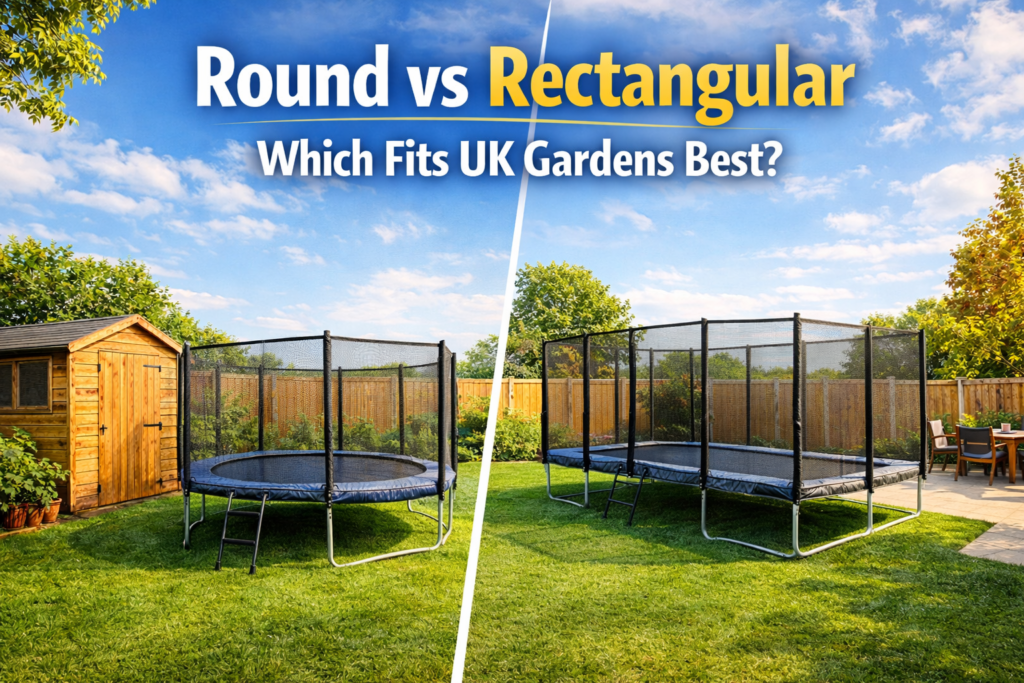
If you’re stuck choosing between a round trampoline and a rectangular one, you’re not alone. Most parents start with a simple question — “which is better?” — and quickly realise it depends on your garden shape, your child’s age, how many kids will use it, and how much you care about bounce performance versus practicality.
In the UK, the decision is even more specific. Gardens are often smaller, fenced, slightly uneven, and exposed to wind. Add patios, sheds, washing lines, and neighbours close by… and suddenly trampoline shape matters a lot more than the product photos make it seem.
If you’re still weighing up all your options, this guide forms part of our complete trampoline advice series for UK families. You can explore more detailed buying tips, safety guidance, and comparisons in our main hub covering everything from sizes and budgets to setup and long-term use — ideal if you want to feel fully confident before choosing the right trampoline for your garden.
This guide breaks it down in plain English so you can decide confidently today.
👉 In This Guide
Quick Answer Summary
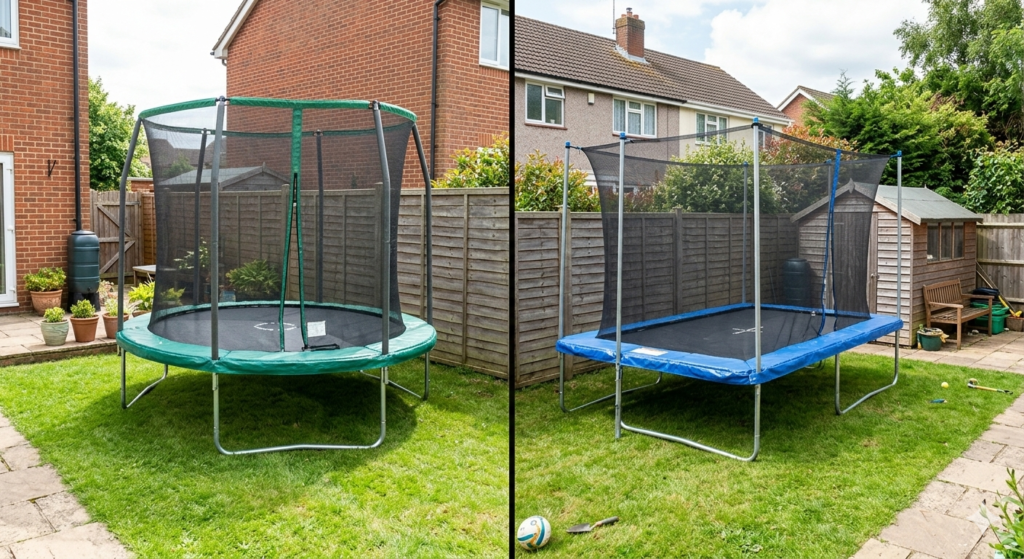
- Best all-round choice for most UK families: Round trampoline
Easier to fit, usually cheaper, and naturally guides jumpers toward the centre (good for safety and casual play). - Best choice for narrow gardens and confident jumpers: Rectangular trampoline
More usable bounce area for the footprint, better performance, and often fits along a long thin lawn — but typically costs more and needs careful setup. - If you’re unsure: go round unless you specifically want the more powerful, consistent bounce of a rectangle (or your garden shape makes round awkward).
Round vs Rectangular Trampoline: Quick Comparison
| Feature | Round Trampoline | Rectangular Trampoline |
|---|---|---|
| Best for | Most families | Confident jumpers / narrow gardens |
| Bounce style | Pulls toward centre | Even across whole mat |
| Space efficiency | Needs wider area | Fits long narrow lawns |
| Safety feel | More forgiving | More powerful bounce |
| Price | Usually cheaper | Usually more expensive |
| Longevity | Good for younger kids | Better for older kids |
| Ease of placement | Very easy | Needs careful positioning |
Why Shape Matters More Than People Think
On paper, both shapes “do the same thing”. In real life, shape changes:
- how the bounce feels
- where kids naturally drift while jumping
- how easy it is to fit safely into a UK garden
- how much you’ll pay
- how stable it is in wind
- how long it stays fun as kids grow
So rather than asking “which is better”, a better question is:
Which shape matches my garden and the way my kids will actually use it?
Round Trampolines (UK Reality Check)
Round trampolines are the standard for family gardens. If you’ve seen trampolines in your street, most will be round.
What Round Trampolines Are Best For
- One child bouncing at a time
- Younger children and beginners
- Casual everyday play
- Families with average-sized UK gardens
- Households that want value for money
The Bounce Feel (Simple Explanation)
Round trampolines tend to pull jumpers toward the centre. That’s because the springs are arranged evenly around a circular frame, and the tension naturally guides movement inward.
That’s helpful because most kids don’t jump in a perfectly controlled way — they drift, they bounce sideways, they try silly moves. A round shape gently “corrects” that.
The Biggest Advantages (Round)
1) Easier to place safely
A round trampoline usually sits nicely in the centre of a lawn with even clearance around it.
2) Safer for mixed ages
Because the bounce tends toward the centre, younger kids are less likely to end up repeatedly bouncing into the net.
3) Better value
In the UK, round trampolines are more common, so there’s usually more choice at lower prices.
If you want help narrowing down what’s actually worth buying, you can point readers to our guide to the best trampolines for UK gardens.
Where Round Trampolines Can Be Annoying
- They can waste space in narrow gardens because the circular footprint doesn’t align with fence lines.
- For older kids, the bounce can feel less “sporty” or consistent than a rectangle.
- If you’re trying to fit a trampoline into a corner (not recommended), round is awkward.
Rectangular Trampolines (UK Reality Check)
Rectangular trampolines are often used in gymnastics training, which is why they’re associated with a stronger, more controlled bounce.
What Rectangular Trampolines Are Best For
- Older kids who want higher, more consistent bounce
- Confident jumpers
- Multiple children taking turns
- Narrow gardens where a circle doesn’t fit well
- Families that want maximum bounce space for the footprint
The Bounce Feel (Plain English)
Rectangular trampolines have a more even, predictable bounce across the mat. The springs are tensioned differently, which means you can bounce near the edges without the same “pull to the middle” effect you get on a round.
That’s why they feel more powerful and controlled — but also why they’re often used by more confident jumpers.
The Biggest Advantages (Rectangular)
1) More usable jumping area for the space
A 10ft rectangular trampoline can feel like it has more “working space” than a 10ft round because there’s less wasted curve at the edges.
2) Fits long narrow gardens better
Many UK gardens are basically a rectangle of lawn behind a patio. A rectangular trampoline can align with that shape and give you better clearance.
3) Better for progression
If your child is going to be doing more than casual bouncing (or they’re the kind that will try flips no matter what you say), rectangular is often the shape they’ll prefer.
Where Rectangular Trampolines Can Be a Poor Choice
- They’re usually more expensive
- They can encourage higher jumping (which increases risk if rules aren’t followed)
- They often require better-quality frames and assembly
- The stronger bounce can be too much for very young kids
If you want to cover risk without being alarmist, a good internal link here is our parent guide on trampoline safety
Which Is Best for UK Gardens? (By Garden Type)
1) Small UK Gardens / New Builds
Most new-build gardens are smaller, with patios, sheds, and narrow lawns.
- Best for most families: Round (simpler, safer, more forgiving)
- Best if the lawn is long and thin: Rectangular can fit better
The key here is safe clearance. If you’re still not sure what size fits your space, link readers to our UK garden size guide for choosing the right trampoline size (internal link: What Size Trampoline Should I Buy?).
2) Medium Family Gardens
This is the most common UK setup: a rectangular lawn with a fence, maybe a shed, and a seating area.
- Best choice for most: Round trampoline
- Choose rectangular if: your child is older, confident, or you want a more “sporty” bounce
3) Large Gardens
If space isn’t your issue, you can choose purely based on how it’ll be used.
- Round: great for casual family fun
- Rectangular: better bounce performance and progression
Safety Differences (Without the Drama)
Let’s be real: any trampoline can be unsafe if it’s badly placed, used by multiple kids at once, or treated like a wrestling ring.
But shape does change behaviour.
Round Trampolines and Safety
- Kids tend to drift toward the centre
- Bounce is less aggressive
- Feels more forgiving for beginners
Rectangular Trampolines and Safety
- Kids can bounce strongly across more of the mat
- Higher bounce potential
- Better for controlled jumping, but also makes “big moves” easier
This doesn’t mean rectangles are “dangerous” — it means they suit families who will enforce rules more consistently.
The Rule That Matters More Than Shape
One at a time.
Most trampoline injuries happen when multiple kids use it together and collide, not because of the trampoline shape.
Noise, Neighbours and Real UK Living
Trampolines can be surprisingly noisy, especially on hard or compacted ground.
Consider:
- Springs creaking during use
- Thuds from energetic jumping
- Children’s voices carrying over fences
- Proximity to neighbouring bedrooms
Rectangular trampolines often produce sharper impact sounds due to stronger bounce.
If neighbours are close, positioning the trampoline away from shared boundaries can help keep relationships friendly.
Wind and Stability in UK Weather
Shape doesn’t only affect bounce — it affects how a trampoline behaves in wind.
- Trampolines can lift, shift, or tip in gusty conditions.
- Larger trampolines catch more wind.
- Trampolines placed in exposed gardens (especially coastal or on a hill) need proper anchoring.
Round vs rectangular doesn’t change the need to secure it properly — it just changes the footprint and how wind catches the net.
If you want to keep readers safe and reduce “trampoline flew into neighbour’s car” stories, have a look over our storm-proof guide to anchoring. This guide will give you all the tips and tricks to make sure your new trampoline stays securely one the ground.
Which Shape Lasts Longer?
Durability depends more on build quality than shape, but usage patterns matter.
Round trampolines often experience more edge impact as children drift outward, while rectangular trampolines distribute force more evenly across the frame.
In practice:
- A well-built round trampoline can last many years of casual family use
- A rectangular trampoline may handle heavier bouncing better over time
- Rust resistance and frame thickness matter far more than shape
Choosing a galvanised steel frame is usually more important than choosing round or rectangular.
Price and Value: What Most Parents Actually Care About
If you’re deciding purely on cost:
- Round trampolines are usually cheaper at the same size
- Rectangular trampolines often cost more because they’re built for higher performance
But value isn’t just price. It’s:
- How long will the kids use it?
- Will it fit the garden properly?
- Does it feel stable and safe?
- Will the frame rust and wobble within 12 months?
If you’re buying on a tighter budget, you can direct readers to a money-focused option like our guide to safe trampolines under £300 (but don’t link to it inside this article if you’ve already used your 3 internal links — save it for Related Guides).
Round vs Rectangular: The “Regret” Triggers to Avoid
Here’s what causes most trampoline regrets in UK gardens.
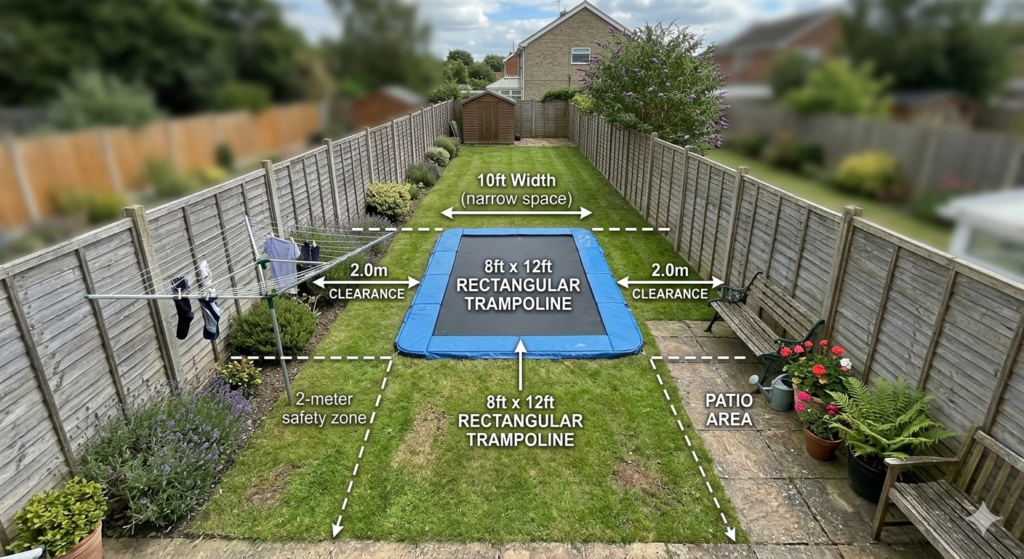
Regret #1: Buying round when your garden is too narrow
Result:
- squeezed clearances
- constant fence contact
- awkward access points
Fix:
If your lawn is narrow but long, rectangular can be a better fit.
Regret #2: Buying rectangular for very young kids
Result:
- bounce feels too powerful
- harder to control movement
- parents feel more nervous
Fix:
For under-6s, round is usually the calmer, more forgiving option.
Regret #3: Not planning the “use space”
Parents measure the trampoline footprint but forget:
- ladder access
- where the zip opens
- space to supervise
- mowing around it
Fix:
Mark it out on the lawn before buying.
Regret #4: Ignoring wind exposure
Result:
- trampoline shifts across lawn
- net poles loosen
- worst case: trampoline lifts
Fix:
Anchor it properly from day one.
So… Which Should You Choose?
Here’s the simplest “pick your situation” decision:
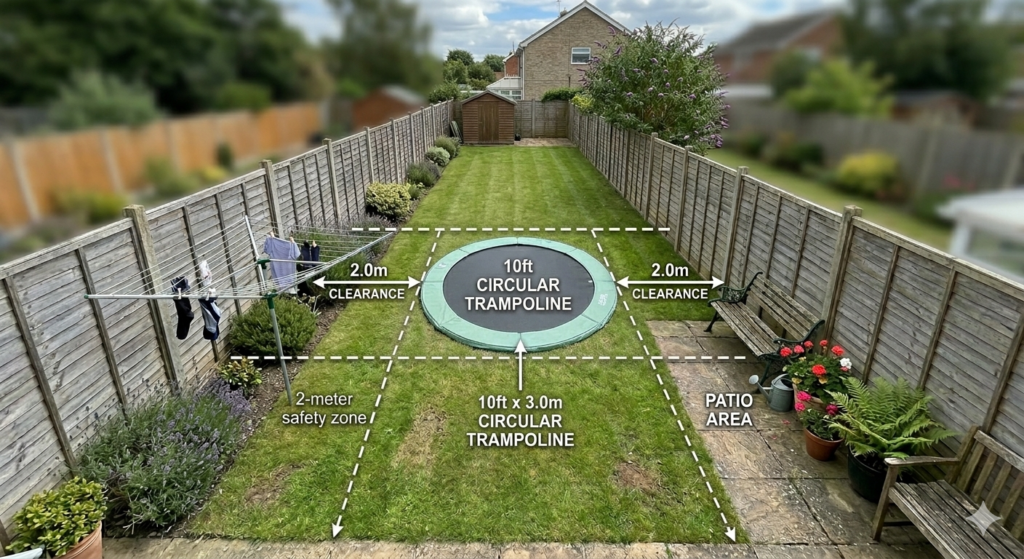
Choose a Round Trampoline If…
- your child is young or a beginner
- you want the safest all-round family choice
- you want better value for money
- you don’t want the trampoline to dominate the space
- your garden shape is fairly open (not super narrow)
Choose a Rectangular Trampoline If…
- your garden is long and narrow
- your child is older / confident
- you want a stronger, more consistent bounce
- you’re happy paying more for performance
- you’ll enforce rules like “one at a time”
Final Recommendation (Most UK Families)
If you want the best balance of practicality, price, and safety for a typical UK family garden:
Choose a round trampoline.
If you have a narrow garden or an older child who’s going to outgrow casual bouncing quickly:
Consider a rectangular trampoline — but only if you can place it safely and anchor it properly.
The best trampoline isn’t the “best shape” in general. It’s the one that fits your garden and matches how your kids will use it.
🧭 Related Guides
If you’re planning the full setup (and want to avoid the common regrets), these guides will help:
About The Author – Andrew Marshall
Andrew Marshall is the creator of Simple Days Outside and a UK parent of three who regularly camps, walks, and explores outdoor activities with his family. His guides focus on practical gear, realistic family adventures, and simple ways to help families enjoy the outdoors across the UK. The recommendations on this site are based on real-world use, research, and the kind of equipment families actually rely on for weekend trips and everyday outdoor fun.