

Written by Andrew Marshall
UK parent of three sharing practical advice to help families enjoy camping, walking, garden play, and simple outdoor adventures across the UK.
Creator of Simple Days Outside.
If your kids are anything like ours, the moment they spot a muddy puddle the footwear debate is over — they’re jumping straight in.
But for the rest of the walk, what they’re wearing actually matters. For UK family walks, the choice often comes down to wellies or walking boots.
But for the walk itself, the choice between wellies and walking boots genuinely matters. We’ve done both. We’ve done muddy forest trails in wellies and come back with three pairs of soaking socks because someone found the one puddle deeper than their boot height. We’ve also done a short countryside loop in walking boots when the ground was pure mud and spent twenty minutes cleaning them in the car park while the kids asked if we could do it again.
The honest answer is that neither is always better. It depends on the walk, the weather, and your child. This article breaks down exactly when each one wins — and when each one lets you down.
If you’re planning more walks with the kids, you can also explore our Family Walking & Easy Hiking hub, where we share practical gear guides and tips for making family walks easier and more enjoyable across UK trails.
👉 Jump to the Section You Need
The Simple Difference
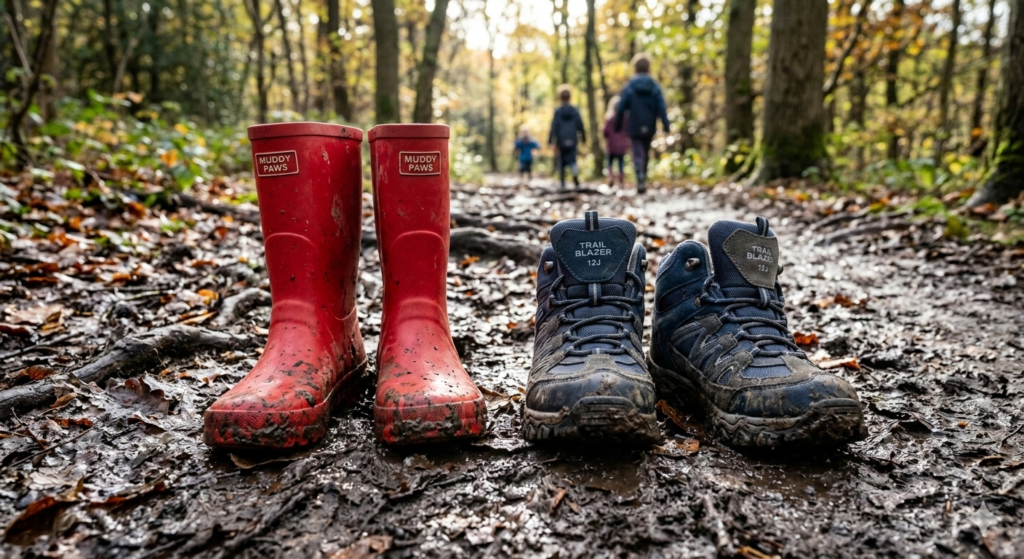
Wellies are designed for one thing: keeping feet dry in wet, muddy conditions. They’re waterproof from sole to top, easy to clean, and most kids already own a pair.
Walking boots are designed for support, grip, and comfort across mixed terrain. They’re built to handle longer walks, uneven ground, and varied conditions — not just mud.
For UK family walks, the real question isn’t which is better overall. It’s which is better for where you’re going today.
Quick Comparison: Wellies vs Walking Boots for Kids
| Feature | Wellies | Walking Boots |
|---|---|---|
| Waterproofing | Excellent — full waterproof coverage | Good — depends on height and membrane |
| Weight | Heavier than you’d think | Varies — lightweight options available |
| Ankle Support | None | Good to excellent |
| Comfort on long walks | Poor | Good |
| Grip on muddy ground | Decent | Better on mixed terrain |
| Deep puddles and mud | Excellent | Limited by boot height |
| Price | Usually cheaper | Higher — but last longer |
| Best for | Short muddy walks, farms, festivals | Longer walks, hills, mixed terrain |
When Wellies Win
The ground is genuinely wet and muddy throughout
If the walk is through boggy fields, farmland, or muddy woodland paths where you know the mud is unavoidable from start to finish — wellies are often the right call.
There’s no waterproof walking boot that survives a proper boggy field as well as a welly. Once the mud is deeper than ankle height, wellies win every time.
We took the kids to a farm walk near the Clyde last autumn after two days of rain. The path was proper wet mud from the first gate. Wellies were the obvious choice — easy to clean, no expensive boots ruined, and the kids could stomp through everything without us saying a word about it.
Short loops and easy paths in wet weather
For a quick after-school walk, a loop around a country park, or a muddy play area adventure — wellies are completely fine. You’re not covering big distances, the terrain isn’t demanding, and the main priority is keeping feet dry.
Farm visits, festivals, and events
Anywhere that’s muddy but flat — wellies are ideal. The lack of support doesn’t matter because you’re not hiking, and the waterproofing is unbeatable for standing water and soft ground.
Young kids who splash everything
Let’s be honest: under about age five, the battle to keep feet dry is largely lost anyway. Wellies make life easier for parents and more fun for kids on muddy days.
Where Wellies Let You Down
Anything longer than about an hour
This is the big one. Wellies have no cushioning, no support, and no flexibility. On a proper walk — even a fairly gentle one — kids start to notice after 45 minutes to an hour.
We made this mistake on a longer woodland trail. Both kids were in wellies because the forecast looked wet. The path wasn’t that muddy, the walk was longer than expected, and by the halfway point both of them were complaining about their feet. Not because the wellies leaked. Because wellies aren’t designed for walking in — they’re designed for standing in wet things.
Uneven ground, hills, and rocky paths
Wellies have a flat, rigid sole. On a path with tree roots, rocks, loose stones, or any kind of incline, that flat sole gives very little grip. Kids slip more, trip more, and feel less confident on uneven ground.
On anything resembling a proper hill, we’ve never taken wellies. It’s walking boots every time.
Warm or dry weather
If the day turns out drier than expected, wellies trap heat fast. Sweaty welly feet is a very specific kind of misery that kids make sure you know about.
Kids who walk quickly or cover real distance
Active kids who move fast on trails burn through welly energy surprisingly quickly. The lack of cushioning and support means tired feet come much sooner than in proper walking boots.
When Walking Boots Win
Longer walks and proper trails
For anything over an hour, walking boots are significantly more comfortable. The cushioning, support, and flexibility mean kids can walk further before their feet start complaining.
This is why we default to walking boots for most family walk days. The kids cover more ground, complain less about tired feet, and we spend less time managing footwear problems mid-walk.
Hills, rocky paths, and mixed terrain
On a proper trail — roots, rocks, uneven ground, any kind of ascent or descent — walking boots are clearly better. The grip is more reliable on wet rock and loose ground, and the ankle support genuinely matters when kids are moving fast and not watching their feet.
We did a trail above Loch Lomond last spring where the path got rocky and slippy about halfway up. Our eldest was in walking boots and moved confidently. Our youngest had lighter trail shoes and was fine on most of it…. but the one moment he slipped, you could see why ankle support matters on that kind of ground. This is something we talk more about in our guide to walking boots vs trail shoes for kids, where we compare how each option performs on UK trails.
Year-round walking in the UK
UK weather is unreliable at best. A walk that starts dry can turn wet quickly — and a good waterproof walking boot handles that transition far better than wellies handle dry ground.
For all-year family walks, walking boots are the more versatile option.
Kids who walk regularly
If your family walks most weekends and does a mix of terrain, investing in a decent pair of waterproof walking boots for kids is worth it. They’ll get used constantly, they last well, and kids who walk in proper boots generally enjoy walks more — because comfortable feet make everything easier.
Where Walking Boots Let You Down
Proper deep mud and boggy ground
A waterproof walking boot is waterproof to a point. Once mud or water goes over the top of the boot, that protection disappears completely. In a truly boggy field or a walk with significant standing water, wellies simply do the job better.
Quick washing and easy cleaning
Wellies take thirty seconds to clean. Walking boots take considerably longer. After a muddy walk with kids, that’s not nothing.
Cost when kids are growing fast
Kids outgrow footwear quickly. Spending £50-80 on walking boots that last one season can feel frustrating. Wellies are cheaper to replace, which is one reason many families keep both.
The Honest Answer: Which Is Better for Muddy Walks?
For a short, genuinely muddy walk — wellies.
For a longer walk where the ground is mixed or the route is more demanding — walking boots.
The mistake most families make is defaulting to wellies for any wet day walk, then discovering thirty minutes in that the path isn’t actually that muddy and the kids’ feet are already complaining.
Our general approach after years of family walks across the west coast of Scotland:
- Wellies: Farm walks, short muddy loops, boggy ground, festival-style events, anything under 45 minutes in wet conditions
- Walking boots: Anything over an hour, hills, mixed terrain, rocky paths, all-year general walking
That split covers most situations. The only time we get it wrong now is when we underestimate how boggy the ground actually is — and on the west coast, that happens more than we’d like to admit.
What About Neoprene Wellies?
Worth a quick mention because they solve one specific problem.
Standard wellies have no insulation — cold feet in winter are almost guaranteed. Neoprene wellies add a lining that keeps feet significantly warmer, which makes them much more comfortable for cold autumn and winter walks.
They’re heavier than standard wellies and still have the same support and comfort limitations — but for short muddy winter walks, they’re worth considering if your kids complain about cold feet.
Are Some Wellies Better for Walking?
Not all wellies are the same.
Basic rubber wellies with flat soles can feel uncomfortable quickly on longer walks. However, some modern wellies include:
- deeper tread patterns
- better cushioning
- thicker insoles
These make short countryside walks more comfortable, though they still won’t match the support or flexibility of proper walking boots.
For families who mainly walk on muddy farmland or wet fields, choosing wellies with better grip can make a noticeable difference.
Getting the Right Fit
Wellies
Kids wellies should have around 2cm of growing room — enough that they don’t trip, but not so big the boot slips at the heel. Too loose and they’ll come off in deep mud (it happens, usually in the worst possible spot on the path).
Thick welly socks make a big difference to both warmth and comfort.
Walking boots
Leave a thumb’s width at the toe. If you’re unsure what to look for when buying footwear for kids, it can also help to understand how to choose the right walking boots for kids, including fit, support and grip. Try them with proper walking socks rather than thin school socks — the fit can feel completely different. A good fit around the heel is the most important thing — if the heel lifts with every step, blisters follow quickly.
We now always bring the walking socks when we’re buying new boots. Sounds obvious but we didn’t do it the first few times and regretted it.
Quick Decision Guide
Choose wellies if:
- The walk is short (under an hour)
- Ground is genuinely boggy or waterlogged throughout
- It’s a farm visit, play area, or flat muddy event
- Your child is very young and puddle-splashing is the priority
Choose walking boots if:
- The walk is over an hour
- The route involves hills, rocks, or uneven ground
- Conditions are mixed — could be wet, could be dry
- Your child walks regularly and needs comfortable footwear
If you can only have one: A lightweight waterproof walking boot covers more situations across a UK year than wellies do. Wellies are brilliant for what they’re built for — but walking boots handle a wider range of conditions more comfortably.
What We Actually Use
We keep both — and we’re glad we do.
The wellies come out for farm walks, short muddy loops near the Clyde, and any walk where we know the ground is going to be consistently boggy. They’re easy, the kids can stomp freely, and cleanup takes two minutes.
The walking boots come out for everything else — proper trail days, hill walks, longer woodland routes, and any walk where the terrain is going to be mixed. Our kids cover far more distance in boots before the complaints start, and on any kind of serious path the grip and support genuinely matter.
The ideal family kit is one of each, used for the right situation. If budget means choosing one — go for the walking boots. You can always improvise for a muddy farm walk. You can’t improvise support and cushioning on a long trail.
Related Family Walking Guides
Choosing the right footwear is only one part of making family walks easier and more enjoyable. These guides cover other useful gear and tips that help families explore the outdoors more comfortably.
About The Author – Andrew Marshall
Andrew Marshall is the creator of Simple Days Outside and a UK parent of three who regularly camps, walks, and explores outdoor activities with his family. His guides focus on practical gear, realistic family adventures, and simple ways to help families enjoy the outdoors across the UK. The recommendations on this site are based on real-world use, research, and the kind of equipment families actually rely on for weekend trips and everyday outdoor fun.