

Written by Andrew Marshall
UK parent of three sharing practical advice to help families enjoy camping, walking, garden play, and simple outdoor adventures across the UK.
Creator of Simple Days Outside.
When we started looking at paddle boards a few years ago, the inflatable versus hard board debate felt more complicated than it needed to be. Forums were full of experienced paddlers arguing the merits of fibreglass and carbon fibre while we were just trying to figure out how to get a board to a Scottish loch in a family hatchback.
We went inflatable. Three years later — after paddling lochs, sea bays, rivers, and flat reservoirs across the west coast of Scotland — we’ve never once wished we’d gone the other way. There’s something about pulling up to a loch on a clear morning, having boards inflated and on the water in fifteen minutes, and paddling out into that kind of silence that makes the whole decision feel obvious in retrospect.
That’s not to say hard boards are wrong. They’re genuinely better in certain situations. But for most UK beginners, especially families, the decision is more straightforward than it’s often made out to be.
The Short Answer
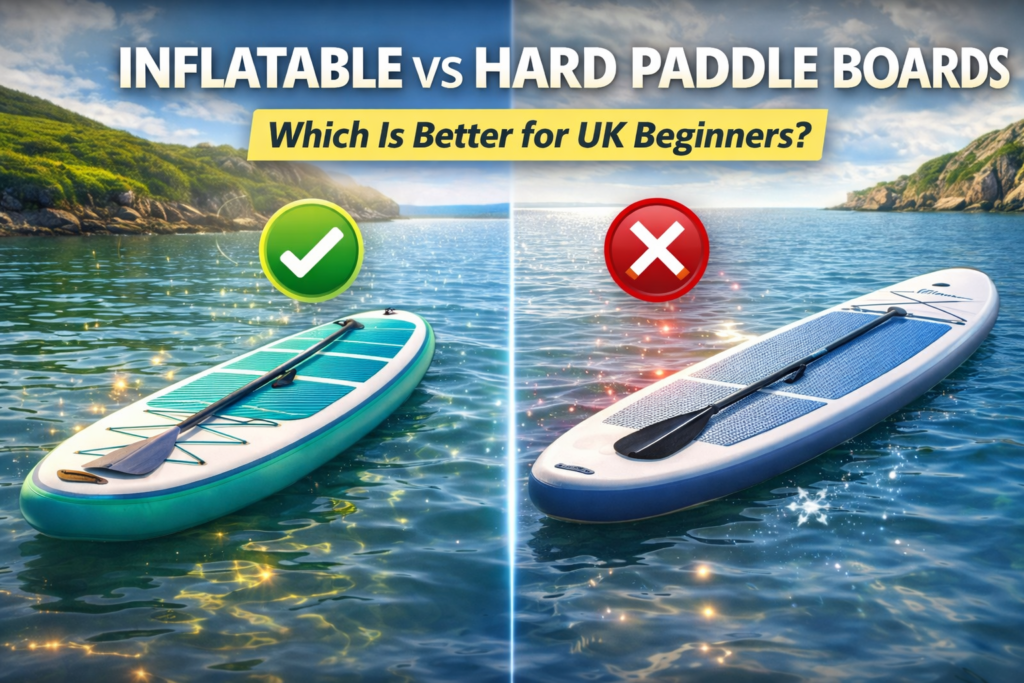
For most UK beginners — inflatable paddle board.
For performance paddlers who want the best possible experience on flat water and have somewhere to store and transport a 10–12 foot rigid board — hard board.
If you’re new to paddle boarding, paddling with family, and need something that fits in a car boot — the inflatable wins on almost every practical measure that matters in real UK conditions.
At a Glance: Inflatable vs Hard Paddle Board
| Inflatable | Hard Board | |
|---|---|---|
| Performance | Good for beginners | Better for experienced paddlers |
| Stability | Excellent for beginners | Can be tippier on narrower models |
| Storage | Packs to rucksack size | 10–12ft — needs dedicated space |
| Transport | Car boot | Roof rack or van |
| Setup time | 5–15 mins to inflate | Immediate |
| Durability | Handles knocks well — but puncture risk exists | Scratches and dents — no puncture risk |
| Price entry point | ~£150–500 | ~£400–1000+ |
| Best for | Families, beginners, varied UK water | Performance paddlers, flat water, racers |
Performance on the Water
Hard boards perform better. That’s the honest starting point.
A rigid epoxy or fibreglass board glides more efficiently, tracks straighter, and responds more precisely to paddle strokes. If you’re racing, doing SUP yoga seriously, or surfing waves consistently, a hard board gives you a meaningful performance advantage.
An inflatable SUP is slightly slower, has marginally more flex, and doesn’t track quite as crisply — particularly in wind, which on UK water is rarely absent for long.
For a beginner, none of this matters in the way you’d expect. The performance difference between an inflatable and a hard board becomes relevant when you’re good enough to feel it — which takes longer than most people think. In the first year of paddling, your technique is the limiting factor, not the board. A beginner on a quality inflatable and a beginner on a hard board look exactly the same on the water.
Stability
This surprises most people: modern inflatable boards are often more stable than hard boards at the beginner level.
A quality inflatable inflated to the correct PSI — usually 15–20 PSI — is rigid enough to feel solid underfoot, and the slight give in the material actually helps with balance on choppy water. The wider beginner-spec inflatables (around 32–34 inches) offer a forgiving platform that makes learning significantly less frustrating.
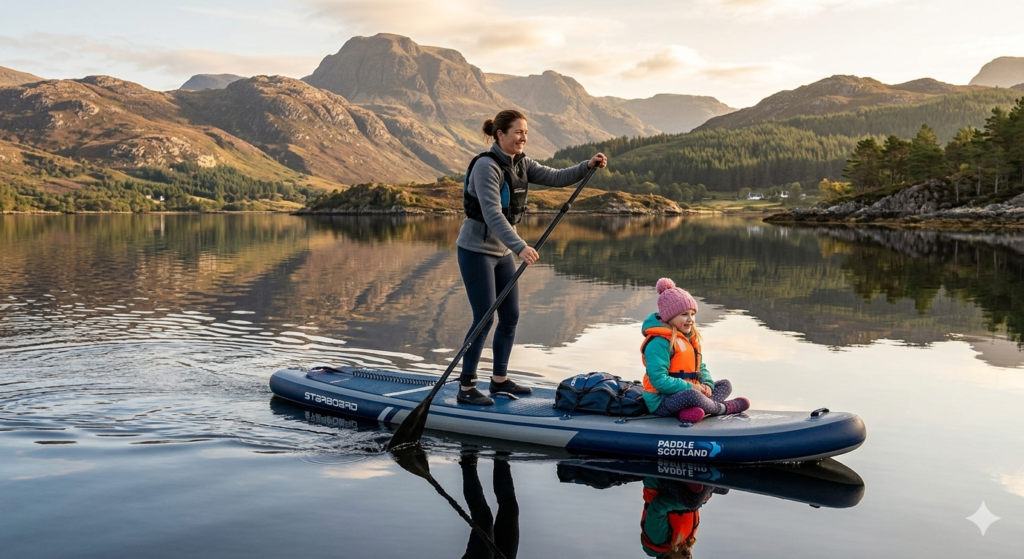
We took the kids out on a sheltered sea loch on the west coast last summer — neither of them fell in during the first session. Partly good conditions, partly that wide inflatables are genuinely forgiving in a way that narrow hard boards aren’t.
Hard boards, particularly narrower performance models, can feel more unpredictable for beginners. Wider beginner hard boards exist but they’re bulkier to store and transport — which brings us to the part that actually determines most families’ decision.
Storage and Transport — The Real Decision
This is where inflatables win decisively, and for most UK families it’s not even close.
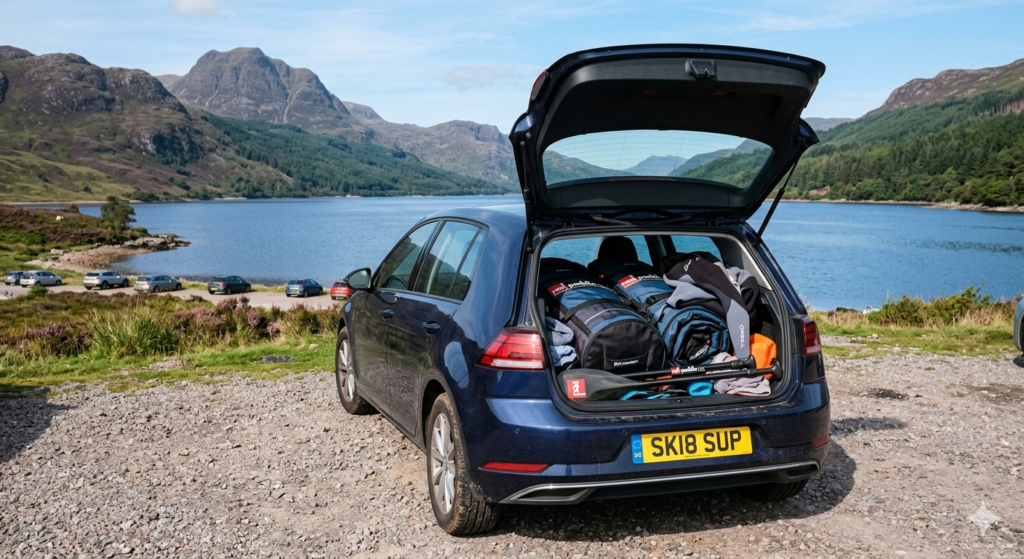
A deflated inflatable paddle board packs down into a rucksack roughly the size of a large camping bag. Two boards fit in a wardrobe. You can store them under the stairs, in a garage corner, or in a flat with no outdoor space. They travel in a car boot alongside wetsuits, paddles, a pump, and whatever else a family day out requires.
A hard board is 10–12 feet long and needs dedicated storage — a garage wall mount, a shed, or outdoor storage that’s secure and weatherproof. It needs a roof rack or a van to transport. Even with a roof rack, you’re adding wind noise, fuel consumption, and the faff of loading and securing a 12-foot board before every session.
We couldn’t get hard boards in the car. That was the beginning and end of the decision for us. The boards that get used are the ones that are easy to take out. If every paddle boarding session requires a 20-minute roof rack loading process, the boards start staying at home — and the whole point of having them disappears.
Durability — and the Puncture Question
Quality drop-stitch inflatable boards can handle knocks against rocks, scraping over gravel shorelines, and the general rough treatment of outdoor family use without serious damage. We’ve dragged our boards across rocky loch shores more times than we can count — hauling them out over kelp-covered rocks, loading them onto pebbly beaches, bumping them against the car. Our inflatables have a few scuff marks and nothing else across three seasons.
Hard boards scratch, dent, and can delaminate if knocked hard enough. Repairs are more involved and more expensive. On that front, inflatables have a clear advantage.
The honest flip side: inflatables can puncture. Hard boards cannot.
In practice, punctures on quality boards are rare — the drop-stitch construction is tougher than it looks and most UK paddle boarding environments don’t involve sharp objects. In three years of paddling on varied water, we haven’t had one. But the risk exists, and it’s worth knowing about.
The sensible approach: carry a SUP repair kit in your bag. They’re small, cheap, and fix most punctures in ten minutes. Think of it the same way you’d think about a puncture repair kit for a bike — you hope you never need it, but you’re glad it’s there.
Setup Time — the Honest Trade-off
Inflatable boards require inflation. That’s the most legitimate practical advantage of hard boards — they’re ready immediately.
With a manual SUP pump, inflation takes 10–15 minutes per board. Cold Scottish morning, two boards to inflate, wetsuits to pull on — it adds time to the session.
We bought an electric SUP pump after the first season and it changed the routine completely. It plugs into the car’s 12V socket and inflates a board to 15 PSI in about 5 minutes while you’re getting wetsuits on. It’s become as standard a part of our kit as the paddle board leash and the waterproof dry bag. If you’re going inflatable, buy an electric pump at the same time — it removes the only genuine friction point of inflatable ownership.
UK Conditions: What Actually Matters
UK paddling conditions are variable in a way that genuinely affects this decision.
Flat calm days on sheltered lochs are perfect for either board. But the UK also delivers wind, chop, and weather that changes faster than you’d like — conditions where stability matters more than performance.
In our experience, a good inflatable handles mixed UK conditions well at beginner and intermediate level. The stability advantage on choppy water partly offsets the tracking disadvantage in wind. When conditions got rougher than expected on a coastal paddle last summer, the wide inflatable felt reassuring rather than vulnerable. A narrower hard board in the same conditions would have been significantly more challenging to manage.
The variety of water in the UK is also worth considering. Lochs, coastal bays, rivers, and reservoirs all have different launch points — and many of them involve dragging a board over rocks or shallow gravel entries. Inflatables handle this without concern. Hard boards require considerably more care.
Our most memorable sessions have been on sea lochs on the west coast — the kind of places where you paddle out and the only sounds are water and whatever’s living in the hills above you. The inflatable boards have handled everything those days have thrown at them, including the inevitable scramble over rocks at the put-in. Those are the days that make the whole thing worth it.
If you’re new to getting on open water with kids, it’s worth reading up on the basics before your first session — our guide to outdoor swimming and water safety for kids in the UK covers the essentials that apply equally to paddle boarding.
What You Need Alongside the Board
First-time buyers consistently underestimate what comes with the board and what doesn’t. Here’s what to budget for before you get to the water:
Electric SUP pump — buy this at the same time as the board, not after the first session of manual pumping. Plugs into your car’s 12V socket and inflates a board in around 5 minutes. Non-negotiable for family use with two boards.
View Electric SUP Pumps on Amazon →
SUP paddle — check whether the board package includes one and whether it’s fibreglass or plastic. Plastic paddles are heavy and tiring over longer sessions. A fibreglass SUP paddle is worth the upgrade if it’s not included.
View SUP Paddles on Amazon →
Paddle board leash — attaches the board to your ankle so it doesn’t drift if you fall. Essential for safety on anything other than a completely sheltered flat pond. Falls happen, especially early on.
If you’re paddling with younger children on the board, a buoyancy aid is worth considering alongside a leash — our guide to the best life jackets for kids covers the options suited to open water and loch paddling in the UK.
View Paddle Board Leashes on Amazon →
Wetsuit — in Scotland and most of the UK, this is a safety item not a comfort item. Water temperature is cold year-round. A 3/2mm wetsuit suits summer paddling, a 4/3mm wetsuit is worth considering for spring and autumn sessions.
View Wetsuits on Amazon →
Waterproof dry bag — for your phone, keys, and anything else you’re carrying. Falls happen and they happen fast.
View Dry Bags on Amazon →
SUP repair kit — small, cheap, lives in the bag permanently. Punctures are rare on quality boards but you want to be able to fix one on the day if it happens.
View SUP Repair Kits on Amazon →
Boards Worth Buying
Budget entry level — under £300
Decathlon’s Itiwit inflatable paddle board range is the best value at this price point. Honest quality for the money, widely available, and backed by a brand with genuine outdoor credentials. Good for trying the sport before committing to a higher spend.
The practical sweet spot — £300–£500
This is where most families will be happiest. Bluefin Cruise paddle boards sit in this range and have become one of the most consistently recommended beginner options in the UK — double-layer construction, a decent paddle included, and strong real-world reviews from people actually using them in UK conditions.
If you’re serious from the start — £500+
Red Paddle Co is the benchmark. Used by instructors and regular paddlers across the UK, genuinely excellent build quality, and boards that will last a decade of regular use. Worth the investment if you know paddle boarding is going to become a regular part of your life. [Check on Amazon →]
Frequently Asked Questions
Can you surf on an inflatable paddle board?
Yes, with limitations. Inflatables handle small to moderate waves but lack the manoeuvrability of a hard surf SUP. For dedicated wave riding, a hard board is significantly better. For the occasional wave on a mixed session, an inflatable is fine and genuinely fun.
How long do inflatable boards last?
A quality inflatable, stored correctly and inflated to proper PSI, should last 5–10 years with regular use. The most common failure points are valve leaks and seam separations — both repairable with a SUP repair kit. Avoid leaving boards inflated in direct sunlight for extended periods, which stresses the seams over time.
Do inflatable boards actually feel solid underfoot?
At proper inflation pressure — 15 PSI and above — a quality inflatable feels surprisingly solid. The flex that people worry about is mainly a problem with cheap boards or boards inflated below recommended pressure. First-time paddlers are consistently surprised by how rigid a properly inflated board feels.
What PSI should I inflate to?
Most beginner boards recommend 15 PSI. Check your specific board’s manual — the range is usually printed on the board itself. Don’t over-inflate beyond the maximum rating, particularly in warm weather where internal pressure rises.
Do I need a wetsuit for paddle boarding in Scotland?
Yes — and this isn’t optional for safety reasons. Water temperature in Scottish lochs and coastal waters is cold year-round. A 3/2mm wetsuit suits summer paddling; a 4/3mm wetsuit is worth considering for spring and autumn. If you’re not sure what to expect at different times of year, our guide to UK sea and loch water temperatures by month is worth a look before you plan your first session.
Falling in is part of learning — you need to be prepared for it to be cold when it happens.
Is a hard board worth it if I improve?
Possibly — but most paddlers never reach the level where the performance difference is genuinely meaningful. If you’re racing, doing SUP yoga, or paddling flat water multiple times a week, a hard board becomes worth considering. For regular family sessions on varied water, a quality inflatable is competitive for most paddlers’ entire time in the sport.
Which Would We Actually Choose?
Inflatable, without hesitation — and three seasons of paddling across genuinely varied Scottish water gives us a reasonable basis for that view.
The transport advantage is decisive. The storage advantage is decisive. The durability on rough entries and exits is a genuine bonus. Yes, inflatables can puncture — carry a repair kit and it stops being a concern. The performance difference at our level, on the water we paddle, is not something we’ve ever felt limited by.
If you have a van or a roof rack, a garage with wall space, and you’re specifically interested in flat water performance or surf SUP — a hard board has genuine advantages worth considering.
For everyone else, and that’s most UK beginners, a quality inflatable in the £300–£500 range is the right call. Buy a good electric SUP pump at the same time. It makes the whole thing faster, easier, and means you’re on the water rather than standing on the shore with aching arms before you’ve even started.
The best paddle board is the one you actually use. For most families in the UK, that’s the one that fits in the boot.
Related Guides
More outdoor gear guides and family water sports advice in our Summer Fun & Water Hub
About The Author – Andrew Marshall
Andrew Marshall is the creator of Simple Days Outside and a UK parent of three who regularly camps, walks, and explores outdoor activities with his family. His guides focus on practical gear, realistic family adventures, and simple ways to help families enjoy the outdoors across the UK. The recommendations on this site are based on real-world use, research, and the kind of equipment families actually rely on for weekend trips and everyday outdoor fun.