

Written by Andrew Marshall
UK parent of three sharing practical advice to help families enjoy camping, walking, garden play, and simple outdoor adventures across the UK.
Creator of Simple Days Outside.
The first time we stood in a paddle board shop and asked what size we needed, the answer was about fifteen minutes long and involved words like volume, rocker, and displacement. We left more confused than we arrived.
The honest answer — for most UK beginner families — is much simpler than the industry makes it sound. There’s a size range that works for the vast majority of people, a few dimensions that genuinely matter, and a handful of mistakes that are easy to avoid once you know what to look for.
If you’re still deciding whether paddle boarding is right for your family before committing to a size, our Summer Fun & Water Hub covers everything from first days on the water to the gear that makes it easier. If you’re already decided and just need to know what to buy — read on.
Why Size Matters More Than Most Buyers Expect
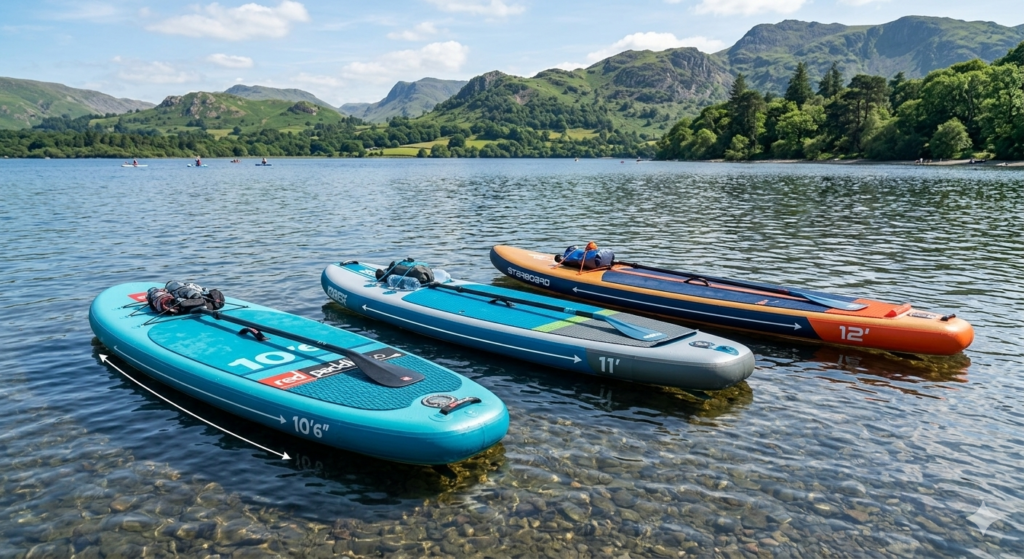
A paddle board’s dimensions directly affect three things beginners care about most: stability, how easy it is to paddle, and whether it suits the water you’re actually on.
If you haven’t yet decided between an inflatable and a hard board, our guide to inflatable vs hard paddle boards for beginners covers that decision first — size matters most once you’ve settled on the type.
A board that’s too narrow will feel unstable and make learning significantly harder than it needs to be. A board that’s too short won’t track well and will wander in open water. A board that’s too long is harder to manoeuvre in tighter spaces and more awkward to handle at the water’s edge.
None of these problems are unfixable — but buying the right size from the start means you spend your sessions actually paddling rather than fighting the board.
The good news: for most UK beginner families paddling lochs, coastal bays, and reservoirs, the right size range is fairly consistent. Once you understand what each dimension does, the decision becomes much clearer.
The Three Dimensions That Actually Matter
Length — affects speed and tracking
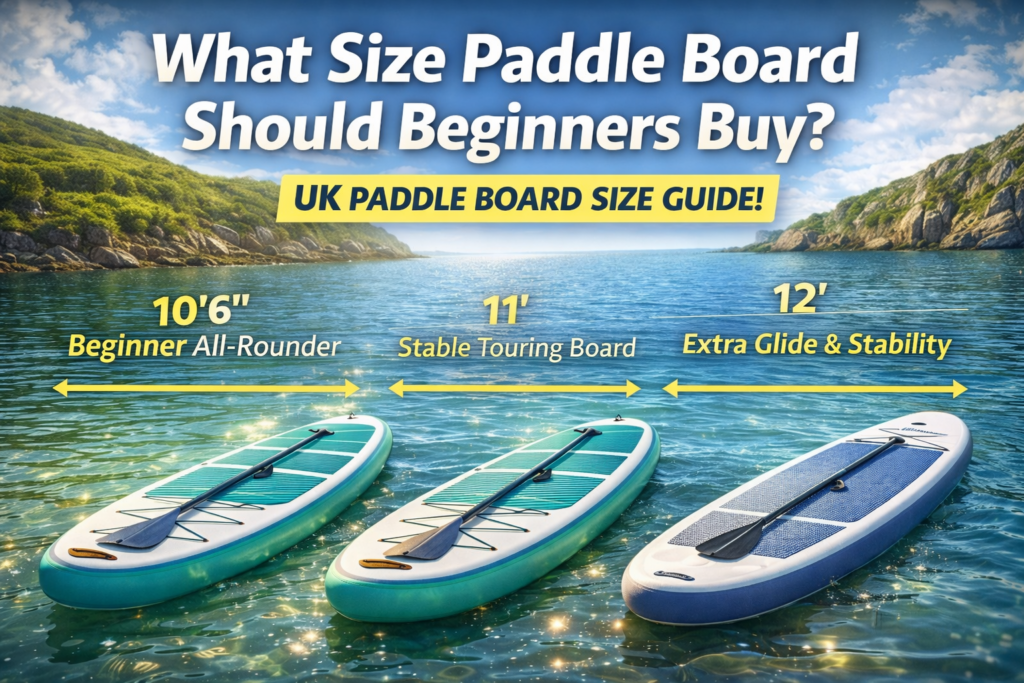
Paddle board length is measured in feet and inches. Most beginner and all-round boards fall between 9 feet and 12 feet.
Under 9ft — children’s boards and surf-specific SUPs. Not suited to general paddling for adults.
9ft–10ft — shorter all-round boards, better for younger children or smaller adults. More manoeuvrable but slower and less stable in open water.
10ft–11ft — the beginner sweet spot. Long enough to track well and maintain speed, short enough to handle on varied water. The most common length for first-time buyers and families, and the range where most quality beginner boards sit.
11ft–12ft — touring and longer all-round boards. Better tracking and speed over distance, but bigger and heavier to handle at the water’s edge. Worth considering if you plan to cover long distances regularly.
12ft and over — touring and racing boards. Not beginner territory.
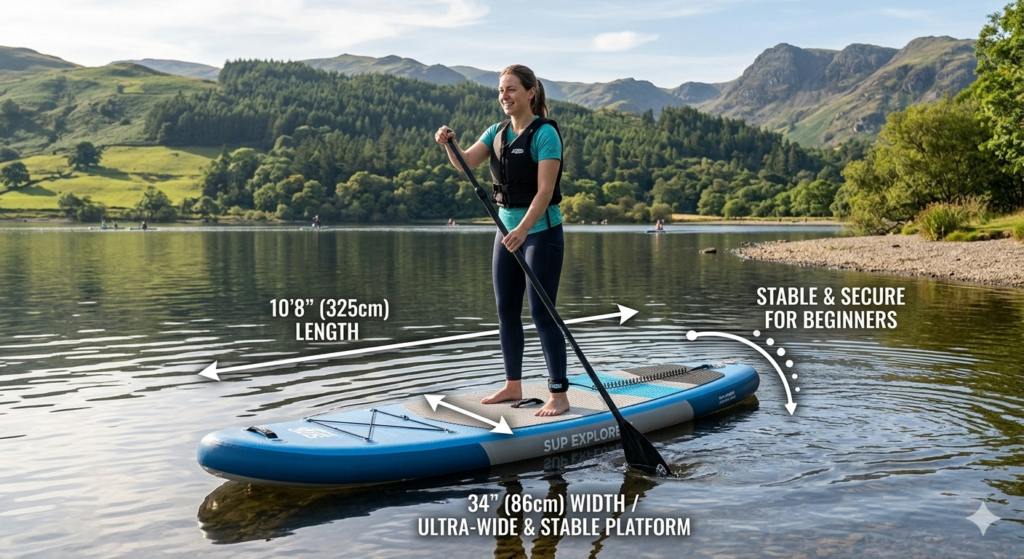
Our boards are 10’6″ and that length has suited every type of water we’ve paddled — lochs, sea bays, a river section, flat reservoir water. Long enough to feel stable and efficient, short enough to manage without it becoming a physical effort just getting to the water.
Width — the most important dimension for beginners
Width determines stability more than any other single measurement. It’s measured in inches and most beginner boards fall between 30 and 36 inches.
30 inches and under — performance and racing width. Faster but significantly less stable. Not suitable for beginners regardless of what the product listing says.
31–32 inches — intermediate width. Suitable for paddlers who’ve moved beyond the basics and want more efficiency without sacrificing all stability.
32–34 inches — the beginner sweet spot. Wide enough to feel genuinely stable underfoot on varied water, narrow enough to paddle without it feeling like hard work. This is where most quality all-round beginner boards sit and where most families will be happiest.
34–36 inches — very wide beginner boards and yoga SUPs. Maximum stability, useful for paddlers who are particularly nervous about balance. Slower than narrower options.
Our boards are 33 inches wide. On a calm loch that width feels more than stable. On choppy coastal water it feels reassuring. It’s the width we’d buy again without hesitation.
Thickness — why it matters more than most listings explain
Most inflatable paddle boards are either 4 inches or 6 inches thick, and this dimension gets less attention than it deserves.
4 inch boards — older or budget construction. The problem with a thin board isn’t that it looks less impressive — it’s that it flexes underfoot when you stand on it. That flex is immediately noticeable when you’re paddling. The board bends slightly with every stroke and every shift in weight, which makes it feel unstable, makes it less efficient in the water, and is genuinely tiring over a longer session. Heavier paddlers feel this more than lighter ones, but most adults notice it.
6 inch boards — the current standard for quality inflatables. Significantly more rigid underfoot. A 6 inch board inflated to 15 PSI feels like standing on something solid rather than something giving beneath you. Most boards in the £250+ range are 6 inches thick, and the difference versus a 4 inch board is immediately apparent the first time you stand on one.
If you’re comparing two boards and one is 4 inches and one is 6 inches, the 6 inch board will almost always feel better to paddle. Always check the thickness spec before buying — it’s often buried in the listing details.
Weight Capacity — the Number Most Families Miss
Every paddle board has a maximum weight capacity, and it matters more for families than for solo paddlers.
The capacity figure in the listing is the technical maximum — not the comfortable paddling maximum. As a practical rule, aim to stay at or below 75–80% of the stated capacity for stable, comfortable paddling. At the limit, boards sit lower in the water, feel less stable, and are harder to paddle efficiently.
For a solo adult, most 10’6″ all-round boards with a capacity of 120–150kg have comfortable headroom.
For families — and this is the thing that catches people out — once children see what paddle boarding looks like, they want to get on the board with you. It happens almost every session. A parent at 80kg with a child at 35kg is 115kg total. A board with a 120kg capacity is at its limit. A board with a 150kg capacity has comfortable room.
We learned this the easy way because we’d already checked the weight limits before we bought. We’ve had plenty of moments on lochs where one of the kids wanted to hop on for a stretch and we could say yes without any concern. If the board had been at its capacity with just one adult, that wouldn’t have been an option. Always check the weight capacity and think about who might realistically end up on the board together — not just who you’re buying it for today.
Volume — What It Means and When It Matters
Volume is measured in litres and determines how much weight a board can support while staying buoyant. Higher volume boards float higher in the water and support more weight.
For most beginners, volume is less important to focus on directly than length, width, and weight capacity — because those dimensions already determine volume. A longer, wider, thicker board will always have higher volume.
The rough guide:
- Under 200 litres — lighter paddlers, children’s boards
- 200–250 litres — average adult paddlers up to around 80kg
- 250–300 litres — larger adults or boards designed to carry a child alongside an adult
- 300+ litres — tandem boards, touring boards for heavier paddlers
If the weight capacity looks right for your needs, the volume will usually follow. It’s worth checking if you’re between two similar options, but it shouldn’t be the first number you look at.
Size by Paddler Type
Average adult beginner (under 85kg)
Length: 10ft–10’6″ | Width: 32–34″ | Thickness: 6″ | Capacity: 120kg+
This covers the vast majority of adult beginners in the UK. A 10’6″ x 33″ x 6″ board is stable, efficient, and capable across all types of water a beginner is likely to paddle.
Larger adult beginner (85kg+)
Length: 10’6″–11′ | Width: 33–34″ | Thickness: 6″ | Capacity: 140kg+
Heavier paddlers benefit from slightly more length and volume to maintain the same buoyant, stable ride. The width stays similar — it’s the length and weight capacity that need attention at higher body weights.
Older children and teenagers paddling independently
Length: 9’–10′ | Width: 30–32″ | Thickness: 6″ | Capacity: 80–100kg
Children paddling independently can use a shorter, lighter board that’s easier for them to manage. A full adult board works for taller teenagers but can feel unwieldy for younger or lighter kids. A board sized for their weight and height means they actually get to paddle rather than just being shuffled around on something too large.
Families where children will share a board with an adult
Length: 10’6″–11′ | Width: 33–34″ | Thickness: 6″ | Capacity: 150kg+
The length and width stay similar to a standard adult board, but the weight capacity needs to account for an adult and child together comfortably. This is the single most important spec to get right if you know the kids will want to come on the board — and they will.
If younger children are coming on the water with you, our guide to the best life jackets for kids on UK lakes and lochs is worth reading before your first session.
Paddlers who want to cover distance
Length: 11’–12′ | Width: 31–33″ | Thickness: 6″ | Capacity: 120kg+
Longer boards track better, glide further with each stroke, and reward paddlers who want to cover ground. The trade-off is that they’re bigger and heavier to carry and store. A worthwhile step up once you’ve built technique and know that longer paddles are what you enjoy.
At a Glance: Beginner Size Guide
| Paddler Type | Length | Width | Capacity |
|---|---|---|---|
| Average adult beginner | 10’–10’6″ | 32–34″ | 120kg+ |
| Larger adult (85kg+) | 10’6″–11′ | 33–34″ | 140kg+ |
| Older child / teen | 9’–10′ | 30–32″ | 80–100kg |
| Family board (adult + child) | 10’6″–11′ | 33–34″ | 150kg+ |
| Distance / touring | 11’–12′ | 31–33″ | 120kg+ |
Boards Worth Buying at Each Size
Best budget all-round board — under £200
Decathlon Stand Up Paddle Inflatable Pack 10’6″ (1–2 persons)
Decathlon’s own-brand 10’6″ pack is the most accessible entry point on this list. Rated for up to 130kg and designed for one or two persons — meaning an adult and child together is within the stated capacity. At £199.99 currently (reduced from £239.99), it’s the lowest price on this list for a complete package from a brand with genuine outdoor credentials.
The 336 reviews at 4.5 stars tell the real story — this is a board that consistently works for the people buying it. Not the most advanced construction, but honest quality for the price and everything you need to get started included in the pack. Available in store at Decathlon if you want to see it before buying, which is worth doing if there’s one near you.
Best mid-range all-round board — £299–£329
Aqua Marina Fusion 10’10” x 32″ x 6″
The Aqua Marina Fusion has become one of the most recommended beginner boards in the UK for good reason. At 10’10” long, 32″ wide, and 6 inches thick with a 150kg capacity, it hits the right specification for most adult beginners and has enough weight capacity for a parent and child together without being at the limit.
The Drop Stitch Light Technology makes it noticeably stiff underfoot for a board at this price — it doesn’t flex the way cheaper 4-inch boards do. The complete package includes a three-part paddle, dual-action pump, leash, fin, and carry bag. Rated 4.8 stars across reviews and consistently praised for tracking well even in light wind and chop. Available at both Decathlon and Amazon.
One honest note from reviews: the included paddle is functional but on the heavier side. If you paddle regularly, a fibreglass paddle upgrade is worth considering. The board itself is excellent for the money.
Best for families who’ll regularly have children on the board — £350–£450
Bluefin Cruise 11′ x 32″ x 6″
The longer version of Bluefin’s most popular beginner range. At 11 feet with a higher weight capacity than the 10’8″ version, it’s specifically worth considering if an adult and child sharing the board is a regular plan rather than an occasional one. Double-layer construction, complete package included, and strong real-world reviews from UK paddlers across varied water.
The extra length also helps with tracking — useful if your paddling tends to involve open loch or coastal water where holding a straight line over distance matters.
Best for performance and longevity — £500+
Red Paddle Co Ride 10’6″ x 32″ x 6″
Red Paddle Co is the benchmark for inflatable paddle boards in the UK. The Ride is their most popular all-round model and the one used by paddling instructors and outdoor centres across the country — not because it’s the most expensive option, but because it’s the best-built board available at any price short of a carbon fibre hard board.
The MSL fusion construction is noticeably more rigid than double-layer alternatives. The fin system is better. The valve is better. Everything about it is built to a higher standard and it shows immediately when you inflate it and stand on it. It will still be performing perfectly in ten years when most other boards have been replaced.
At 130kg capacity it’s at the lower end for adult-plus-child use, but the board quality makes it the one to buy if you’re investing for the long term rather than testing the water.
The Most Common Sizing Mistakes
Buying too narrow too soon. The most frequent beginner mistake, usually made because narrower boards look more like what experienced paddlers use. A 30″ board is faster and looks impressive — but it’s noticeably less forgiving for someone learning. Start at 32–34″ and narrow down later if you want more speed.
Ignoring weight capacity. Especially common with family buyers who are thinking about one adult paddler rather than the combined weight that actually ends up on the board. Calculate the real combined weight, add a comfortable margin, and buy accordingly.
Buying a 4 inch board to save money. The flex on thin budget boards is immediately noticeable underfoot and makes every session harder than it needs to be. The extra rigidity of a 6 inch board is worth the price difference for any paddler who’ll use it more than a couple of times.
Prioritising length over width. Length looks impressive in listings but width determines your actual experience as a beginner. A shorter, wider board is nearly always better for a first-time paddler than a longer, narrower one.
Not accounting for the kids. Buying a board right at capacity for one adult and then being stuck when the children want to come on too. Always build in headroom.
Frequently Asked Questions
Is 10’6″ the right size for most beginners?
For most adult beginners in the UK, yes. It’s the most common beginner length for a reason — long enough to track well and feel stable, short enough to transport and handle without it becoming a chore. Pair it with a 32–34″ width and 6 inch thickness and you have the most forgiving, capable beginner setup available.
One thing that affects how long you’ll comfortably use any board in the UK is water temperature — our guide to UK sea and loch water temperatures by month helps you plan sessions and kit properly through the year.
Can a child use an adult paddle board?
Older children and teenagers can use adult boards, particularly at the wider end of the range. Younger or smaller children will find a shorter, lighter junior board easier to manage independently. If a child is sharing a board with an adult, a full adult board with generous weight capacity is the right choice.
Does height affect which size I should buy?
Taller paddlers generally benefit from longer boards — there’s more surface area underfoot and the proportions feel more natural. As a rough guide, paddlers over 6ft often find 11ft boards more comfortable than 10’6″. For paddlers under 6ft, 10’6″ suits most body types well.
Does weight matter more than height for sizing?
For stability and buoyancy, weight matters more. The weight capacity and volume of the board determine how high it sits in the water and how stable it feels. Height matters for board feel and proportion but is secondary to making sure the board can comfortably support the paddler.
What’s the difference between an all-round board and a touring board?
All-round boards — 10’–11′, 32–34″ wide — are designed for varied conditions and general use. Stable, forgiving, and capable on most types of water. Touring boards are longer, narrower, and optimised for speed over distance. They’re faster but significantly less stable and not suitable as beginner boards.
Can two adults use the same board?
Not comfortably on a standard single board. Tandem boards exist as a specific product category. Standard all-round boards are designed for one paddler — the weight capacity accounts for one adult plus kit, not two adults. An adult and a child together is fine on a board with sufficient capacity.
What We’d Recommend
For most UK families starting out — a 10’6″ board at 33–34″ wide and 6 inches thick with a weight capacity of at least 130kg, ideally 150kg if children are likely to share the board.
That’s the specification we’re on and it’s covered three seasons across lochs, sea, rivers, and reservoirs without us ever feeling limited by the size. For a UK family starting out, it’s the right place to begin.
The one thing we’d emphasise above everything else: start wider than you think you need to. The most common regret in paddle boarding is buying something too narrow and spending the first season working too hard just to stay upright. Nobody ever regretted starting stable.
Related Guides
More paddle boarding advice, gear guides, and family water activity ideas in our [Water Sports & Paddle Boarding Hub].
About The Author – Andrew Marshall
Andrew Marshall is the creator of Simple Days Outside and a UK parent of three who regularly camps, walks, and explores outdoor activities with his family. His guides focus on practical gear, realistic family adventures, and simple ways to help families enjoy the outdoors across the UK. The recommendations on this site are based on real-world use, research, and the kind of equipment families actually rely on for weekend trips and everyday outdoor fun.