

Written by Andrew Marshall
UK parent of three sharing practical advice to help families enjoy camping, walking, garden play, and simple outdoor adventures across the UK.
Creator of Simple Days Outside.
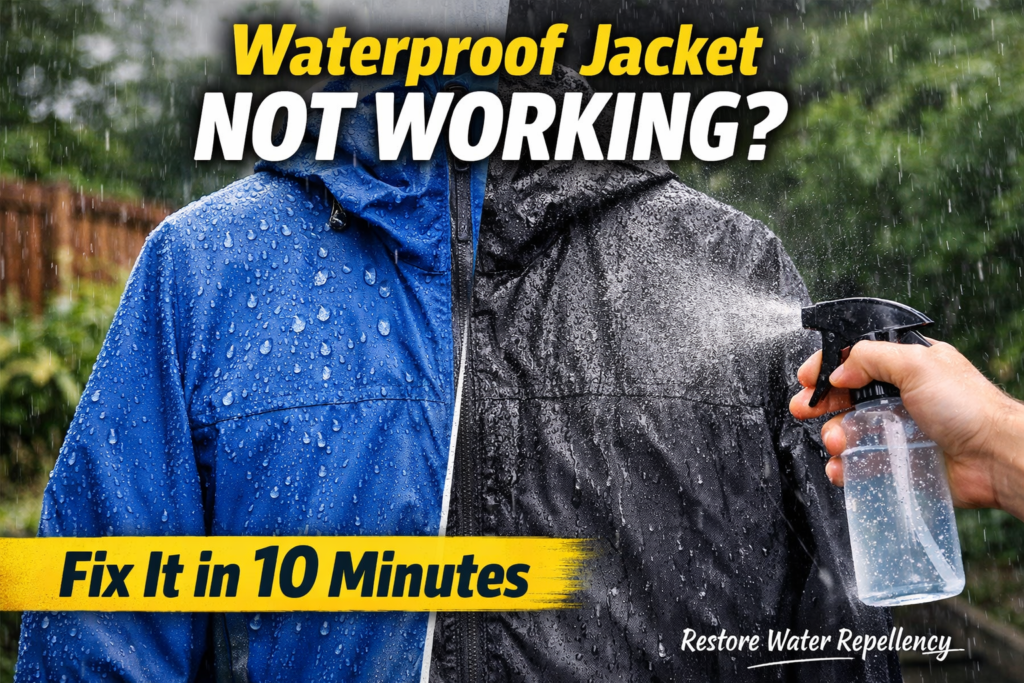
A waterproof jacket can look absolutely fine, still feel sturdy, and yet start letting you down the moment proper UK weather turns up. One of the biggest surprises for people is that a jacket does not have to be torn or worn out to stop performing well. Quite often, it just needs cleaning and reproofing.
On our days out from the local area to the Highlands, our jackets take a battering — beach days, forest walks, muddy school runs, and everything in between. With three kids in waterproofs most of the year, learning to reproof properly has saved us replacing jackets we didn’t need to replace. For everything else we use to keep the family dry outdoors, our Practical Outdoor Clothing & Comfort Hub has it all in one place.
I have had jackets that seemed finished because the rain started sitting heavily on the outer fabric and everything felt cold, damp, and miserable after half an hour outside. At first it is easy to assume the waterproofing has completely failed, but a lot of the time the jacket is simply wetting out because the durable water repellent coating on the outside has worn away. Once that outer layer stops beading water properly, the jacket feels far less breathable and much less pleasant to wear.
The good news is that reproofing a waterproof jacket is usually straightforward. You do not need to be an outdoor gear expert, and you do not need to replace a decent jacket just because the rain no longer beads on the surface like it used to.
Jump to a Section
Quick answer: how do you reproof a waterproof jacket?
To reproof a waterproof jacket, first clean it with a specialist cleaner made for waterproof clothing, then apply a reproofing treatment such as a spray-on or wash-in product. After that, follow the care label to reactivate the finish, often with gentle heat if the jacket allows it.
For most jackets, the basic process is:
- Clean the jacket properly
- Rinse out any normal detergent residue
- Apply a waterproof reproofing product
- Let it dry or use low heat if the care label allows
- Test whether water beads on the outer fabric again
That is the simple version. Getting the best result comes down to doing each part properly.
What does “reproofing” actually mean?
Reproofing does not usually mean rebuilding the entire waterproof membrane inside the jacket. It usually means restoring the water-repellent finish on the outer fabric.
Most waterproof jackets work with two layers of protection:
The waterproof membrane or coating underneath
This is the part that stops rain getting through into your clothing.
The DWR finish on the outside
DWR stands for durable water repellent. This is the treatment that helps rain bead up and roll off the outer fabric.
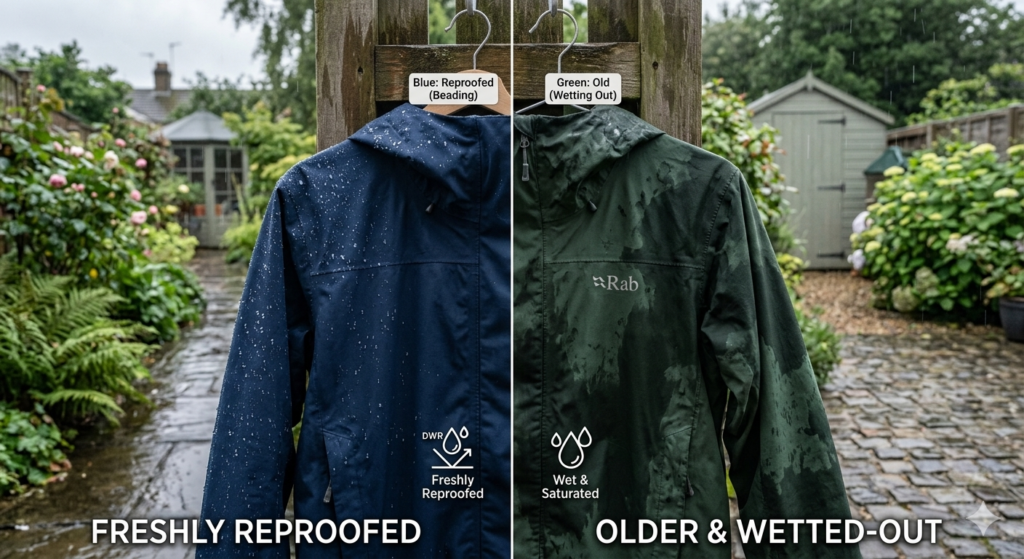
When that outer finish wears away, the fabric starts absorbing water rather than shedding it. That is why the jacket can feel soaked on the surface even if the inner membrane is still technically waterproof.
A lot of people describe this as the jacket “leaking,” but sometimes it is more a case of the outer fabric becoming saturated, cold, and less breathable. If you have ever come home from a wet school run or family walk and thought your jacket felt strangely clammy and heavy, that is often what is happening.
Signs your waterproof jacket needs reproofing
A jacket usually tells you it needs attention before it becomes unusable.
Look out for these signs:
Water stops beading on the surface
If rain used to form little beads and roll off, but now soaks into the outer layer, reproofing is probably due.
The jacket feels cold, heavy, or soggy in rain
This often means the face fabric is wetting out.
Breathability seems worse than before
When the outer fabric becomes saturated, sweat and body heat do not escape as well. The jacket can feel stuffy inside even if it is not actually leaking.
The shoulders and arms get wet first
This is common because those areas get more rubbing from backpacks, car seats, and regular movement.
It looks clean enough but performs badly
That is another common clue. Waterproof jackets can lose water repellency long before they look badly worn.
Shoulders and arms tend to go first in our experience — the constant friction from backpacks and buggy handles wears the DWR away faster than anywhere else.
Before you reproof: clean the jacket first
This is the step people skip most often, and it makes a big difference.
A dirty waterproof jacket will not reproof properly. Everyday grime, body oils, sunscreen, mud, and leftover detergent can all interfere with performance. Sometimes a jacket that seems to need reproofing only really needs a proper clean.
I have made this mistake before with outdoor gear and it is frustrating because you end up using extra product when the fabric was not properly prepared in the first place. Clean first, then judge.
Why normal detergent is a problem
Standard laundry detergent is not ideal for waterproof jackets because it can leave residues behind. The same applies to waterproof trousers — if your kids wear waterproof trousers on walks and forest days, they need the same treatment.Fabric conditioner is even worse, as it can coat the fibres and interfere with breathability and water repellency.
If you have been washing waterproofs with normal detergent for a while, that does not necessarily mean the jacket is ruined, but it does mean it is worth giving it a good specialist wash before reproofing.
What to use instead
Use a cleaner designed for waterproof clothing. These are made to clean technical fabrics without leaving behind the residues that standard laundry products can leave.
You will usually see these sold as:
- waterproof garment wash
- technical cleaner
- outdoor clothing wash
How to wash a waterproof jacket before reproofing
Always check the care label first, but this method suits many waterproof jackets.
1. Empty the pockets
Check every pocket, especially inside ones.
2. Fasten zips and close flaps
Zip the jacket up and secure Velcro tabs or poppers so the fabric is protected during washing.
3. Brush off obvious mud first
If the jacket is caked in mud, brush or wipe it off before it goes in the machine.
4. Clean the detergent drawer if needed
If you are using a washing machine, make sure there is no leftover detergent or fabric conditioner hanging around in the drawer.
5. Use a specialist cleaner
Wash according to the cleaner instructions and jacket care label, usually on a gentle cycle.
6. Rinse thoroughly
If needed, run an extra rinse to make sure no residue remains.
At this stage, sometimes you may already notice improved performance. If the jacket was mainly clogged with dirt and oils, cleaning alone can help the outer fabric behave better.
Spray-on vs wash-in reproofers: which is better?
This is one of the most common questions, and the answer depends on the jacket.
Spray-on reproofer
A spray-on product is applied to the outside of the jacket only.
Best for:
- breathable waterproof jackets
- jackets with wicking linings
- shells where you want to target the outer fabric only
- higher-performance outdoor jackets
Why people like it:
It restores water repellency on the outside without coating the inner lining unnecessarily.
Possible downside:
It takes a bit more effort because you need to apply it evenly.
For many waterproof jackets, especially better quality breathable ones, spray-on tends to be the safer and more precise option.
We’ve used both over the years depending on what we had to hand. For the kids’ jackets that get the heaviest use, spray-on gives more control — you can focus on the shoulders and hood where they need it most.
Wash-in reproofer
A wash-in product goes into the washing machine and treats the garment more generally.
Best for:
- simpler waterproof garments
- items like overtrousers or less technical outerwear
- situations where ease matters most
Why people like it:
It is quick and simple.
Possible downside:
It can also treat the inside of the jacket, which may slightly affect moisture-wicking or breathability depending on the garment.
For family use, wash-in products can be convenient, especially when doing several items together, but for a jacket you rely on regularly, I would usually lean toward spray-on unless the manufacturer recommends otherwise.
How to reproof a waterproof jacket step by step
Here is the full method.
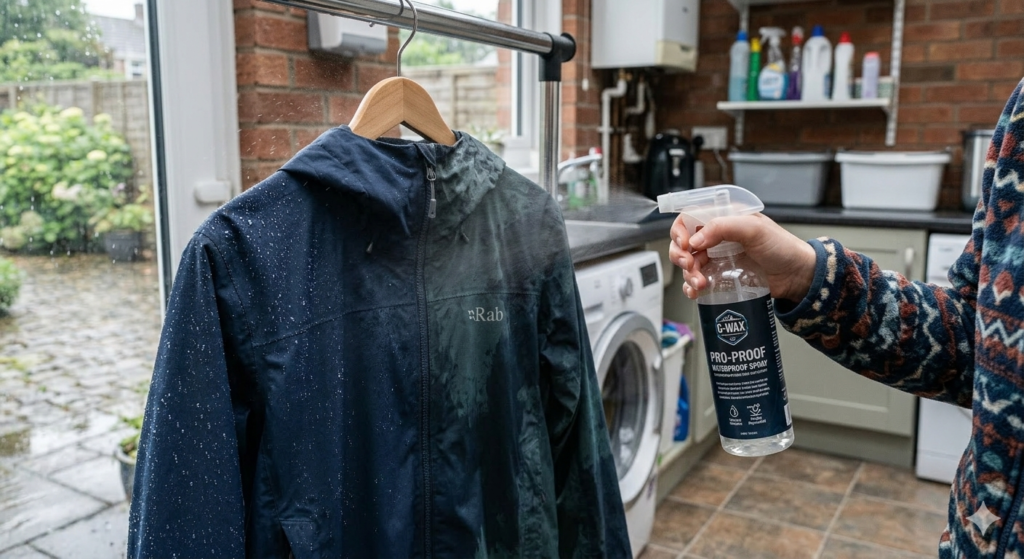
Method 1: using a spray-on reproofer
Step 1: Wash the jacket first
Use a specialist cleaner and rinse thoroughly.
Step 2: Leave the jacket damp
Many spray-on reproofers are designed to be applied while the jacket is still damp rather than fully dry.
Step 3: Hang it up
Put it on a hanger or lay it flat somewhere you can reach all areas easily.
Step 4: Spray evenly across the outer fabric
Focus especially on high-wear areas such as:
- shoulders
- sleeves
- chest
- hood
- lower back
Try not to soak random areas heavily while leaving other sections lightly treated.
Step 5: Wipe away excess
Use a clean damp cloth to wipe off drips or overly wet patches. This helps stop streaking and sticky residue.
Step 6: Dry according to the label
Some jackets allow tumble drying on low heat, while others need air drying only. Follow the care label.
Step 7: Reactivate with gentle heat if allowed
For many jackets, a little heat helps set or reactivate the DWR finish. A low tumble dry or very gentle ironing through a cloth may be allowed on some garments, but only if the care label says so.
Method 2: using a wash-in reproofer
Step 1: Clean the jacket first
Do not skip this.
Step 2: Add the wash-in product as instructed
Follow the product directions carefully. More is not always better.
Step 3: Run the correct cycle
Use the cycle recommended by the product and jacket care label.
Step 4: Dry properly
Again, this may be line drying or low tumble drying depending on the garment.
Step 5: Test water beading
Once dry, sprinkle or spray a little water on the surface to see whether it beads and rolls away.
Should you tumble dry a waterproof jacket after reproofing?
Sometimes yes, but only if the care label allows it.
This is where people need to be careful. Gentle heat can help reactivate or set the water-repellent finish on some jackets, but too much heat can damage coatings, seam tape, or delicate synthetic fabrics.
A lot of outdoor gear performs best with a low tumble dry after cleaning or reproofing, but you should never assume. The label matters.
If the care label does not allow tumble drying, air dry the jacket instead.
For UK families especially, it is tempting to rush this bit because we often want the jacket ready again quickly for the next walk, school run, or weekend trip. Drying gear properly after wet days is something we cover in more detail in our guide to drying waterproof jackets and trousers. But overheating a jacket is one of those mistakes that can shorten its life faster than bad weather ever will.
How often should you reproof a waterproof jacket?
There is no fixed rule like every three months or once a year. It depends on how often the jacket is used and how harshly.
You may need to reproof more often if:
- the jacket is used several times a week
- it is worn in heavy rain regularly
- it gets rubbed by a backpack
- it is washed frequently
- it is used for family walks, camping, commuting, and school runs all season
For occasional use, once or twice a year may be enough. For heavy regular use, you might notice performance dropping sooner.
A good rule is this: reproof when water stops beading well, not just because the calendar says so. In practice for us that’s usually once a season for the adults’ jackets and sometimes twice for the kids’ jackets — particularly the ones worn for school runs as well as weekends.
Can you reproof a jacket without washing it first?
Technically, you can, but it is usually a poor idea.
Reproofing over dirt, grease, and residue often gives weaker, patchier results. If you are taking the time to do the job, it is worth doing it properly.
The only exception might be if the jacket has just been freshly washed with the right cleaner and is already clean enough for treatment.
What if reproofing does not work?
If the jacket still performs badly after cleaning and reproofing, a few things could be going on.
The jacket may need another clean
Sometimes residue is still sitting in the fabric, especially if normal detergent has been used before.
The DWR may not have been activated properly
Some products work best after low heat, where permitted.
The waterproof membrane may be failing
If the inner waterproof layer is damaged or peeling, reproofing the outer fabric will not fix that.
Seams or tape may be damaged
Leaks around taped seams, cuffs, or zips can feel like general waterproof failure.
The jacket may simply be near the end of its life
Reproofing helps restore performance, but it cannot always rescue old or damaged gear forever.
I think this is the point where people often judge a jacket unfairly. A decent jacket can usually recover surprisingly well with the right care, but there is also a stage where it is genuinely worn out and no amount of spray will magically turn it back into new gear.
Common mistakes to avoid when reproofing waterproof jackets
These are the mistakes most likely to reduce performance or waste your time.
Using normal detergent
This can leave residues that affect breathability and water repellency.
Using fabric conditioner
Best avoided for waterproof jackets.
Reproofing a dirty jacket
You will often get patchy or disappointing results.
Applying too much product
More product does not automatically mean better waterproofing. It can leave the fabric feeling sticky or uneven.
Ignoring the care label
Particularly when it comes to tumble drying or ironing.
Assuming every jacket needs wash-in treatment
Some perform better with a spray-on product.
Waiting until the jacket seems completely useless
Catching the issue earlier usually makes restoration easier.
Most of these we’ve done at least once — the fabric conditioner one in particular, before we knew any better.
Can you use home remedies to reproof a waterproof jacket?
It is better not to.
People sometimes look for DIY shortcuts, but waterproof jackets are technical garments and it is easy to make them worse with oils, waxes, or unsuitable laundry products. Specialist waterproofing products are made for the job and usually cost far less than replacing the jacket.
For everyday coats, some people experiment more, but for proper waterproof outdoor jackets, I would stick with products designed specifically for waterproof clothing.
Is reproofing worth it for cheaper jackets?
Usually, yes.
If the jacket still fits well, the seams are in good condition, and the waterproof layer is otherwise intact, reproofing can be very worthwhile. Even a more budget-friendly waterproof jacket can feel much better after a proper clean and reproof.
That matters even more for families because replacing multiple jackets gets expensive fast. If you can keep one child’s school-run coat or your own weekend waterproof going for another season, that is money well saved.
How to tell if your jacket is actually waterproof again
Once the jacket is dry, test it simply.
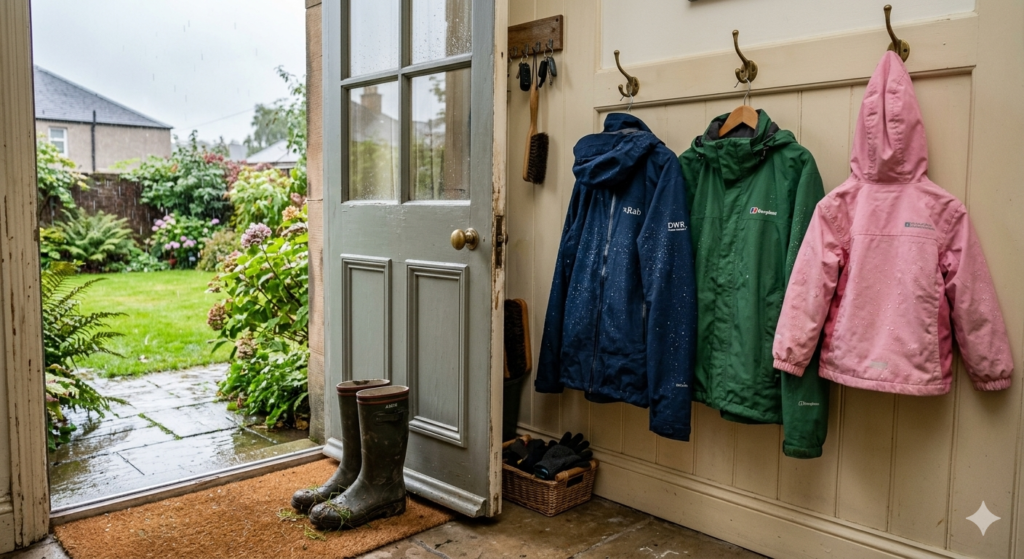
Sprinkle or spray a little clean water onto the outer fabric.
What you want to see is:
- water beading into droplets
- droplets sitting on the surface rather than soaking in
- water rolling off when you tilt the fabric
If the water still darkens the fabric straight away, the treatment may not have taken properly, or the jacket may need further attention.
Extra care tips to help waterproof jackets last longer
Reproofing helps, but day-to-day care matters too.
Wash less often, but wash properly
Do not over-wash, but do not leave grime building up forever either.
Avoid crushing the jacket for long periods
Stuffing it damp into the boot of the car or the bottom of a bag is not ideal.
Dry it properly after wet use
Hang it up rather than leaving it bunched.
Follow the care label
Especially around heat.
Keep sun cream, oils, and dirt from building up
Salt from coastal days is worth rinsing off too — we spend a lot of time near the sea and salt residue quietly degrades DWR faster than rain alone does.
I have found that jackets often last better when you treat them more like proper gear and less like just another coat tossed over a chair. That sounds obvious, but in a busy family routine it is exactly the sort of thing that gets forgotten.
When should you replace a waterproof jacket instead of reproofing it?
Reproofing is worth trying first in many cases, but replacement may make more sense if:
- the inner membrane is peeling
- the seam tape is lifting badly
- the fabric is cracked or damaged
- zips or cuffs have failed badly
- repeated cleaning and reproofing no longer makes much difference
If the jacket is structurally sound though, reproofing is often the better first move.
FAQs
Can I reproof a waterproof jacket in a normal washing machine?
Yes, usually, as long as the care label allows machine washing and you use the correct specialist products. Make sure there is no leftover detergent or fabric conditioner in the machine first.
Do I need to reproof after every wash?
No. Many jackets do not need full reproofing after every clean. Reproof when water stops beading well or performance noticeably drops.
Is spray-on or wash-in better for waterproof jackets?
Spray-on is often better for breathable jackets because it targets the outer fabric only. Wash-in is convenient, but it can also affect the inside of the garment.
Why is my jacket still getting wet after reproofing?
The outer fabric may still be wetting out, the treatment may not have been applied properly, the DWR may not have been activated, or the waterproof membrane itself may be failing.
Can I use fabric softener on waterproof jackets?
No, it is best avoided because it can interfere with the jacket’s performance.
How long does reproofing last?
It depends on how often the jacket is worn, washed, and rubbed by things like backpacks or car seats. Heavy use means more frequent reproofing.
Is Reproofing Worth the Effort?
A waterproof jacket that stops beading rain is not always a failed jacket. Very often it just needs proper care.
For most people, the best approach is simple: clean it with a specialist waterproof wash, apply the right reproofer, dry it correctly, and test it before the next wet day. Done properly, this can restore water repellency, improve comfort, and help the jacket feel far more reliable again.
In the UK, where a jacket can be used for school runs, beach walks, campsites, muddy weekends, and everyday drizzle all in the same month, reproofing is one of those small maintenance jobs that genuinely pays off. It is cheaper than replacing good gear early, and it helps you get more life out of something you already own.
If your jacket still fits, still feels comfortable, and is otherwise in decent shape, it is usually well worth trying.
3 Related Guides at the Bottom
About The Author – Andrew Marshall
Andrew Marshall is the creator of Simple Days Outside and a UK parent of three who regularly camps, walks, and explores outdoor activities with his family. His guides focus on practical gear, realistic family adventures, and simple ways to help families enjoy the outdoors across the UK. The recommendations on this site are based on real-world use, research, and the kind of equipment families actually rely on for weekend trips and everyday outdoor fun.