

Written by Andrew Marshall
UK parent of three sharing practical advice to help families enjoy camping, walking, garden play, and simple outdoor adventures across the UK.
Creator of Simple Days Outside.
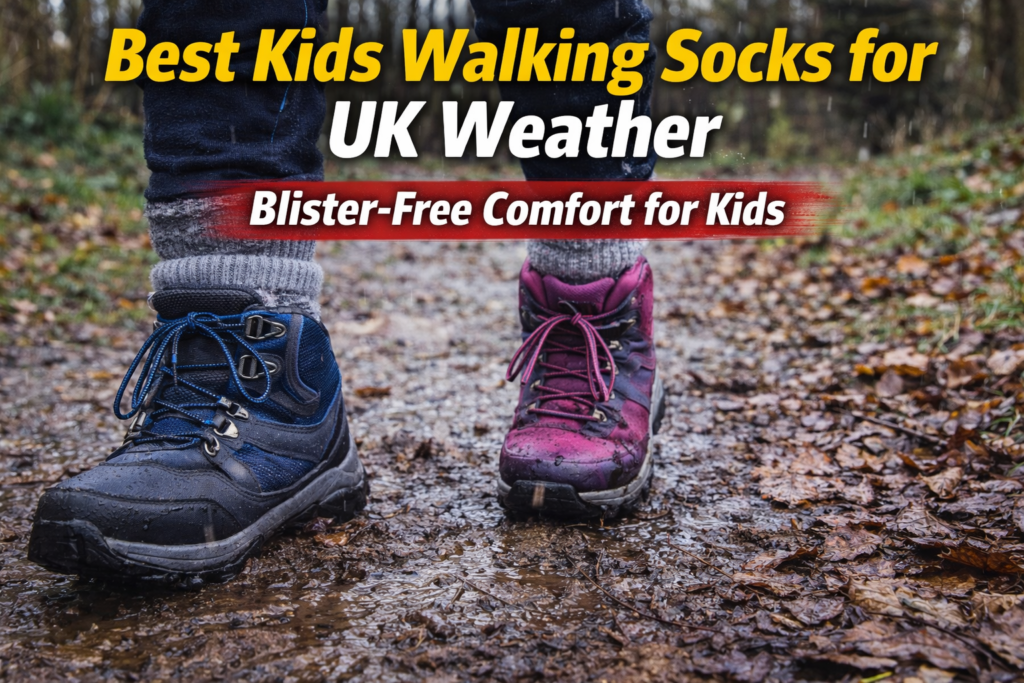
Most parents put a lot of thought into boots and jackets and then grab whatever socks are in the drawer. It’s understandable — socks seem like a minor detail. But bad socks are one of the most common reasons children get blisters, complain about cold feet, or want to turn back early on what should have been a good day out. The same goes for waterproof gloves — extremities are usually what ends a family walk early, not the weather itself.
The right pair of walking socks manages moisture, cushions the foot inside the boot, and stays put rather than bunching around the toes. The wrong pair — usually cotton, usually too thin — soaks through, loses its shape, and causes exactly the kind of friction that ends walks early.
We’ve done enough autumn circuits around the Trossachs and winter beach days on the Argyll coast to know the difference. Everything else we use to keep the kids comfortable outdoors is in our Practical Outdoor Clothing & Comfort Hub.
Why Walking Socks Actually Matter
Cotton is the enemy
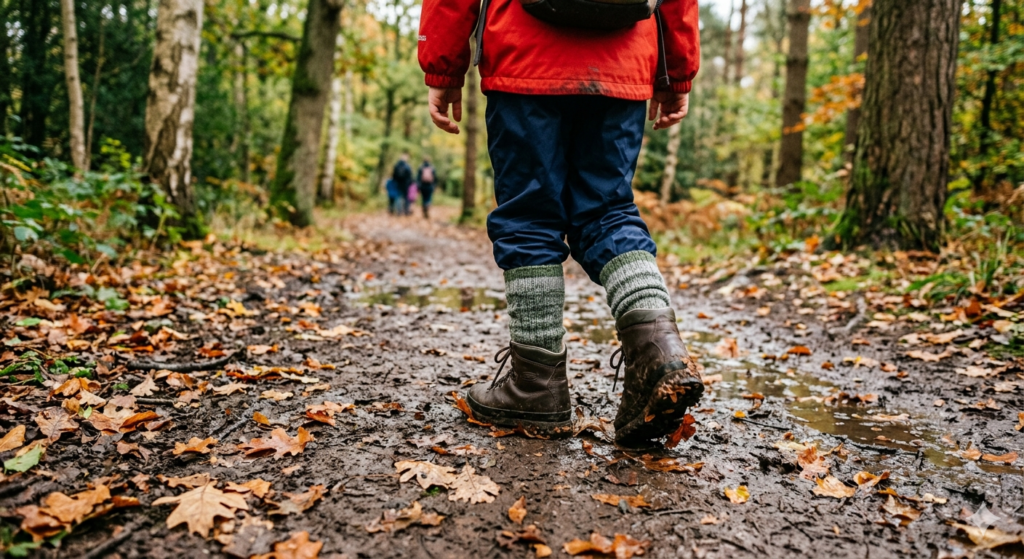
This is the single most important thing to understand about kids’ walking socks. Cotton absorbs moisture and holds it against the skin. Wet skin softens quickly and blisters faster. For short walks on dry days it’s fine — for anything muddy, cold, or more than an hour on your feet, cotton socks are a liability. The same logic applies when choosing a kids waterproof jacket — materials matter far more than price.
Technical walking socks use wool, synthetic fibres, or blends that wick moisture away from the skin rather than absorbing it. Feet stay drier, warmer, and blister-free significantly longer.
Cushioning matters more than thickness
A common mistake is assuming the thickest sock is the warmest and most protective. Thickness and cushioning are not the same thing. A well-constructed sock with targeted cushioning at the heel and ball of the foot does more than a thick but uniform sock — and a sock that’s too thick inside already-snug boots will cause more pressure and friction, not less.
Height should match the boot
Ankle socks with mid-height boots leave a gap where the boot top rubs directly against bare skin. For kids in walking boots, a crew or mid-height sock that sits above the boot collar is the right choice. For wellies, longer socks that protect the full calf are worth having.
Fit affects everything
A sock that bunches at the toes or slides down the heel causes blisters regardless of the material. Look for anatomical shaping, arch support, and elastane content that keeps the sock genuinely fitted throughout a walk.
Our Picks: Best Kids Walking Socks
1. Bridgedale Junior Trekker Socks — around £8–11 per pair (Amazon)
Best for: the best all-round kids’ walking sock on this list — warm, durable, and stays fitted mile after mile.
Bridgedale has been making technical socks for serious walkers for decades and the Junior Trekker is the kids’ version of one of their most trusted designs. The wool and nylon blend gives warmth without overheating, manages moisture far better than cotton, and the Lycra zones at the arch and cuff keep the sock genuinely fitted throughout the walk rather than gradually sliding toward the toes.
What makes these stand out is durability. Parents who’ve bought cheaper socks know the experience of finding holes after a handful of washes — the Bridgedale construction is noticeably tougher. The midweight cushioning is also well-judged: enough padding to protect feet on uneven ground without making boots feel tight.
One thing worth knowing: these are labelled as Junior but fit slim adult feet too, which makes them a solid choice for older children who are between kids’ and adult sizing.
We used these on a long forest circuit near Loch Lomond — by the end both older kids still had dry, comfortable feet. That’s the standard a good walking sock should meet.
2. Quechua Kids’ Hike 500 Crew Hiking Socks 2-Pack — around £5–7 for 2 pairs (Decathlon)
Best for: regular family walks at excellent value — the best Decathlon pick for kids who walk often.
Decathlon’s Hike 500 kids’ sock is a properly technical walking sock at a price that makes stocking up on multiple pairs straightforward. The 100% synthetic construction uses anti-friction yarn with PTFE coating at the heel and toe — the areas where blisters actually form — along with terry knit reinforcement in the highest-wear zones.
The ventilated arch knit and water-repellent yarn keep feet noticeably drier than a standard sock, and the anatomical fit with elastane holds the sock in place rather than letting it migrate during a walk. Coming in a 2-pack at this price, these are the kind of socks you can keep a spare pair in the bag without worrying about the cost.
For families who walk regularly through places like Glen Finglas or the forest paths around Loch Ard, having three or four pairs of a dependable budget sock is more practical than one expensive pair.
Our youngest goes through socks faster than boots — having a stack of these means we’re never searching for a matching pair at 8am before a forest walk.
3. Quechua Kids’ Hike 100 Hiking Socks 2-Pack — around £3–5 for 2 pairs (Decathlon)
Best for: younger children, shorter outings, and families just starting out with proper walking socks.
The Hike 100 is Decathlon’s entry-level kids’ hiking sock — organic cotton and linen construction with terry towelling underfoot, a moisture-wicking ventilation channel, and anatomical shaping with elastane. It’s not a technical performance sock in the way the Hike 500 is, but for shorter outings and occasional family walks it’s perfectly capable and genuinely affordable.
For younger children who are just starting to do longer walks and whose feet are growing quickly, spending less per pair makes sense. The Hike 100 covers the essentials: it’s more structured and moisture-aware than a supermarket sock, it stays on properly, and it’s comfortable from the first wear.
Be clear about what it is though — for long days on rough terrain, step up to the Hike 500 or Bridgedale. For a Sunday walk on a well-maintained path, the Hike 100 is more than enough.
These are what we’d put on a four or five year old for a two-hour path walk — no need to spend more at that age and that distance.
4. Danish Endurance Kids Merino Wool Hiking Socks (3-Pack) — around £18–22 for 3 pairs (Amazon)
Best for: cold weather, longer walks, and children with sensitive skin who struggle with synthetic fibres.
Danish Endurance’s merino walking socks are the premium pick on this list and earn their price for the right child. The merino wool blend thermoregulates naturally — warm when it’s cold, not overheated when active — and the moisture management is excellent. Merino also has natural antibacterial properties, which means socks stay fresher for longer between washes, useful on multi-day trips or camping weekends.
The anatomical left-right shaping is a nice touch — most socks are symmetrical, but shaped socks genuinely feel more fitted and reduce bunching at the toe. The seamless toe construction removes the ridge that causes rubbing on longer walks, and arch support keeps the sock positioned correctly throughout the day.
For children who find synthetic fibres scratchy or uncomfortable, merino is worth the extra cost. It’s soft against skin in a way that performance synthetics simply aren’t.
Sizing note: Danish Endurance adult sizes start small — their XS fits roughly UK 3–5, which covers older children and younger teens well.
5. Bridgedale Junior Hiker Socks — around £9–12 per pair (Amazon)
Best for: older children and teenagers on more demanding terrain — more technical than the Junior Trekker.
The Bridgedale Junior Hiker is a step up from the Junior Trekker in construction — slightly more technical build, heavier cushioning, and better suited to longer days on rougher ground. If your child is doing Duke of Edinburgh walks, mountain paths, or anything involving significant ascent and descent, this is the sock worth having.
Bridgedale’s Lycra zoning system appears throughout this model too, keeping the sock fitted and preventing the sliding that causes blisters on longer distances. The wool content provides genuine warmth regulation that matters when conditions change mid-walk — something that happens reliably on Scottish hills regardless of what the forecast said at breakfast.
On a full day in the Cairngorms or anything with real descent on wet rock, this is the sock we’d reach for over the Junior Trekker.
Merino Wool vs Synthetic vs Wool Blend: Which Is Better?
Parents often ask whether to go for merino, synthetic, or a blend. The honest answer is that it depends on what your child is doing and how sensitive their skin is.
Merino wool is the warmest, softest, and best at temperature regulation. It handles both cold and active conditions well, stays odour-free longest, and suits children with sensitive skin. It’s also the most expensive and needs a little more care in the wash.
Synthetic socks like the Quechua Hike 500 dry fastest, are most durable, and perform well in wet conditions where quick-drying matters. They’re the best value option for regular use and are generally machine washable without any special treatment.
Wool blends like the Bridgedale Junior Trekker sit in the middle — warmth and softness of wool combined with the durability and shape-retention of nylon. For most families doing UK walks year-round, a wool blend is the practical sweet spot. The same layering logic applies to everything above the ankle — thermal base layers follow identical principles for warmth without bulk.
We tend to use the Decathlon Hike 500 as everyday walking socks and save the merino for colder months or longer days — that combination covers most situations without overspending on socks that children will wear out in a season.
Getting the Right Size
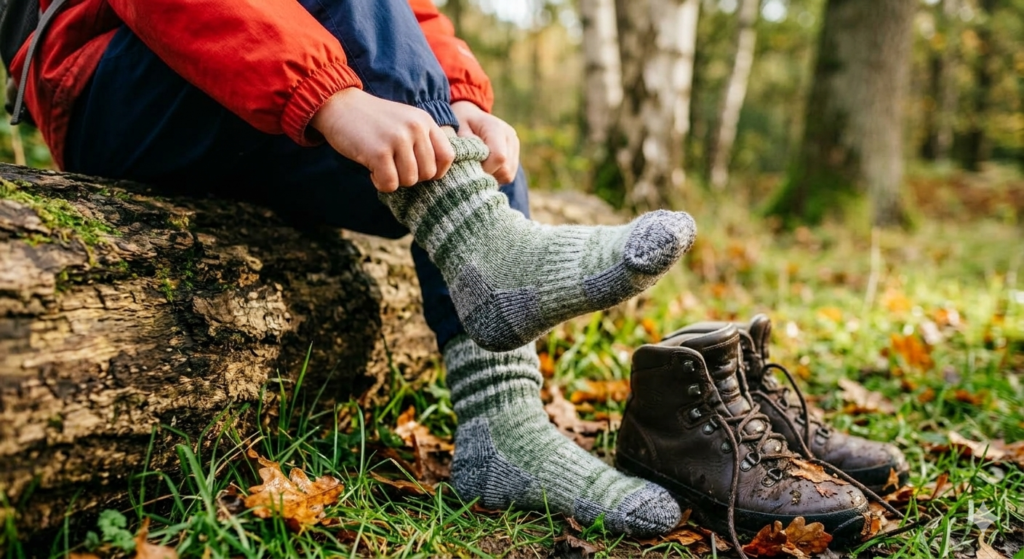
Walking socks sized correctly make a significant difference. A sock that’s too large bunches at the toe and heel — exactly where blisters form. Most brands size by UK shoe size, which is straightforward, but a few points are worth knowing.
Children in between sizes should go smaller rather than larger — a slightly snug sock stays fitted, a slightly large one doesn’t. Also check that the sock height is appropriate for the boot being worn: mid-height walking boots need a crew-length sock that sits above the boot collar. If the sock finishes below the boot, the boot edge rubs directly against skin.
Looking After Kids’ Walking Socks
Technical socks last significantly longer with a bit of care.
Wash at 30–40°C and avoid fabric conditioner — it coats the fibres and reduces moisture-wicking performance over time. The same applies when drying waterproof jackets and trousers — heat and the wrong products quietly ruin outdoor gear. This is particularly important for merino and wool blend socks.
Air dry rather than tumble dry where possible, especially for merino. Heat degrades wool fibres and reduces the natural elasticity that keeps the sock fitted.
Turn socks inside out before washing — this protects the outer surface and cleans the sweat-contact layer more effectively.
For the same reason it’s worth reproofing waterproof jackets regularly, it’s worth washing walking socks properly — small maintenance habits extend the life of outdoor gear significantly.
Frequently Asked Questions
How many pairs of walking socks does a child need?
At minimum two pairs — one on, one clean and dry. For a weekend trip or camping, three pairs is more practical. Having a spare pair in the day bag is worth the habit, especially on longer walks where wet socks mid-route are a genuine problem.
Can kids wear walking socks with wellies?
Yes, and it makes a noticeable difference. A technical sock inside a wellie keeps feet warmer and reduces the rubbing that happens when a cotton sock shifts inside rubber. Longer crew socks that reach above the wellie top are particularly good for cold days.
At what age should children start wearing proper walking socks?
As soon as they’re in walking boots regularly — typically from about three or four onwards. For younger toddlers in wellies, a longer warm sock matters more than a technical one. Once children are doing proper trail walking in laced boots, technical socks become worthwhile.
Do walking socks make boots feel tighter?
A correctly sized sock in a correctly sized boot shouldn’t. If boots suddenly feel tight with technical socks on, it usually means the boots are too small rather than the socks too thick — worth checking boot fit at the start of each season.
Which Socks Should You Buy?
For most families, the Quechua Hike 500 2-Pack is the practical starting point — proper technical construction, great value, and good enough for the majority of UK family walks. Stock up on a few pairs and you’ll always have a dry clean pair ready.
For colder months or longer days, the Bridgedale Junior Trekker adds warmth and durability that justifies the higher price. For children with sensitive skin or anyone heading into genuinely cold conditions around the Scottish hills in autumn and winter, Danish Endurance merino is worth the investment.
The one thing all five picks have in common is that they’re not cotton. That alone makes more difference than anything else on a wet walk in October.
After years of grabbing supermarket socks and paying for it in blisters and complaints on the way back to the car, that’s the one change that made the biggest practical difference for us.
Related Guides
About The Author – Andrew Marshall
Andrew Marshall is the creator of Simple Days Outside and a UK parent of three who regularly camps, walks, and explores outdoor activities with his family. His guides focus on practical gear, realistic family adventures, and simple ways to help families enjoy the outdoors across the UK. The recommendations on this site are based on real-world use, research, and the kind of equipment families actually rely on for weekend trips and everyday outdoor fun.