

Written by Andrew Marshall
UK parent of three sharing practical advice to help families enjoy camping, walking, garden play, and simple outdoor adventures across the UK.
Creator of Simple Days Outside.
Last Updated: 31st March 2026
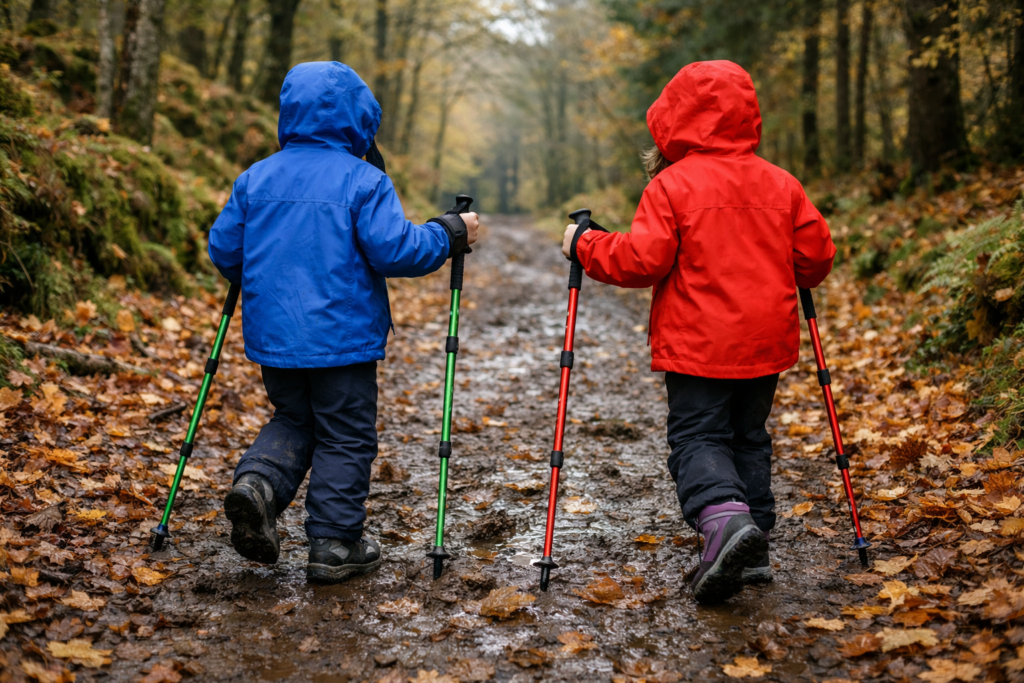
The moment a child gets their own pair of hiking poles, something shifts. Suddenly a muddy hillside becomes something to conquer rather than complain about. A long climb that would normally involve at least three requests to stop becomes manageable — because they have something to lean on, push off from, and genuinely engage with. We’ve seen it happen on the Loch Lomond paths more times than we can count. Getting the right footwear sorted first makes the poles even more effective — waterproof walking boots that actually keep kids’ feet dry on muddy trails means the whole kit works together.
Hiking poles aren’t just for adults or serious mountaineers. For children between about 5 and 14 on family walks, gentle trails, and country paths, they provide balance support on uneven ground, take some of the strain off young legs on descents, and make the whole experience feel more purposeful. In wet Scottish conditions where paths can be slippy and muddy — which in west coast Scotland means most of the year — the extra stability makes a real practical difference.
The four poles below are confirmed available on Amazon UK, sized and weighted for children rather than simply being adult poles shortened down, and priced for a family budget rather than a serious trekker’s kit list.
More family outdoor gear picks are in our Family Walking & Easy Hiking Hub.
What to Look for Before Buying Kids Hiking Poles
Weight is everything at this age
An adult hiking pole weighs around 250–350g each. A child carrying poles that are too heavy will use them for approximately ten minutes and then hand them to you to carry — which defeats the purpose entirely. The best kids poles come in around 175–200g each. That difference is significant when small arms are swinging them for two hours.
Adjustability determines how long they’ll last
Children grow. A pole that fits a 6-year-old often won’t fit the same child at 8. The best kids poles have a length range of at least 40–50cm to account for growth — the difference between lasting one hiking season and lasting three or four. If you’re still deciding on footwear at the same time, how far kids can realistically walk at different ages helps plan which routes are actually suitable before buying any gear.
Flip locks over twist locks for beginners
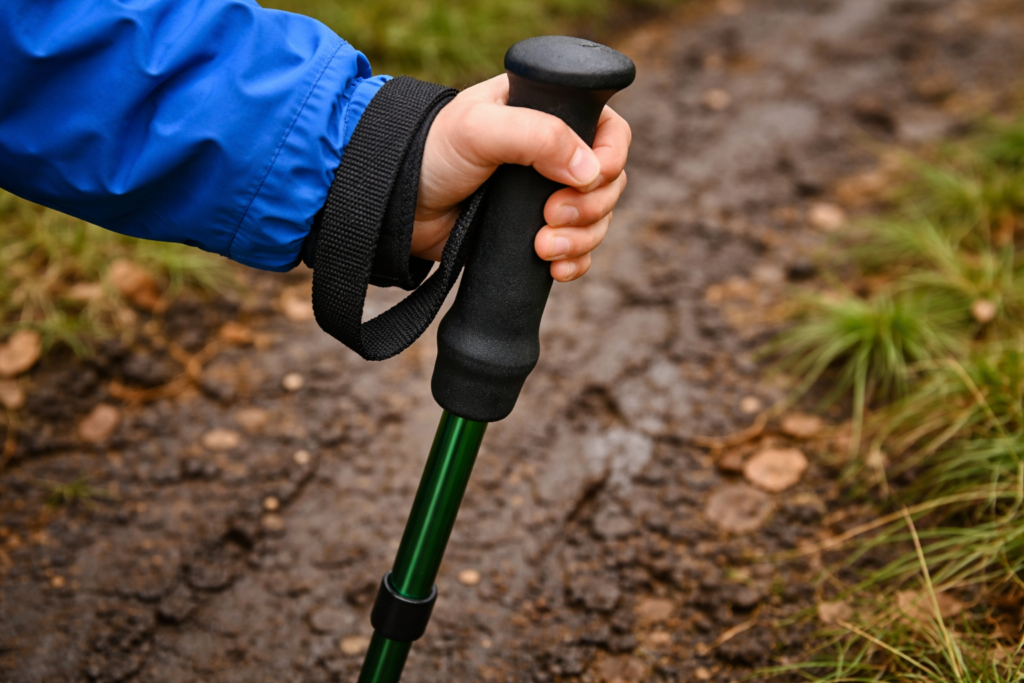
Flip locks — the lever mechanism that clamps the pole sections together — are considerably easier for children to operate than twist locks. A twist lock requires grip strength and coordination that younger children often don’t have. If your child can’t adjust their own poles, they won’t use them properly. Look for flip lock mechanisms specifically.
EVA foam grips over hard plastic
Hard plastic grips cause blisters on young hands surprisingly quickly. EVA foam grips are softer, absorb moisture, and are much more comfortable for children over longer walks. All four poles below use EVA foam for this reason.
Check whether it’s sold as a single pole or a pair
This is the detail most buyers miss on Amazon. Some kids poles are listed and priced as a single pole — you need two. Check carefully before ordering. Each listing below is noted as single or pair so there are no surprises when the delivery arrives.
How to Set the Right Height
The correct pole height for a child is set with the elbow bent at approximately 90 degrees when the pole tip is on the ground. Too long and the child leans forward awkwardly. Too short and they’re stooping.
A useful shorthand: pole length in centimetres should be roughly two-thirds of the child’s height. A child who is 120cm tall needs poles set at around 80cm. Most of the poles below cover this range comfortably across the typical ages of 5–12.
We set our kids’ poles a centimetre or two shorter than this rule suggests for downhill sections — the slightly shorter length gives better braking control going down a slope, which on some of the steeper Loch Lomond paths makes a real difference. On flat ground and uphill, the standard height works well.
The Four Picks Worth Buying
1. Kids Hiking Poles by USA Brand — 2-pack, around £18–24
Best for: younger beginners aged 5–10 who need a proper kids-specific pair with bright colours and simple flip lock adjustment.
This is the most kid-specific option on this list — designed from the ground up for children rather than adapted from an adult product. The poles adjust from 17 to 36 inches (43–91cm) which covers most children from around age 5 through to 11 or 12 depending on their height. Flip lock adjustment means a child can set their own height without needing an adult to do it for them — a detail that matters more on the trail than it sounds at home.
The bright colourful designs are worth mentioning because they matter more than adults expect. Children who like the look of their gear use it more willingly and for longer. These come as a proper pair which is the main practical advantage over the single-pole options further down the list.
The wrist straps are sized for small wrists rather than just being adult straps at maximum tightening — a practical detail that makes a real difference on longer walks when a child needs to let go of the pole without dropping it on a rocky path.
The poles pack down small enough for a child to carry in their own rucksack, which in our experience is one of the best ways to get children genuinely invested in their gear from the start.
2. Kids Trekking Pole — Lightweight Telescopic, around £10–14 each
Sold as a single pole — order two
Best for: families who want the lightest possible option and are happy to order two poles separately.
At 179g this is the lightest option on this list and the weight difference from heavier alternatives is noticeable in practice — particularly on longer walks when children’s arms begin to tire. The 6061 aluminium alloy construction is sturdy without adding unnecessary weight, and the EVA grip is sized for smaller hands with a concave anti-slip surface that works well even with gloves on in colder Scottish weather.
Adjustable from 51 to 100cm it covers children from around 6 years old up to approximately 10–11 depending on height. The tungsten steel tip handles muddy, rocky paths well — rubber tips are included for road and pavement sections where the metal tip would wear and create unnecessary noise.
The pink and green colour options are cheerful without being garish — genuinely something a child would want to use rather than a dull adult-style pole in a smaller size.
One important note repeated clearly: this is sold as a single pole. Add two to your basket or order twice. It’s a common point of confusion that leads to disappointed children on the morning of a planned walk.
3. Retractable Trekking Poles for Children — around £12–16 each
Sold as a single pole — order two
Best for: older children aged 8–14 or taller kids who need a pole that grows with them across several hiking seasons.
At 190g and adjusting from 55 to 115cm, this option covers a wider height range than the smaller kids poles above — particularly useful for children who are taller for their age, or for families who want a pole that will still fit a 13-year-old who was an average-height 9-year-old when it was first bought. The wide adjustment range is the main reason to choose this over the lighter option above.
The external lock system is designed for one-handed operation — easier for children to self-adjust mid-walk without stopping to fiddle, which matters on longer routes where pole height might need tweaking between flat sections and descents.
The carry bag and mud holders are included. On very wet Scottish ground, the mud baskets prevent the pole sinking too deep into soft paths — a detail that sounds minor until a child’s pole disappears to the knee in a bog and the walk comes to an abrupt halt.
Our eldest has been using poles in this length range since last year on the Loch Lomond east bank paths — which get particularly boggy after rain. Having poles with enough length to push off properly made the difference between a reluctant trudge and an enthusiastic scramble.
4. High Stream Gear Kids Hiking Poles — 2-pack, around £16–22
Best for: families who want a proven kids-specific branded pair with outdoor-inspired designs and shorter handles designed for small hands.
High Stream Gear started as a family business built around the experience of parents hiking regularly with their own children — which shows in the design decisions. The handles are 5.1 inches rather than the adult proportions found on shortened adult poles, which means children can actually grip them properly rather than wrapping small hands around something too large.
The pair adjusts from 25 to 40 inches (63–101cm) and the carrying bag means the poles can live in a child’s rucksack as standard kit between walks. Four outdoor-inspired designs give children some choice — and in our experience, children who chose their own poles ask to bring them far more often than children whose poles were chosen for them.
Suitable from around 5 years upward, these are a solid first pair for families just starting to bring children on regular walks and wanting gear that was actually designed with a child’s proportions and walking style in mind rather than shrunk from an adult template.
Do Kids Really Need Hiking Poles?
Honest answer: not always, but more often than parents expect.
On flat, easy paths in dry conditions — probably not essential. On anything with a meaningful descent, on muddy ground after rain, or for children who tire easily on longer walks — the difference is real and noticeable.
The specific benefits for beginners are balance on uneven ground, knee and ankle support going downhill, and something to engage with physically which keeps younger children focused on the walk rather than their legs. Our youngest went from refusing to walk past the first kilometre on a hilly path to completing a full 5km loop at Loch Lomond partly because having poles made the whole thing feel like an activity rather than exercise. Keeping younger children engaged on longer walks is something making family walks actually fun covers in more depth — poles are one piece of it but not the whole picture.
The other benefit that isn’t often mentioned: poles make children feel like they’re doing something proper. They’re equipped. They’re explorers. That psychological shift in a child who has their own kit — sized for them, chosen with them — is worth more than any specific physical advantage the poles provide.
A Note on Pole Tips for UK Trails
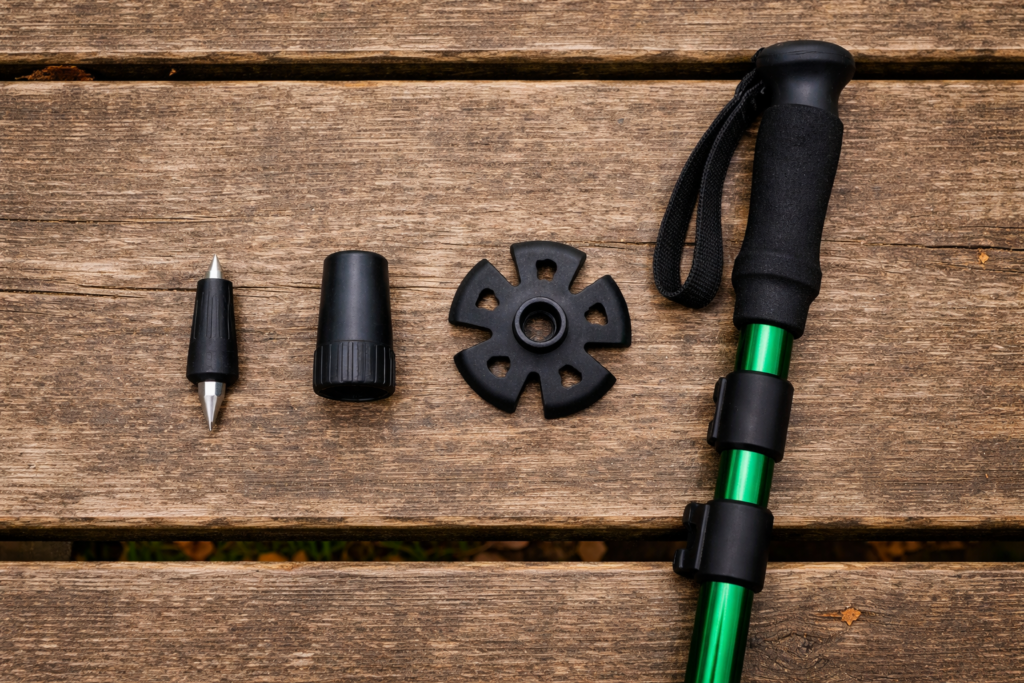
Most poles come with three tip types — tungsten steel for mud and soft ground, rubber caps for hard paths and pavement, and mud baskets which prevent the pole sinking too deeply in very wet conditions.
For UK walking in any season, the mud baskets are worth attaching for anything involving open fields or moorland paths. The poles can sink surprisingly deep into soft Scottish ground without them and a child who loses their pole in mud is not going to have a good time.
Switch to rubber tips when walking on road sections, car parks, or paved paths — the tungsten tip on hard surfaces is noisier, creates unnecessary sparks on stone, and wears faster than it needs to.
Frequently Asked Questions
What age can children start using hiking poles? Most manufacturers recommend 5–6 as the minimum — younger children don’t yet have the coordination to use poles safely without creating a trip hazard on the trail. From around 6 upward, with proper height adjustment and some basic instruction at the start of a walk, most children take to them quickly and naturally.
Should children use one pole or two? Two poles provide balanced support and are the standard recommendation for any terrain with uneven ground or descents. One pole is sometimes preferred by older children on flat, easy paths — but for beginners on varied terrain, two poles give better stability and confidence from the start.
How do I know when the poles need adjusting? If a child is walking with arms almost fully extended — poles too long — or with elbows raised high above 90 degrees — poles too short — it’s time to adjust. Worth checking at the start of every walk as children grow faster than most parents notice. Poles set five minutes before a walk are always better than poles adjusted on the move.
Can children use adult poles shortened down? Technically yes, but not ideally. Adult poles at minimum length are often still too long for younger children, and the grips are sized for adult hands which causes discomfort and makes the poles harder to hold securely over a long walk. A purpose-built kids pole at £15–20 per pair is a better choice than adult poles that don’t quite fit.
How should I teach a child to use poles for the first time? Start on flat ground before any real terrain. Show them the correct elbow angle and how to plant the pole slightly ahead of their foot rather than behind it. Let them walk with the poles for ten minutes before hitting any meaningful gradient. The technique comes naturally quickly — most children need less instruction than parents expect, and getting the height right is more important than any specific technique advice.
What We’d Actually Buy
For a first pair for a younger child aged 5–8 — the Kids Hiking Poles by USA Brand or the High Stream Gear pair. Both come as a proper pair, both are designed for smaller hands and heights, and the bright colours are genuinely motivating for children who are new to hiking and need a reason to want to bring their poles.
For a slightly older child aged 8–13 or one who’s going to grow significantly over the next few years — the Retractable poles at 55–115cm. The wider adjustment range means they’ll still be the right size in three years without needing replacing.
For the lightest possible option — the single telescopic pole at 179g. Worth ordering two and pairing them — the weight saving over heavier alternatives is meaningful on longer walks when small arms begin to feel it.
Whatever you choose, pack the rubber tip covers separately in a small bag and show children how to swap them before the walk starts. It takes thirty seconds and means the poles work properly on every surface. If this is your first family walk with poles, what to pack for a 2–3 hour UK trail covers the full kit list so nothing gets forgotten on the day.
Related Guides
About The Author – Andrew Marshall
Andrew Marshall is the creator of Simple Days Outside and a UK parent of three who regularly camps, walks, and explores outdoor activities with his family. His guides focus on practical gear, realistic family adventures, and simple ways to help families enjoy the outdoors across the UK. The recommendations on this site are based on real-world use, research, and the kind of equipment families actually rely on for weekend trips and everyday outdoor fun.