
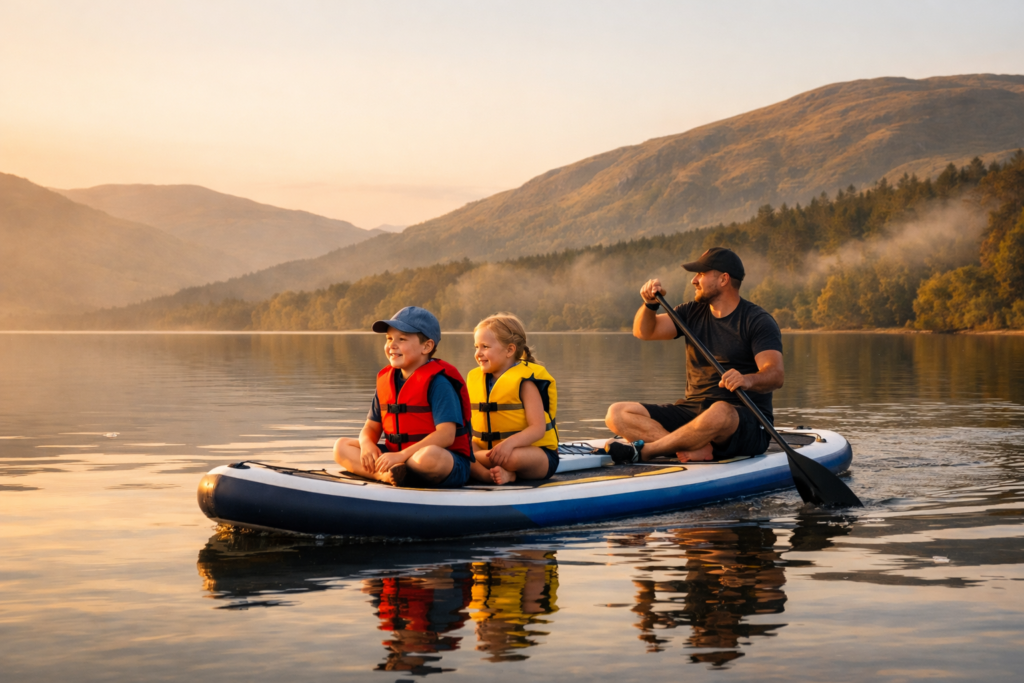

Written by Andrew Marshall
UK parent of three sharing practical advice to help families enjoy camping, walking, garden play, and simple outdoor adventures across the UK.
Creator of Simple Days Outside.
Last Updated: 7th April 2026
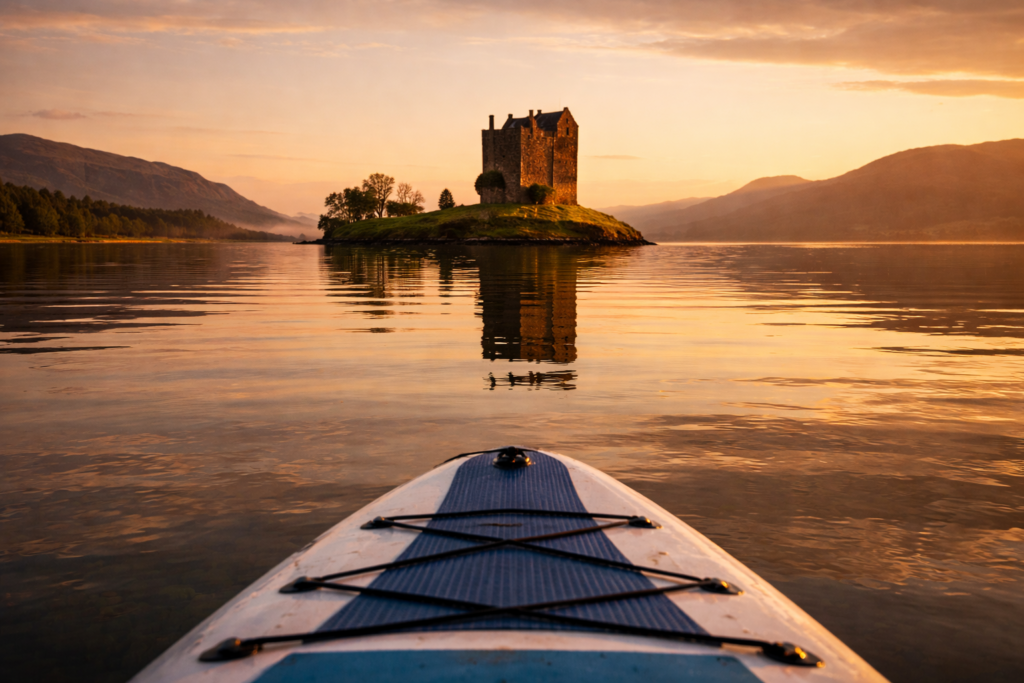
Paddling around Castle Stalker at sunset, the kids quiet for once, the loch completely flat and the old tower reflected perfectly in the water below us — it’s one of those evenings that doesn’t feel entirely real while it’s happening. We’d packed well that day. Everything was where it needed to be, the kids were warm and fed, and the drive home was easy. Nobody cried. Nobody was cold. The dry bag was actually in the car.
That’s not always how it goes.
On a less organised morning at Loch Lomond, we stood in a car park in light drizzle arguing about whose job it was to remember the dry bag. The board was inflated. The kids were ready. The dry bag was sitting on the kitchen worktop at home. We paddled anyway — phones stuffed into jacket pockets, snacks loose in a carrier bag that got wet within ten minutes, hoping for the best. It wasn’t a disaster but it was a fraction of the day it could have been.
The difference between those two trips wasn’t luck. It was preparation. Everything below is what we’ve built up across a lot of sessions on Scottish lochs — what genuinely needs to come with you, how to think about it, and why each item earns its place in the car.
If you’re still working out which board to bring, getting the size right for beginners is worth sorting before you go — it affects everything from stability to how many kids you can safely have on the water at once.
Start Here: Safety Kit
Nothing else on this list matters if the safety gear isn’t sorted. This isn’t the section to skim or decide to sort out later. Get this right first, every single time, before the board is even inflated.
Buoyancy Aids — One for Every Person on the Water
The most important item on this entire list. Every person getting on a paddle board needs a buoyancy aid — adult, teenager, toddler, everyone. No exceptions and no negotiating with kids who don’t want to wear one.
It’s worth understanding the difference between a buoyancy aid and a life jacket, because they’re not the same thing and the distinction matters. A life jacket is designed to turn an unconscious person face-up in the water — it’s the right choice for offshore sailing or situations where someone might be unable to help themselves. A buoyancy aid provides flotation while keeping arms completely free for movement, which makes it the right choice for active water sports like paddle boarding where the wearer is conscious, moving, and needs full arm mobility to paddle and balance.
If you’re on open water with very young children or non-swimmers, understanding when a life jacket is the right choice instead is genuinely worth reading — the decision isn’t always straightforward. But for paddle boarding with children who can follow instructions and swim at least a little, a well-fitted buoyancy aid is what you want.
Sizing is by weight, not by age. Check the label and match it to your child’s actual weight — a buoyancy aid that’s sized for a seven-year-old by age but fitted on a child who’s heavy for their age won’t perform correctly. To test the fit, put it on fully clipped and lift the collar sharply upward. If it rides up over the chin, it’s too loose or too big. It should stay firmly in place.
Put buoyancy aids on before leaving the car. Not at the water’s edge, not halfway down the path to the launch point. At the car, before anything else comes out. It establishes the habit and means there’s no moment of chaos at the bank where someone’s trying to clip a child in while another child is already heading toward the water.
Search buoyancy aid for kids paddle boarding for options sized from toddler through to older children and adults.
Leashes
A leash connects the paddler’s ankle to the board. For flatwater loch paddling, a coiled leash is ideal — it sits neatly at the ankle, doesn’t drag in the water, and extends only when needed. If someone falls off, the board stays within reach rather than drifting away on the wind or current.
This matters more with kids than it does paddling alone. If your youngest goes in and you go in after them, the board drifting twenty metres away is a serious problem. Leash attached means the board is always there.
For children paddling their own boards, fit the leash to their ankle the same way you would your own. For a young child riding on an adult’s board, the adult’s leash covers both of you.
Safety Whistle
Clip a waterproof whistle to your buoyancy aid and leave it there permanently. It weighs almost nothing, costs very little, and is the fastest and most effective way to signal distress on open water. Three short blasts is the universal distress signal. It carries further than shouting and works when your voice has given out.
It’s one of those items you’ll likely never use. But on a remote Scottish loch with no other boats in sight, you want it there.
First Aid Kit
A compact waterproof first aid kit lives in the dry bag on every session. Kids plus rocky shorelines plus cold wet feet equals a certainty of minor injuries — cuts, grazes, the occasional stubbed toe on a hidden rock at the launch point. Having a basic kit means you deal with it in two minutes and carry on rather than cutting the day short.
Waterproof outdoor first aid kits designed for water sports take up almost no space and are worth having in the bag permanently rather than as an afterthought.
What Everyone Should Wear
The most common mistake families make on UK paddle boarding days is dressing for the air temperature rather than the water temperature. On a warm Scottish July day the air might be 18 degrees and the loch might be 12. That gap matters enormously if someone goes in.
Wetsuits
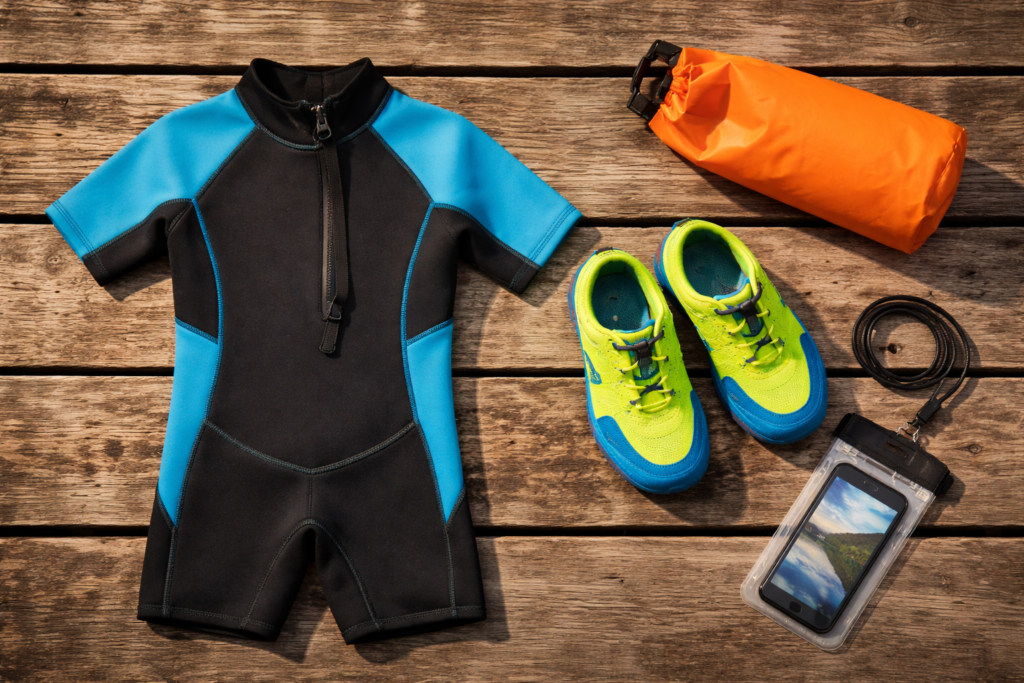
For most UK family paddle boarding from spring through early autumn, a wetsuit is the right choice for everyone. A kids wetsuit in 3/2mm — meaning 3mm of neoprene on the body and 2mm on the limbs — gives enough warmth for an unplanned swim without restricting movement so much that paddling becomes difficult. Full-length suits are better than shorties for Scottish loch temperatures; shorties are fine on genuinely warm days in sheltered sea lochs but those days are rarer than you’d hope.
Adults in wetsuits paddle differently to adults who aren’t. You stop second-guessing every wobble when you know that falling in is inconvenient rather than immediately awful. That change in confidence passes to the kids — they read your body language on the board more than most parents realise.
A thin base layer or rashguard under the wetsuit adds a small amount of warmth and makes getting in and out of the suit slightly easier, particularly for kids who find the neoprene tight around the neck.
Water Shoes
Every child needs water shoes for UK loch paddle boarding and this is not an item to skip or assume wellies will cover. Launch points on Scottish lochs are frequently rocky, muddy, covered in slippy algae, or all three simultaneously. Getting a child across twenty metres of that in bare feet or socks adds at least ten minutes to every launch, usually involves someone falling over, and sets the tone for the session before you’ve even got near the water.
Kids water shoes drain quickly, dry fast, pack flat, and grip on wet rock in a way that nothing else does. Adults benefit from them just as much.
Sunscreen — Applied Properly
Open water reflects UV radiation significantly more than being on land does. On an overcast Scottish day in June you can come home with a genuine sun burn from a morning on the loch because you assumed cloud cover meant no exposure. It doesn’t.
Apply kids water resistant sunscreen SPF50 before launching and pack enough to reapply after an hour on the water. Pay attention to the back of the neck, the backs of hands, and the tops of ears — the areas consistently missed and consistently burned on water days.
Lip balm with SPF is the most persistently forgotten item on our packing list. Wind and water dry lips out fast. It lives in the dry bag now and we don’t think about it — it’s just always there.
Warm Layers for After
A full change of clothes per child goes in the dry bag every time. Not in the boot in a bag, not in a rucksack on the bank — in the dry bag, sealed, guaranteed dry. Getting back to the car after a loch session with no dry layer is genuinely miserable when the temperature drops in the afternoon, which it does reliably on west coast Scottish days. The warm layer at the end of the Castle Stalker trip made the difference between a happy memory and a difficult forty-minute drive home.
Bring a flask of something hot if the session is longer than two hours. It sounds unnecessary until you’re standing on a cold loch bank at 7pm trying to get a wetsuit off a six-year-old who’s shivering.
Board and Paddle Setup
We use an inflatable board and have done from the start. The practical reasons stack up quickly when you’re fitting a family day around three children of different ages and sizes. Inflatables pack into a rucksack or a board bag that fits across the back seats or in the boot without rearranging the entire car. They’re softer when a child loses balance and falls into the board rather than the water — which happens more than falling into the water does, especially early on. And they’re more forgiving at launch and landing points where a rigid board would take damage from rocks.
For families specifically, the practical differences between inflatable and hard boards matter more than the performance differences that experienced solo paddlers care about. The stability, weight, and packability of an inflatable wins for family use almost every time.
Board Width and Weight Capacity
Width is the most important specification for family paddle boarding and it’s the one most people overlook when buying. A board 32 inches or wider is noticeably more stable than a narrower race-oriented shape, and gives a young child room to sit or move at the front without the board feeling like it’s about to tip. For a long time our eldest sat at the front while one of us paddled from behind. A wider board made that workable. On a narrower board it would have been manageable but tense.
Check the weight capacity carefully if you’re planning to paddle with a child on the same board. A typical family inflatable carries 120–150kg — enough for an adult and a child, but check the specific board. Overloading a board affects stability significantly.
Adjustable Paddles
A child using an adult paddle at full length is working against themselves. The blade hits the water at the wrong angle, the leverage is wrong, and small arms tire out in ten minutes. A kids adjustable SUP paddle that shortens to an appropriate length makes paddling genuinely achievable for children rather than a frustrating physical struggle. The correct length for a child is roughly their height plus ten centimetres — the handle should sit about a hand’s width above their head when the blade is on the ground.
Pump and Repair Kit
The pump comes with most inflatable boards but confirm it’s in the car before leaving. Inflating a full family board takes ten to fifteen minutes with a manual pump — longer if you’re sharing the job with enthusiastic but ineffective small helpers. A SUP electric pump makes the process significantly faster and is worth considering if you’re doing this regularly.
A basic repair kit takes up almost no space and is worth having if you’re heading to a remote location. On Loch Tulla there is no nearby shop. On the Loch Laich paddle past Castle Stalker we were twenty minutes from the nearest village. A slow puncture with no repair kit on a remote loch is a problem that could have been avoided for the price and size of a small patch kit.
Protecting Your Kit
Dry Bag
The item that caused the car park argument and the item that gets the most use of anything on this list. A 10-litre roll-top dry bag holds phones, keys, snacks, first aid kit, warm layers, and anything else that can’t get wet. The roll-top seal is only waterproof when rolled down a minimum of three times and clipped — a single fold is not waterproof and several car park conversations have been had about this.
Buy a bright colour. Orange, yellow, red — something that shows up against water and on a dark loch bank. If it goes overboard, you want to be able to see it.
If you have a lot of gear across multiple people, a second smaller dry bag for snacks and food keeps everything organised and means you’re not unpacking everything to get to the biscuits halfway through the session.
Waterproof Phone Pouch
Separate from the dry bag, a waterproof phone pouch worn around the neck means the phone is accessible for photos without unpacking the sealed bag every time you want to use it. On the Castle Stalker evening the light changed fast and the window for the best photos was narrow. Having the phone immediately to hand made the difference between getting those shots and not.
Look for a pouch that’s rated to at least IPX8 and has a lanyard long enough to actually use the touchscreen while it’s around your neck.
Food, Water, and Energy
Kids on the water run out of energy faster than they tell you. The pattern is consistent — they’re fine, they’re fine, they’re fine, and then suddenly they’re not fine and the session is over. Packing more food than you think you need and making water available constantly rather than when asked changes how long the day lasts and how it ends.
High-energy snacks that don’t require preparation work best on the water — cereal bars, dried fruit, cheese portions, oatcakes, anything that comes out of a bag ready to eat. Avoid anything that needs unwrapping fiddly packaging with wet hands on a moving board.
Water is non-negotiable regardless of where you’re paddling. Kids won’t ask for it until they’re already dehydrated and on a loch with no facilities, there’s no backup plan. A water bottle per child, filled before leaving the car park.
The Launch — What to Do Before Anyone Gets on the Water
This part of the day gets rushed more than any other and it’s where most of the problems begin. The board is inflated, the kids are excited, the water is right there — and the temptation is to just get on. Spend five minutes on the bank first.
Buoyancy aids checked and properly fitted on everyone. Leashes attached. Dry bag sealed and clipped to the board’s bungee cord. Phones in the waterproof pouch or inside the sealed dry bag. And one conversation with the kids — every time, even with the eldest who’s done this before — about what happens if someone falls in. Where to swim. How to get back onto the board from the water. Stay calm, stay with the board, don’t panic.
That conversation is the most valuable five minutes of the whole day. A child who has thought through falling in before it happens responds completely differently when it does. The first time our youngest went in she was calm because we’d talked about it on the bank that morning. She knew what to do. She did it. We got her back on the board in under a minute and she laughed about it.
Run through it every time. It takes less than two minutes and it changes how the whole session feels.
If You’re Paddle Boarding in Scotland
Two things get added to the list for Scottish loch sessions specifically, and both matter more than they might sound.
Midges
If you’re launching near woodland — and Loch Lomond is particularly notorious — Smidge midge repellent goes on before you start inflating the board. Not after you’ve inflated. Not at the launch point. Before the board comes out of the bag, because you will be standing still for ten to fifteen minutes during inflation and that is precisely when midges do their worst work. Smidge is the product that consistently works in Scottish conditions — it’s worth seeking out specifically rather than using a generic insect repellent that won’t perform the same way.
Midge season runs roughly from late May through September, with the worst periods in June and August. Early morning and early evening near water and trees are the peak risk windows. If you’re launching after 5pm near Loch Lomond in July, treat midge protection as seriously as sunscreen.
Weather
Scottish loch weather changes faster and more dramatically than forecasts suggest. A morning that starts calm and clear can turn within an hour. On Loch Tulla we had a squall come through with no warning on what had been a flat calm day — twenty minutes of wind and rain that dropped the temperature significantly and made paddling back to the launch point difficult. A lightweight waterproof layer per person that packs into the dry bag adds almost no weight and has saved several sessions from turning into miserable scrambles back to the car.
Check the forecast before you go but don’t rely on it as the only input. Look at the hills around the loch as you arrive — cloud building on high ground is a reliable early indicator of changing conditions. If it looks like weather is coming, launch earlier rather than later.
If you’re heading to a Scottish loch for the first time, understanding what makes open water safe for families is worth reading before you arrive — conditions vary between sites significantly and not all are equally suitable for families with young children.
The Quick-Reference Checklist
For the sessions when you don’t have time to read everything back, this is what needs to be in the car:
Safety: Buoyancy aid per person — sized correctly. Leash per board. Whistle clipped to buoyancy aid. Waterproof first aid kit.
Clothing: Wetsuit per person. Water shoes per person. SPF50 water resistant sunscreen. Lip balm with SPF. Full change of clothes per child in dry bag. Warm layer per person.
Board and paddle: Inflatable board with manual or electric pump. Adjustable paddle per paddler. Repair kit.
Gear protection: 10L dry bag sealed properly. Waterproof phone pouch.
Food and water: Water bottle per person filled before launching. High energy snacks — more than you think you need.
Scotland specific: Smidge. Lightweight waterproof layer per person.
Related Guides
About The Author – Andrew Marshall
Andrew Marshall is the creator of Simple Days Outside and a UK parent of three who regularly camps, walks, and explores outdoor activities with his family. His guides focus on practical gear, realistic family adventures, and simple ways to help families enjoy the outdoors across the UK. The recommendations on this site are based on real-world use, research, and the kind of equipment families actually rely on for weekend trips and everyday outdoor fun.