

Written by Andrew Marshall
UK parent of three sharing practical advice to help families enjoy camping, walking, garden play, and simple outdoor adventures across the UK.
Creator of Simple Days Outside.
Last Updated: 7th April 2026
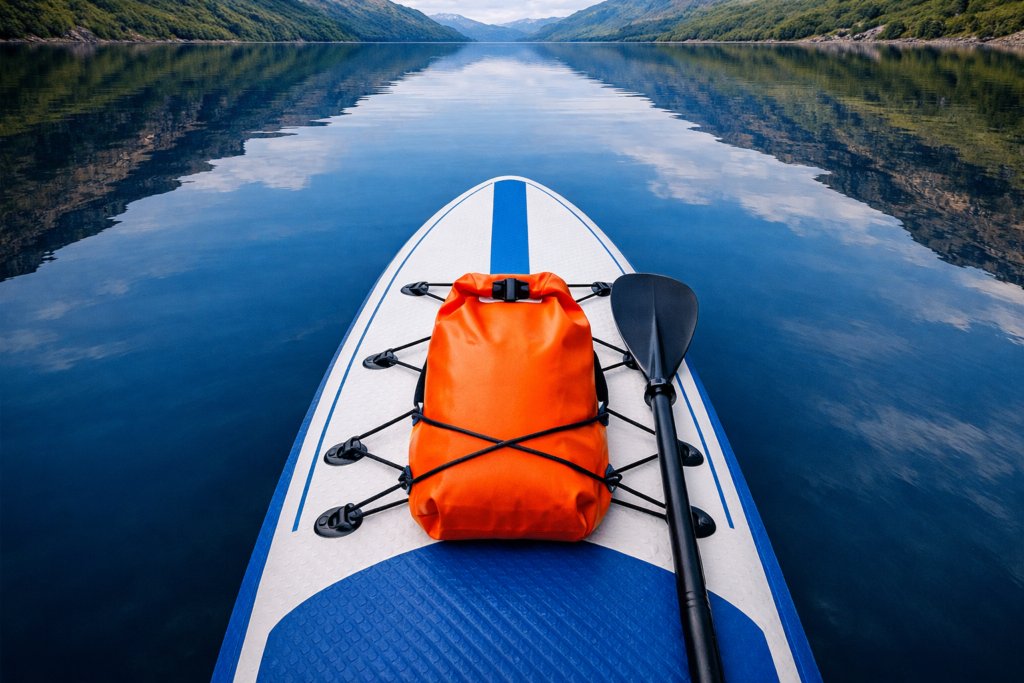
There’s a particular kind of frustration that only happens on the water. You’ve paddled out, the kids are finally settled, you’re fifty metres from the shore on a flat Loch Lomond morning with the hills sitting perfectly still in the reflection below you — and then you notice it. The dry bag sitting on the front of the board. The top flap loose. Not rolled. Not clipped. Just sitting there open like you left it on the kitchen counter.
Your phone is in there. The car keys are in there. You’re fifty metres from shore on an inflatable with two children who have no interest in paddling back yet.
We got lucky that day. The bag didn’t go in. Nothing got wet. But I paddled the rest of that session with one eye on the bag the whole time, which is not how a family morning on the water is supposed to feel. It was entirely our fault — we’d rushed the launch, skipped the check, and paid for it in low-grade anxiety for two hours. That session prompted a proper rethink of what we were actually using and why.
Since then we’ve been through several dry bags across very different conditions — flatwater family days on Loch Tulla, longer sessions on Loch Lomond, and sea paddling on the Argyll coast where the stakes around waterproofing feel considerably more real. The differences between bags that genuinely work and bags that look like they work become clear quickly once conditions stop being ideal.
A dry bag is just one piece of the kit puzzle — everything else your family needs on the water covers the full picture from buoyancy aids to midge repellent.
What to Know Before You Buy
Three things determine whether a dry bag actually does its job on a paddle board. Worth understanding before spending anything.
Material Matters More Than the Price Tag Suggests
The two materials you’ll encounter are PVC and TPU-laminated nylon. PVC is heavier and more rigid but genuinely tough — it handles being dragged across rocks, scraped along the deck of an inflatable, and generally treated without care. It’s the material in most mid-range and budget bags and it works well in normal conditions.
TPU-laminated nylon is lighter, more packable, and more flexible — including in cold temperatures, which matters more than most people realise. PVC stiffens noticeably in cold conditions. On a Scottish loch in April or October, a PVC bag becomes harder to seal and less comfortable to handle. TPU-laminated nylon stays flexible and manageable regardless of water temperature. It’s the material in premium bags and it’s one of the reasons those bags justify their higher cost for regular paddlers in colder water.
Welded seams are non-negotiable on either material. Stitched seams leak. If a bag doesn’t explicitly state welded or RF-welded seams, assume it will let water in eventually.
The Roll-Top Closure — and Why Most Leaks Are Human Error
A roll-top dry bag is only waterproof when sealed correctly. Roll the top down a minimum of three times — four is more reliable — then clip the buckle. A single fold is not a seal. It keeps splashes out on a calm day and fails the moment the bag goes in the water or gets a sustained soaking.
Leave a small amount of air inside the bag before rolling it closed. This does two things: it helps maintain the seal under pressure, and it makes the bag buoyant. A sealed dry bag with air inside floats. An overstuffed bag with no air pocket doesn’t seal as well and sinks faster if it goes overboard.
Don’t overfill. A bag that’s packed to its absolute limit can’t be rolled down enough times to seal properly. Size up if you’re consistently running out of room.
Getting the Size Right
It’s the same logic that applies to getting your board size right — going off instinct rather than actual measurements usually means buying twice.
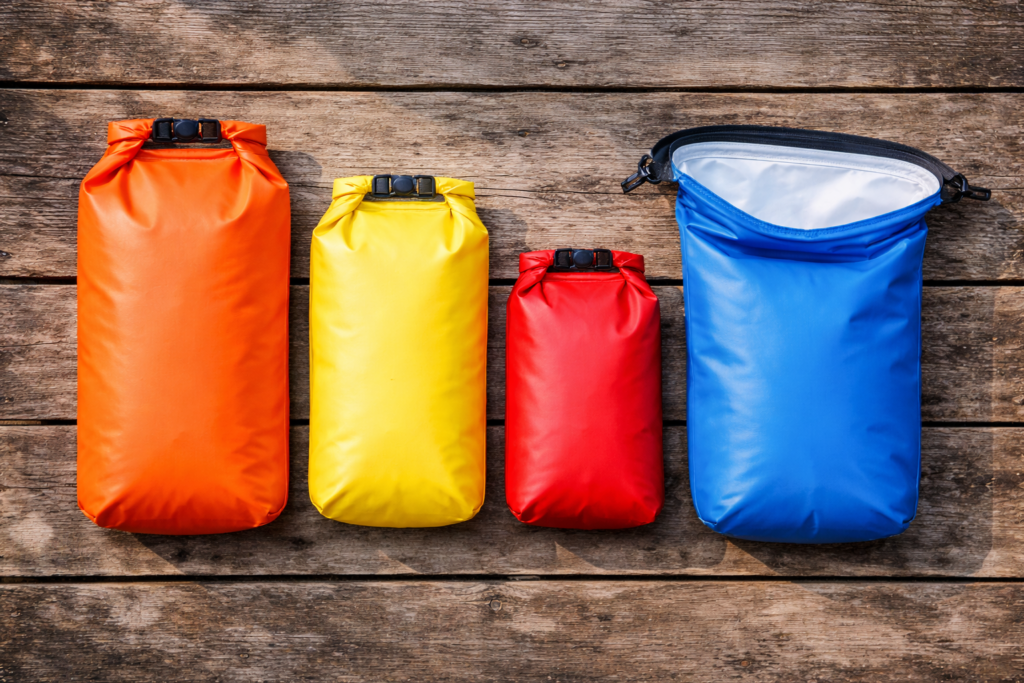
For a phone, keys, and wallet on a short solo paddle, 5–10L is sufficient. For a family day with changes of clothes, snacks, sunscreen, first aid, and warm layers, 20L is the minimum and 30L is more honest. A bag that’s too small gets overfilled and can’t seal. A bag that’s too large and half-empty doesn’t seal as tightly either. Most families find two bags work better than one — a 20L for the main kit and a smaller 5–10L for things you need mid-session without unpacking everything.
Attaching the Bag to the Board
This doesn’t get mentioned in most dry bag reviews and it’s something first-time buyers consistently ask. The bungee cord system on most inflatable paddle boards is designed to hold a dry bag on the deck — clip the bag’s D-ring to the bungee, thread the cord through, and the bag stays in place even if the board tips. Don’t just rest the bag on top of the bungee without securing it. On a moving board with children shifting weight around, an unsecured bag migrates toward the water faster than you’d expect.
If your bag has lash loops or multiple D-rings, use them. The more attachment points you can use, the more stable the bag sits.
The 5 Best Dry Bags for Paddle Boarding
1. Earth Pak Waterproof Dry Bag — Best All-Round Budget Pick
You want something reliable, properly waterproof, and priced so you can buy two without it hurting. This is that bag.
Available sizes: 10L, 20L, 30L, 40L, 55L Material: 500D PVC with welded seams Best for: Families wanting solid everyday waterproofing without overspending
The Earth Pak is the dry bag most family paddlers should start with. No clever features, no premium materials, no marketing noise — just a properly built roll-top PVC bag that keeps things dry, floats when it needs to, and costs enough less than the premium options that buying a second one for snacks and mid-session kit makes financial sense.
The 500D PVC is noticeably thicker than cheaper bags in the same price bracket. The welded seams are solid throughout. Roll it down four times on Loch Tulla with the kids’ spare layers inside and it comes off the board dry regardless of what the afternoon weather decides to do. That’s the standard it needs to meet and it meets it.
The 10L and 20L versions come with a shoulder strap and a D-ring for clipping to the board’s bungee. From 30L upward it switches to a dual backpack strap with a sternum clip — useful when you’re carrying it across the car park and down to the launch point. Every size ships with an IPX8-rated phone pouch included, which sounds like a useful bonus. In practice, the pouch is sized for older, smaller phones and won’t close properly around most current large-screen devices. Worth knowing before you rely on it.
The one honest caveat worth repeating: the buckle clips are plastic and feel cheaper than the rest of the bag. They work, but they’re not built for years of hard use. Rinse the bag after salt water sessions, keep it out of prolonged direct sun, and don’t stretch it beyond its rated capacity — the bottom seams are the first point to show stress if you do.
Genuinely good for: First-time buyers, families doing regular lake and loch sessions, anyone wanting two bags across different sizes without a large spend. Worth knowing: Buy the 20L as your main bag and a 10L as your mid-session access bag in a different colour. The included phone pouch won’t fit most modern smartphones.
2. Sea to Summit Big River Dry Bag — Best Premium Everyday Bag
You paddle regularly, sometimes in conditions that aren’t ideal, and you want a bag you won’t think about replacing for years.
Available sizes: 5L, 8L, 13L, 20L, 35L, 65L Material: 420D TPU-laminated nylon Best for: Regular paddlers who want a bag that performs in colder water and lasts properly
The Sea to Summit Big River is where experienced paddlers almost always land eventually. The cost is higher than the Earth Pak — noticeably so — and the difference in material is immediately obvious when you pick it up. The 420D TPU-laminated nylon is lighter and more packable than PVC, abrasion-resistant in a way that matters when the bag is getting dragged across the rough deck of an inflatable repeatedly, and — critically for Scottish loch paddling — stays properly flexible in cold water. PVC stiffens when the temperature drops. On an April morning on Loch Lomond when the air is still sharp, a Sea to Summit seals and handles the same as it does in July. That difference feels minor until you’re trying to roll and clip a stiff, cold PVC bag while also managing children who want to be on the water already.
The white interior lining is a detail that sounds minor and isn’t. You can actually see what’s inside without unpacking it. On a loaded family board that’s a small practical gain that adds up across a full day.
The lash points are the other meaningful upgrade. Most dry bags have a single D-ring at the buckle. The Big River has multiple daisy chain webbing loops running down the sides — proper attachment points that let you fix the bag to the board in multiple configurations rather than hoping the bungee cord holds it. On a session where the board is carrying gear for four people and two children are moving around constantly, a bag that’s properly fixed in place rather than just resting on the deck is a different experience entirely. The oval-shaped base adds to this — it sits flat and stable on the board rather than rolling toward the edge every time weight shifts.
The field-replaceable buckles are the feature that justifies the price over years of use. If a clip breaks after three seasons, you replace the buckle rather than the bag. The lifetime guarantee backs that up.
If you’re paddling Scottish lochs regularly, understanding how cold the water actually gets month by month puts decisions like this — material choice, wetsuit weight, what you’re trusting your kit to — in proper context.
The 13L is the most versatile size for keeping essentials dry on a family session. The 20L covers a full day’s worth of small items comfortably. The 35L is relevant for overnight or multi-day trips.
Genuinely good for: Regular paddlers, anyone on Scottish or exposed open water, paddlers who’ve been through a cheaper bag and want something that won’t need replacing. Worth knowing: Expensive relative to the other bags here. For families doing a handful of sessions a year on sheltered lochs, the Earth Pak does 90% of the same job for significantly less. The Big River earns its cost for regular paddlers in more demanding conditions.
3. Unigear Waterproof Dry Bag — Best Value for Families Needing Multiple Bags
You’ve got three children, all of whom need their own kit kept dry, and you don’t want to spend £30 per bag.
Available sizes: 2L, 5L, 10L, 20L, 30L, 40L Material: 500D PVC with fully welded seams Best for: Families wanting the same bag across multiple sizes and colours without a large per-bag spend
The Unigear sits in the same budget tier as the Earth Pak and the construction is comparable — 500D PVC, high-frequency welded seams throughout, roll-top closure with a clip buckle. What makes it worth a separate entry for families specifically is how well it works as a system across different sizes.
With three children, keeping kit organised on the water is a consistent problem. One bag means unpacking everything to find the sunscreen. Two bags means a slightly better version of the same problem. What actually works is each person’s kit in their own bag — different colours, different sizes, stacked on the deck bungee and immediately identifiable. The Unigear range runs from 2L up to 40L, all in the same construction and design, all available on Amazon UK without a significant per-bag spend. Buy four different colours and the chaos of a family paddle boarding session becomes noticeably more manageable.
The core waterproofing is solid. UK paddlers’ reviews specifically mention how well the roll-top seal holds up when the bag goes in the water, and the welded seam construction performs comparably to bags at twice the price in standard loch and lake conditions.
There is one honest warning about the included phone pouch that deserves to be stated clearly rather than buried. A UK reviewer specifically noted that the lanyard clip on the phone pouch failed while attempting to get back onto a paddle board in open sea water. The phone went into four metres of water and wasn’t recovered. The bag itself was fine. The included phone pouch lanyard clip was the failure point. Use the main bag for your phone or use a separate dedicated waterproof phone pouch with a locking mechanism. Don’t trust the included lanyard clip in open water or anywhere you can’t retrieve a dropped phone.
Genuinely good for: Families needing multiple bags across different sizes, keeping each person’s kit separate and identifiable on the water, anyone on a budget who doesn’t want to compromise on the actual waterproofing. Worth knowing: The included phone pouch lanyard clip has failed in real open water conditions. Treat it as unusable in sea or deep water.
4. Overboard Pro-Sports Waterproof Dry Tube — Best for Sea Paddling and Exposed Conditions
You’re on the Argyll coast, the tide is moving, the conditions have shifted since you launched, and you need to know the bag is genuinely waterproof — not just splash resistant.
Available sizes: 20L, 40L, 60L Material: 600D nylon-coated PVC tarpaulin with welded seams Best for: Sea paddling, tidal water, exposed lochs, anywhere conditions can deteriorate
Overboard is a British brand and the Pro-Sports Dry Tube is built to a noticeably different standard than the other bags on this list. The 600D nylon-coated PVC tarpaulin is heavier and more robust than standard 500D PVC — the kind of construction used in serious whitewater kayaking kit rather than family flatwater sessions. Pick it up next to an Earth Pak and the difference is immediately apparent. It’s denser, more rigid, and feels like something built for conditions rather than just labelled for them.
On the Argyll coast, where a calm morning can shift into wind and chop faster than the forecast suggested, that construction difference stops being academic. The roll-top seal on the Pro-Sports tube is genuinely tight — independent testing has shown contents coming out dry after a full submersion, not just after splash exposure. The IP66 rating means quick submersion is within its design spec. It floats when sealed with air inside, and the shoulder strap and carry handle make it manageable across a rocky west coast launch point even fully loaded.
The 20L is the practical size for a sea paddling day — enough capacity for what you need without the bag becoming unwieldy on the board. The 40L works for longer trips or carrying wetsuits and bulk kit for the whole family. The 60L is a group bag — one bag, multiple people’s kit, big enough to matter.
The trade-off is weight and bulk. This is not a bag that packs down small or sits lightly on the board. It’s heavier than the Sea to Summit and noticeably larger than the Earth Pak when fully loaded. On a sheltered Loch Tulla family morning, it’s more bag than the situation asks for. On the Argyll coast with the tide running and the hills disappearing into cloud, it’s exactly the right call.
Genuinely good for: Sea paddling, exposed tidal water, west coast Scottish lochs, paddlers who have had a lighter bag fail in serious conditions. Worth knowing: Meaningfully heavier and bulkier than other bags on this list. Right-sized for open and exposed water — more than you need for sheltered flatwater family sessions.
5. HEETA Dry Bag Backpack — Best for Longer Walks to the Water
The car park at your launch point is not close to the water. You know this because you’ve done the walk three times already this summer, loaded like a pack horse, and your shoulder still remembers it.
Available sizes: 20L, 40L Material: TPU-coated PVC Best for: Families with gear-heavy sessions, launch points that require a walk, anyone who wants one bag that works on land and on the water
Most dry bags solve the problem of keeping things dry on the water. The HEETA solves a different problem first — getting everything to the water without it being a miserable experience.
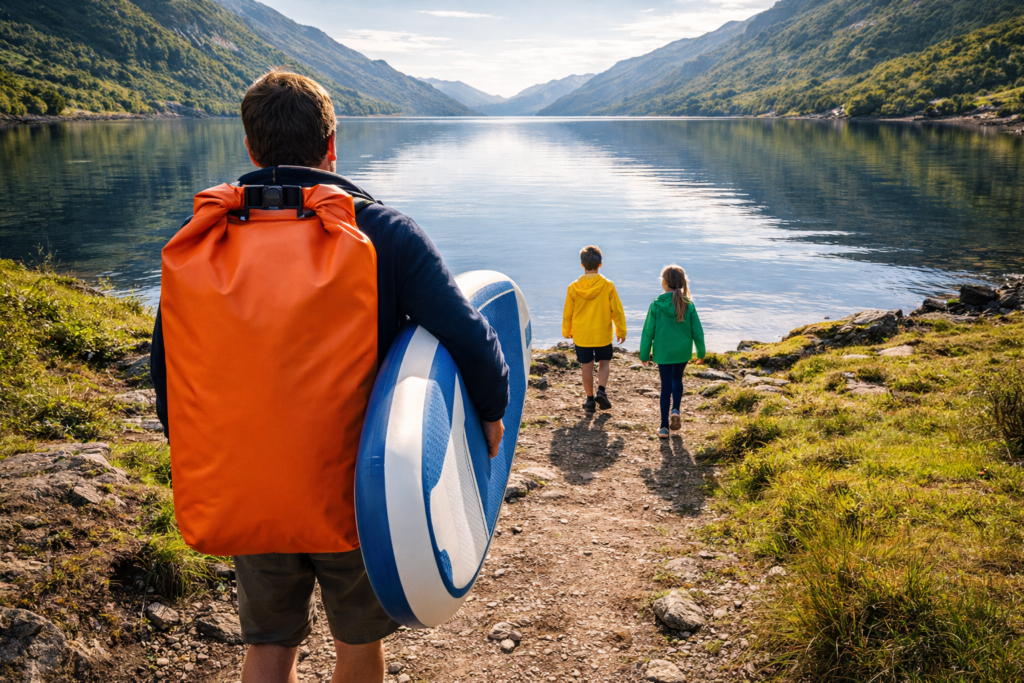
Loch Lomond launch points are not always straightforward. Parking is not always next to the water. On one session this summer we were the best part of half a mile from the launch point across a rough track — a deflated board, two paddles, buoyancy aids, wetsuits, the dry bag, snacks, water bottles, and three children who were helpful right up until the moment they weren’t. A single shoulder strap tube bag over that distance, fully loaded, is uncomfortable in a way that sours the start of the day before you’ve even seen the water.
The HEETA’s padded dual shoulder straps and sternum clip change that completely. The load distributes across both shoulders properly. The 40L swallows everything a family needs for a full day — changes of clothes, snacks, first aid, warm layers, sunscreen — in a single bag that you can carry comfortably across a car park, down a rough path, and to the launch point without your shoulder filing a formal complaint.
On the board, it clips to the bungee via the D-ring and sits on the deck. The roll-top seals correctly when rolled four times. The waterproofing handles splashes and rain without issue — it’s not the bag for deliberately submerging in sea conditions, that’s the Overboard’s territory — but for Scottish loch and lake paddling where the main risks are a capsize or a Scottish summer shower, it performs reliably.
The backpack system can also be removed entirely if you want to streamline the bag when it’s fixed to the board and you’re not planning to carry it any distance. That flexibility between backpack carrier and standard dry bag is the feature that justifies it as a separate category from the other bags here.
Genuinely good for: Families doing gear-heavy sessions, launch points requiring any meaningful walk, anyone who wants one bag that genuinely works on land and on the water. Worth knowing: Not designed for submersion in rough open sea conditions. Right-sized for lake and loch paddling. In genuinely exposed conditions, the Overboard is the right bag.
Which One Should You Actually Buy?
For occasional family sessions on Scottish lochs or sheltered UK lakes, and you want something reliable without spending a lot — Earth Pak 20L, plus a second 10L in a different colour for mid-session access. That combination costs less than a single premium bag and covers most situations.
For regular paddling, colder water, or more demanding conditions — Sea to Summit Big River 13L or 20L. The material performs better in cold Scottish water, the lash points actually fix it to the board properly, and it won’t need replacing. The lifetime guarantee is real.
For a family needing bags across multiple sizes and multiple children without a large per-bag spend — Unigear in a range of sizes and colours. Keep each person’s kit separate and identifiable. Ignore the included phone pouch.
For sea paddling or exposed open water on the west coast — Overboard Pro-Sports 20L. Built heavier for a reason. Not a bag you’ll second-guess in conditions.
For sessions where the walk to the launch point is part of the challenge — HEETA 40L. The backpack harness earns its place before you even reach the water.
If you’re still sorting the board side of things before the season starts, choosing the right family board is worth getting right first — the board affects how much deck space you have and how you’ll want to attach the bag.
Related Guides
About The Author – Andrew Marshall
Andrew Marshall is the creator of Simple Days Outside and a UK parent of three who regularly camps, walks, and explores outdoor activities with his family. His guides focus on practical gear, realistic family adventures, and simple ways to help families enjoy the outdoors across the UK. The recommendations on this site are based on real-world use, research, and the kind of equipment families actually rely on for weekend trips and everyday outdoor fun.