

Written by Andrew Marshall
UK parent of three sharing practical advice to help families enjoy camping, walking, garden play, and simple outdoor adventures across the UK.
Creator of Simple Days Outside.
Last Updated: 8th April 2026
We spent a good few weeks going back and forth on this before we bought our first kayak. Every time I thought I’d settled on a hard kayak — the kind you see stacked outside watersports centres, rigid fibreglass shells that look like they mean business — something practical got in the way. We don’t have a garage large enough to store one properly. Our car doesn’t have a roof rack. The nearest decent put-in point from where we live is thirty minutes away and loading a rigid kayak onto a roof every time we want to use it started to feel like a project rather than a day out.
So we went inflatable. And we’ve never regretted it. But that’s our situation — and our situation isn’t everyone’s.
The inflatable vs hard kayak debate has a real answer, but it isn’t the same answer for every family. It depends on where you live, where you paddle, how often you go, how much space you have, what your children’s ages are, and honestly how much faff you’re prepared to deal with at the start and end of every session. This article works through all of it properly so you can make the right call for your actual circumstances rather than someone else’s.
What We’re Actually Comparing
Before getting into the detail, it’s worth being clear about what sits on each side of this comparison. Hard kayaks — also called rigid or hardshell kayaks — are made from solid materials: polyethylene, fibreglass, or composite. They’re a fixed shape, can’t be compressed or packed away, and require dedicated transport and storage. They perform better on the water in most measurable respects and they last decades with basic care.
Inflatable kayaks are made from PVC — either basic vinyl or higher-quality drop-stitch construction — and can be deflated, rolled, and packed into a bag the size of a large rucksack. They compromise on performance relative to a rigid kayak but the modern versions, particularly the drop stitch inflatable kayak range, have closed that gap considerably over the last five years.
Both categories exist across a wide range of quality and price. A bad hard kayak is worse than a good inflatable. A bad inflatable is worse than a bad hard kayak. The comparison here is between reasonable mid-range options in each category rather than the cheapest examples of either.
The Storage Question — and Why It Often Decides Everything
For most UK families, storage is where this decision actually gets made regardless of any other consideration. If you can’t store it properly, you won’t use it properly.
A standard hard kayak sits at around 3 to 4 metres long and 60–70cm wide. It weighs between 18 and 30kg depending on the material. You can’t put it in a loft. You can’t put it in most garages without permanently dedicating floor space to it. If you rent, a rigid kayak in the garden requires landlord conversations and a decent weatherproof cover. Even homeowners with reasonable outdoor space find that a rigid kayak stored outside degrades faster in UV, takes up space that was previously doing something else, and becomes something you walk past rather than use.
An inflatable kayak deflated and rolled fits into a rucksack roughly the size of a large camping backpack. It lives in a cupboard under the stairs, on a shelf in the shed, in the corner of a spare room. Ours lives in a bag in the hallway. It comes with us when we’re not planning to use it because it’s easy enough to bring just in case. That spontaneity — the ability to pull the kayak out of the boot on a calm evening without it being a planned event — changes how often you actually end up on the water.
If you have a dedicated garage, outbuilding, or outdoor storage space specifically for kit, a hard kayak is straightforward to store and the disadvantage largely disappears. If you live in a flat, a terrace with a small garden, or any house where outdoor storage is genuinely limited, an inflatable is the practical reality rather than a compromise.
If you’ve already landed on inflatable as the right choice for your storage situation, the best inflatable kayaks for UK family paddling covers the specific models worth buying across different budgets and family sizes.
Transport — Roof Racks, Boot Space, and Real Life
A hard kayak requires a roof rack or a trailer to get anywhere. Roof racks need fitting to your specific vehicle, they’re not cheap, and not all cars have the mounting points required. Once fitted, a roof rack carrying a kayak changes fuel consumption, creates wind noise at speed, affects how the car handles, and makes every low-clearance car park a source of mild anxiety.
Loading a rigid kayak onto a roof requires at least two people — one at each end — and either a loading system or two people of similar height coordinating a lift that’s ungainly and occasionally results in paint scratches. At the end of a family session when everyone is wet and tired and the children are arguing about something, loading a rigid kayak back onto the roof is the last thing you want to be managing.
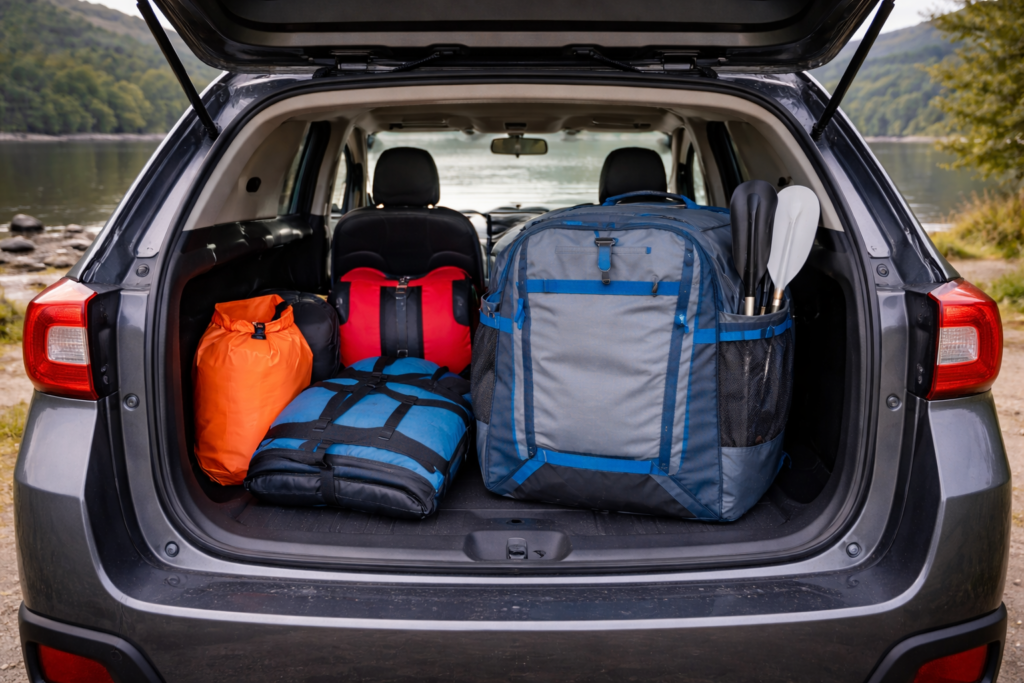
An inflatable goes in the boot. Or the back seat. Or the footwell if it’s a smaller kayak. Ours fits in the boot alongside everything else a family day generates — the dry bags, the buoyancy aids, the packed lunch, the midge repellent. We’ve never needed to reorganise the vehicle around the kayak or make a second trip to the car.
The transport advantage of an inflatable is most significant for families with standard hatchbacks or SUVs without roof bars. For families who already own a fitted roof rack system — perhaps because they ski or cycle regularly — the transport gap closes considerably.
Performance on the Water — Where Hard Kayaks Win Clearly
This is where the comparison gets honest and where inflatables have to accept a genuine disadvantage.
A hard kayak tracks better. The rigid hull holds its line in the water more efficiently, particularly in a crosswind or mild chop. On a long loch crossing or a river with any meaningful current, the difference in how much effort you spend correcting direction versus actually making progress is noticeable. A well-designed rigid kayak glides; a budget inflatable wanders.
A hard kayak is faster. The stiffer hull resists flexing during the power phase of each paddle stroke, transmitting more energy into forward movement. At the same paddling effort, a rigid kayak will be meaningfully quicker than a basic vinyl inflatable over any distance.
A hard kayak handles rougher conditions better. On open water with wind and chop, a rigid hull responds more predictably. The sides don’t flex. The tracking doesn’t deteriorate. For sea kayaking, river paddling with technical content, or open loch crossings in variable conditions, a hard kayak is the safer and more capable tool.
The performance gap is real but it’s also relative. On a flat calm Scottish loch on a still morning — which is the context for most family paddling sessions — the difference between a quality inflatable kayak for adults and a rigid kayak at the same price is smaller than the specifications suggest. Families paddling for enjoyment rather than speed or distance will cover the same water in either type and have a similar experience on calm days.
Where the performance gap matters most for families is when conditions change unexpectedly. Wind building across an open loch, current picking up on a river, a longer crossing than planned — these are the moments when a hard kayak’s performance advantage translates into meaningful safety margin rather than just convenience.
Stability — More Complicated Than It Sounds
Stability in a kayak splits into two types: primary stability and secondary stability. Primary stability is how stable the kayak feels sitting still on flat water. Secondary stability is how stable it feels as it tilts — whether it recovers from a lean or keeps going.
Many inflatable kayaks have excellent primary stability. They’re wide, flat-bottomed, and sit on the water rather than in it. For a child getting into a kayak for the first time on a calm lake, a wide inflatable feels very secure. It’s difficult to tip through normal movement and the consequences of a wobble are usually a paddle stroke away from correction.
Hard kayaks vary enormously in stability depending on design. A wide recreational hard kayak designed for beginners on flat water can match or exceed the primary stability of an inflatable — the rigid hull doesn’t flex when weight shifts, which adds a planted quality that some inflatables lack. A narrow touring or sea kayak has lower primary stability deliberately — it’s faster and more responsive but requires more confident paddling technique to feel comfortable.
For families with young children on flat water, a wide beginner inflatable kayak and a wide recreational hard kayak are both genuinely stable platforms. The inflatable has one practical advantage here: softer sides. A child falling sideways against the inflated tube of a kayak is less alarming than a child hitting the hard plastic side of a rigid hull, which matters during the learning phase when unexpected movements are part of every session.
Durability — The Long Game
This is where hard kayaks have a fundamental advantage that no inflatable fully closes.
A well-made polyethylene hard kayak will last twenty to thirty years with basic care. It can be dragged across rock and shingle, left in the sun, stored imperfectly, and knocked around without significant consequences. The material is inherently robust and repairs to polyethylene kayaks are straightforward for most damage.
Inflatable kayaks are vulnerable to punctures, UV degradation, and valve failure in ways that hard kayaks simply aren’t. A sharp rock at a launch point, a hidden branch just below the surface on a river, a careless foot — any of these can put a hole in an inflatable that a rigid kayak would shrug off completely. Modern puncture resistant inflatable kayaks use reinforced PVC and drop-stitch construction that significantly reduces puncture risk, but the material is inherently more fragile than polyethylene.
That said, the durability gap is smaller in practice than it sounds in theory. Most family paddlers on UK lakes and calm rivers will never puncture an inflatable through normal use. The scenarios that would damage a quality inflatable are also the scenarios that would damage a budget hard kayak. The risk is real but manageable with care, a repair kit in the bag, and sensible choice of launch points.
Inflatable kayaks also degrade if stored wet, exposed to prolonged UV without protection, or repeatedly inflated past their rated pressure. A rigid kayak left in a shed for two years comes out ready to use. An inflatable left stored incorrectly for two years might have UV-degraded PVC that fails on the first inflation. The care requirements are different and, in some respects, more demanding.
Cost — Entry Price vs Long-Term Value
The initial price comparison looks favourable to inflatables. A decent two person inflatable kayak UK with paddles and pump comes in between £150 and £400 depending on construction quality. A comparable rigid two-person recreational kayak — without paddles, without transport, requiring a roof rack purchase — starts significantly higher and can run to £800 or more before it’s in the water.
The long-term calculation is less straightforward. A rigid kayak bought once and cared for properly might last the entire span of the family’s paddling years. An inflatable at budget price might need replacing every three to five seasons depending on use and care. Across ten years, the total spend on inflatables can exceed the one-time cost of a quality hard kayak.
The cost of transport is also part of the equation. A roof rack and bars for a family car adds £200 to £500 to the cost of owning a rigid kayak, and some vehicles have limited or no mounting options. An inflatable has no transport cost beyond the petrol to get there.
The practical reality for most families is that an inflatable is the lower-risk initial investment. If the family paddles regularly for two or three seasons and wants to progress to more demanding water, upgrading to a hard kayak at that point makes sense and the initial inflatable spend confirmed the hobby rather than being wasted on it.
Family Specifics — Children’s Ages and What Actually Works
The right answer changes based on how old your children are and how they paddle.
Toddlers and under-fives don’t paddle independently. They sit in the kayak as passengers. For this stage, stability and softness matter more than performance. A wide inflatable with soft tube sides is the most forgiving option — they can move around, lean on the sides, and occasionally throw themselves at the hull without anyone getting hurt. A rigid kayak works at this stage too if it’s wide enough, but the hard sides are less forgiving.
Regardless of age, every child on the water needs a properly fitted buoyancy aid — getting the sizing right for children is worth doing before the first session rather than on the bank with the kayak already inflated and three impatient children watching.
Children aged five to ten are often starting to contribute to the paddling. A children’s kayak paddle is worth having so they can genuinely engage with the activity rather than just being passengers with a paddle as a prop. Inflatables work well here — wide, stable, forgiving — and a tandem inflatable with an adult paddling from the stern and a child at the bow is a practical family setup. A hard kayak tandem also works well but requires more confident water handling from the adult.
Children aged ten and above often want their own boat. This is where a rigid kayak for the older child starts to make sense — lighter junior hard kayaks track better than inflatables and a child developing genuine paddling technique benefits from a rigid hull’s responsive feedback. Some families at this stage run a combination: one or two inflatables for younger children with an adult, and a rigid kayak for the older child paddling independently. It’s a practical arrangement that matches kit to ability without leaving anyone out.
UK Conditions — What Scottish Water Specifically Adds to the Conversation
Scottish lochs, English lakes, calm rivers, coastal sea lochs — the context for UK family paddling is mostly flat to mild water with variable weather. Both kayak types work in these conditions but the conditions themselves add some specific considerations.
Lochs can generate significant chop quickly when wind builds across open water. What starts as a flat calm morning crossing can turn into a more demanding paddle back when the wind picks up in the afternoon, which it does reliably on the west coast. The temperature is cold enough that an unexpected capsize is a serious matter rather than an inconvenience — how cold UK open water actually gets month by month puts that risk in proper context for families planning their first sessions. Cold water shortens the time available to self-rescue significantly compared to what most people expect.
In those conditions, the performance advantage of a rigid kayak on challenging water is meaningful for safety as well as enjoyment. Families paddling regularly on open Scottish lochs in variable conditions would benefit from the additional stability and handling confidence of a hard kayak more than families doing sheltered lake and river sessions elsewhere.
For most family sessions on the kinds of water families actually paddle — sheltered bays, calm mornings, relatively short distances from shore — an inflatable performs well enough and the practical advantages of packing it in a bag outweigh the performance gap. The key is knowing the difference between the sessions where it doesn’t matter and the ones where it does.
A Few Things That Don’t Feature Enough in Most Comparisons
The weight of a hard kayak for a parent managing children alone. A two-person hard kayak can weigh 28–35kg. Loading and unloading that alone, while also managing children and kit, is physically demanding in a way that becomes a genuine barrier to going in the first place. Inflatables carry in a bag. The difference in effort is real and compounds across a whole season.
The noise difference. Paddling a rigid kayak on a still loch is a remarkably quiet experience — the hull cuts through the water with almost no sound. Many inflatables produce a slight slapping sound as the flexible hull moves through choppy water. Negligible for most families, but if the tranquillity of being on the water is part of what you’re seeking, it’s worth knowing.
The resale value. Quality hard kayaks from established brands hold value well on the secondhand market. A five-year-old rigid kayak in good condition typically sells for 60–70% of its original price. A five-year-old inflatable is worth very little regardless of brand. If you think you might eventually sell the kayak, a hard kayak is the better long-term asset.
The adventure range. Inflatables are genuinely portable in ways that hard kayaks aren’t. You can fly with them as checked luggage. You can take them on trains, in campervans, on boats as tenders. The ability to take a kayak somewhere remote by public transport or fit it in a hire car abroad is something a hard kayak simply can’t offer. For families who combine kayaking with travel rather than just paddling local water, that portability has genuine value that doesn’t appear on any spec sheet.
Which One Should You Choose?
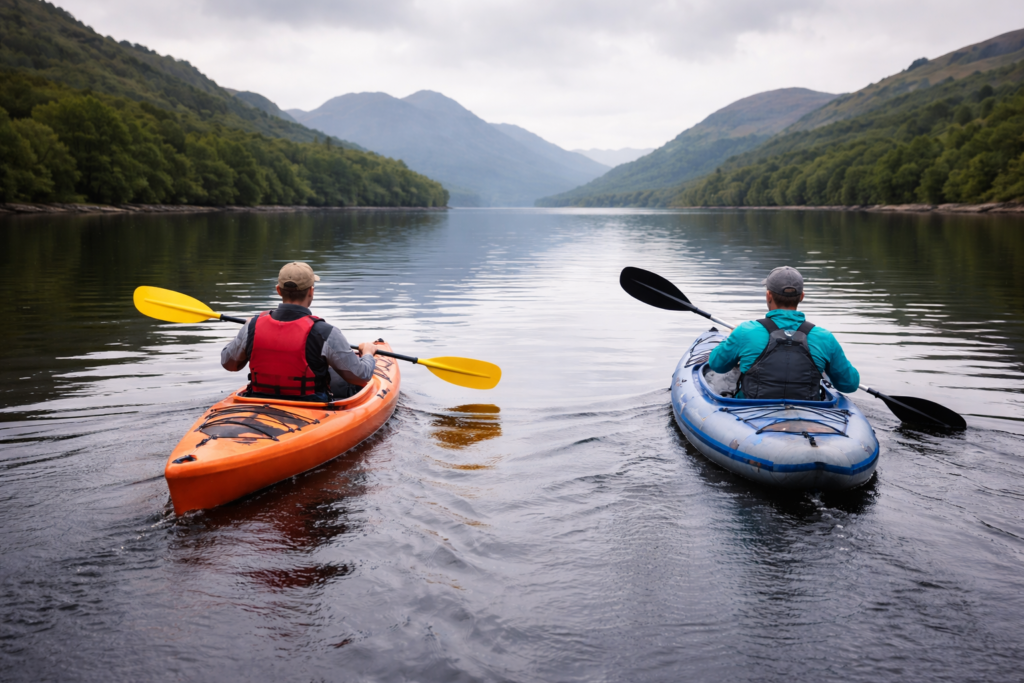
Choose an inflatable if you have limited storage, drive a standard family car without roof bars, paddle occasionally on calm sheltered water, have young children for whom stability and softness matters more than performance, or want to try kayaking properly before committing significant money to a hard kayak. The modern family inflatable kayak at mid-range price is a genuinely capable recreational boat on appropriate water — not a compromise, the right tool for the job.
Choose a hard kayak if you have storage sorted, already have or are willing to buy roof transport, paddle regularly enough to justify the investment, paddle on open or more demanding water, have older children developing real technique, or have already paddled inflatables and want the performance step up that only a rigid hull provides.
The honest answer for most UK families at the start of their paddling journey is inflatable first. The storage, transport, and cost advantages make the entry into the sport practical rather than logistically complicated. The performance limitations are real but they show up in conditions most families don’t paddle in regularly. Get on the water with an inflatable, find out how much the family uses it, and upgrade to a hard kayak if the use justifies it. That sequence loses nothing and avoids an expensive hard kayak sitting in a garage because the logistics of getting it to the water are too involved for a spontaneous Tuesday evening.
Before the first session on UK open water with children, the safety basics families need to know are worth reading — particularly around cold water, capsize recovery, and the conditions to avoid when you’re still finding your feet.
Related Guides
About The Author – Andrew Marshall
Andrew Marshall is the creator of Simple Days Outside and a UK parent of three who regularly camps, walks, and explores outdoor activities with his family. His guides focus on practical gear, realistic family adventures, and simple ways to help families enjoy the outdoors across the UK. The recommendations on this site are based on real-world use, research, and the kind of equipment families actually rely on for weekend trips and everyday outdoor fun.