

Written by Andrew Marshall
UK parent of three sharing practical advice to help families enjoy camping, walking, garden play, and simple outdoor adventures across the UK.
Creator of Simple Days Outside.
Last Updated: 8th April 2026
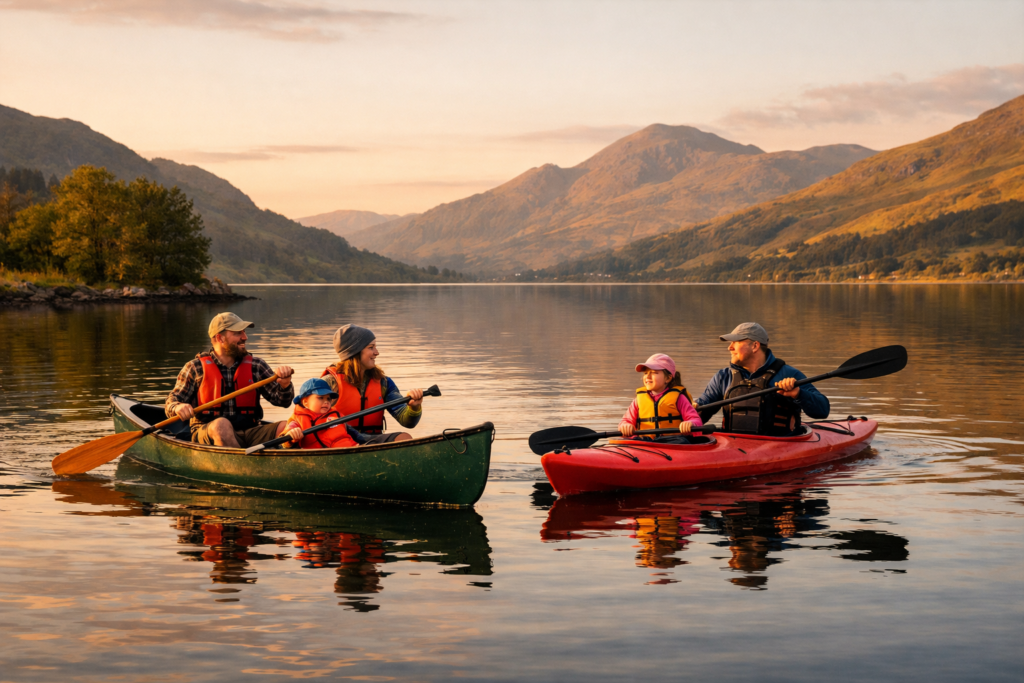
The first time someone asked me whether we kayaked or canoed, I genuinely wasn’t sure which one we were doing. We were on Loch Lomond, sitting low in the water in a two-person inflatable with a double-bladed paddle each, which I was fairly confident made it a kayak — but the couple next to us were in something wider with higher sides and single-bladed paddles, and I’d have called that a canoe without hesitating. We were doing roughly the same thing. Getting across the water. Arguing about whose turn it was to paddle harder.
The kayak vs canoe question sounds simple and then immediately isn’t. Most people have a vague sense that they’re different things but struggle to articulate exactly why, or which one is actually easier to learn, or which one makes more sense for a family with children of different ages. Both are excellent for beginners and families in the right circumstances — but they’re different tools, they suit different people differently, and the choice between them is worth making deliberately rather than randomly.
If you’re also weighing up whether a paddle board might suit your family better than either, the practical differences between paddle boarding and kayaking are worth understanding before committing to any category. Some families find the answer isn’t kayak or canoe at all.
The Actual Difference Between a Kayak and a Canoe
Start here because the confusion is genuinely common and it matters for everything that follows.
A kayak is a closed-deck or low-profile boat where the paddler sits inside the hull with legs extended in front. The paddle is double-bladed — one blade on each end of the shaft — and you alternate sides with each stroke, dipping left then right in a continuous rhythm. Most kayaks sit low in the water, which gives good stability in chop and reduces wind resistance, but also means you’re relatively enclosed and close to the waterline.
A canoe is an open-topped boat where the paddler — or paddlers — sit on seats or kneel on the hull floor. The paddle is single-bladed with a T-grip handle at the top, and you switch sides periodically or use specific corrective strokes to maintain direction. Canoes sit higher in the water, have significantly more interior space, and have open sides that make getting in and out considerably easier.
The key practical differences in plain terms: kayaks are lower, more enclosed, and faster in most conditions. Canoes are more open, more spacious, and easier to load with kit and children. Both can be inflatable or rigid. Both are suitable for beginners on calm water. The choice is largely about what you’re prioritising.
Which Is Easier to Learn?
This is the question most beginners ask first and the honest answer is that neither is inherently easier. They’re different kinds of easy and different kinds of difficult.
Getting Started on Flat Water
On a flat calm lake or loch with no current or wind, a beginner in a wide stable kayak and a beginner in a wide stable canoe will have a broadly similar first experience. Both will make progress on the water within the first few minutes, both will struggle initially with going in a straight line, and both will end the first session having enjoyed it without it feeling technically overwhelming.
The beginner kayak paddle technique is arguably simpler to pick up quickly. The double blade means you’re always doing something on alternating sides, which creates a natural forward momentum and rhythm that most beginners find intuitive within the first fifteen minutes. Plant the blade, pull through, switch sides, repeat. The basic forward stroke doesn’t require much thought once the rhythm settles.
The beginner canoe paddle technique requires more active steering from the start. A single blade on one side of the boat naturally wants to push the bow in the opposite direction — paddle on the right and the boat turns left. Correcting for this is what most beginners find initially frustrating about canoeing. The J-stroke — a corrective paddle motion at the end of each forward stroke — takes time to learn and until you have it, you’ll be switching sides frequently to compensate, which is tiring and inefficient. It clicks eventually, and once it does, paddling a canoe feels natural and almost effortless. The learning curve is just slightly steeper at the very start.
Going in a Straight Line
This is where beginners most often struggle regardless of which craft they’re in, and both present the challenge differently.
A kayak with a fitted skeg or rudder tracks well even for complete beginners — the skeg helps the boat hold its line passively without requiring corrective technique. Without a skeg, a kayak requires regular side-switching or draw strokes to maintain direction, which is manageable on flat water but can become frustrating in any kind of wind.
A canoe without good paddling technique wanders. On a loch with a crosswind, a beginner solo is working hard just to go where they’re pointing. Two paddlers in a tandem canoe — one at the bow, one at the stern — can share the steering load considerably, which makes the tracking challenge much more manageable. This is one of the reasons tandem canoeing is recommended for beginners before attempting it solo.
For absolute beginners wanting the fastest route to going in a reasonably straight line with minimal technique, a two person inflatable kayak with a fitted skeg is probably the most forgiving starting point. Two people paddling alternating sides with a skeg helping directional stability produces acceptable tracking with almost no technique required and a decent experience almost immediately.
Getting In and Out
This is where canoes win clearly and where it matters most for families with young or nervous children.
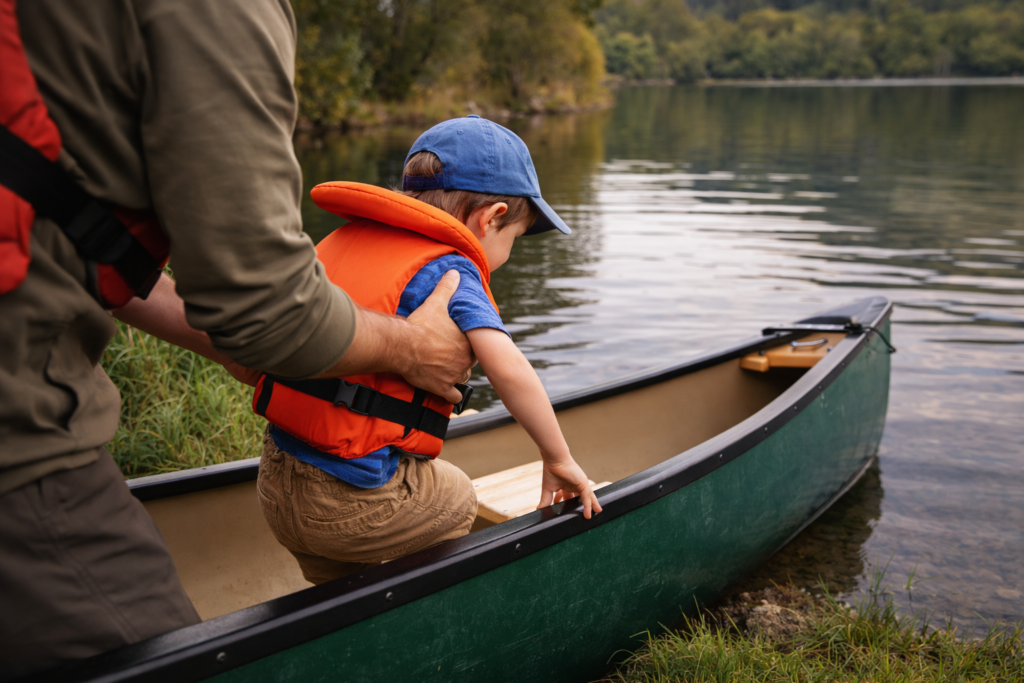
Stepping into a canoe is broadly similar to stepping into a rowing boat — you hold the sides, step in from the bank or a dock, and settle onto the seat. The open sides and higher freeboard make the process straightforward even for people with limited mobility, older family members, or children who move in sudden unexpected bursts.
Getting into a sit-inside kayak requires more care. You lower yourself into the cockpit, legs first, keeping your weight central — if you step onto the side of the kayak rather than the centreline you risk tipping it immediately. For a nervous beginner or a young child this entry can feel precarious at first and occasionally produces a capsize before the session has properly started. Sit-on-top kayaks are considerably easier to board than sit-inside designs and are worth considering specifically for this reason when young children are involved.
Which Is Better for Families With Children?
This is where the comparison gets more specific and the practical differences become genuinely meaningful.
Space and What You Can Carry
Canoes win this comfortably. A standard two or three-person canoe has significantly more interior space than a comparable kayak. You can carry more gear — dry bags, packed lunch, extra clothing, all the things a family day on the water generates — without the boat feeling loaded. A child can shift position inside a canoe without immediately threatening to capsize it. There’s room for a dog. There’s room for the things you forgot you needed when you were loading the car.
A kayak’s enclosed design prioritises efficiency and weather protection over interior space. A tandem kayak has two defined cockpits and not much else. Gear goes in hatches at the bow and stern — accessible, but not immediately. For a short recreational paddle on a calm loch this is fine. For a longer family day where kit access matters throughout, the canoe’s open design is a practical advantage that adds up across the session.
Young Children as Passengers
A canoe is significantly easier for carrying a young child who isn’t paddling. The child sits or kneels in the middle of the boat, there’s room around them, the sides are high enough to feel containing without being completely enclosed, and an adult paddling from the stern has a clear sightline to them throughout the session. The experience for the child is more like sitting in a boat — open, visible, able to look around freely — and younger children who don’t want to sit still in a cramped cockpit generally cope much better with the canoe arrangement.
Getting a young child into a sit-inside kayak cockpit is possible but awkward, and movement is more restricted once they’re in. For families with children under six or seven, a canoe or a wide inflatable family canoe tends to be a more comfortable arrangement for everyone involved.
Before any child gets in either craft, making sure their buoyancy aid fits correctly is the first thing to sort — a buoyancy aid that rides up over the chin in the water is as good as no buoyancy aid at all, and getting the sizing right before the session rather than on the bank with an inflated boat waiting makes the whole start of the day calmer.
Older Children Paddling Independently
As children get older and want their own paddle rather than just riding along, the dynamics shift. A child of eight or nine can sit at the bow of a tandem kayak or canoe and contribute meaningfully to the paddling. By ten or eleven, many children are ready for their own boat — and at this point both kayaks and canoes are viable options depending on the child.
A single kayak for an older child has the advantage of self-containment — they’re in their own craft, making their own progress, with the double blade intuitive enough that most children pick it up quickly. A child in a junior canoe solo has more challenge — the single blade technique and tracking management is harder to master alone, and solo canoeing genuinely requires more skill than a tandem arrangement.
For independent paddling in the eight to twelve age range, a junior kayak is usually the more practical starting point than a solo canoe. The double blade removes the steering complexity until technique develops naturally.
Stability — What It Actually Feels Like
Both kayaks and canoes can be stable. Both can be unstable. The design of the specific boat matters more than the category it belongs to.
A wide, flat-bottomed canoe on flat water is one of the most stable paddling platforms you can be on. The high freeboard, wide beam, and open design all contribute to a feeling of security that many beginners find immediately reassuring. You can shift your weight around, lean over the side to trail a hand in the water, or turn to talk to someone behind you without the boat responding dramatically.
A wide recreational kayak on flat water is similarly stable but in a different way. You’re lower in the water, which means your centre of gravity is lower, which makes the boat more stable under dynamic conditions. On a loch with some chop, a kayak’s lower profile makes it less affected by wave action than a higher-sided canoe in the same conditions.
The stability concern for most beginners is capsizing. Both kayaks and canoes capsize in similar circumstances — sudden weight shifts, being side-on to waves, getting the boat loaded too heavily on one side. Canoes capsize more visibly and feel more dramatic because of their open design — when a canoe goes over, everything that isn’t secured goes with it. A capsized canoe takes on water quickly and is genuinely harder to right and re-enter without training.
A kayak capsize is somewhat easier to manage in trained hands — the enclosed cockpit traps air initially and a kayak with bulkheads will float even when swamped. Self-rescue through a wet exit and re-entry is a teachable skill. However, a beginner in a kayak cockpit who capsizes and finds themselves underwater needing to exit will require calm and practice to manage well. Neither capsize scenario is pleasant without preparation.
For family beginners specifically, a wide inflatable in either kayak or canoe style is the most capsize-resistant starting point. The wide flat hull and buoyant chambers make tipping them genuinely difficult in normal flat water conditions.
Wind and Weather — How Each Handles UK Conditions
This matters considerably for UK paddling and particularly for Scottish water, where the weather has a way of not doing what the morning suggested it would.
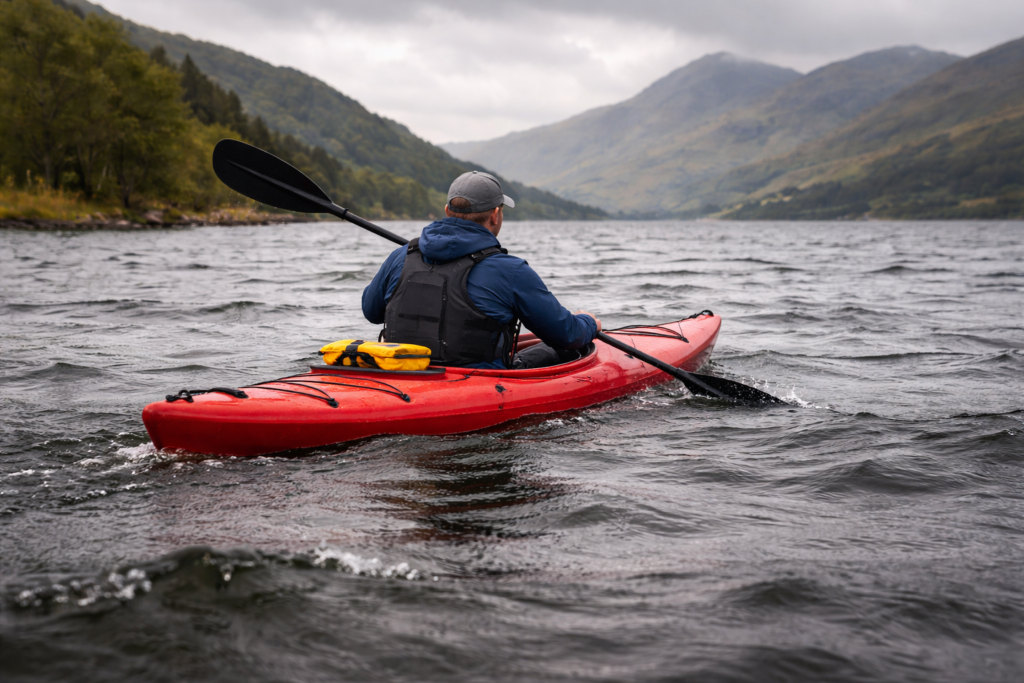
Canoes are more affected by wind than kayaks. The high sides and open interior catch the wind like a sail. On a calm morning on a sheltered loch or a protected river stretch, a canoe handles beautifully and the open design feels like a genuine pleasure. On an exposed loch when the afternoon wind builds across open water — which on the west coast of Scotland it does regularly and sometimes without much warning — a canoe becomes harder to control and exhausting to paddle against. The bow gets pushed around and you spend energy fighting direction rather than making progress toward where you actually want to be.
Kayaks sit lower and present less surface area to the wind. They’re more manageable in a crosswind, more comfortable in light chop, and generally more suited to the variable conditions that UK open water regularly produces. For paddling on exposed Scottish lochs or coastal water where weather changes are part of the experience rather than the exception, a kayak’s lower profile is a practical advantage that goes beyond speed.
Knowing what makes a specific stretch of open water safe for families is worth doing before choosing your location — not all UK water is equally suitable for beginners in either craft, and the conditions that are manageable for experienced paddlers can be genuinely difficult for a family on their first or second outing.
This doesn’t mean canoes can’t handle UK conditions — they can, and plenty of experienced paddlers use them year-round. It means choosing the right water for the conditions. A sheltered river, a woodland loch with natural wind protection, a calm morning before the wind builds — these are the right contexts for a canoe with beginners. An exposed crossing on open water with afternoon wind developing is the right context for a kayak.
Inflatable Options — How They Change the Comparison
Both kayaks and canoes now exist in quality inflatable versions and this changes the practical comparison significantly for families.
An inflatable canoe UK packs into a bag, fits in a car boot, and removes the storage and transport barriers that put many families off rigid canoes entirely. The performance of a quality inflatable canoe on flat water is genuinely close to a rigid entry-level canoe. The space advantage of the canoe format is preserved in inflatable form. For families who want the canoe experience without the logistics of a rigid boat, an inflatable canoe is a real and practical option rather than a compromise.
Similarly, inflatable kayaks have become genuinely capable on calm water, particularly in the drop-stitch format. The performance difference between an inflatable kayak and a rigid kayak is more noticeable than between an inflatable canoe and a rigid canoe — largely because kayak performance relies more heavily on hull rigidity for tracking and speed — but for recreational family use on flat water it’s a difference that rarely matters in practice.
The inflatable advantage applies equally to both categories: storage, transport, and the spontaneity of being able to decide to go on a Tuesday evening without it becoming a logistical operation. If logistics are a barrier to getting on the water regularly, an inflatable version of whichever craft suits your family removes that barrier without significantly compromising the experience on appropriate water.
If inflatable is the right format for your family’s situation, the best inflatable kayaks for UK family paddling covers the specific models worth buying across different budgets and family sizes.
Which Is More Sociable?
This question almost never appears in kayak vs canoe comparisons and it probably should, because for a family day on the water it matters more than tracking efficiency.
Canoeing is inherently more sociable than kayaking. In a canoe, paddlers face the same direction but can easily turn and talk. A child in the middle of a canoe is in the group rather than enclosed in their own cockpit. The open design means conversation, eye contact, and shared experience are easy throughout the session. On a family day on the water, a canoe often feels more like doing something together rather than doing something alongside each other.
In a tandem kayak, the paddler at the bow and the paddler at the stern are physically separated by the length of the boat. Conversation requires raising your voice or turning around, which is awkward while paddling. If you’re with a child who is likely to want to talk throughout — which most children are, constantly, about everything — the canoe’s sociability is a practical advantage rather than just an atmospheric one. The session feels more connected.
For family days where the experience of being on the water together matters as much as the paddling itself, canoeing often produces a warmer, more engaged day.
Portaging — Carrying Between Water
Portaging means carrying your boat overland between water access points — over a weir, across a section of bank, between two connected lochs. It doesn’t come up on every family session but when it does the differences between kayaks and canoes matter.
A rigid canoe is traditionally carried overland by a single paddler using a yoke — a padded crossbar that rests on the shoulders allowing the canoe to be carried upturned overhead. This takes practice and reasonable strength but allows a solo portage of even a large canoe. A rigid kayak is typically dragged or carried between two people, awkward for one person to manage alone over any real distance.
Inflatable versions of both solve the portage problem entirely — deflate, roll, carry in a bag. For families exploring Scottish lochs and rivers where occasional portaging is part of the day, an inflatable in either category is the most practical choice.
Cost Comparison
At entry level, both kayaks and canoes span a similar price range. A budget inflatable kayak or canoe starts under £200. A quality mid-range inflatable in either format runs £300 to £500. Rigid kayaks and canoes start around £400 for basic recreational models and run considerably higher for touring or sea-going designs.
The accessories diverge slightly. Canoe paddles are generally cheaper than kayak paddles at equivalent quality because they’re simpler — one blade, shorter shaft, less engineering. A family needing four canoe paddles spends less than a family needing four double-bladed kayak paddles at the same quality level. Not a dramatic difference but worth factoring in when the kit list adds up.
Transport costs are similar for both rigid formats — roof rack and straps required, which adds £200 to £500 to the true cost of owning a rigid boat. Inflatable formats of both share the zero-transport-cost advantage.
The Honest Recommendation
For most UK families starting from zero with children of mixed ages — some young enough to be passengers, some old enough to want to paddle — a tandem inflatable kayak is the most practical starting point. It’s lower maintenance on tracking, handles UK wind conditions better, packs and transports without a second vehicle or a roof rack, and is less demanding for a beginner paddler to make immediate progress without technique.
If you have a family where everyone is old enough to actively participate, where a longer day with more kit is the goal, and where the session is on a sheltered river or protected loch — a canoe, inflatable or rigid, produces a more spacious, more sociable, and often more genuinely enjoyable day. The paddle technique learning curve is real but short, and the payoff is a boat that fits everyone more comfortably and carries more of what you actually need for a family day out.
A useful way to frame the decision: if getting on the water quickly with minimum fuss is the priority, choose a kayak. If being on the water comfortably together for a longer, more exploratory time is the priority, choose a canoe.
Many families end up with both. A family kayak set for active paddling days and a canoe for longer, slower, more exploratory sessions covers almost every scenario a UK family paddling life produces — and the inflatable versions of both mean neither requires a dedicated storage space or a vehicle with roof bars.
A Few Things Worth Knowing Before You Decide
Try before you buy. Scottish outdoor centres and watersports hire companies across the UK offer both kayaks and canoes for a half day or full day. Trying both before buying gives you information no article can replicate — how each feels underfoot, how quickly your arms tire, whether the cockpit entry bothers you, whether the open canoe design feels reassuring or exposed. One hire session is worth more than a week of research.
The paddle matters as much as the boat. A good paddle in a mediocre boat produces a better experience than a mediocre paddle in a good boat. Budget appropriately for the paddle rather than spending everything on the hull and accepting whatever comes in the kit. This is one of the most consistent pieces of advice from experienced paddlers and one of the most consistently ignored by first-time buyers.
Lessons are worth considering. A two-hour introductory session with a qualified instructor — available through British Canoeing affiliated clubs across the UK — will teach a beginner more about either craft than a full season of self-taught sessions. The British Canoeing One Star Award covers the fundamentals for both and is worth pursuing if the family plans to paddle regularly rather than occasionally.
The terms are used interchangeably and it doesn’t really matter. In the UK, many people say kayaking when they mean canoeing and vice versa. Canoe clubs often paddle kayaks. Kayaking centres teach canoe strokes. The distinction matters when choosing equipment. On the water, nobody cares which word you use.
Related Guides
About The Author – Andrew Marshall
Andrew Marshall is the creator of Simple Days Outside and a UK parent of three who regularly camps, walks, and explores outdoor activities with his family. His guides focus on practical gear, realistic family adventures, and simple ways to help families enjoy the outdoors across the UK. The recommendations on this site are based on real-world use, research, and the kind of equipment families actually rely on for weekend trips and everyday outdoor fun.