

Written by Andrew Marshall
UK parent of three sharing practical advice to help families enjoy camping, walking, garden play, and simple outdoor adventures across the UK.
Creator of Simple Days Outside.
Last Updated: 24th March 2026
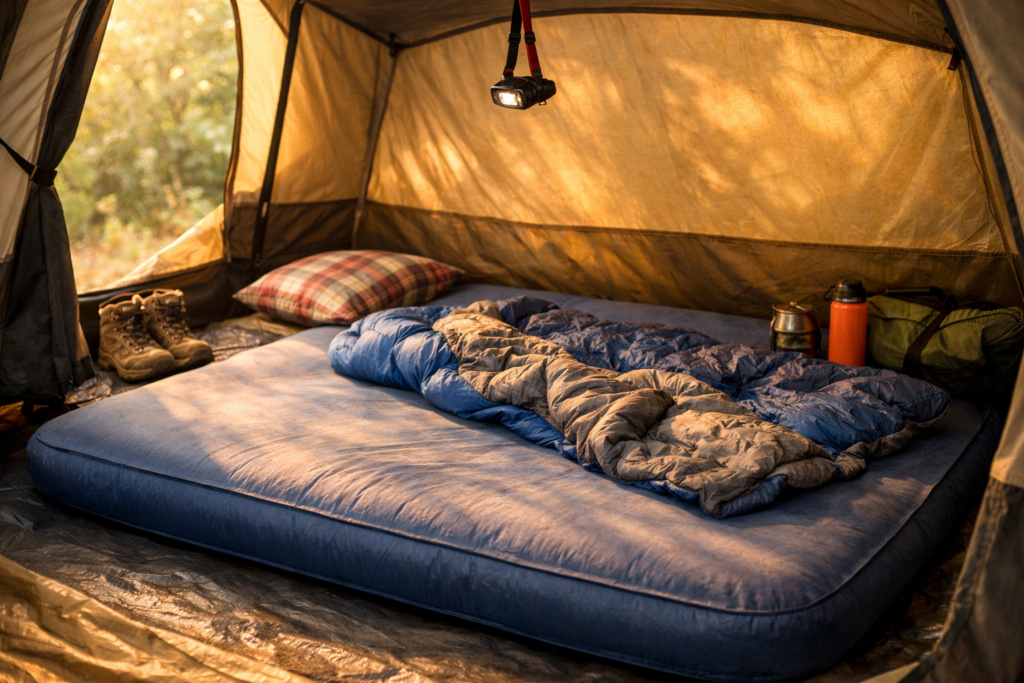
The single biggest upgrade most families make to their camping setup — the one that changes everything — isn’t the tent. It’s the mattress. A decent family tent with a bad sleeping surface produces miserable nights. A decent family tent with a proper double mattress underneath produces the kind of camping trips people actually want to repeat.
We spent two seasons on a basic double airbed before upgrading — the kind that costs £30, inflates in three minutes, and leaves you lying on the ground by 3am because it’s slowly leaked all night. The upgrade wasn’t incremental. It was the difference between waking up stiff, cold, and quietly counting the hours until we could pack up — and actually sleeping. If you’re still on a cheap inflatable or a pair of thin roll mats pushed together, this is the article that changes that. The Family Camping & Short Trips section of the site covers the rest of the sleep system and everything beyond it.
What You’re Actually Choosing Between
Not all double camping mattresses are the same type of product and the difference matters more than brand or price.
Self-inflating mats contain foam that expands when you open the valve — the foam draws air in and the mat partially inflates on its own. You top up with a few breaths or a pump to reach your preferred firmness. The foam provides insulation from the ground even if some air escapes overnight, which makes these significantly warmer than pure air mattresses and far safer against slow punctures. This is the format most serious campers use and most of the options on this list fall into this category.
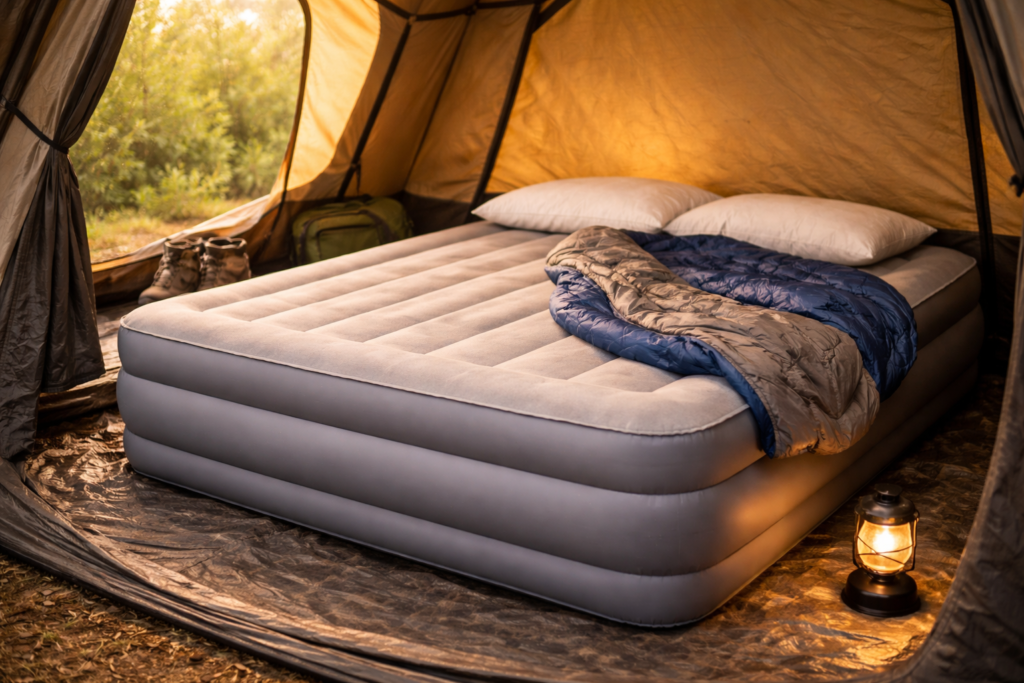
Pure air mattresses contain no foam — they’re inflated entirely with a pump and rely on that air for both comfort and insulation. They’re typically thicker off the ground, cheaper at the entry level, and feel more like a bed at home. The trade-off is that they’re colder in contact with the ground, and a slow leak means waking up on the floor. For short summer trips in large tents where ground temperature isn’t a major concern, they work well. For regular UK camping across spring and autumn, self-inflating is the more reliable choice.
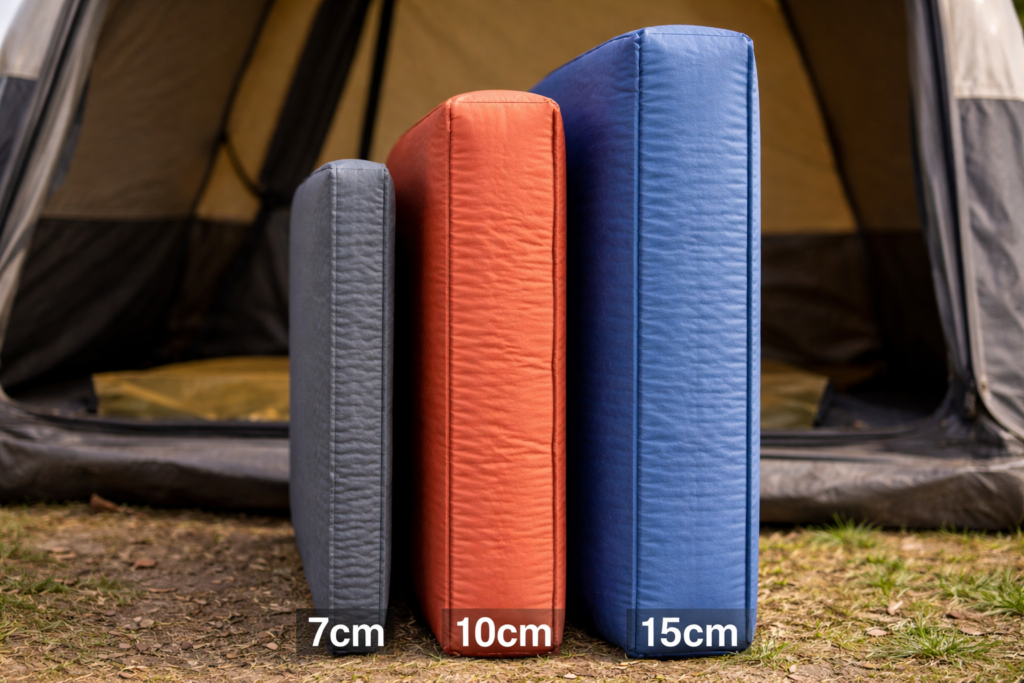
Thickness matters too. Seven to eight centimetres gets you off the ground and comfortable for most adults. Ten centimetres is the sweet spot for couples wanting genuine comfort over multiple nights. Fifteen centimetres and above approaches hotel mattress territory and suits anyone with back issues or who genuinely struggles on a firmer surface.
A double camping mattress in the 130–136cm width range gives two adults enough space without the roll-toward-the-middle problem that narrower options produce — though how much floor space you actually have depends entirely on the tent. If you’re not sure whether your tent is big enough to accommodate a double mat comfortably, working out what size tent a family actually needs is worth doing before you order anything.
The Five Best Double Camping Mattresses for UK Families
Vango Shangri-La II 10 Double — The Premium Self-Inflating Pick
Best for: couples and families who camp regularly and want the closest thing to sleeping at home
If you’re going to buy one double camping mattress and keep it for ten years, the Shangri-La II is the one. Vango’s flagship double self-inflating mat has built a reputation in UK camping that’s difficult to argue with — consistently top-rated, consistently recommended, and consistently the answer when someone asks what to buy if budget allows.
The 10cm thickness uses Vango’s core-cutting construction — foam with material selectively removed to reduce weight and pack size without sacrificing comfort. The vertical sidewalls are what make it genuinely different from cheaper alternatives: rather than a mat that tapers at the edges, the Shangri-La maintains full thickness across the entire sleeping surface. Every centimetre of the top is usable. No roll-off edges. No cold spots where the foam thins out. No uncomfortable ridge down the middle that cheaper doubles sometimes produce between two sleepers.
The Cyclone valve inflates and deflates quickly — open it, come back fifteen minutes later, top up with a few breaths, done. The TPU lamination is more durable and environmentally friendlier than traditional PVC, and the stretch fabric top feels noticeably warmer against skin than a standard polyester surface.
We’ve used ours on trips from May through to October in Scotland and it’s never produced a cold night from below — which on a damp September site in Argyll, with overnight temperatures dropping lower than the forecast suggested, is exactly the reassurance you want from something you’re relying on every night of a trip.
One honest caveat: the pack size when rolled is substantial. It fits in a car boot without drama but it won’t squeeze into a crowded roof box or anywhere space is genuinely tight. This is emphatically a car camping mattress.
Outdoor Revolution Camp Star 15cm Double — Best for Comfort Seekers and Bad Backs
Best for: anyone who prioritises maximum comfort, has back issues, or wants the thickest self-inflating option at a strong price
Fifteen centimetres of self-inflating memory foam is a serious amount of cushioning for a camping mattress — and the Camp Star delivers it at a price point significantly below what you’d expect for this specification. The memory foam core adjusts to body shape in a way standard foam doesn’t, which makes a noticeable difference for side sleepers or anyone who finds thinner mats uncomfortable regardless of the surface they’re on.
The reversible peach polyester fabric is softer than standard camping mat materials — both sides are usable, which means it wears more evenly over time and you can flip it if one side picks up more wear. The two Cyclone valves positioned at the base inflate and deflate the mattress efficiently without the fiddly single-valve process that makes thicker mats frustrating to pack away.
At 201 x 132cm when fully inflated there’s genuine room for two adults without the hammock effect where both people roll toward the middle. The 15cm thickness does mean a larger pack size than the 10cm options — this is the biggest of the self-inflating options on this list when rolled — but for families with boot space, that’s a reasonable trade.
A friend with chronic back pain switched to the Camp Star after two seasons struggling with a 7.5cm mat on a Scottish island camping trip — she’d been managing with ibuprofen every morning by day three. She used the Camp Star for the first time on a week-long trip to Islay last summer and messaged specifically to say she’d finally woken up comfortable. That’s the kind of outcome that earns a product a permanent spot on any list.
Quechua Ultim Comfort Double — Best Value Premium Double
Best for: families wanting a genuine step up from basic airbeds without paying Vango prices, and couples who camp frequently through summer into autumn
Decathlon’s flagship double camping mattress has been T3’s recommended camping bed for good reason — it delivers genuine comfort at a price that makes it accessible without feeling like a compromise. The 200 x 136cm sleeping surface is among the widest on this list, the air and foam hybrid construction provides both cushioning and ground insulation, and the setup is genuinely straightforward.
At 8cm thick it sits between budget options and the premium self-inflating mats above — and it punches above its weight in both comfort and ground insulation. The foam component means that even if air pressure drops slightly overnight — which can happen on cooler nights as temperature affects air volume — you’re not sleeping on a deflated sheet of plastic.
We took the Quechua double on a trip to a Loch Lomond site last summer where three nights of mild Scottish rain produced tent condensation every morning. Everything in the tent picked up some dampness by day two. The Ultim Comfort held its warmth throughout — which for a mattress at this price point is exactly what you need it to do when the conditions aren’t cooperating.
Worth knowing upfront: it’s available exclusively from Decathlon rather than Amazon. The link below goes directly to the product page — delivery is straightforward but worth knowing if you need it quickly or strongly prefer Amazon.
Vango Odyssey Double — Best Mid-Range Self-Inflating Option
Best for: families wanting Vango build quality at a more accessible price than the Shangri-La
The Odyssey is Vango’s Amazon-exclusive double mat — same brand ethos and construction standards as the Shangri-La but pitched at a lower price point with a slightly different foam profile. At 10cm it matches the Shangri-La’s thickness and the self-inflating mechanism works in the same way — open the valve, let it expand, top up to preference.
What you’re trading compared to the Shangri-La is the core-cutting construction and the vertical wall design. The Odyssey uses a more conventional foam core which produces a sleeping surface that’s very comfortable but doesn’t have quite the flat, even feel across the full width that the Shangri-La’s vertical walls achieve. In direct comparison the difference is clear. Used on its own without that comparison, the Odyssey is a genuinely comfortable mat that significantly outperforms anything at a lower price from less established brands.
My honest answer if someone asked whether to buy the Odyssey or stretch to the Shangri-La: if you camp two or three weekends a year, the Odyssey is plenty. If you camp ten or more nights a season, the Shangri-La pays back the extra cost in comfort over time. The Odyssey is the right first proper double mat — and for many families it’ll be the last one they need to buy.
OlarHike Double Inflatable Air Mattress — Best for Large Tents and Extended Trips
Best for: families with a large tent who want maximum height off the ground for week-long or longer trips, and couples who want the closest experience to sleeping in a normal bed
This is a different kind of product from the four self-inflating mats above — worth understanding clearly before buying. The OlarHike is a pure air mattress with no foam core, inflated entirely via its built-in electric air pump in around three to four minutes. At 46cm high when fully inflated — nearly half a metre off the ground — it’s closer to sleeping in a normal bed than any other option on this list.
For a family with a large tunnel or inflatable tent where the mattress stays in one place for a week rather than being packed and unpacked daily, this is genuinely appealing. The height makes getting in and out significantly easier, which is welcome early in the morning or for anyone with mobility considerations. The built-in pump means no separate equipment — plug in, inflate, done.
The honest caveats are worth stating clearly. Unlike the self-inflating mats above, the OlarHike provides no foam insulation from the ground — the air inside the mattress can make it feel significantly cooler than a foam-core mat, particularly on spring and autumn nights. A camping mattress topper or an extra layer underneath addresses both warmth and firmness. Some reviewers report needing to top up air after a few days as the PVC material stretches during initial use — this is normal for air mattresses and the manufacturer acknowledges it. For a week-long trip, factor in a thirty-second top-up each morning as part of the routine rather than treating it as a problem.
For summer camping in a large tent where you’re staying put and want to feel like you haven’t entirely left home, this is the pick.
Five Questions Worth Answering Before You Buy
How long are your trips? For weekend camping and short breaks, any of the self-inflating mats work well. For trips of a week or more, the higher-quality foam construction of the Shangri-La or Camp Star holds up better over consecutive nights. We’ve done five-night trips on the Shangri-La without the mat losing any noticeable firmness — the same wouldn’t be true of a budget alternative at the same price as the Odyssey.
What size tent are you sleeping in? A 200 x 136cm double mattress needs at least that much clear floor space in the sleeping compartment. Most 6-man family tents accommodate a double mat comfortably. Smaller 4-man tents can be tight — we once bought a mat before measuring the tent pod and spent an uncomfortable ten minutes trying to make it fit. Measure first. If you’re also in the market for a new tent alongside a new mattress, the family tents worth considering for weekend camping covers the options that give you enough sleeping compartment space for a proper double mat without going unnecessarily large.
Do you camp in spring and autumn as well as summer? If yes, prioritise a self-inflating mat with a foam core. Ground cold conducts through pure air mattresses significantly more than through foam-core options, particularly on October mornings in Scotland where the ground temperature drops overnight in a way that catches people out.
Are you a side sleeper? Side sleepers benefit most from the 15cm Camp Star — the memory foam conforms to the hip and shoulder in a way that firmer or thinner surfaces don’t. My partner is a side sleeper who consistently found camping mats uncomfortable until we upgraded to a thicker option. Worth paying the extra for if this sounds familiar.
Is pack size a constraint? All the self-inflating options here are substantial when rolled. If boot space is tight with five people’s kit, the Vango Odyssey packs slightly smaller than the Shangri-La and Camp Star. The OlarHike deflates flat and folds into a bag — a different kind of pack size challenge but a manageable one.
What We’d Actually Recommend
For most UK families camping in the three-season window — and particularly for anyone camping in Scotland where ground cold matters year-round — the Vango Shangri-La II 10 Double is the right answer. It’s the one we use, it’s the one that’s consistently recommended by everyone who buys it, and its pack size and boot space requirements are manageable for all but the most loaded family car.
If the Shangri-La price is a stretch, the Quechua Ultim Comfort Double from Decathlon delivers a genuinely premium experience at a lower price — worth the Decathlon trip or a delivery order.
The Outdoor Revolution Camp Star 15cm is the pick for anyone with back issues or who genuinely can’t get comfortable on a firmer surface. The extra 5cm of memory foam changes things for those people in a way that’s hard to overstate.
The Vango Odyssey sits in the honest mid-range — better than anything at a lower price, not quite the Shangri-La, the right answer for families who camp a few weekends a year and want something genuinely good without the premium price. If you’re still building your full camping kit list and want to make sure the mattress choice fits alongside everything else, the full family camping kit list is useful for checking nothing important has been missed.
The OlarHike is for the specific situation — large tent, long trip, preference for height off the ground above all other considerations. Go in knowing the limitations and it delivers exactly what it promises.
FAQ
Are self-inflating mats better than air mattresses for camping?
For UK three-season camping yes — particularly in spring and autumn. The foam core insulates from ground cold in a way a pure air mattress doesn’t, and they’re significantly more puncture-resistant. Air mattresses are fine for summer camping in settled conditions but less reliable on cold nights or over extended trips.
How do I stop a self-inflating mat going soft overnight?
Self-inflating mats don’t go flat the way air mattresses can — the foam retains structure even if some air pressure drops. If a mat is noticeably softer by morning, check the valve is fully closed after topping up. New mats sometimes need several inflation cycles before the foam fully expands — this is normal and improves within the first few uses.
Do I need a separate pump for a self-inflating mat?
No — they self-inflate when you open the valve, requiring only a few extra breaths to reach full firmness. A camping pump speeds up the top-off process significantly for thicker mats like the 15cm Camp Star where the additional air volume takes longer to add manually.
Is a double camping mat warm enough for UK autumn camping?
A self-inflating mat with a decent foam core handles three-season UK camping comfortably. The Vango Shangri-La and Outdoor Revolution Camp Star both provide sufficient ground insulation for October camping. A sleeping bag liner and correctly rated sleeping bag complete the system — if you’re unsure which sleeping bag suits which family member, the full breakdown of sleeping bag options for UK camping covers three-season options across adults and children in one place.
Can two people sleep comfortably on a double camping mat?
Yes — the 130–136cm width of most double mats gives two average adults enough space without the roll-toward-the-middle problem. Couples who move around significantly in their sleep may prefer the Shangri-La’s vertical wall construction which creates a more defined sleeping surface per person. A camping mat repair kit is worth keeping in the boot regardless of which mat you choose — punctures are rare on quality self-inflating mats but worth being prepared for on longer trips.
What’s the best way to store a self-inflating camping mat?
Store loosely rolled with the valve open — never tightly compressed for long periods as this reduces the foam’s ability to self-inflate over time. A mattress storage bag protects it between seasons. Keep it away from sharp objects and store in a cool dry place rather than a damp shed or garage.
Related Guides
How to Stay Warm Camping in the UK — covers ground cold, layering, and the full sleep system in detail, useful alongside any mattress purchase for making sure the warmth picture is complete.
Top 5 Best Camping Beds for Kids — covers what children sleep on alongside the adult double mattress, useful for families running a mixed sleeping arrangement across ages.
Best 6-Man Tents for Families — useful for anyone considering the OlarHike specifically, or any family thinking about the relationship between tent size and mattress size before buying either.
About The Author – Andrew Marshall
Andrew Marshall is the creator of Simple Days Outside and a UK parent of three who regularly camps, walks, and explores outdoor activities with his family. His guides focus on practical gear, realistic family adventures, and simple ways to help families enjoy the outdoors across the UK. The recommendations on this site are based on real-world use, research, and the kind of equipment families actually rely on for weekend trips and everyday outdoor fun.