

Written by Andrew Marshall
UK parent of three sharing practical advice to help families enjoy camping, walking, garden play, and simple outdoor adventures across the UK.
Creator of Simple Days Outside.
Last Updated: April 2026
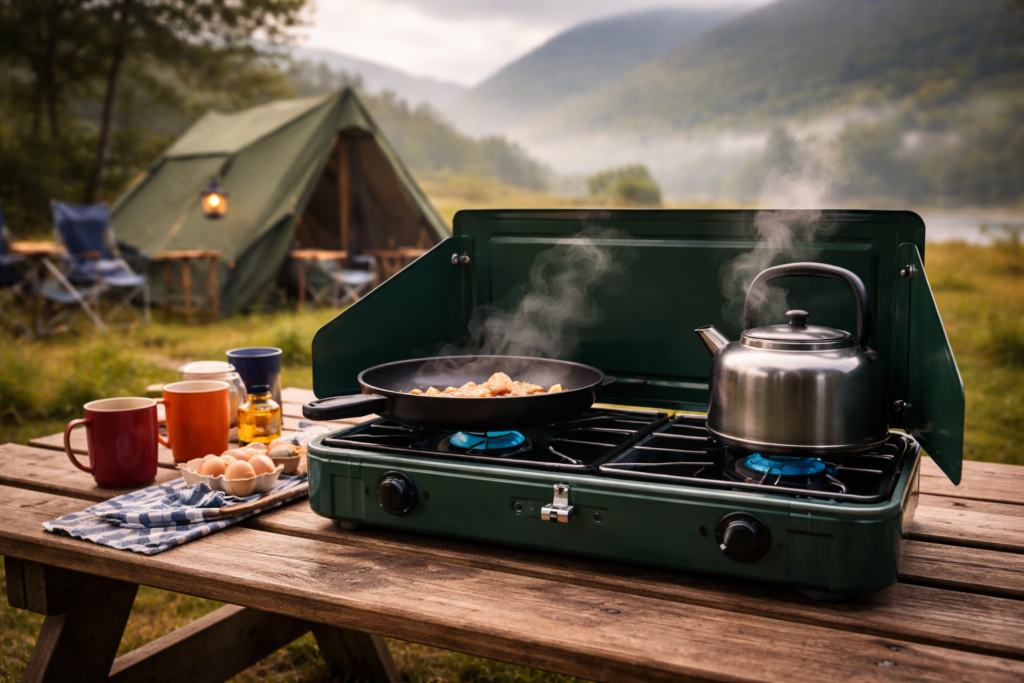
For families specifically, a camping stove isn’t the same purchase as it is for a solo hiker or a couple. You’re not shaving grams from a pack weight. You’re not boiling two cups of water for a morning coffee and calling it breakfast. You’re feeding children who are cold and hungry and have very specific opinions about what they will and won’t eat, in a field, possibly in the rain, while also trying to locate the tin opener and figure out where you put the plates.
The stove that handles that situation is one that lights first time, runs two things at once, and keeps a flame going when the wind picks up. Most of the Scottish west coast campsites where we’ve spent summer weekends are not sheltered, calm environments — they’re exposed, breezy, and the weather changes faster than the forecast suggests. The stove that works at Loch Lomond in a warm August also needs to work at 6pm in September when the temperature has dropped and the kids are asking when dinner is ready.
This covers the stoves worth buying for family camping in the UK, the fuel types worth understanding before you commit, and the things that actually matter when you’re cooking for four in a field.
More family outdoor kit recommendations are across the Family Camping hub — including tents, sleeping gear, and everything else that makes a camping trip genuinely enjoyable.
What Actually Matters for Family Camping
A few things separate a genuinely good family camping stove from one that looks right in the photograph and frustrates you at the campsite. Rather than working through them as a checklist, it’s worth thinking about them as a connected set of decisions — because the choices interlock.
The most fundamental is burner count. A single-ring stove handles one pot at a time. For a couple who mostly need a brew and something simple, that’s fine. For a family trying to cook pasta in one pan and sauce in another while the kettle’s on for the children’s hot chocolate, a single burner becomes a juggling act that takes twice as long as it should and produces food in the wrong order. Two burners is the minimum for genuine family cooking. Three is useful for larger families or longer trips where you’re cooking multiple dishes simultaneously.
Wind resistance follows from that. The UK campsites where families actually go — Scottish coast, Lake District, Snowdonia, the Northumberland moors — are rarely sheltered. A burner without wind protection loses heat in a moderate breeze and becomes nearly useless in a proper gust, which means longer cooking times and more gas burned. Look for side windshields, recessed burners, or Flameguard-style technology in the burner design. On a breezy September evening on Loch Tulla, the difference between a stove with decent wind protection and one without is the difference between dinner in twenty minutes or forty. Simmer control matters for the same underlying reason — a good flame you can turn low cooks scrambled eggs and heats milk for children without burning everything. Most budget stoves are effectively on/off rather than genuinely adjustable, and you feel that limitation the moment you’re trying to do anything more delicate than boiling water.
The fuel question is worth understanding before you buy anything, because the stove and the fuel are a committed relationship. The two main types for UK family camping are EN417 screw-on cartridges — used by Coleman, Cadac HP, and most non-Campingaz stoves — and Campingaz CV push-fit cartridges, which are used by the Campingaz range. Both are widely available, both work well, and neither is objectively better than the other. What matters is knowing which your stove takes before you arrive at a campsite on a Friday evening with an empty cartridge and nowhere open to buy a replacement. A brief note on this in the individual sections below — but the broad principle is: match your fuel type to what’s easiest to find near the campsites you actually use.
If you’re just getting started with family camping, the things no one tells you before the first trip are worth reading before you spend anything on kit.
The Stoves Worth Buying
Campingaz Camp Bistro 3 — Best Compact Single Burner
The Camp Bistro is the stove most UK families start with, and for good reason. It’s inexpensive, compact enough to sit flat in the bottom of a bag, uses the widely-available Campingaz CP250 cartridge, and lights via piezo ignition. At 2,200W it boils a litre of water in around five minutes and handles straightforward camping meals without any fuss. The cartridge slots inside the stove body, the whole unit fits into its own carry case, and the CP250 is resealable — you’re not committed to burning through a full canister before packing the stove away.
The honest assessment is that it’s a single burner and the cooking experience reflects that. For a couple with young children who need a brew in the morning and something simple for dinner, it works perfectly. For a family wanting to cook pasta and sauce simultaneously, or run the kettle while breakfast is on, you’ll be timing things and juggling in a way that turns a twenty-minute meal into a forty-minute one. This stove earns its place as a second burner in a two-stove setup — kettle on the Bistro, main cooking on a double — rather than as the sole cooking solution for a family of four.
The CP250 cartridge availability is its strongest argument. It’s findable across Europe, which matters on longer or continental trips where you can’t plan around a specific outdoor shop.
Campingaz Camping Kitchen 2 CV — Best Double Burner for Most Families
This is the stove that covers most UK family camping situations well without overcomplicating anything. Two independent burners, piezo ignition on both, enamelled steel pan supports that handle pots up to 28cm — large enough for a family pasta pot — and a lid that folds down to form a windshield on the prevailing side. The whole unit folds flat to around 49 × 35 × 10cm, which fits into the boot of a family car without drama and sits on a picnic table without feeling enormous.
The CV470 Plus cartridges use Campingaz’s Easy Clic Plus system — push in, twist to lock, ready to cook. No threading, no hose required for the basic setup, though you can connect to refillable R904/R907 gas bottles via a hose and regulator if you camp frequently enough that the economics make sense. For families who want to arrive at a campsite and start cooking within five minutes of unloading the car, the push-fit cartridge system makes that genuinely achievable.
The thing that repeatedly earns this stove its place on our trips along the Argyll coast is parallel cooking — pasta boiling on one ring, sauce doing its thing on the other, without anyone having to stand over it timing swaps. That’s the moment family camp cooking stops feeling like a compromise and starts feeling like a meal. The stove that makes dinner calm is doing more work for family camping morale than any piece of kit in the boot.
The honest note: the windshield only covers one side, which means positioning matters in a wind. Back it up against the car or a rucksack on the exposed side and it handles UK conditions well. In genuinely exposed locations without any natural shelter, a separate camping stove windshield is worth the few pounds it costs.
That said, the stove is only part of it — everything your family actually needs to bring on a camping trip is worth working through before you go, so the stove isn’t the only thing you’ve thought about.
Coleman Classic 3-Burner Camping Stove — Best for Bigger Families and Longer Trips
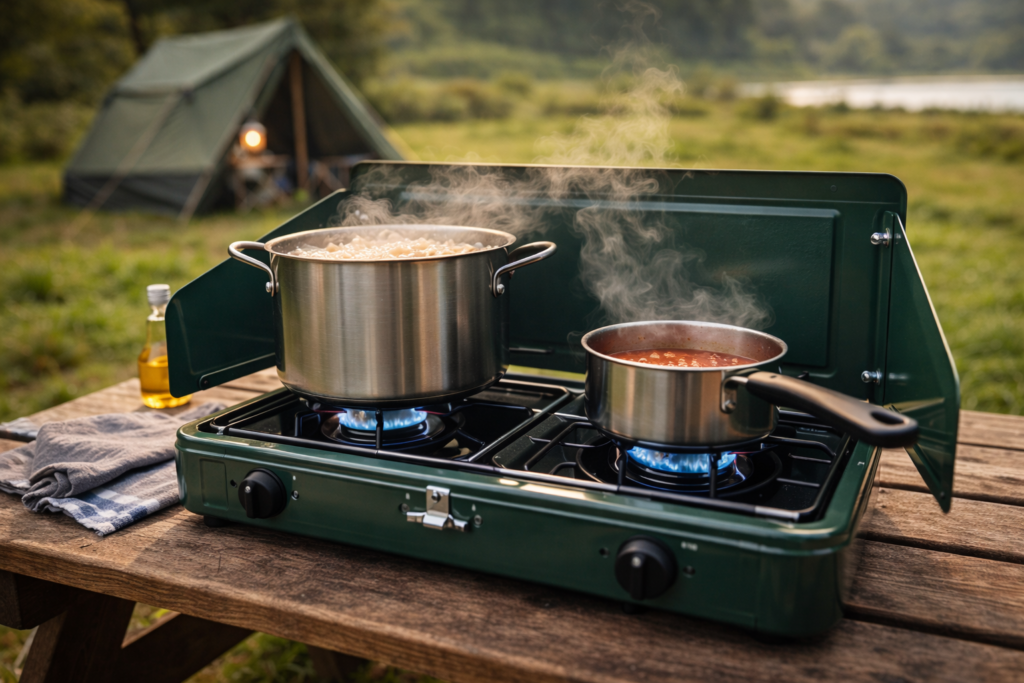
Three burners changes the character of camp cooking entirely. On day one of a weekend trip, two burners is fine. By day three or four of a longer trip, when you want a proper stew alongside rice alongside something separate for the child who has decided they don’t like stew this week, three rings running simultaneously is the difference between cooking and actually managing a meal.
The Coleman has 28,000 BTU total output across three independently adjustable burners, dual WindBlock side panels that fold out during cooking to shield the flames from crosswind, and a push-button InstaStart igniter. The removable chrome-plated grate makes post-cooking cleanup straightforward — the kind of easy clean that matters on day four when everyone’s tired. It runs on standard propane cylinders via a push-fit regulator, the cylinders are findable at most outdoor retailers and hardware shops across the UK, and the whole stove folds flat with a built-in carry handle.
I’ve cooked on a three-burner Coleman-style setup during a week at a campsite near Loch Venachar and the thing that stood out was how much more relaxed cooking felt with a spare ring available. Kettle on the back burner, dinner on the front two, no timing juggle required. For families who camp for more than a weekend at a time, that extra ring earns its place quickly.
The honest caveat: this is a larger and heavier stove than the Campingaz options. It’s a car camping stove — it goes from boot to picnic table and stays there for the trip. It isn’t a stove you carry any distance. For families doing organised site camping where the car is nearby, that’s not a limitation. For anything involving carrying gear to a pitch, it is.
Cadac Safari Chef 2 HP — Best for Families Who Want More Than Just Cooking
The Cadac is genuinely different from everything else on this list and it deserves to be understood on its own terms rather than compared directly to a conventional two-burner stove. It comes with four interchangeable cooking surfaces — a BBQ grid, a flat griddle, a pot stand, and a dome lid that doubles as a shallow pan or wok. The cooking surface is 30cm across. The whole thing packs into a bag about the size of a football. It runs off a standard EN417 threaded gas cartridge and lights via piezo ignition.
What this means in practice is that one compact piece of kit replaces both a camping stove and a camping BBQ. You can grill sausages properly. You can make pancakes on the flat griddle without them sliding off onto the grass. You can do a genuine stir fry in the dome. The cooking options this opens up on a five-day family camping trip are meaningfully wider than anything a conventional burner setup provides, and the children will want pancakes at breakfast every single morning once they’ve had them once — the flat griddle plate produces them without any fuss and the kids can stand around watching without being a hazard.
It’s also genuinely compact. The pack size is smaller than most two-burner stoves and the cooking surface is larger than it looks. For families who camp regularly and want to cook adventurously rather than just functionally, the Cadac is the stove that makes outdoor cooking feel like something worth doing rather than a necessity between arriving and sleeping.
The honest caveats are real though. There’s no built-in windshield — the design is open by nature — so it needs a sheltered position or a separate windshield accessory in exposed conditions. It’s more expensive than the Campingaz options. And for a family that camps twice a year on an organised site and mostly wants pasta and sausages, the premium is hard to justify. The Cadac makes most sense for regular campers who’ll use every cooking surface across a season.
Fuel Types — What You Need to Know Before You Buy
The fuel question catches most first-time family campers out, usually at the worst possible moment.
EN417 screw-on cartridges are the standard type used by most camping stoves — Coleman, Cadac HP, and the majority of non-Campingaz brands. They thread directly onto the burner, contain a butane/propane mix that performs well across typical UK temperatures, and are widely available at outdoor shops and online as camping gas cartridges EN417. The propane element in the mix means they continue to work in cold conditions where pure butane would struggle — relevant for UK shoulder season camping.
Campingaz CV cartridges use a push-fit valve system rather than a screw thread. They’re resealable — detach without burning the full cartridge, reattach on the next trip — and as widely available across Europe as EN417 canisters. The Campingaz CV470 Plus cartridges fit the Camping Kitchen 2 and similar models. If you’re buying a Campingaz stove, you’ll be using these.
Refillable gas bottles — Campingaz 904/907, Calor, Flogas — connect via a hose and regulator and cost less per unit of gas than cartridges. For families who camp frequently, the economics favour switching to refillable bottles once you’ve accumulated enough camping weekends to justify the cylinder deposit. The practical consideration is planning — you need to swap the bottle before it runs out, which requires either carrying a spare or knowing there’s a stockist near your next campsite.
Practical Things That Make a Real Difference
Bring a lighter as backup. Piezo igniters fail occasionally, especially after storage in a damp bag through winter. A long-handled lighter costs almost nothing and lives in the kitchen bag permanently. Every family camping setup should have one and most people learn this the hard way the first time.
Position the stove deliberately. Wind is the main enemy of efficient camping cooking and most UK campsites are in exposed locations. Back the stove up against the car, use the tent as a windbreak, or bring a dedicated windshield. A stove sheltered from the prevailing wind cooks noticeably faster and uses less gas than the same stove in an open position facing into it.
If you’re planning a first overnight trip with the kids, a simple packing plan for one night away helps avoid the classic mistake of overpacking everything except the things you actually need.
Know your cartridge capacity and bring more than you think you need. A standard CP250 Campingaz cartridge lasts around 75 minutes at full burn — roughly a long weekend of cooking if you’re careful about not leaving the flame running when nothing’s on it. Running out of gas on the second evening of a three-night trip with three hungry children is the kind of experience that only needs to happen once. Checking the site facilities before you go also saves surprises — the things worth confirming before you book a UK campsite include whether gas cartridges are available on site.
Match pan size to burner size. An oversized pan hanging off a compact single-ring stove is unstable and inefficient. Check that your pans actually fit the pan supports before leaving home. A family camping pan set sized correctly for a two-burner setup makes a meaningful difference to how cooking actually works at the campsite.
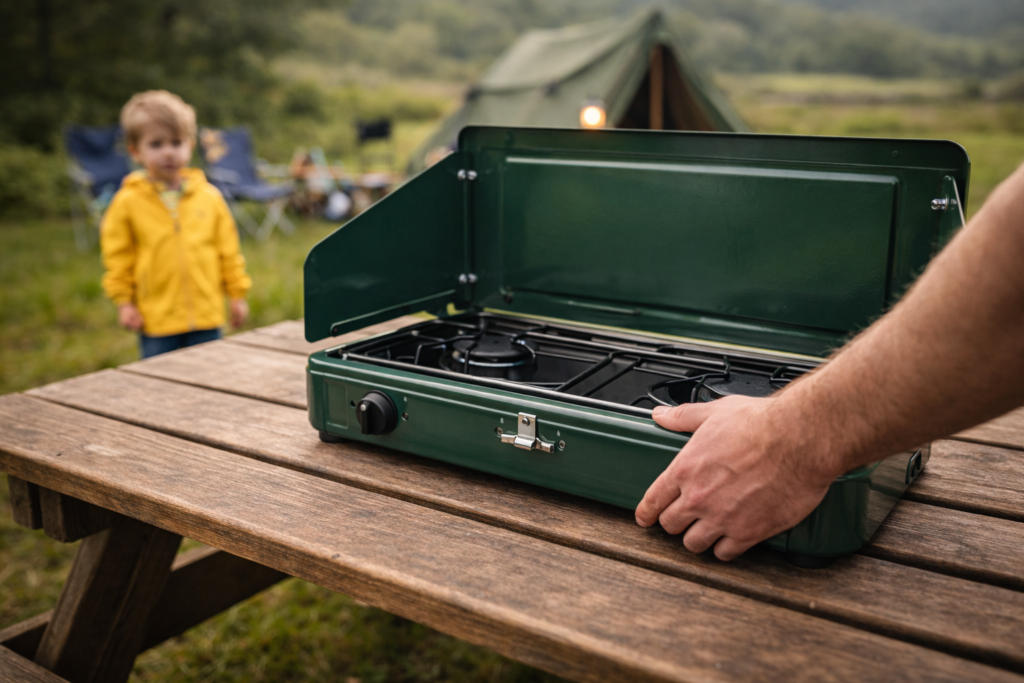
Cook safely around children. A camping stove on a picnic table with small children nearby is a different safety situation from a kitchen hob. The stove should always be on a stable, level surface — not on grass that slopes, not on an uneven table that rocks. Keep children at arm’s length from the burners when they’re lit. Cartridge stoves can topple if caught by a child running past — the cartridge end is heavier than it looks and the centre of gravity is higher than on a domestic hob. If you’re cooking in a tent porch — a reasonable thing to do in heavy rain — ensure the porch is properly ventilated and never cook inside an enclosed sleeping area.
Which Stove for Your Family
Just starting out, want something simple and inexpensive — Campingaz Camp Bistro 3. Accept it’s a single burner and plan around that. Cook one thing at a time, use a second small stove for the kettle if needed. It works well for its purpose.
Most UK families doing regular camping and wanting to cook proper meals — Campingaz Camping Kitchen 2 CV. The double burner covers everything a family actually needs, the fuel system is simple, and it fits into any car boot without reorganising the rest of the gear.
Bigger families, longer trips, or anyone who wants cooking to feel effortless rather than managed — Coleman Classic 3-Burner. More stove, more boot space needed, but the extra ring pays for itself in reduced stress within the first long trip.
Regular campers who want to actually cook outdoors rather than just heat food — Cadac Safari Chef 2 HP. The versatility is genuinely worth it once you’re using it consistently. The pancake breakfasts alone will make it a family favourite within one trip.
Related Guides
About The Author – Andrew Marshall
Andrew Marshall is the creator of Simple Days Outside and a UK parent of three who regularly camps, walks, and explores outdoor activities with his family. His guides focus on practical gear, realistic family adventures, and simple ways to help families enjoy the outdoors across the UK. The recommendations on this site are based on real-world use, research, and the kind of equipment families actually rely on for weekend trips and everyday outdoor fun.