
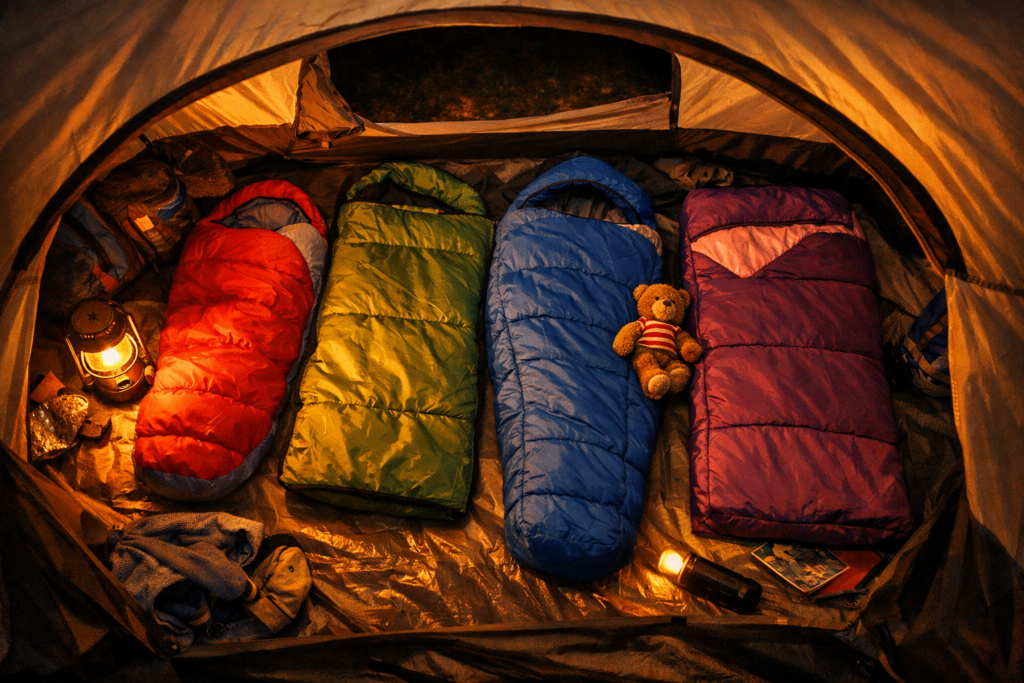

Written by Andrew Marshall
UK parent of three sharing practical advice to help families enjoy camping, walking, garden play, and simple outdoor adventures across the UK.
Creator of Simple Days Outside.
Last Updated: 24th March 2026
Getting children to sleep on a camping trip is one of those things that sounds straightforward until you’re actually doing it at 10pm in a field in Argyll with a six-year-old who has decided the sleeping bag feels weird and wants their duvet. Get it wrong and you spend the trip sharing your sleeping bag with a cold, grumpy small person. Get it right and camping nights become one of the things your kids genuinely love about being outdoors.
The bag itself matters more than most parents account for — not just for warmth, but for whether the child will actually stay in it, get themselves in and out independently, and sleep through rather than waking cold at 3am. Kids sleeping bags aren’t just small adult bags. The sizing, the shape, the lining feel, and the zip ease are all more important for children than for adults. For more on making family camping work from the start, the Family Camping & Short Trips section of the site has everything from kit lists to campsite picks.
Why Kids Sleeping Bags Are Different From Adult Ones
The most important difference is size — and not in the way most people think. A bag too large for a child creates cold air space at the feet that the child’s body has to heat overnight. A small body generating less heat than an adult simply can’t keep that extra space warm, which means the child sleeps cold regardless of what the bag is rated to.
The other difference is feel. Children are considerably more sensitive to how a sleeping bag feels against their skin than adults tend to be. A scratchy or plasticky lining that an adult barely notices can be enough to stop a child settling. Soft brushed linings make a real difference to whether a child actually relaxes into the bag or spends twenty minutes complaining about it.
And then there’s the zip. I’ve been that parent at midnight in a dark tent while a child with a stuck zip gets increasingly distressed — it’s not a situation you want to be in twice. Children getting up for the toilet at night need to manage the zip themselves. A zip that’s stiff, prone to snagging, or requires adult-level coordination to operate is a problem in a way it simply isn’t for adults.
The One Mistake Most Parents Make
Buying a bag slightly too big so the child can grow into it.
It seems sensible — children grow fast, bags aren’t cheap, buy a bit of room and it’ll last longer. The problem is that extra room at the feet is cold air. On a mild summer night this barely matters. On a Scottish campsite in May or September, a child with 15cm of empty bag beyond their feet will be cold by midnight regardless of the temperature rating on the label.
The fix isn’t to buy a new bag every year — and if you’re planning a first camping trip, what to actually pack for one night with kids is worth reading before you buy anything, so you’re not over-investing in kit before you know what you need. The version of buying ahead that actually works is choosing a bag with an adjustable length system — the Quechua options on this list both have Pull & Fit systems that shorten the effective length for younger children and extend as they grow.
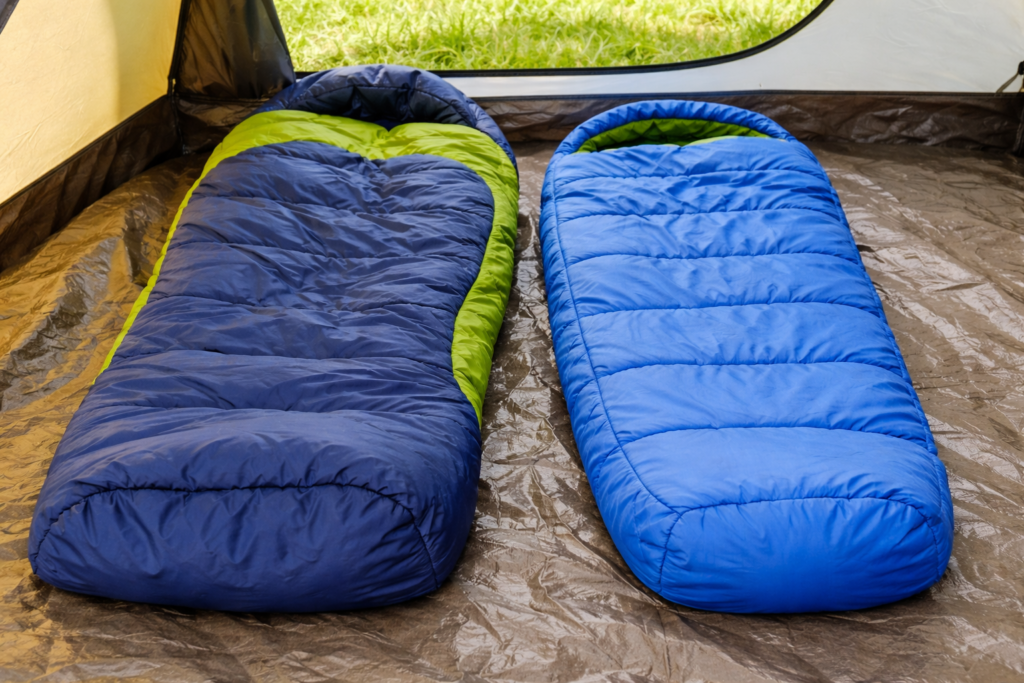
The 5 Best Kids Sleeping Bags for UK Camping
1. Vango Atlas Junior — Best All-Round Kids Bag for UK Camping
This is the bag I’d buy first for a child between roughly five and ten who is going to be camping regularly through the UK three-season window. The Atlas Junior is a proper mummy-shaped bag with an 8.5 TOG rating — warm enough for spring and summer camping without being stifling on mild nights — and the Polair shell and lining combination is noticeably softer than cheaper alternatives at this price point.
The mummy shape is worth mentioning specifically for kids. Some parents assume their child will prefer a rectangular bag for the extra room, but in practice younger children often sleep better in a mummy bag because it feels more like being wrapped up — less open space to feel lost in. Our youngest took to his mummy bag immediately on his first trip and has never once complained about it feeling restrictive, which I’d genuinely worried about before he tried one.
The junior sizing keeps the bag properly fitted for children rather than leaving cold space at the feet, and the smooth zip with woven puller is easy enough for a child to manage independently — which matters considerably at 2am when they need the toilet and you’d rather not be involved.
One honest caveat: the TOG rating makes this a two-season bag rather than a full three-season one. For camping from late April through September in the UK it performs well. For October camping in Scotland, layering up in thermals inside the bag is advisable.
2. Quechua MH500 Children’s Sleeping Bag 0°C — Best for Colder Nights
If you camp from early spring through to late autumn — particularly anywhere in Scotland where September nights can drop sharply — this is the kids bag worth knowing about. Comfort rated to 0°C with a limit temperature of -5°C, the MH500 is Decathlon’s warmest children’s option and significantly warmer than most kids bags at a comparable price.
The Pull & Fit system adjusts the bag to fit children between 115cm and 155cm — a practical range covering roughly age five through to early teens. Rather than buying progressively larger bags as a child grows, this one adapts, which makes the cost-per-use considerably better over a few seasons of regular camping. We’ve recommended this one to friends who camp on the Argyll coast where overnight temperatures in May can surprise you — it’s the bag that gives you a proper margin when the forecast turns out to be optimistic.
The polyester insulation retains warmth even if the bag picks up tent condensation overnight — a real consideration on west coast Scottish sites where the inside of a tent can be noticeably damp by morning. For families who camp later in the year or at altitude, this is the bag to reach for. If you’re still working out where to take them first, 12 things worth checking before you book a pitch can save a lot of disappointment — particularly for first trips with younger children.
One honest caveat: it’s heavier and bulkier than the lighter summer options on this list. For car camping this is irrelevant — for anything involving carrying kit any distance it’s worth knowing.
3. Quechua Kids’ Sleeping Bag 10°C Lightweight and Compact — Best for Summer and First Trips
This is the bag I’d hand to a parent whose child is going camping for the first time — or whose family mainly camps in summer and doesn’t need the full three-season performance of the heavier options. Comfort rated to 10°C, lightweight, compact, and with a Pull & Fit adjustable length system that grows with the child.
The integrated stuff sack that doubles as a soft toy is a detail that sounds like a gimmick until you see a child genuinely excited to carry their own sleeping bag to the tent. Our youngest spent an entire drive to a Loch Lomond campsite insisting on holding it in the back seat rather than having it in the boot. Small things matter when you’re trying to get children enthusiastic about camping — and anything that gives a child ownership over their own kit tends to help considerably.
The khaki colourway is practical rather than decorative — it doesn’t show the kind of dirt a sleeping bag accumulates over a summer of regular camping, which is a genuinely useful feature for a bag that will be washed regularly. If it’s your child’s first time camping, what first-time family camping is actually like covers the things most guides don’t mention — useful preparation before the first night away.
One honest caveat: 10°C comfort means this is a summer option. A mild Scottish August night is fine. A May camping weekend in Argyll where the temperature drops to 5°C at 3am is pushing it without thermal pyjamas. For families doing most of their camping in July and August this is a well-priced, practical starting point.
4. Vango Kanto Junior — Best for Children Who Hate Scratchy Linings
Every family has at least one child who is particular about textures — the one who notices immediately if a fabric feels slightly wrong and will tell you about it at length. The Kanto Junior is the bag for that child. The Polair Snug lining is noticeably softer and cosier than standard polyester, and it’s the kind of fabric that children tend to snuggle into rather than fight against.
Ours has been on every trip since we bought it for our middle one — who is exactly the child described above — and has never once produced a complaint about how it feels. That alone earns it a permanent place on this list. The mummy shape tapers correctly for junior sizing, keeping warmth in without making the child feel restricted, and the zip guard prevents snagging which is one of the more common frustrations with cheaper kids bags.
The two-season rating is honest — spring and summer camping without issues, late autumn with some extra layering. One note worth knowing: the shaped hood uses an elasticated opening rather than a drawcord on junior models — a deliberate safety feature for younger children. It means slightly less adjustability on cold nights but it’s absolutely the right call for a sleeping bag used by children under eight.
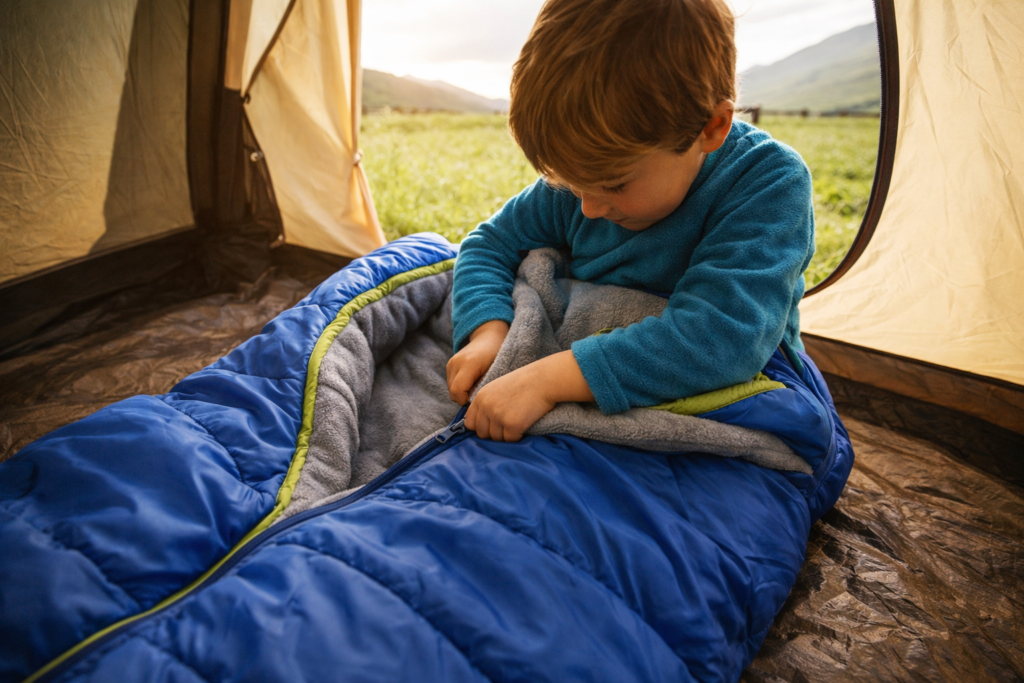
5. Eurohike Youth Sleeping Bag — Best for Older Children and Budget-Conscious Families
The Eurohike Youth sits at the older end of this list — sized for children and young teenagers who’ve outgrown junior bags but aren’t quite at adult sizing. It’s the honest budget option for families who need to kit out an older child without paying adult bag prices, and it delivers solid three-season performance that handles UK camping reliably.
The rectangular shape suits older children who want the freedom to move around, and the price point makes kitting out a child who’s going to grow into an adult bag within a couple of years a financially sensible decision. It does what it needs to do — keeps a child warm through a UK summer and into autumn — without requiring a significant outlay for what is effectively a transition bag.
For families with a mix of ages, the Eurohike Youth bridges the gap between the junior sizing of the Vango and Quechua options above and the adult bags covered separately. If budget allows and your child camps regularly, the full family sleeping bag options are worth a look — particularly the Vango 250S which is sized correctly for that age group and gives a proper three-season margin.
Which Bag for Which Age?
Ages 3–6: The Quechua 10°C Lightweight for summer camping — lightweight, adjustable, and the stuff-sack toy detail genuinely helps with getting small children excited. The MH500 0°C if you camp in cooler months or want one bag that covers more of the year without worrying about temperature margins.
Ages 6–10: Vango Atlas Junior for most UK camping. Quechua MH500 if you camp in Scotland from spring through autumn and want the extra warmth margin for unpredictable nights.
Child who is fussy about textures, any age: Vango Kanto Junior without hesitation — the lining is what makes it different and it’s the only bag on this list that solves that specific problem properly.
Ages 10–14: Eurohike Youth for a practical and affordable option. If budget allows and they camp regularly, the full family sleeping bag options are worth a look — particularly the Vango 250S which is sized correctly for that age group.
First camping trip, any age: The Quechua 10°C Lightweight — affordable, adjustable, and the soft-toy stuff sack is a genuinely useful way to get a child engaged with their own camping kit before the trip even starts.
FAQ
Can young children get in and out of a mummy sleeping bag independently?
Older children generally manage well — the zips on most mummy kids bags are designed for small hands. For children aged three to five, a rectangular bag is easier for independent use. The Quechua bags use full-length zips that children find manageable. Practise at home before the trip so the first attempt isn’t at midnight in a dark tent.
What do I do if my child keeps wriggling out of their sleeping bag overnight?
Very common with younger children. A kids sleeping bag liner inside the bag adds warmth even when the bag shifts, and a kids thermal base layer to sleep in means a child who kicks the bag off stays warm for longer. Some parents find that practising at home until the child is familiar and comfortable with the bag reduces overnight wriggling significantly.
Are mummy bags safe for young children?
Yes, provided the bag is correctly sized and uses an elasticated hood rather than a drawcord — drawcords on hoods are a safety concern for younger children. The Vango Kanto Junior specifically removes the drawcord on junior models for this reason. Always check hood design before buying for children under six.
How often should I wash a kids sleeping bag?
More often than an adult bag — children are harder on gear. After every one or two trips for regular use is reasonable. A sleeping bag liner reduces how often the main bag needs washing by acting as a barrier layer. Most synthetic kids bags are machine washable at 30°C — always check the care label first.
When should my child move up to an adult sleeping bag?
When they outgrow the junior sizing — typically approaching 150–155cm in height, usually around age 11–13 depending on the child. The Eurohike Youth on this list bridges that gap. Moving to an adult bag too early recreates the cold-space problem the whole article is about — resist the urge to skip the intermediate step.
Do kids sleeping bags have temperature ratings like adult ones?
The ratings exist but aren’t standardised for children the way they are for adults — ISO testing uses adult test subjects. The comfort ratings on kids bags are indicative rather than certified. As a working rule, add a couple of degrees to the stated comfort rating as your margin for children, and prioritise correct fit over the stated temperature figure.
What should my child wear inside a sleeping bag?
One layer of kids thermal pyjamas or a base layer is enough for most conditions. Overdressing causes sweating which then leads to the child getting cold when the moisture cools. On genuinely cold nights add a kids fleece layer over the base layer and a hat. A kids sleeping bag liner adds warmth without the layering complexity.
Related Guides
About The Author – Andrew Marshall
Andrew Marshall is the creator of Simple Days Outside and a UK parent of three who regularly camps, walks, and explores outdoor activities with his family. His guides focus on practical gear, realistic family adventures, and simple ways to help families enjoy the outdoors across the UK. The recommendations on this site are based on real-world use, research, and the kind of equipment families actually rely on for weekend trips and everyday outdoor fun.