

Written by Andrew Marshall
UK parent of three sharing practical advice to help families enjoy camping, walking, garden play, and simple outdoor adventures across the UK.
Creator of Simple Days Outside.
Last Updated: 31st March 2026
This is a question we’ve genuinely gone back and forth on. The honest answer isn’t a straight yes or no — it depends on the child’s age, the terrain you’re walking, and whether your particular child is the type who will use a pair of poles for two hours or carry them for ten minutes and hand them to you.
What follows is the most useful version of this answer we can give — based on what actually happens on family walks, what the research says about poles and joint loading, and what we’ve seen work and not work with our own children on the paths around Loch Lomond and the west coast.
More family walk planning and gear picks are in our Family Walking & Easy Hiking Hub.
The Honest Case For Hiking Poles With Kids
They genuinely help on descents
This is where poles earn their place on a family walk. Going downhill — particularly on uneven, wet, or steep ground — puts significant loading on children’s knees and ankles. Research on trekking poles consistently shows they reduce the force on lower limb joints by around 12–16% on downhill sections. For children who are tired by the time a descent begins, that reduction in physical stress makes a noticeable difference to whether they finish a walk in good spirits or in tears. Getting the footwear right matters just as much — waterproof walking boots that keep kids’ feet dry on wet descents work alongside poles rather than instead of them.
They improve balance on tricky ground
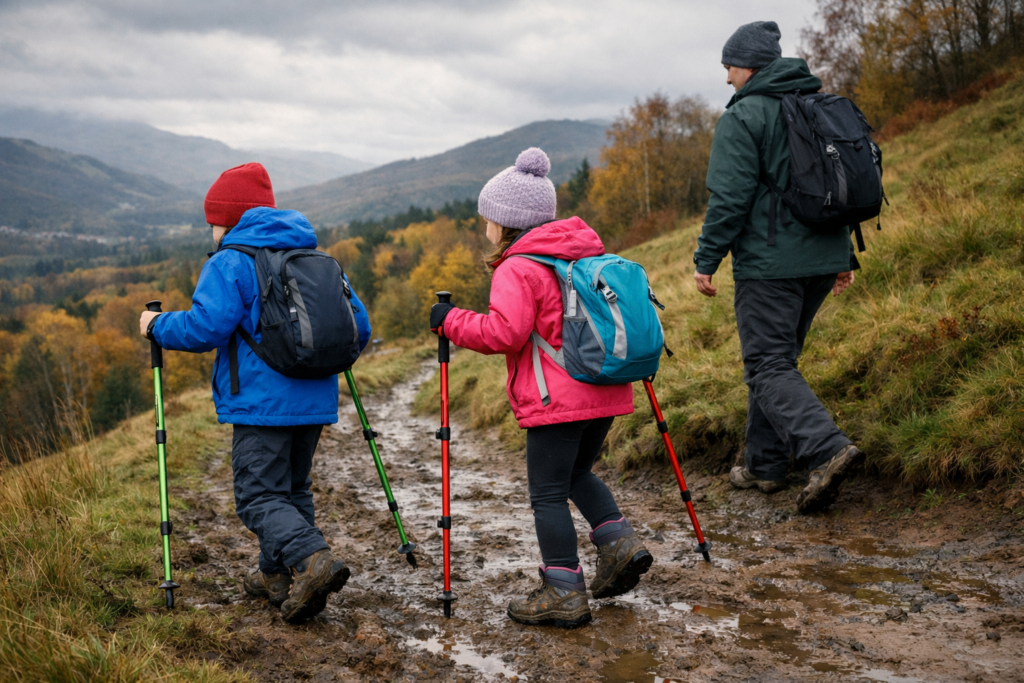
Children naturally have a higher centre of gravity relative to their height than adults, which makes them more susceptible to slipping and losing balance on uneven ground. Two poles give two additional points of contact — effectively turning a biped into something closer to a quadruped on slippy sections. On muddy trails after Scottish rain, on rocky paths, on anything that requires a step-and-assess approach, the additional stability is real and visible.
Our youngest went from tentative and slow on any path with loose stones to confident and consistent once they had poles to check footing with. The poles became an exploratory tool as much as a support tool — prodding at muddy sections to test depth, checking stream crossings, investigating things by the path. That engagement kept the walk going considerably longer than it would have otherwise.
They make longer walks more manageable
Research suggests poles help walkers adopt a more efficient gait — longer strides, better rhythm, more upright posture. For children carrying a small rucksack on a longer day, poles distribute some of the effort to the upper body and help maintain pace. The practical result on a 5–6km family walk is that children often have more in reserve for the final section rather than running out of energy at the three-quarter point.
They give children a sense of ownership over the walk
This benefit is underrated in most hiking gear guides. A child who has their own poles — sized for them, chosen with them, theirs to carry — approaches a walk differently to a child who is simply along for the exercise. The poles are something to use, to engage with, to feel purposeful about. On more than one occasion, a walk that was heading for complaints before it started turned into something the children were leading because they had kit to use. If you’ve already decided poles are worth trying, lightweight kids hiking poles worth considering covers the confirmed UK options across different ages and budgets.
The Honest Case Against
On easy flat paths they’re mostly unused
A gentle country park stroll on a well-maintained path in dry conditions is not a situation where poles add much. Most children on easy terrain will carry them awkwardly or not use them correctly — and you’ll spend more time adjusting, reminding, and retrieving dropped poles than the poles are worth.
Young children need to learn to walk without them first
Some outdoor experts argue that children who use poles before they’ve developed natural balance on uneven ground can become reliant on them and fail to build the proprioceptive skills that come from learning to navigate terrain independently. There’s a reasonable case that on moderate terrain, children aged 4–6 benefit more from developing their own balance than from being propped up with poles.
Our approach has been to let younger children walk without poles on moderate ground and introduce them when the terrain genuinely requires additional support — steeper paths, longer distances, or consistently wet and muddy conditions.
They can become a hazard in the wrong hands
A 7-year-old with two metal-tipped poles on a narrow path with other walkers behind them requires supervision and clear rules. Tips can catch on roots and throw a child off balance. Poles swung at the wrong moment catch other people’s legs. Children who are using poles as swords rather than walking aids are a liability rather than an asset.
The fix is establishing clear rules before the walk starts — poles go on the ground, not in the air — and stopping any misuse immediately rather than letting it slide once. Most children respond well to this if it’s set as a clear expectation rather than a repeated request.
Some children simply won’t use them
No amount of encouragement will make a child who has decided they don’t want poles use them properly. If your child tries them and actively doesn’t want them, don’t push it. An unwanted pair of poles will end up being carried by a parent within fifteen minutes and will create resentment rather than enthusiasm for future walks.
When Poles Are Definitely Worth It
Based on what actually happens on family walks rather than theoretical hiking advice, here are the specific situations where poles consistently justify themselves:
Long descents on uneven ground. This is the clearest use case. Any path with a significant downhill section on rocky or muddy terrain — the poles come out.
Wet conditions on slippy paths. In the UK this means most walks in autumn and winter and a significant proportion of spring and early summer. On genuinely slippy ground, poles are a safety item as much as a comfort one.
Children aged 6–10 on walks over 5km. At this age and distance, the additional support and rhythm that poles provide has a measurable effect on whether a child finishes the walk well. If you’re unsure what distance is realistic for your child’s age before committing to a longer route, realistic walking distances for kids by age is worth checking first.
Children who are tentative or anxious about uneven ground. Some children find rough terrain genuinely unsettling. Poles provide confidence as much as physical support — the knowledge that there are two additional contact points changes how a child approaches a challenging section of path. We’ve seen this transform a child who was stopping every few steps on a rocky section into one walking confidently without needing to stop at all.
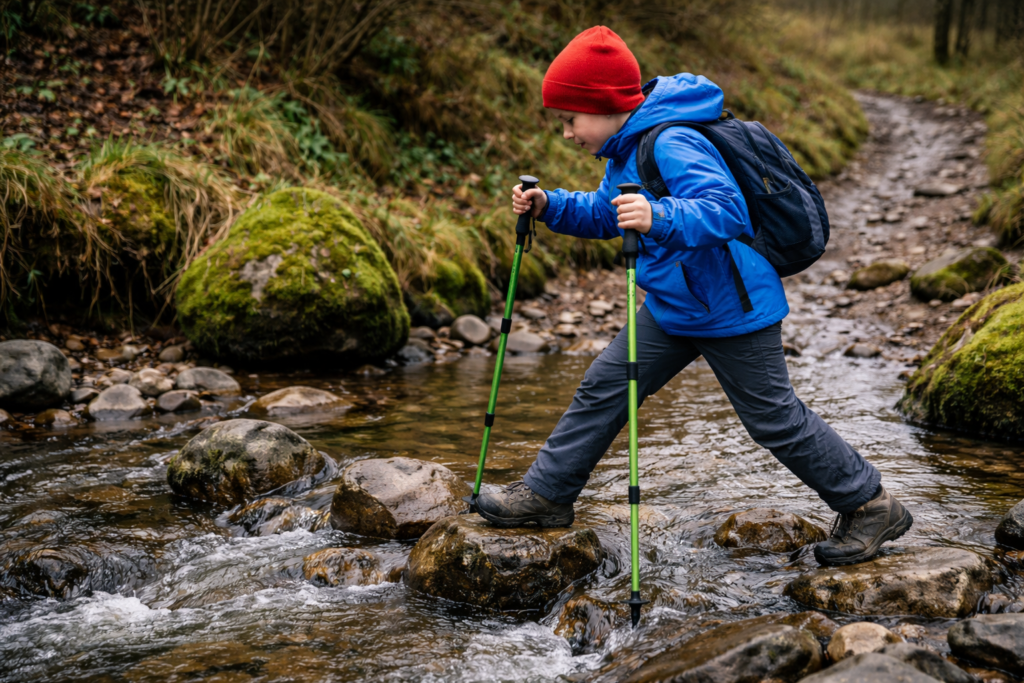
Stream crossings and boggy sections. Two poles to test depth and provide balance through a crossing make an otherwise stressful moment manageable. On west coast Scottish paths this scenario arises more often than expected — the ground can look firm and turn out to be knee-deep in the wrong spot.
When Poles Probably Aren’t Worth It
Short, easy, flat walks on well-maintained paths. The poles will be more trouble to manage than they’re worth. Leave them at home.
Children under 5 or 6 on moderate terrain. Let them develop natural balance first. Poles at this age on easy ground are likely to be more distraction than assistance and the balance development argument against them is at its strongest here.
Narrow paths with lots of other walkers. The tip hazard in a crowded space outweighs the benefit. Poles can be stowed in a rucksack for these sections and brought out again on open terrain.
Children who actively resist using them. Save the energy and the argument. Some children take to poles immediately and some never warm to them — both responses are completely normal.
What About Letting Kids Use Adult Poles Shortened Down?
This comes up regularly and the honest answer is: it works as a temporary solution but isn’t ideal for regular use.
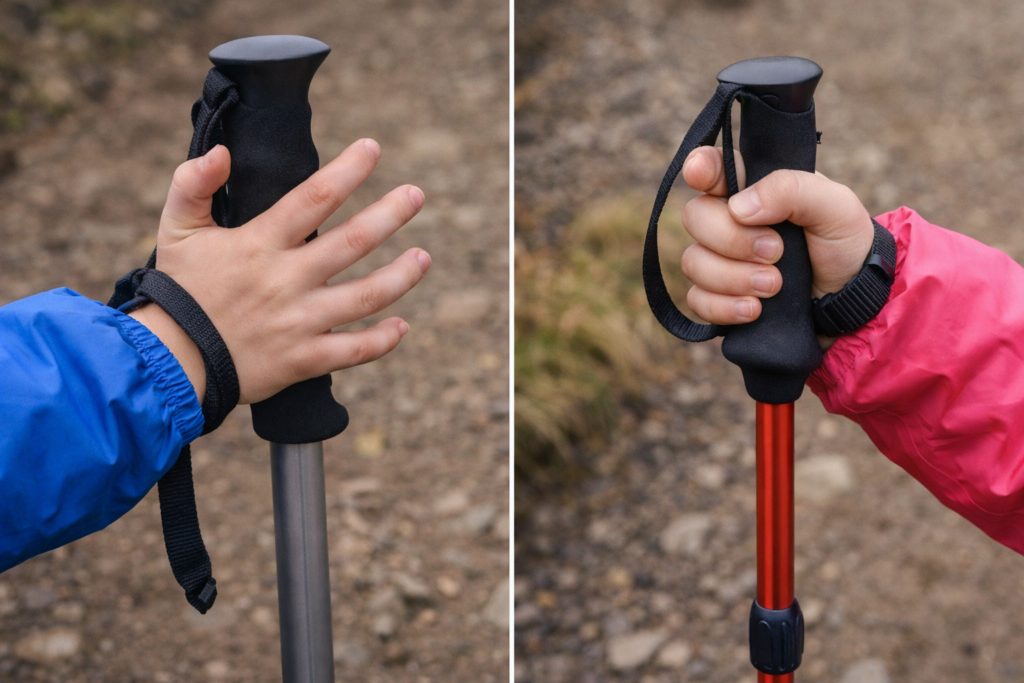
Adult poles at minimum length are often still too long for children under about 10. The grips are sized for adult hands, which means the child can’t get a proper secure hold — they grip with the fingers rather than the palm, which causes fatigue and reduces control over longer sections. The wrist straps are designed for adult wrists and won’t adjust small enough to sit correctly.
For an occasional walk where you want to try poles before investing in a kids pair, borrowing adult poles shortened down is reasonable. For regular family walking, a purpose-built kids pole is worth the £15–25 it costs — the difference in grip fit and weight is significant enough to matter across a full walk. Pairing poles with the right footwear for the terrain makes the biggest combined difference — walking boots vs trail shoes for kids covers which sole type suits which kind of path.
The Verdict
Hiking poles are worth it for most families who walk regularly on any terrain with gradient, wet ground, or meaningful distance. They aren’t worth bothering with for occasional easy strolls on flat, dry paths.
The break-even point for most UK families is somewhere around a 4–5km walk with a hill or two in mixed weather — which describes most genuinely interesting family walks in Britain. If that’s the kind of walking your family does regularly, poles are a worthwhile investment that will get used.
If your family mainly does easy country park loops on well-maintained paths in good weather, save the money for something else.
The age sweet spot is 6–12. Below 6, the coordination required to use poles effectively isn’t fully there yet and the balance development argument against them is stronger. Above 12, most children are tall and coordinated enough for lightweight adult poles. At either end of that range, walking boots vs trail shoes for kids is worth reading alongside this — the sole grip difference between boot and trail shoe becomes particularly relevant when poles are also in the mix on varied terrain.
Frequently Asked Questions
At what age should children start using hiking poles? Most manufacturers suggest 5–6 as the lower limit. Below this age, the coordination required to use poles without tripping over them or creating a hazard for other walkers isn’t reliably developed. From 6 upward, with proper height adjustment and a five-minute introduction on flat ground before hitting terrain, most children adapt quickly and naturally.
Should children use one pole or two? Two poles for any terrain with gradient or uneven ground — the balanced support from both sides is meaningfully better than a single pole for both balance and walking rhythm. One pole is occasionally preferred by older children on flat, easy paths as a personal preference rather than a practical necessity.
Will hiking poles make my child dependent on them? Only if they’re used on terrain where they aren’t needed. On moderate, easy ground, encourage children to walk without poles and develop their natural balance. Use the poles for terrain where they genuinely help — significant descents, wet ground, longer distances. Treating them as a tool for specific situations rather than a permanent walking aid keeps the balance development concern from becoming a real problem.
What’s the best way to introduce poles to a child who’s never used them? Five minutes on flat ground before the walk starts — not on the trail itself. Show the correct elbow angle, approximately 90 degrees when the tip is on the ground. Demonstrate planting the pole slightly ahead of the foot rather than behind it. Let them walk normally for a few minutes with the poles just held loosely to get used to the weight, then introduce the planting motion. Most children are using them naturally within ten minutes and need less instruction than parents expect.
Are poles safe for children on shared trails with other walkers? Yes, with clear rules established beforehand. Tips on the ground at all times — not swung, not waved, not used as anything other than walking poles. On narrow sections with other walkers close by, poles can be carried vertically or stowed until the path opens up. The safety concern is real but entirely manageable with clear expectations set before the walk rather than repeated reminders during it.
Related Guides
About The Author – Andrew Marshall
Andrew Marshall is the creator of Simple Days Outside and a UK parent of three who regularly camps, walks, and explores outdoor activities with his family. His guides focus on practical gear, realistic family adventures, and simple ways to help families enjoy the outdoors across the UK. The recommendations on this site are based on real-world use, research, and the kind of equipment families actually rely on for weekend trips and everyday outdoor fun.