

Written by Andrew Marshall
UK parent of three sharing practical advice to help families enjoy camping, walking, garden play, and simple outdoor adventures across the UK.
Creator of Simple Days Outside.
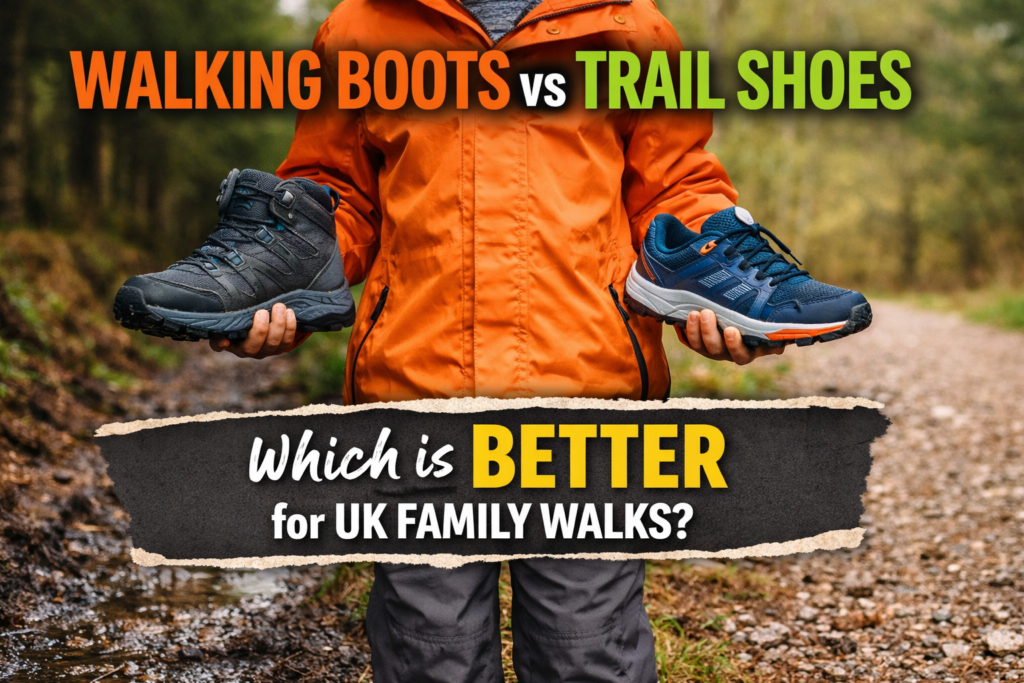
If you’ve ever stood in the kids’ footwear aisle (or scrolled Amazon at night) thinking, “Do they actually need proper walking boots?” — you’re not alone. For UK family walks, the choice usually comes down to walking boots or trail shoes. If you’re still deciding after this guide which boots are worth considering, our guide to the best walking boots for kids compares some of the most reliable options available.
Both can be great. Both can also be the wrong choice if you pick them for the wrong kind of walk.
We’ve made the mistake of buying “proper boots” that were too stiff and heavy, then wondered why the kids suddenly hated walking. And we’ve also tried trail shoes on wet, boggy paths where everyone ended up with damp socks and grumpy faces. The sweet spot is matching footwear to the real conditions you’ll face in the UK: muddy woodland, wet grass, rocky tracks, and the odd “it’s not raining… yet” day.
If you’re building out your walking kit, you can also browse our Family Walking & Easy Hiking hub for practical gear guides and family-walk tips that suit UK trails.
Jump to a Section
The simple difference
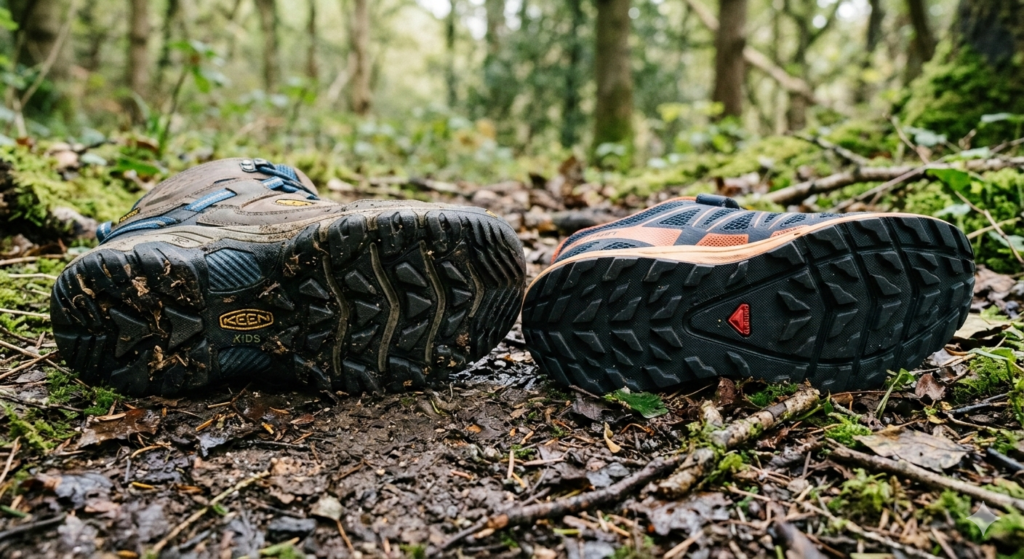
Walking boots are built for support and protection (ankles, toes, uneven ground).
Trail shoes are built for lightweight comfort and movement (more like a grippy trainer, but tougher).
For most UK families, the best choice isn’t “boots are better” or “trail shoes are better” — it’s which one fits your child, your routes, and the weather.
Walking Boots vs Trail Shoes for Kids (Quick Comparison)
| Feature | Walking Boots | Trail Shoes |
|---|---|---|
| Weight | Heavier | Much lighter |
| Ankle Support | Higher ankle support | Minimal ankle support |
| Waterproof Protection | Usually better | Depends on model |
| Comfort | Can feel stiff | Trainer-like comfort |
| Grip | Strong grip for rough terrain | Good grip for trails |
| Best For | Muddy trails, hills, winter walks | Dry trails, parks, summer walks |
Quick Answer: Which Is Better for Kids?
For most UK family walks, lightweight walking boots are the safest all-round choice because they offer better protection, grip and waterproofing.
However, trail shoes are often more comfortable for kids, especially on dry paths or during warmer months.
If your child prefers lighter footwear and your walks are mostly on firm trails, trail shoes can work perfectly well. For muddy paths, hills, and wet conditions, walking boots usually perform better.
Quick decision guide (most families can choose in 30 seconds)
Choose kids walking boots if:
- Your child is walking on muddy, uneven trails regularly
- You do hills, rocky paths, or routes with tree roots/loose stones
- Your child needs more ankle stability
- You walk in the wet seasons (which… is most of the UK)
Choose kids trail shoes if:
- Your child hates bulky footwear and walks better in “trainer-like” shoes
- Your routes are mostly dry tracks, park trails, firm woodland paths
- You want a lighter option for summer and warmer weather
- Your child runs ahead a lot and prefers flexible shoes
We noticed this with our youngest: give him something stiff and boot-like and he drags his feet. Put him in a lighter trail shoe and suddenly he’s miles ahead, looking back like we’re the slow ones.
Walking boots for kids: what they do well
1) Better ankle support
Boots come up higher around the ankle. That doesn’t “stop” ankle twists completely, but it can give more stability on uneven ground — especially on paths with rocks, roots, and steep sections.
This mattered on one rocky trail above Loch Lomond where the kids were moving quickly and not watching their feet. In trail shoes they were fine most of the time, but when the ground got rough and slippy, we could see the value of that extra support.
2) More protection from bumps and scrapes
Boots usually have:
- a tougher toe bumper
- more rigid sides
- thicker materials around the foot
That helps when kids kick stones, catch toes on roots, or scrape the side of the shoe against rock. (And kids do all of that constantly.)
3) Often warmer and better in prolonged wet
Many kids walking boots are waterproof and have more coverage. On wet grass and muddy trails, boots often keep feet drier for longer than low-cut trail shoes.
Even when both are waterproof, the extra height helps reduce water getting in from splashes and deep puddles — which kids will always find, no matter how “careful” you asked them to be.
4) Better for longer “proper walk” days
For bigger walk days (hills, longer trails, mixed terrain), boots often win because they combine grip, protection and support. If your family does a few big days a month rather than little park loops, boots can be a smart default.
Where kids walking boots can be a pain
1) Heavy = kids complain sooner
The biggest downside is weight. Adults can tolerate it. Kids feel it immediately. Heavy boots can make children:
- tire faster
- trip more
- ask for breaks more often
We’ve had walks where the only thing “wrong” was that the boots were too clunky. The trail was fine. The weather was fine. The boots weren’t.
2) Stiff boots can rub and cause blisters
Some boots need “breaking in”. Kids don’t want that. If a boot is stiff around the ankle or heel, it can rub quickly — especially if socks are thin.
3) Boots can run hot in summer
On warm days, boots can feel sweaty, and sweaty feet often lead to rubbing. Trail shoes usually breathe better, which is one reason they’re so popular for summer family walks.
Trail shoes for kids: what they do well
1) Lighter = kids walk further
This is the big one. Trail shoes are usually lighter and more flexible, so kids walk naturally and stay happier longer.
If your child runs ahead, climbs, and treats every walk like an adventure mission, trail shoes often make them feel faster and freer.
Last summer we did a dry forest trail near Ben Ime at Loch Long in trail shoes and the kids covered twice the distance they normally would. No complaints, no boot-related negotiations, just walking. On a dry day on a good path, trail shoes genuinely change the experience.
2) More comfortable straight away
Trail shoes feel like trainers — but with better tread, stronger materials, and often a bit of toe protection, similar to trail running shoes. Kids who hate boots often love trail shoes because there’s no “stiff boot” feeling.
3) Great grip on dry paths and mixed trails
A proper trail shoe has grippy lugs (tread) designed for dirt paths, gravel, and woodland tracks. For most UK family walks in decent conditions, trail shoes are genuinely enough.
4) Better for summer, travel, and everyday use
Trail shoes pull double-duty. Kids can wear them:
- on walks
- to the park
- on holidays
- for day trips
Boots can feel like “special gear”, while trail shoes feel like normal shoes.
Where kids trail shoes can let you down
1) Less ankle support on rough ground
If your route is rocky, steep, or slippery, trail shoes can be absolutely fine — but some kids benefit from the extra stability of boots. It depends on how they move and how confident they are on uneven terrain.
2) Water can get in more easily
Even waterproof trail shoes sit low. So if your child steps into a deep puddle, the water can pour in over the top. Once that happens, it’s game over.
We’ve had that classic UK moment: “It’s not even raining!” — then one deep puddle later, one sock is soaked and the walk becomes a countdown to the car.
3) Less protection from sharp rocks and heather
On rougher terrain (or where there’s heather, scree, sharp stones), boots often protect better. Trail shoes can feel “too soft” if the ground is aggressive.
So… which is better for UK walks?
Here’s the honest answer:
Boots are better when conditions are rough and wet
If most of your walks involve mud, wet grass, steep hills, rocky tracks, or you walk all year round, boots are the safer default.
Trail shoes are better when your child values comfort and speed
If your child complains about boots, moves better in flexible shoes, and your walks are mostly tracks, firm trails, parks, forest paths, trail shoes often lead to longer and happier walks.
A lot of families end up with both:
- Trail shoes for spring/summer and easier walks
- Boots for autumn/winter and bigger, wetter trails
That’s basically where we landed too — because UK weather doesn’t stay consistent for long.
The most important factor: your child’s walking style
Two kids can walk the same trail and need different footwear.
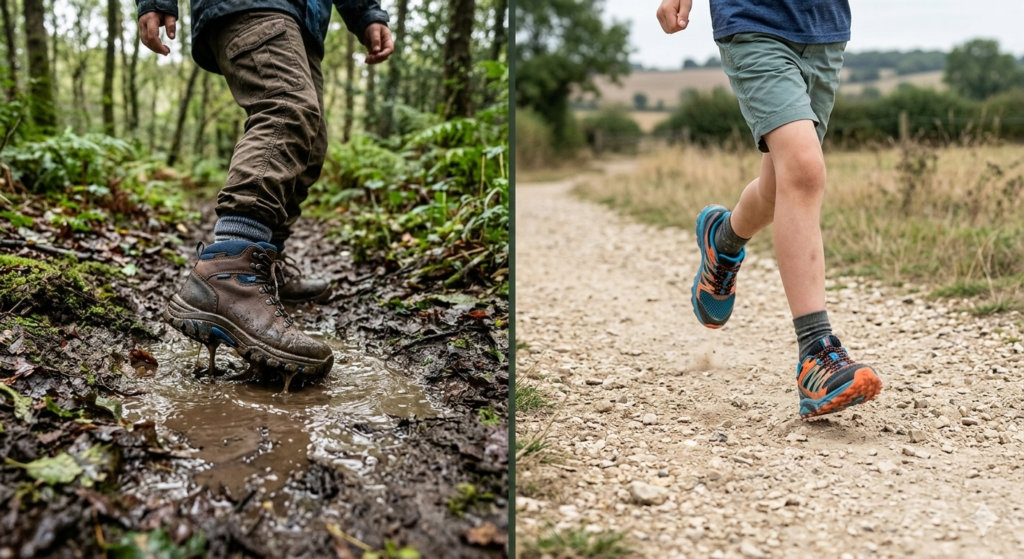
- Some kids stomp, slide, and bounce across everything (trail shoes often work great).
- Some kids are cautious, slow, or prone to rolling ankles (boots can help).
- Some kids just hate stiff footwear (trail shoes save your sanity).
Our eldest is happy in boots and barely notices them. Our youngest feels every gram and every stiff bit — so trail shoes (or very light boots) make walking easier for everyone.
Fit matters more than “boots vs shoes”
You can choose the perfect type and still have a miserable walk if the fit is wrong.
If you’re unsure what to look for when fitting footwear for kids, it can help to understand how to choose the right walking boots for kids, including sizing, grip and ankle support.
What “good fit” looks like
- Heel feels secure (not lifting up)
- Toes have a little room (roughly a thumb width)
- No pinching across the top of the foot
- Comfortable around the ankle collar (especially for boots)
Try footwear with proper walking socks, not thin school socks. That alone reduces rubbing massively.We do this every time now — bring the actual walking socks to the shop. It sounds obvious but it makes a real difference, especially with boots that have a padded ankle collar.
A Common Mistake When Choosing Kids Walking Footwear
A common mistake is choosing footwear based purely on appearance rather than how it performs on real trails.
Some boots look sturdy but feel extremely heavy for kids, while some trainers look suitable for walking but lack the grip needed for muddy paths.
If your child regularly walks on uneven trails, choosing proper walking footwear with good grip and a comfortable fit makes a noticeable difference.
We made this mistake with a pair we bought at a non-specialist shop — looked sturdy, felt fine in the store, and within ten minutes on the trail our eldest was asking if we could turn back. The boots weren’t bad. They just weren’t right for a child’s walking style.
What about waterproofing?
In the UK, waterproofing is useful… but it’s not magic.
- Waterproof boots or shoes help keep rain and wet grass out until water eventually comes in over the top — which is why most times we prefer proper waterproof walking boots for kids when regular rain is expected.
- Once soaked inside, waterproof footwear can take longer to dry.
- On warm days, waterproof footwear can be sweatier.
If your child is constantly in puddles, boots help more simply because they’re higher. But if the day is dry and warm, breathable trail shoes can be the better experience.
We’ve done walks where waterproof boots were perfect… and others where the kids’ feet were sweaty and uncomfortable even though it never rained. Matching footwear to the season actually matters.
Boots vs Trail Shoes by Season
In the UK, many families end up choosing footwear depending on the time of year.
Spring and summer:
Trail shoes often work well because they’re lighter and more breathable.
Autumn and winter:
Walking boots are usually the better option thanks to their extra protection and better performance on muddy trails.
Because UK weather changes quickly, many families eventually keep both options available.
Common UK scenarios (and what I’d choose)
Park loops, gravel tracks, woodland paths in decent weather
Trail shoes
Comfort wins. Less fatigue, more fun.
Muddy forest trails, wet grass, winter walks
Walking boots
Better coverage, warmer, usually drier.
Easy hills on dry paths
Trail shoes (or light boots if your child needs support)
If the ground is dry and firm, trail shoes are normally enough.
Rocky trails, roots, steep descents, mixed terrain
Walking boots
More support and protection for little feet moving fast downhill.
“My kid hates boots and refuses to walk”
Trail shoes
You can’t win a walking day if the footwear starts an argument before you leave the house.
What I’d do if you’re only buying one pair
If you want one “do most things” option for UK family walks:
- Choose a lightweight walking boot (not a heavy traditional boot).
- Prioritise comfort, flexibility, and a grippy sole.
- Waterproof is useful, but don’t sacrifice comfort for it.
That gives you the support of boots without the “brick on the foot” feeling that kills kids’ enthusiasm.
What We’d Actually Buy
If you’re leaning towards boots, the Merrell Moab Speed Mid Waterproof is the one we’d start with for most kids — light enough that they don’t feel like traditional hiking boots, waterproof enough for typical UK trails. We’ve covered it in detail in our kids’ lightweight walking boots guide.
If you’re leaning towards trail shoes, the Salomon XA Pro range suits kids who move fast and prefer a trainer-like feel. Good grip, durable, and they work well across three seasons.
If you’re not sure yet, our full kids’ waterproof walking boots guide covers the main options side by side with what each one suits best.
Which Would We Choose?
Walking boots and trail shoes both work in the UK — the best option depends on the kind of trails you do and how your child moves.
If your walks are mostly muddy and wet, boots usually win. If your child wants comfort and freedom, trail shoes can be the reason they’ll happily walk another hour.
The best sign you picked right is simple: they stop thinking about their feet and start enjoying the walk. We’ve had that on the forest trails and on muddy paths in November. When it happens, the whole day is easier for everyone.
Related Family Walking Guides
Choosing the right footwear is only one part of making family walks easier and more enjoyable. These guides cover other useful gear and tips that help families get outdoors more comfortably.
About The Author – Andrew Marshall
Andrew Marshall is the creator of Simple Days Outside and a UK parent of three who regularly camps, walks, and explores outdoor activities with his family. His guides focus on practical gear, realistic family adventures, and simple ways to help families enjoy the outdoors across the UK. The recommendations on this site are based on real-world use, research, and the kind of equipment families actually rely on for weekend trips and everyday outdoor fun.