

Written by Andrew Marshall
UK parent of three sharing practical advice to help families enjoy camping, walking, garden play, and simple outdoor adventures across the UK.
Creator of Simple Days Outside.
Last Updated: 17th March 2026
Most parents buying a first balance bike have the same worry: will my toddler actually use it, or will it end up in the garage after three goes? The honest answer is that it depends almost entirely on one thing — weight. A bike a toddler can manoeuvre easily gets used. A heavy, stiff one gets abandoned. Everything else on this list flows from that.
The market is full of options ranging from budget foam-wheeled bikes to lightweight magnesium alloy designs, and the difference between a bike a toddler loves and one that gathers dust in the hallway often comes down to a few specific features rather than price.
We’ve had balance bikes in our family since our eldest was about two — currently on our third child making use of them — and the pattern is consistent: lighter bikes get used more, bikes that are too heavy or too stiff get abandoned within weeks. Everything else we use to get the kids outdoors is in our Family Outdoor & Activities Hub.
What to Look for Before You Buy
Weight above everything else
The weight of a balance bike matters significantly more than most parents expect. Heavier models can sit around 5kg, while well-designed options come in closer to 3kg. That difference is a large percentage of a toddler’s body weight — and a bike a child can’t easily manoeuvre or pick up is a bike they’ll stop wanting to use.
Every balance bike on this list weighs under 4kg. That’s not a coincidence.
Seat height
The most important fit measurement. With the child sitting on the saddle, feet should rest flat on the ground with a slight bend in the knees. Too high and they can’t push off confidently. Too low and they can’t generate any speed. Most good balance bikes have a generous adjustment range — check the minimum seat height specifically if you’re buying for a younger or smaller toddler rather than relying on the stated age range, which can be misleadingly wide.
Air tyres vs foam tyres
Budget bikes typically use foam or solid EVA tyres — puncture-proof and maintenance-free. Mid-range and premium bikes use air-filled tyres, which provide noticeably better grip and a smoother ride on uneven surfaces. For park paths and pavements, foam tyres are fine. For anything rougher — gravel, grass, coastal paths — air tyres make a genuine difference.
Steering limiters
Limited-turn handlebars stop toddlers making sudden sharp turns before they have the control to manage them. Most good beginner bikes include some form of steering restriction. It’s a small feature that makes the early weeks considerably less stressful for both child and parent.
Brakes
Not essential for very young beginners — most toddlers use their feet to stop rather than a hand lever. A brake becomes more useful as they gain speed and confidence. Several bikes on this list include one; others don’t. Either works for a genuine beginner.
Our Top 5 Balance Bikes for UK Toddlers
1. Hornit AIRO 12″ Balance Bike — £139
Best for: families who want the best balance bike available at this price point — lightweight, beautifully made, and built to last across multiple children.
The Hornit AIRO is the standout balance bike in the UK market and it earns that position consistently across every review site and parent forum. The magnesium alloy frame weighs just 2.95kg — one of the lightest available — and comes with a lifetime warranty on the frame and forks. That warranty matters if you’re planning to pass it down through siblings.
What makes the AIRO genuinely different from cheaper alternatives is the combination of air-filled rubber tyres on aluminium rims, sealed bearings that protect against road debris, and a neoprene-padded stem for added safety. These aren’t cosmetic choices — they translate directly into a smoother, more confidence-building riding experience than foam-tyred budget bikes offer.
The adjustable seat accommodates inside leg measurements of 30–46cm, roughly covering ages 18 months to 5 years — meaning one bike covers the full toddler window. The footrests integrated into the frame are a practical touch for when children gain enough confidence to lift their feet and glide.
It comes in six colours including Flamingo Pink, Magma Red, and Hammer Yellow. Our youngest has the turquoise version and it’s still in excellent condition after being used by two older siblings before her. The colour is still bright, the frame has a couple of scuffs, and the tyres are fine. At this price point that longevity is exactly what you’re paying for — one purchase that covers the full balance bike years for every child in the family.
2. B’Twin Runride 900 12″ Balance Bike — around £90–100 (Decathlon)
Best for: families who want excellent quality at a lower price point — and the added benefit of Decathlon’s Second Life scheme.
Decathlon’s B’Twin Runride range is one of the most consistently recommended mid-range options in the UK, and the 900 is the pick of the range. The aluminium frame is lightweight, and the 12″ wheels come with pneumatic tyres for more grip and comfort on pavements and uneven terrain — which puts it meaningfully above the basic Runride 100 and 500 models.
The low step-over height makes getting on and off independently easy from an early age, and the adjustable seat covers a good range of heights. Build quality is solid for the price and Decathlon’s aftersales service is reliable.
The real advantage of buying from Decathlon is the Second Life scheme — once your child outgrows the bike, you can sell it back to Decathlon at a guaranteed price. For a product children only use for a year or two, that buy-back option makes the effective cost considerably lower than the sticker price suggests.
Worth checking stock in your nearest Decathlon store as well as online — the range changes periodically. Search ‘Runride 900’ within the balance bikes section to find the specific model.
3. Kinderkraft FLY PLUS 2 Balance Bike — around £45–55 (Amazon UK)
Best for: families who want a magnesium frame at a budget-friendly price — lightweight construction without the premium price tag.
The Kinderkraft FLY PLUS 2 is the pick for families who want the weight advantage of a magnesium alloy frame without spending over £100. Magnesium is significantly lighter than steel and aluminium, and on a balance bike that a toddler has to manoeuvre independently, that difference is felt immediately. A child can pick this bike up, turn it around, and push off without fighting the weight of it — which sounds like a small thing until you’ve watched a toddler repeatedly abandon a heavier bike rather than wrestle with it.
The retro-style design with 12-inch wheels and adjustable seat covers children from around 2 years old, and the foam EVA wheels are puncture-proof and maintenance-free — genuinely useful for families who don’t want to deal with tyre pressure checks on a toddler’s bike. The handlebar lock limits the turning angle and prevents sudden uncontrolled turns, which makes the early weeks of learning considerably less nerve-wracking.
Build quality is solid for the price and Kinderkraft has a reliable track record across the UK market. For a magnesium frame balance bike at this price point, the FLY PLUS 2 represents genuinely good value — particularly for families who want the lightweight advantage without committing to a premium price.
4. Kinderkraft TOVE Balance Bike — around £35–50 (Amazon UK)
Best for: very young beginners from 18 months — the lightest bike on this list and the easiest for toddlers to handle independently from day one.
The TOVE weighs just 2kg which makes it the lightest balance bike on this list by a significant margin and genuinely one of the lightest available anywhere in the UK market. At this weight a toddler can pick it up, carry it, turn it around, and push off without any assistance. That independence is exactly what makes balance bikes work for young children, and the TOVE delivers it better than anything else at this price point.
The frame is made from durable PP and TPR plastic rather than metal which contributes directly to the low weight and also means it’s resistant to drops, impacts, and the general treatment toddlers dish out. The seat adjusts between 31 and 34.5cm, which suits children from around 18 months to 4 years. The puncture-proof foam wheels are pump-free and spokeless no inflation required, ever, and no spokes to catch small fingers. Two built-in carry handles on the frame mean a parent can grab it easily when a toddler inevitably decides they’ve had enough and sits down on the path.
Assembly takes three steps and requires no tools — genuinely ready to ride within minutes of opening the box. The limited steering angle prevents sudden sharp turns, the handlebar grips are non-slip rubber, and the rounded frame has no protruding edges that could cause injury.
The TOVE is suitable from 18 months up to 25kg, which gives it a good age range for the price. It’s not a bike that will be passed between multiple siblings over five years the way the Hornit AIRO will — but for a first balance bike for a very young toddler where you want something light, simple, and low-cost, the TOVE is difficult to argue with.
5. B’Twin Runride 500 10″ Balance Bike — around £35–45 (Decathlon)
Best for: very young toddlers and first-time balance bike buyers on a tight budget — the 10″ wheels make it more appropriate for smaller children than most 12″ options.
The smaller 10″ wheel size of the Runride 500 makes it a better fit for children at the younger end of the balance bike range — from around 18 months to 3 years — because the lower seat height and compact geometry suit smaller bodies better than a standard 12″ bike. Most balance bikes default to 12″ wheels, which can feel too large for a genuine beginner toddler just finding their feet.
It comes with Decathlon’s Stop Easy brake designed for small hands — a useful feature even for beginners — and the ball bearings give a noticeably smoother roll than the basic Runride 100. At this price it’s one of the better-value genuine beginner bikes available in the UK.
For a child who’s only just started walking confidently, the 10 inch wheel size makes a more meaningful difference than any other spec on this list. It’s the detail most buying guides miss — and the reason we’d always recommend parents of very young toddlers look at 10 inch options before defaulting to the standard 12 inch.
As with all Decathlon bikes, the Second Life scheme applies — worth factoring in when comparing against similarly priced Amazon alternatives that offer no buy-back option.
Do Balance Bikes Actually Work?
Yes — and the evidence from families who’ve used them is consistent. Children who use a balance bike typically skip stabilisers entirely and go straight to riding confidently once they get their first pedal bike.
The reason is straightforward: balance and steering are the hard parts of cycling. Pedalling is the easy part. A balance bike teaches the difficult skills first, at a pace and intensity the child controls. By the time pedals are introduced, the child already knows how to balance and steer — pedalling is just one new thing to add rather than three.
Our eldest went from balance bike to pedal bike in an afternoon. Our middle one took a week. Our youngest is still on the balance bike. The timeline varies but the progression is always smooth — no wobbling, no stabiliser removal trauma, no falling off on day one of a pedal bike.
If a toddler shows no interest initially, the most common reason is that the bike is too heavy or the seat is too high. Lower the seat first, try again on a smooth flat surface rather than grass, and give it a few sessions before worrying. Most resistance dissolves once they realise they can move independently — the moment it clicks is usually sudden and unmistakable.
A balance bike also fits naturally into wider outdoor play — once toddlers are confident on two wheels, they tend to stay outside longer and cover more ground. If you’re thinking about how to make the garden or local green space more engaging alongside the bike, turning outdoor space into something kids actually want to explore is worth thinking about early rather than as an afterthought.
Getting the Fit Right
Fit is the single most important factor in how quickly a child takes to a balance bike.
The seat should be set so both feet rest flat on the ground when sitting, with a slight bend in the knees. Too high and the child can’t push off — they’ll just sit there. Too low and they can’t generate momentum or build up to gliding.
Seat height is worth checking carefully before buying — minimum seat height against your child’s inside leg measurement is more reliable than the stated age range, which can be misleadingly wide across brands. A bike listed as suitable from 2 years might have a minimum seat height that doesn’t actually fit a small two year old. Measure first, order second.
What to Wear on the First Ride
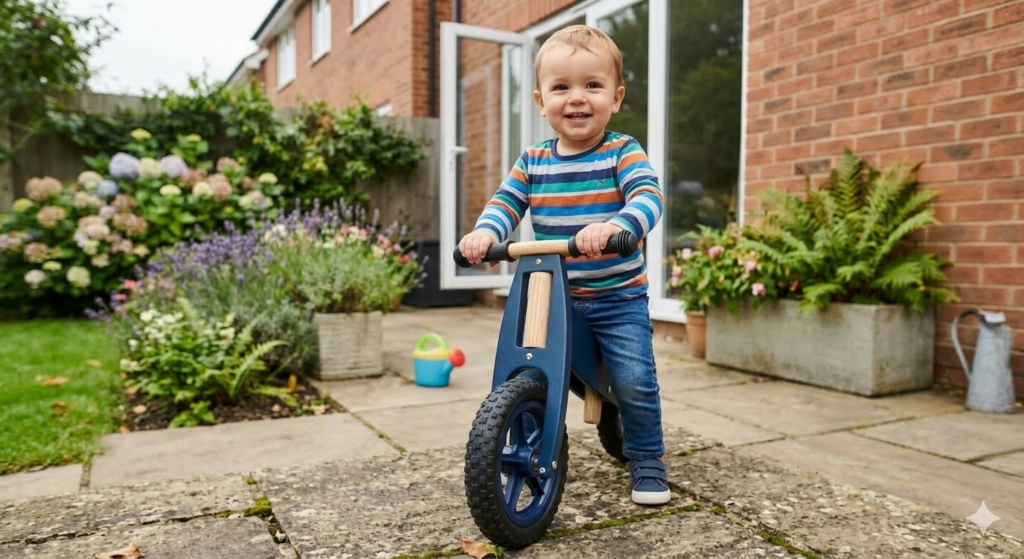
A helmet is non-negotiable from the first ride. Children fall sideways on balance bikes more than they fall forwards — a properly fitted kids’ bike helmet that covers the back of the head matters from day one. Both Hornit and Decathlon sell children’s helmets alongside their bikes.
Knee pads for toddlers are worth having for the first few weeks while confidence is building, particularly on harder surfaces. Most children outgrow the need for them quickly once they learn to put their feet down reliably.
Footwear matters more than most parents expect too — closed-toe shoes with a flat grippy sole give the best feel for pushing off and stopping. Wellies work in a pinch for muddy days but aren’t ideal for everyday riding. A good pair of toddler outdoor shoes makes a practical difference on longer sessions — particularly once children start covering real distances rather than just scooting around the garden.
Alongside the bike, having somewhere to take a break and regroup matters on longer outdoor sessions. A pop-up play tent or den in the garden gives younger children a base to return to, which can actually extend how long they stay outside rather than coming in at the first sign of tiredness.
Frequently Asked Questions
What age should a toddler start a balance bike? Most children are ready between 18 months and 2 years, though some start as young as 14–16 months if the bike has a low enough minimum seat height. The readiness indicator isn’t age — it’s whether they can walk steadily and show interest in wheeled toys.
Is a balance bike better than a bike with stabilisers? For most children, yes — and the evidence is consistent. Stabilisers teach children to lean into turns incorrectly and don’t develop the balance instinct that cycling actually requires. When stabilisers come off, children effectively have to relearn how to ride. A balance bike teaches correct balance from the start — the transition to a pedal bike is faster, smoother, and less traumatic for everyone involved.
How long do children use balance bikes? Typically one to three years, depending on the age they start and how quickly they progress to a pedal bike. A child who starts at 18 months may use a balance bike until 4 or 5. One who starts at 3 may move to pedals within six months.
Are foam tyres or air tyres better? For flat park paths and pavements, foam tyres are perfectly adequate and have the advantage of being puncture-proof. For grass, gravel, and uneven ground — which on the west coast of Scotland is almost guaranteed — air tyres provide noticeably better grip and a smoother ride. If your child will be using the bike on mixed terrain, air tyres are worth the additional cost.
Can balance bikes be handed down between siblings? Yes — and this is one of the best arguments for spending more on a quality model. The Hornit AIRO‘s lifetime frame warranty and the Decathlon Second Life scheme both exist specifically because good balance bikes outlast individual children. Our AIRO has been used by three children and is still in daily use.
Do balance bikes come ready to ride? Almost — most require five to ten minutes of assembly. The handlebars usually need aligning and tightening, and the seat height needs setting. Both tasks need a 5mm Allen key — most bikes include one in the box but worth having a spare.
When should a child move from a balance bike to a pedal bike? When they’re consistently gliding with both feet off the ground for several seconds and steering confidently. At that point the balance is there and a pedal bike is the natural next step. Most children hit this stage between 3 and 5 but it varies considerably. Once they’re ready to move up, what goes underneath a climbing frame or play area in the garden matters just as much as the equipment itself — safety surfaces make a real difference once children are moving faster and with more confidence outdoors.
Which Balance Bike Should You Buy?
For most families, the choice comes down to budget and terrain.
If you’re buying for regular outdoor use on mixed surfaces and want a bike that lasts across multiple children, the Hornit AIRO at £139 is the clearest recommendation. The weight, the build quality, and the lifetime warranty justify the price across a three to five year use period — and across multiple siblings it becomes one of the most cost-effective purchases on this list.
For families who want solid quality at a lower price with the added bonus of a buy-back scheme, the B’Twin Runride 900 from Decathlon at around £90–100 is the most practical mid-range option.
For a lightweight magnesium frame at a budget-friendly price with foam tyres, the Kinderkraft FLY PLUS 2 at around £60–75 is a strong choice that punches above its price point.
For very young toddlers from 18 months who need the lightest possible bike to handle independently on smooth surfaces and paths, the Kinderkraft TOVE at around £35–50 is the standout choice — at just 2kg it’s the easiest bike on this list for small children to actually use without help.
For very young toddlers who’ll be riding on varied outdoor terrain — grass, gravel, uneven paths — the Decathlon Runride 500 in 10″ is the better fit. The smaller wheel size and included brake give it an advantage outdoors that the TOVE‘s flat surface design doesn’t match.”
Whatever you choose, set the seat height correctly on day one, put a helmet on before the first ride, and then get out of the way. Most toddlers take to balance bikes faster than their parents expect — and the first time you see them gliding with both feet off the ground, the purchase makes complete sense.
Related Guides
About The Author – Andrew Marshall
Andrew Marshall is the creator of Simple Days Outside and a UK parent of three who regularly camps, walks, and explores outdoor activities with his family. His guides focus on practical gear, realistic family adventures, and simple ways to help families enjoy the outdoors across the UK. The recommendations on this site are based on real-world use, research, and the kind of equipment families actually rely on for weekend trips and everyday outdoor fun.