

Written by Andrew Marshall
UK parent of three sharing practical advice to help families enjoy camping, walking, garden play, and simple outdoor adventures across the UK.
Creator of Simple Days Outside.
Last Updated: 18th March 2026
Most children’s bikes with stabilisers end up in the garage within six months. Not because the child doesn’t want to ride — but because the bike is too heavy, the brakes don’t fit their hands, or the stabilisers were fitted flat to the ground so the child never develops the balance instinct that would let them eventually ditch them.
Getting this right from the start makes the difference between a child who rides every weekend and one who asks to go home after ten minutes. Here’s what actually matters.
We’ve had several bikes through our family over the years and the weight of the bike matters more than most parents realise. A heavy bike with stabilisers is hard work for a small child — they get frustrated, stop enjoying it, and the stabilisers never come off because the bike never gets used enough. A light bike with well-fitted stabilisers is a different experience entirely. Everything else we use to keep the kids active outdoors is in our Family Outdoor & Activities Hub.
The Honest Truth About Stabilisers
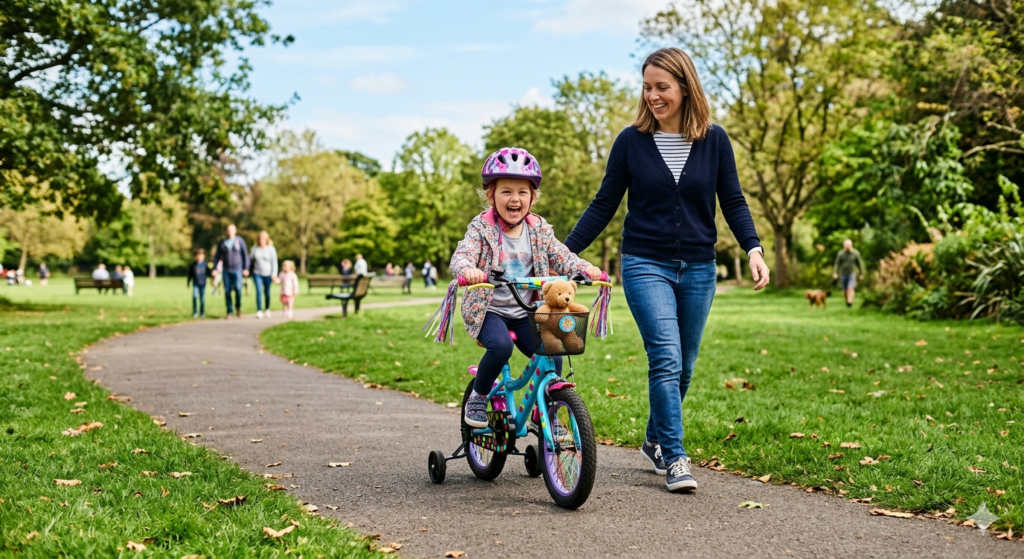
Stabilisers allow a child to focus on pedalling and steering without worrying about balance. That’s genuinely useful for children who haven’t used a balance bike, children with additional needs who may find balance bikes difficult, or children who simply want to be included in family cycling before they’re ready for two wheels.
What stabilisers don’t teach is balance — and that’s worth knowing upfront rather than as a surprise when the time comes. When the stabilisers come off, there will be a learning curve. It’s not a failure of the method, it’s just how it works. Most children get there within a few sessions on flat ground with a patient adult alongside. Our middle one took an afternoon. The youngest took a week of five-minute attempts before it clicked — then never looked back.
For children who have already mastered a balance bike, going straight to a pedal bike without stabilisers is usually the faster route. For everyone else, a bike with stabilisers is a perfectly valid and widely used approach.
What to Look for Before You Buy
Weight — the most important factor
A children’s bike with stabilisers should be as light as possible. Heavy bikes — anything over 9–10kg — are genuinely hard for young children to ride, which means they don’t ride them, which means the stabilisers never come off. Aluminium frames are significantly lighter than steel and worth prioritising even at a slightly higher price.
Brakes designed for small hands
Standard adult-sized brake levers are too large for young children to operate effectively. Look for short-reach brake levers with an adjustment screw that narrows the gap to the handlebar — this makes a significant difference to whether a child can actually stop safely rather than just dragging their feet.
Stabiliser quality and adjustability
Stabilisers that are adjustable in height are worth prioritising — and this matters more than most people realise. See the section below on fitting them correctly. Stabilisers that attach and detach easily mean less faff when the time comes to remove them.
Mudguards and chainguard
A full chainguard keeps small fingers away from the chain and stops trouser legs catching. Mudguards mean a wet park path doesn’t ruin the ride — and in Scotland particularly, this is not a theoretical concern.
Wheel size and age fit
12-inch wheels suit most children aged 3–5 at 88–107cm. 14-inch wheels suit ages 4–6 at around 90–115cm. 16-inch wheels suit ages 5–7 at roughly 105–120cm. Height and inside leg are more reliable guides than age — check the manufacturer’s sizing guide rather than relying on age ranges alone.
How to Fit Stabilisers Correctly — The Detail Most Parents Miss
Most stabilisers come fitted flat to the ground from the box. This is actually the wrong position.
Stabilisers fitted flat mean the bike never tilts — the child is always perfectly upright and never develops any sense of balance. When the stabilisers eventually come off, they have to start almost from scratch.
The correct position is with the stabilisers set slightly higher than flat — around 1–2cm of clearance from the ground when the bike is upright. This means the bike tilts slightly when cornering and the child’s body naturally compensates, beginning to develop the balance instinct gradually while still having the safety net.
Most adjustable stabilisers have a wing nut or bolt that allows this adjustment. As a starting point: fit them so the bike can tilt about 5–10 degrees before the stabiliser touches the ground. It looks alarming at first but children adapt within minutes and the long-term benefit is significant — the transition to two wheels is considerably smoother for children whose stabilisers were set up this way. Once the stabilisers do come off, having somewhere safe and engaging to practise matters a garden set up for active play gives children the space and confidence to keep going.
Our Picks: Best Kids Bikes With Stabilisers
1. Raleigh Pop 12″ Kids Bike with Stabilisers — around £140–170
Best for: first-time riders aged 3–5 who need a reliable, lightweight bike from a trusted UK brand.
The Raleigh Pop 12 is consistently one of the most recommended first pedal bikes in the UK and earns that reputation through genuine quality rather than marketing. The aluminium frame keeps the weight to 8.3kg — meaningfully lighter than many cheaper steel-framed alternatives at this size. For a child just learning to push themselves on a pedal bike, that difference is felt immediately.
The brake levers are specifically designed for small hands with an adjustment screw to narrow the reach for smaller fingers. This is a detail that cheaper bikes skip and which makes a real practical difference to whether a child can stop safely. High-rise handlebars give an upright riding position that suits younger, less confident riders.
Internal cable routing hides the brake cables within the frame — removing a potential snag hazard and giving the bike a cleaner look. Puncture-resistant tyres, mudguards, and stabilisers are all included. Suited to children aged 3–5 or 88–107cm tall.
One of ours used a Pop before moving to a full pedal bike — the build quality held up through siblings and the brake adjustment was one of the first things I noticed compared to cheaper alternatives we’d tried before. The stabilisers removed cleanly and the transition to two wheels was straightforward when the time came.
2. Raleigh Pop 14″ Kids Bike with Stabilisers — around £150–180
Best for: slightly older or taller children aged 4–6 who have outgrown or skipped the 12″ size.
The Pop 14 carries all the same design principles as the 12″ — aluminium frame, child-specific brake levers with adjustment screw, internal cable routing, mudguards — in a slightly larger package suited to children aged 4–6 at 88–107cm.
At under 9kg it remains manageable for children in this age group and the higher riding position gives a little more room to grow into. The stabilisers are included and attach and remove cleanly.
For families whose child is at the upper end of the 12″ range but not quite ready for a 16″, the Pop 14 avoids the common mistake of buying a bike that’s too big to build confidence on. A bike that fits well and feels manageable is a bike that gets ridden — and getting ridden consistently is what actually teaches children to pedal. We bought the 14″ for our middle child specifically because they were tall for their age — a 12″ would have been outgrown within a season.
3. B’Twin 14″ Kids Bike with Stabilisers — around £120–140 (Decathlon)
Best for: families who want excellent value at the 14″ size — strong build quality at a noticeably lower price than the Raleigh equivalent.
Decathlon’s B’Twin range is one of the best-kept secrets in UK kids cycling. The 14″ bike with stabilisers is designed for children aged 3–4.5 at 90–105cm and comes with stabilisers included as standard, a full chainguard, and mudguards. The low step-through frame makes getting on and off independently easy from an early age.
The Stop Easy braking system — Decathlon’s proprietary lever design that reduces required hand force by around 30% — is a meaningful safety feature that makes effective braking genuinely achievable for small hands. This is the kind of detail that makes a real difference on a first bike and is usually only found on more expensive alternatives.
The stabilisers are tool-free to remove — which means no rummaging for spanners when the day comes to take them off. That day arrived earlier than expected with our youngest, and having stabilisers that come off in two minutes rather than twenty makes it a much less fraught experience.
Decathlon’s Second Life scheme applies — once your child outgrows the bike, you can sell it back at a guaranteed price, which reduces the effective cost meaningfully for a product children typically use for one to two years.
4. B’Twin 16″ Kids Bike with Optional Stabilisers — around £190-200 bike + £7.99 stabilisers
Best for: children aged 4.5–6 at 105–120cm who need a 16″ bike but still want the option of stabilisers.
The B’Twin 16″ is a strong step-up option for children ready for a larger wheel size. At 6.85kg it’s one of the lightest 16″ kids bikes available under £200 in the UK — a meaningful advantage where steel-framed alternatives can come in considerably heavier.
The 16″ B’Twin doesn’t include stabilisers as standard, but Decathlon sells B’Twin-specific 16″ stabilisers separately for £7.99 — making the total cost very competitive while giving flexibility to buy without them for children ready to go straight to two wheels.
The aluminium frame carries a lifetime warranty on frame, stem, and handlebar — with spare parts guaranteed for 10 years. For a bike that might see multiple children through, that’s a meaningful commitment. The lifetime frame warranty is what tipped us toward Decathlon for our eldest’s step-up bike — knowing we could still get parts years later made the decision easier. Front and rear lights are included, the Stop Easy braking system is fitted, and the full chainguard keeps school uniforms clean.
Compatible stabilisers: B’Twin 16″ Stabilisers — £7.99 at Decathlon
5. Glerc Bubble Kids Bike with Stabilisers — 12″, 14″ & 16″ — around £80–110 (Amazon UK)
Best for: families who want a colourful, well-equipped first bike with stabilisers and accessories included across multiple sizes.
The Glerc Bubble is a cheerful, practical budget bike that covers the 12–16″ range in a single product line — useful if you’re buying for a child who’ll need a size up within a year or two and want to stick with the same brand. It comes with a basket, rear rack, and removable stabilisers as standard, which gives a child’s first bike a sense of personality that purely functional alternatives don’t.
The Bubble arrives 95% assembled with tools included — most families report around 20 minutes to complete setup, which is straightforward for a Sunday morning before heading to the park. The short-travel handbrake is designed for young riders, giving good stopping control with minimal hand strength required.
One honest note: the HI-TEN steel frame is heavier than aluminium alternatives — some reviewers note the bike comes in at 12–15kg depending on size, which is noticeably heavier than the Raleigh or B’Twin options. For shorter outings on flat ground this is manageable, but for a child riding longer distances or any incline, the weight difference is worth considering.
For a child who has strong opinions about what their bike looks like — and most do — the Glerc Bubble’s colourful designs and accessories mean they’re excited to ride it, which matters more than the weight difference on a flat park path.
When to Remove the Stabilisers
Knowing when to take the stabilisers off is as important as choosing the right bike.
The signs to look for: the child consistently rides with their weight centred rather than leaning into the stabilisers. The stabilisers are barely touching the ground during straight-line riding. The child is confident at speed and shows interest in going faster. They’re able to steer predictably and stop when needed.
When these signs appear, removing the stabilisers and lowering the saddle slightly — so both feet can rest flat on the ground — gives the transition the best chance of going smoothly. Don’t rush it and don’t delay it once the signs are there.
We did the first stabiliser-free attempt at Balloch Country Park — wide flat tarmac paths, no traffic, enough space to pick up speed gradually. It took about twenty minutes before confidence replaced anxiety. Location matters — a busy pavement or a grassy slope is the wrong setting for the first attempt. If you have outdoor space at home, safety surfaces under play equipment apply equally to the area where children practise their first two-wheel attempts — a soft or level surface makes a fall much less daunting. A kids cycling helmet is essential throughout, but especially during those first wobbly two-wheel sessions.
Children who are ready usually surprise their parents with how quickly the balance clicks. Most of the anxiety is on the adult’s side.
Frequently Asked Questions
What age should a child have stabilisers? Most children start on stabilisers between 3 and 5 years old, though this varies by child and whether they’ve previously used a balance bike. A child who has used a balance bike may not need stabilisers at all. A child starting cycling for the first time between 4 and 6 will typically benefit from them initially.
Are stabilisers bad for learning to ride? They’re not bad — they’re a different route to the same destination. Children who learn with stabilisers do need to go through a transition period when they come off, whereas balance bike graduates typically don’t. But many children have learned perfectly well with stabilisers and the approach remains widely used across the UK.
How do I know when to take the stabilisers off? When a child is consistently riding with their weight centred and the stabilisers are barely touching the ground during normal riding, they’re ready. Lower the saddle first so feet can rest flat, remove the stabilisers, and start on flat quiet ground. The Loch Lomond cycle paths around Balloch are ideal for this — wide, flat, tarmac, and forgiving.
Do I need to buy a specific brand of stabilisers for my child’s bike? For B’Twin bikes, Decathlon’s own stabilisers are designed specifically for their frames and are the recommended option. For most other brands including Raleigh, universal stabilisers for kids bikes fit 12–20″ wheels and work reliably. Avoid very cheap unbranded options — the axle attachment quality varies significantly.
Can stabilisers be added to any kids bike? Almost all bikes up to and including a 20-inch wheel will accept stabilisers, though it’s worth checking compatibility before purchasing separately. Most bikes with 12–16″ wheels are compatible without modification.
How heavy should a kids bike be? As a rule of thumb, a child’s bike should weigh no more than 30–40% of the child’s body weight. For most 3–6 year olds this means looking for bikes under 9–10kg. Lighter is always better — aluminium frames are worth the extra cost for this reason.
What safety gear does my child need alongside the bike? A properly fitted kids bike helmet is non-negotiable from the very first ride. For younger children building confidence, kids knee and elbow pads are worth having for the first few weeks — particularly on harder surfaces. Kids cycling gloves protect small hands in a fall and give better grip on the handlebars. None of this needs to be expensive — basic versions of all three do the job perfectly well.
Which Bike Should You Buy?
For most families, the choice comes down to budget and how long you want the bike to last.
If budget allows and you want a lightweight, well-built bike from a trusted UK brand, the Raleigh Pop 12 or 14 is the most reliable choice. The brake lever design and aluminium frame justify the cost — and the bike holds its value well if passed between siblings.
For excellent value at a lower price, the B’Twin 14″ from Decathlon matches the Raleigh on many key features — particularly the Stop Easy braking system — at a meaningfully lower price. The Second Life buyback scheme makes it even more practical.
For the 16″ size with stabilisers as an option, the B’Twin 16” with separately purchased Decathlon stabilisers is the best combination of weight, quality, and price available in the UK right now.
For families on a tighter budget who want a colourful first bike with accessories included, the Glerc Bubble covers the basics with cheerful designs across multiple sizes.
The bike that gets ridden is the right bike. Get the weight right, get the fit right, adjust the brake levers before the first ride — and then get out of the way. Most children take to it faster than their parents expect.
Related Guides
About The Author – Andrew Marshall
Andrew Marshall is the creator of Simple Days Outside and a UK parent of three who regularly camps, walks, and explores outdoor activities with his family. His guides focus on practical gear, realistic family adventures, and simple ways to help families enjoy the outdoors across the UK. The recommendations on this site are based on real-world use, research, and the kind of equipment families actually rely on for weekend trips and everyday outdoor fun.