
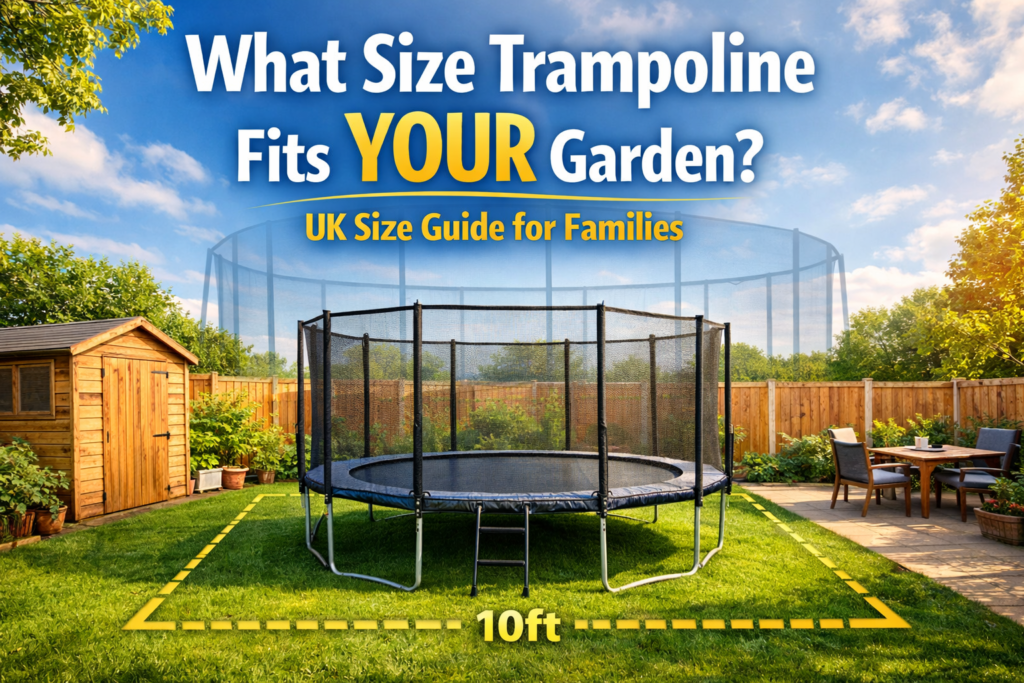

Written by Andrew Marshall
UK parent of three sharing practical advice to help families enjoy camping, walking, garden play, and simple outdoor adventures across the UK.
Creator of Simple Days Outside.
Buying a trampoline sounds simple — until you start measuring your garden and realise how quickly things get complicated. Too small and the kids lose interest. Too big and it dominates the space or becomes unsafe. For many UK families, getting the size right is the difference between years of outdoor fun and an expensive regret.
This guide is part of our wider advice on creating safe, fun outdoor spaces for children, so if you’re still planning your setup you can explore more ideas in our Garden & Outdoor Play for Kids hub — covering everything from trampolines and climbing frames to practical ways to turn your garden into a space kids actually use.
Whether you have a compact new-build garden, a typical semi-detached lawn, or a larger family space, here’s how to choose a trampoline that actually fits your life.
👉 In This Guide
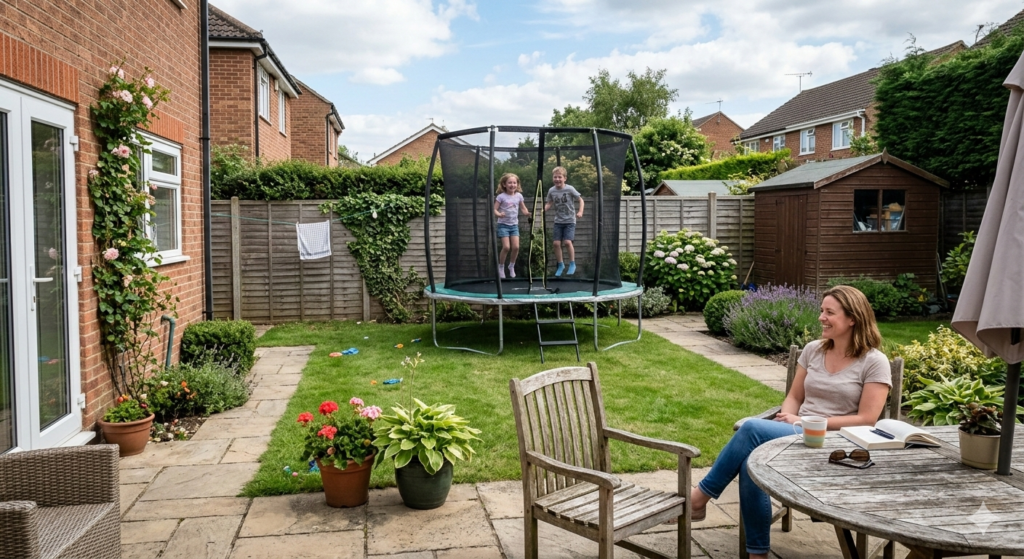
Quick Answer Summary
If you just want the short version:
- Small garden (new build / narrow lawn): 6–8ft trampoline for one younger child
- Medium garden (typical family garden): 10ft trampoline for one child or siblings taking turns
- Larger garden: 12–14ft trampoline for multiple children and long-term use
- Teenagers or energetic siblings: 12ft minimum
Most UK families find that a 10ft trampoline with enclosure is the safest “middle ground” — big enough to enjoy, small enough to place safely.
If you have two or more children close in age, go one size bigger than you think.
Quick Garden Size → Trampoline Size Guide
| Lawn Width Available | Recommended Size | Suitable For |
|---|---|---|
| Under 3.5 m (11–12 ft) | 6–8 ft | One young child |
| 3.5–4.5 m | 10 ft | One child / occasional sharing |
| 4.5–5.5 m | 12 ft | Siblings / long-term use |
| Over 5.5 m | 14 ft | Multiple children / teens |
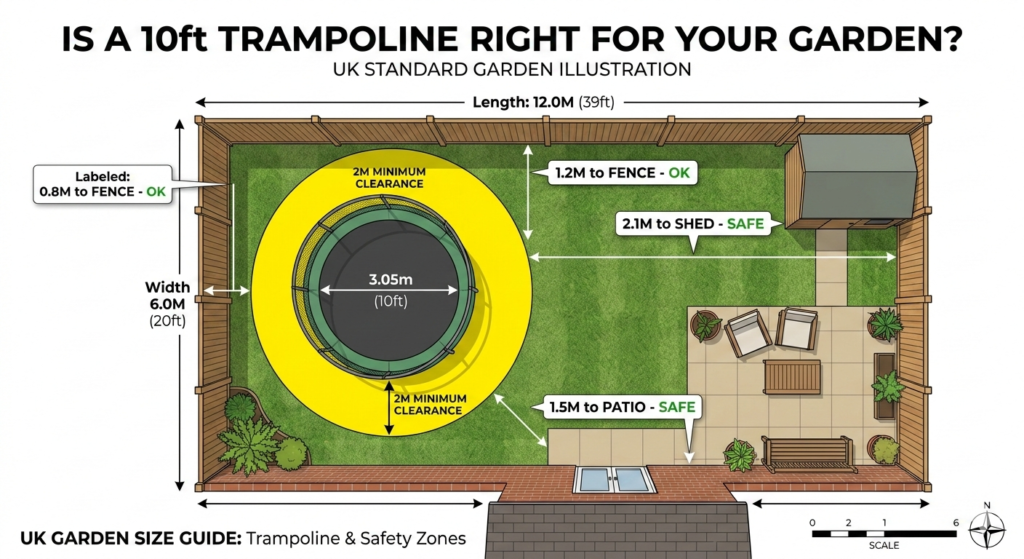
Always allow at least 1 m clearance around the trampoline.
Trampoline Sizes Explained (UK)
Manufacturers list trampoline sizes by frame diameter (edge to edge), not including the safety net, which adds extra width.
Here’s what each size realistically means.
6ft Trampoline
- Best for toddlers and very young children
- Fits small gardens where space is tight
- Limited bounce area
- Usually outgrown by age 6–7
A 6ft model can work as a starter trampoline, but many parents find children quickly want something bigger.
8ft Trampoline
- Suitable for one primary-school child
- Works in compact gardens
- Moderate bounce space
- May feel small after a couple of years
An 8ft trampoline with enclosure is often the largest size that comfortably fits newer housing developments.
10ft Trampoline
- Ideal for most UK families
- Suitable for one child or siblings taking turns
- Good balance of fun and space efficiency
- Usually lasts well into later childhood
A 10ft garden trampoline is often considered the safest default choice.
12ft Trampoline
- Great for multiple children
- Strong bounce performance
- Needs a decent lawn area
- Feels “proper” rather than toy-like
A 12ft garden trampoline is where play value really increases, but space requirements jump too.
14ft Trampoline
- Best for large gardens
- Suitable for teens and energetic users
- Can dominate smaller spaces
- Requires careful placement
If you have the room, a 14ft trampoline with safety net offers the most longevity.
How Long Will Each Size Last?
As a rough guide:
- 6ft: 1–2 years
- 8ft: 2–4 years
- 10ft: 5+ years for most families
- 12ft+: Often lasts through childhood
Children don’t just grow taller — they bounce harder, jump higher, and want more space.
If you expect the trampoline to stay in your garden long-term, choosing a slightly larger size now often avoids upgrading later.
How Much Space Do You Need? (The “Real Space” Rule)
A common mistake is measuring only the trampoline’s frame diameter. In reality, you need space for:
- The frame
- The safety net poles
- A fall zone around it
- Access for the ladder and entry zip
Minimum Clearance Around the Trampoline
Ideally allow:
- At least 1 metre on all sides (more if possible)
- Clear space from fences, walls, sheds, and patios
- No hard objects nearby
So a 10ft trampoline often needs closer to 13–14ft of clear garden width.
Overhead Clearance
Don’t forget what’s above:
- Tree branches
- Washing lines
- Pergolas
- Low roofs
- Garden lights
Children bounce higher than most parents expect, especially on larger models.
Why Clearance Matters
Trampolines shift and flex during use, especially with energetic jumping, so clearance isn’t just about safety — it prevents constant bumping into fences and structures.
If safety is a concern, it’s worth reading a broader overview of trampoline risks and precautions in our guide to whether trampolines are safe for children.
How to Measure Your Garden for a Trampoline
Before buying, measure the usable lawn area — not the entire garden.
Check:
- Distance between fences at the narrowest point
- Space taken by sheds, patios, or decking
- Areas that must remain clear for walking or seating
- Whether gates or paths need access
A simple way to visualise the space is to mark out the trampoline footprint using:
- Garden furniture
- Rope or string
- A hosepipe
- Chalk on patio areas
This quickly shows whether the trampoline will dominate the garden or fit comfortably.
Typical UK Garden Scenarios
Most UK homes fall into a few predictable layouts.
Small Garden / New Build / Narrow Plot
Common in modern developments:
- Long but narrow lawns
- Close fences
- Patio taking up significant space
- Limited privacy
Best choice: 6ft or 8ft trampoline
An 8ft trampoline with enclosure often fits if placed carefully along the garden’s length rather than width.
Tips:
- Position centrally rather than against a fence
- Ensure gate access remains usable
- Consider how it affects lawn mowing
Medium Family Garden
Typical semi-detached or older detached homes:
- Decent rectangular lawn
- Room for a shed and seating area
- Enough width for safe clearance
Best choice: 10ft trampoline
A 10ft garden trampoline works well without overwhelming the space. It also leaves room for football, picnics, or other play equipment.
Larger Garden
Detached homes or rural properties:
- Wide open lawn
- Fewer restrictions
- Space for multiple play features
Best choice: 12ft or 14ft trampoline
A 12ft garden trampoline gives children plenty of room to bounce safely and remains enjoyable into teenage years.
Sloped or Uneven Gardens
Many UK gardens are not perfectly flat.
Important considerations:
- Trampolines must sit level
- Uneven legs cause frame stress
- Bounce becomes unpredictable
Solutions include:
- Minor ground levelling
- Positioning on the flattest section
- Professional landscaping if needed
Avoid placing a trampoline halfway up a slope.
Patio or Artificial Grass Areas
Possible, but not ideal without planning.
Issues to consider:
- Hard surfaces increase injury risk
- Anchoring may be difficult
- Drainage underneath matters
If placing on a patio, protective trampoline ground mats can help soften the surrounding area.
Round vs Rectangular: Does It Change the Size You Need?
Yes — shape affects both space use and bounce behaviour.
Round Trampolines
Most common for homes.
Advantages:
- Direct bounce toward the centre
- Easier for beginners
- Safer for casual play
- Usually cheaper
They fit most gardens well and are the standard choice for families.
Rectangular Trampolines
Less common but popular for serious jumpers.
Advantages:
- Stronger, more even bounce
- Larger usable jumping area
- Better for gymnastics-style play
However, they require more space and precise placement. A rectangular model of the same stated size often feels bigger in practice.
For small or medium gardens, round trampolines are usually the easier option.
Safety and Placement Basics
Getting the size right is only part of the equation. Placement matters just as much.
Safety Net
Always choose a model with an enclosure. Modern designs integrate the net inside the frame to reduce impact with springs.
Ladder Placement
You’ll need space for safe entry. A trampoline ladder should face open garden space, not a wall or fence.
Fall Zones
Keep these areas clear:
- Furniture
- Toys
- Planters
- Hard landscaping
A trampoline should never feel boxed in.
UK Weather Reality Check
In the UK, trampolines rarely stay perfectly clean or dry.
Consider:
- Persistent rain and water pooling
- Moss growth on shaded lawns
- Winter storage or cover use
- Exposure to coastal winds
- Rust risk in damp climates
Positioning the trampoline where it gets some sunlight can help keep the jumping surface drier and reduce moss buildup.
Anchoring in UK Weather
Wind is a major issue, especially in exposed areas. Even medium trampolines can lift or tip.
Using a trampoline anchor kit is strongly recommended. For a step-by-step approach, see our guide to keeping trampolines secure during storms.
Avoid These Placement Mistakes
- Too close to fences
- Directly beside sheds
- On uneven ground
- Under low branches
- On very hard surfaces without protection
What Most Parents Get Wrong (and How to Avoid It)
After years of backyard experience across the UK, a few patterns appear again and again.
1. Buying Too Small
It feels safer initially, but children quickly get bored.
Solution:
If space allows, size up once.
2. Buying Too Big
A trampoline that dominates the garden reduces usable space and can create safety issues.
Solution:
Measure clearance, not just diameter.
3. Forgetting Access Space
You need room to climb on and supervise.
Solution:
Plan where the ladder and zip will face.
4. Underestimating Wind Exposure
Trampolines can travel surprisingly far in strong gusts.
A weatherproof trampoline cover helps reduce wind drag when not in use.
5. Choosing Cheap Frames
Low-quality steel rusts quickly in the UK climate.
A durable 12ft garden trampoline with galvanised steel frame will last far longer than a bargain model replaced every few years.
One Child vs Siblings: Does Size Matter?
For a single child, a 10ft trampoline usually provides plenty of space.
For siblings:
- Larger sizes reduce collisions
- Taking turns is safer than simultaneous jumping
- Age gaps matter — older children bounce much harder
If children are likely to use the trampoline together, choosing at least a 12ft model makes play safer and more enjoyable.
Final Recommendation: How to Decide Today
If you’re still unsure, use this simple checklist.
Choose 6–8ft if:
- Garden is narrow or compact
- Child is under 6–7
- Space is more important than longevity
Choose 10ft if:
- You have a typical UK family garden
- One main user (or siblings taking turns)
- You want a safe, balanced option
Choose 12–14ft if:
- You have plenty of lawn space
- Multiple children will use it
- You want something that lasts into teen years
Before You Buy, Double-Check:
- Measure full clearance area
- Check overhead obstacles
- Identify flat ground
- Plan ladder position
- Consider wind exposure
- Leave room for mowing and maintenance
A Simple Rule Most Parents Find Helpful
If you can comfortably walk all the way around the trampoline without squeezing past fences or obstacles, it’s probably the right size for your garden.
If it feels crammed in before installation, it will feel worse once children start using it.
The Bottom Line
For most UK homes, the safest and most practical choice is a 10ft trampoline with enclosure. It fits typical gardens, provides enough bounce to stay fun for years, and doesn’t overwhelm the outdoor space.
If you have the room, going up to a 12ft garden trampoline offers better long-term value — especially for siblings or older children. If space is tight, an 8ft trampoline with enclosure can still provide plenty of enjoyment without turning your garden into a permanent obstacle course.
The key isn’t buying the biggest trampoline you can afford. It’s choosing the one that fits your garden, your children, and your daily life.
Get that balance right, and a trampoline becomes one of the most used — and most loved — features of a family garden.
🧭 Related Guides
Keep Exploring: Helpful Trampoline Guides for UK Families
If you’re still deciding — or want to make sure you get the safest, best long-term setup — these guides cover the most important next questions. From choosing a reliable model to keeping it safe in everyday use and stormy weather, they’ll help you avoid common mistakes and get the most value from your trampoline.
About The Author – Andrew Marshall
Andrew Marshall is the creator of Simple Days Outside and a UK parent of three who regularly camps, walks, and explores outdoor activities with his family. His guides focus on practical gear, realistic family adventures, and simple ways to help families enjoy the outdoors across the UK. The recommendations on this site are based on real-world use, research, and the kind of equipment families actually rely on for weekend trips and everyday outdoor fun.