

Written by Andrew Marshall
UK parent of three sharing practical advice to help families enjoy camping, walking, garden play, and simple outdoor adventures across the UK.
Creator of Simple Days Outside.
Last Updated: May 2026
The first proper sunny day of the year has a way of catching families out. The sunscreen is somewhere in a bathroom cupboard from last summer, the hats are in a box in the loft, and the children are already outside squinting into a sky that seemed entirely improbable three weeks ago. UK sunshine arrives fast and then disappears, which means sun protection tends to feel urgent and optional in equal measure depending on the week.
A good sun hat is genuinely worth sorting before the season starts rather than after the first burn. Children’s skin is significantly more susceptible to UV damage than adult skin — dermatologists consistently flag childhood sun exposure as the period where cumulative damage is most significant and most preventable. In the UK, UV levels are strongest between April and September, and overcast days can still produce significant UV exposure — a fact that catches families out on what feels like a grey afternoon at a Scottish beach that turns out to have burned everyone’s shoulders. A wide-brimmed UPF50+ hat costs less than a single tube of factor 50, lasts multiple seasons with reasonable care, and protects the face, neck, and ears without requiring reapplication every two hours.
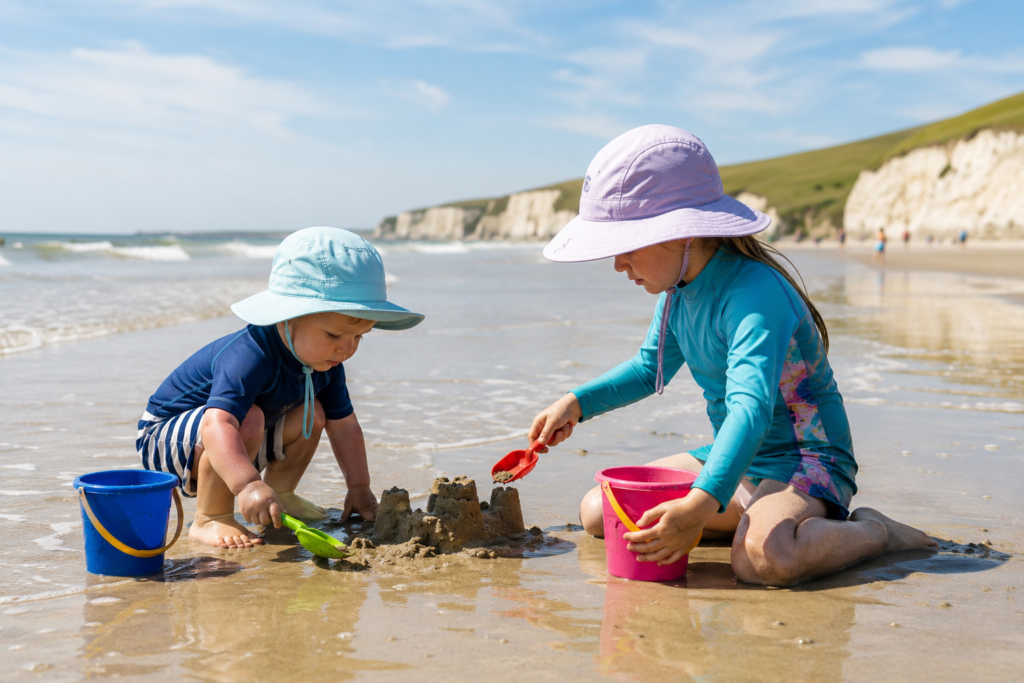
The real problem with children’s sun hats isn’t finding one with a good UV rating. Almost every purpose-built sun hat has a decent rating. The real problem is finding one a child will actually wear. A hat removed and thrown into the sea within three minutes of arriving at the beach provides no UV protection whatsoever, regardless of what the label says. That’s what narrows the field — not the UPF numbers but the chin straps, the fit, the weight, and whether a particular four-year-old has decided that hats are categorically unacceptable this summer.
More outdoor clothing and kit guides for family days out across the Practical Outdoor Clothing & Comfort hub — worth a look if you’re building the full warm-weather outdoor wardrobe for the children.
What to Look for Before Buying
The UV rating and brim width matter, but they connect to each other and to the fit in ways that are worth understanding together rather than as separate checklist items.
UPF50+ is the rating to look for — the hat equivalent of SPF in sunscreen. It means the fabric blocks 98% of UV rays. Most purpose-built sun hats carry this rating. Standard cotton bucket hats from supermarket aisles often don’t — they provide shade but not meaningful UV protection, and the difference between shade and UV blocking is larger than it sounds on a bright Scottish afternoon where the UV index is higher than the overcast sky suggests. The rating should appear explicitly on the listing or label rather than being implied by the style.
Brim width connects directly to what’s actually protected. A narrow brim shades the top of the face. A wide brim — at least 7cm for a child — shades the face, ears, and part of the neck simultaneously. For full coverage, a neck flap extending from the back of the brim protects the back of the neck, which is one of the most commonly burned areas on children during outdoor days and one of the areas most frequently missed during sunscreen application. For active children who find neck flaps annoying, a hat with a retractable or foldable flap is the practical compromise — full coverage available when needed, tucked away when not.
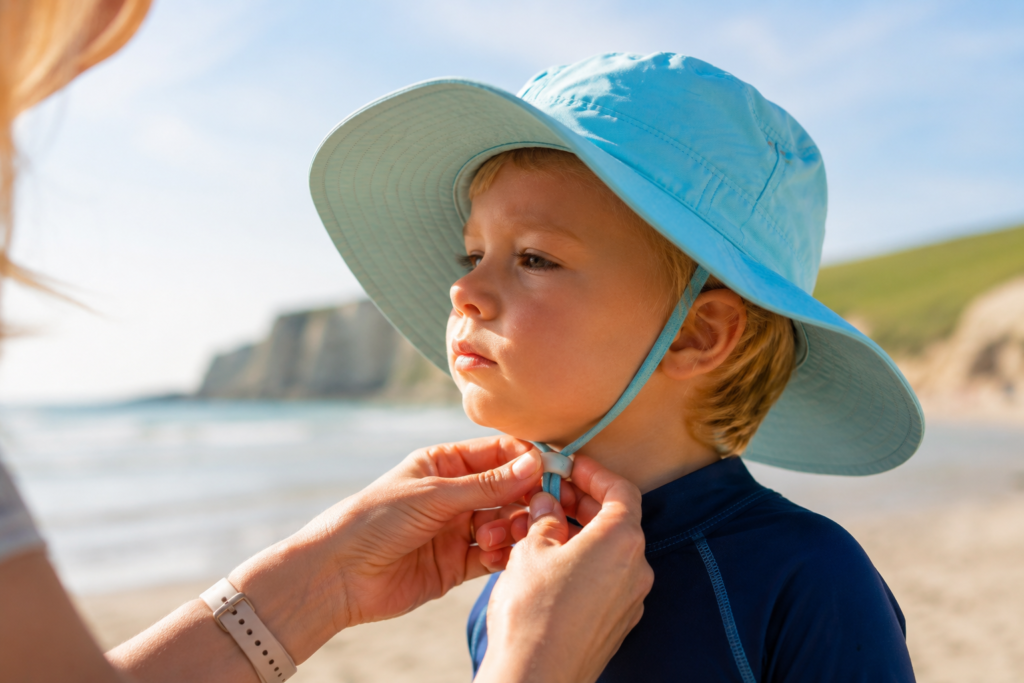
Getting the hat to stay on connects to fit, chin straps, and fabric in ways that become obvious after the first beach trip where the hat spends more time on the sand than on anyone’s head. A chin strap is essential for babies and toddlers — it should be soft enough not to dig in and have a breakaway clip that releases under pressure to prevent any choking risk if the strap catches during play. For children aged roughly five and above who have accepted hats as part of going outside, an inner drawstring that adjusts the fit keeps it secure in wind without a chin strap that gets removed within five minutes. Below that age, the chin strap is doing most of the work. Keeping a child comfortable enough to keep a hat on is part of the broader challenge of dressing children for unpredictable UK outdoor days — the same principles of breathability and comfort apply across every layer.
Breathability and material determine whether a child wears the hat happily or constantly tries to pull it off. Lightweight nylon and polyester fabrics, mesh panels in the crown, and moisture-wicking inner sweatbands are the features that make a hat comfortable enough to stay on through a full beach or park afternoon. A heavy stiff hat on a warm day is something most children resist regardless of how good the UV rating is.
The 5 Worth Buying
1. Jan & Jul Gro-With-Me Aqua-Dry Bucket Hat — Best for Toddlers and Growing Kids
The Gro-With-Me design is the feature that sets this hat apart from every other toddler sun hat on the market. The fully adjustable headband — tightened and loosened via a simple toggle — means you can buy a size up and have the hat fit correctly for two or three summers rather than one. This matters considerably more for sun hats than for most children’s kit because they’re worn intensively for three months and then grown out of before the following season. A hat that lasts three summers at a price point that looks expensive for one summer suddenly looks very reasonable.
The Jan & Jul Gro-With-Me sun hat carries UPF50+ protection built into the fabric weave rather than applied as a chemical treatment — which means the rating doesn’t wash or fade over multiple seasons. The water-repellent Aqua-Dry fabric dries quickly after rain or water play, the wide brim with a fireman-style back extension covers face, ears, and neck simultaneously, and the toggle chin strap is trickier for small fingers to undo than a standard clip. That last detail matters when a toddler treats hat removal as a competitive sport.
We have put these through multiple west coast Scotland trips where the weather moved between overcast and suddenly very bright within the same afternoon. The quick-dry fabric and secure fit mean it performs regardless of what the day turns into. For the rest of the outdoor day kit, the waterproof jackets worth buying for UK children covers the layer that handles the other half of UK summer weather — the inevitable cloud that follows the sunshine.
2. Columbia Bora Bora Jr. Booney — Best for Active Older Kids
Columbia’s outdoor kit has a specific quality that shows up on actual outdoor days rather than in product descriptions — it does what it says without requiring much management. The Bora Bora Jr. Booney applies the brand’s adult hiking hat approach to children’s sizing: UPF50+ fabric, moisture-wicking construction that pulls sweat away from the head during active play, and the classic booney style with a wide 360-degree brim that shades face, ears, and neck without a separate flap.
On a full day at Loch Lomond last summer with two children who spent several hours alternating between water and walking, the Bora Bora stayed on, stayed comfortable, and didn’t require the constant hat-negotiation that cheaper alternatives tend to produce by mid-afternoon. The brim is structured enough to hold its shape across a full summer of daily use — cheap wide-brim alternatives tend to start the season looking purposeful and end it looking defeated, which is the difference you notice after the second or third season with the same hat.
The adjustable chin strap handles wind and active play without coming off. For families doing regular outdoor days — beach trips, loch-side walks, campsite afternoons — this is the hat that earns its place without requiring much thought.
The honest note: the booney style doesn’t suit every child’s preference. Children who find hats hot or constricting do better with the mesh-vented bucket hat alternatives below.
3. Kidz Banz Sun Hat — Best Value Wide-Brim for Toddlers
Kidz Banz is a UK brand specifically designed around children’s sun protection and the hat reflects that focus clearly. The adjustable velcro tab on the brim — rather than the internal drawstring most comparable hats use — lets the brim size be dialled in precisely for a toddler’s head without the gap-and-droop that standard bucket hats produce when they’re slightly too large. The wide brim provides meaningful coverage of face and ears, and the hat is reversible — two designs in one, which matters more than it sounds when a three-year-old has strong opinions about which pattern they’re wearing.
The Kidz Banz kids bucket hat is UPF50+ rated, quick-dry, and machine washable — the combination that makes it genuinely practical for regular family use rather than reserved for special occasions. The quick-dry fabric means it can go through a paddling pool incident and be back in service the same afternoon. At its price point it’s the honest recommendation for parents who want genuine sun protection without spending premium prices on a hat that’s likely to be lost on a beach within the season.
The honest note: Kidz Banz suits toddlers and younger primary-school-age children better than older kids. For children aged seven and above, the Jan & Jul or Columbia options are the more appropriate fit.
4. Columbia Cachalot Kids Hat — Best for Maximum Coverage
The Cachalot is the hat for children who burn easily or spend extended time in direct sun — beach holidays, outdoor activity days, camping trips where reliable shade isn’t available throughout the day. UPF50 fabric, moisture-wicking construction, and antimicrobial treatment that keeps the hat fresh through a week of daily wear without developing the smell that cotton hats acquire by day three of a camping trip.
The neck flap provides full neck coverage and folds away into the back of the hat when not needed. That detail makes it more versatile than a standard legionnaire-style hat where the flap is permanent — on a shadier afternoon walk the flap disappears, on a full beach day in direct sun it comes back out. One of ours has been used across two camping seasons by a child who burns on the back of the neck in any direct sun, and the fold-away flap is the feature that makes it the hat that actually gets used rather than rejected as too covered-up.
The adjustable back fits from toddler through to older primary school age — a genuine multi-season hat rather than one that’s outgrown before it’s paid for itself.
5. Connectyle UPF50+ Kids Bucket Hat — Best Budget Option
The Connectyle is Amazon’s Choice for kids’ sun hats with over 9,000 reviews and a consistently high rating — which for a hat at this price point is a genuine signal rather than a marketing label. UPF50+ fabric, mesh side vents in the crown that provide meaningful airflow on warm days, and an internal moisture-wicking sweatband that keeps the inside of the hat from becoming uncomfortable on a hot afternoon.
The Connectyle kids sun hat is the budget recommendation — not the hat for a child who burns on the neck or needs maximum coverage, but well suited for everyday park days, school trips, and general summer outdoor use where the priority is reliable UPF50+ coverage at a sensible price. Available in multiple colours, adjustable fit, packs flat into a bag. For families who want a good sun hat without spending premium prices, this is the right starting point.
The honest note: no neck flap, so the back of the neck is less covered than on the Columbia or Jan & Jul options. For longer outdoor days in direct sun, pairing with sunscreen on the back of the neck is worth doing.
Getting the Hat to Actually Stay On
This is the part most sun hat articles skip and the part that determines whether the hat you bought is actually doing any protection.
Start young. Children who have worn hats from their earliest outdoor experiences accept them as part of going outside in the same way shoes are non-negotiable. Children who encounter hats for the first time at age three having never worn them regularly have considerably stronger opinions about the whole arrangement. Our youngest wore a hat from six months old and is now seven and still puts it on without being asked. The eldest didn’t wear one consistently until age four and the negotiation is ongoing.
The transition from needing a chin strap to not needing one varies by child rather than following a reliable age pattern — somewhere between four and six for most children, when they’ve accepted that hats are part of going outside rather than something being done to them. Until that transition happens, the chin strap is doing most of the work and should be secure enough to survive wind and running. A kids sun hat chin strap is worth having as a backup if a preferred hat doesn’t have one — clip-on versions convert most bucket-style hats into something that survives a breezy beach afternoon.
The same thinking about fit and security applies to waterproof gloves for children — accessories that get removed and lost within twenty minutes if the fit isn’t right. The principle is the same: secure enough to stay on, comfortable enough to be forgotten about.
Offer genuine choice within a limited range. Letting a child pick the colour or pattern from two or three appropriate options gives them a stake in wearing it. The Kidz Banz reversible design is particularly useful here — two looks in one hat creates the illusion of more choice without requiring two hats.
Measure the head circumference before ordering rather than relying on age-based sizing. Children’s hat sizing varies considerably between brands — a five-year-old with a larger head will be swimming in a hat labelled for age three to six, and a hat that slides forward over the eyes gets removed immediately. Most manufacturers provide head circumference measurements in centimetres. A soft tape measure around the widest part of the head, just above the eyebrows and ears, takes thirty seconds and prevents the mid-summer return-and-reorder cycle.
For beach and water days, a changing robe is the other piece of kit that earns its place alongside a good sun hat — keeping children warm and dry between water and dry land without the cold-beach changing battle.
Which Hat for Your Family
For toddlers who grow out of hats before they wear them out: Jan & Jul Gro-With-Me. The adjustable headband earns multiple seasons from a single hat and the chin strap stays on through the most determined removal attempts.
For active older children doing full outdoor days in direct sun: Columbia Bora Bora Jr. The structured brim, moisture-wicking fabric, and chin strap handle everything a busy outdoor day produces.
For toddlers and younger children at the beach and in the garden: Kidz Banz. Reversible, quick-dry, machine washable, wide brim — the practical everyday choice at a sensible price.
For children who burn easily or spend extended time in direct sun without reliable shade: Columbia Cachalot. The fold-away neck flap is the feature that makes it worth the cost for children who genuinely need full coverage.
For everyday park days and general summer use on a budget: Connectyle. Over 9,000 reviews, Amazon’s Choice, UPF50+, less than the cost of a tube of factor 50. The right starting point for families who want reliable sun protection without navigating the premium end of the market.
Related Guides
About The Author – Andrew Marshall
Andrew Marshall is the creator of Simple Days Outside and a UK parent of three who regularly camps, walks, and explores outdoor activities with his family. His guides focus on practical gear, realistic family adventures, and simple ways to help families enjoy the outdoors across the UK. The recommendations on this site are based on real-world use, research, and the kind of equipment families actually rely on for weekend trips and everyday outdoor fun.