

Written by Andrew Marshall
UK parent of three sharing practical advice to help families enjoy camping, walking, garden play, and simple outdoor adventures across the UK.
Creator of Simple Days Outside.
Blisters end more family walks than bad weather does. One minute everyone is fine, the next a child is limping and sitting down on the path refusing to move — and you’re two miles from the car.
The frustrating thing is that blisters are almost entirely preventable. They’re not random bad luck. They happen for specific reasons, and once you know what those reasons are, fixing them is straightforward.
We had a particularly grim afternoon above Loch Katrine a few years back — our eldest ground to a complete halt with a heel blister the size of a fifty pence piece, two miles still to go, and no plasters in the bag. After that we got serious about working out what actually causes blisters and what stops them. Everything we use to keep the kids comfortable outdoors is in our Practical Outdoor Clothing & Comfort Hub.
Why Blisters Form
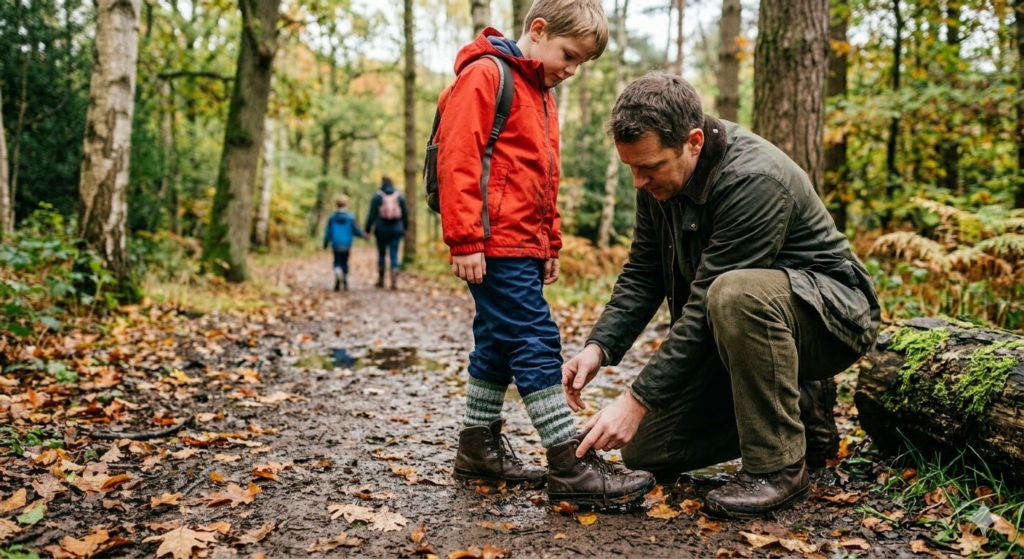
Blisters are caused by friction. When the same patch of skin is repeatedly rubbed — by a boot, a seam, a bunched sock — the skin layers separate and fluid fills the gap.
Three things create friction inside a boot: heat, moisture, and movement. A hot, sweaty foot sliding around inside a loose boot is a blister waiting to happen. A cool, dry foot in a well-fitted boot with the right socks almost never blisters. Everything in this guide comes back to controlling those three things.
The Main Causes — and Exactly How to Fix Them
Wrong Socks
This is the single biggest cause of blisters in children, and the easiest to fix.
Cotton socks are the problem. Cotton absorbs moisture and holds it against the skin — wet skin softens quickly and blisters far faster than dry skin. Cotton also loses its shape when damp, which means it bunches and shifts inside the boot, creating the friction that does the damage.
Switching to kids’ technical walking socks in a wool blend or synthetic changes things immediately. A good kids’ hiking sock wicks moisture away from the skin rather than trapping it, has targeted cushioning at the heel and ball of the foot, and stays fitted throughout a walk rather than migrating toward the toes. Our Best Kids Walking Socks for UK Weather guide covers the specific pairs worth buying.
Socks that are too large are almost as bad as cotton ones — excess fabric bunches at exactly the points where blisters form. When between sizes, always go smaller.
Boots That Don’t Fit Right
The second most common cause, and the most misunderstood.
Too big is the most common mistake. Parents often buy a size or two up to get more wear as children grow, which is understandable — but a boot with too much room allows the foot to slide forward on descents and backward on ascents. That sliding is friction, and friction is blisters. The heel is worst affected because it lifts slightly with every step rather than staying planted.
Too small creates pressure blisters at the toes and across the top of the foot — different to friction blisters but just as effective at ending a walk early.
The right fit for a walking boot is snugger than a trainer. With a walking sock on, toes should wiggle freely but not slide forward. The heel should stay planted when walking — if it lifts, the boot is too big regardless of the size on the label.
Boot fit is worth checking properly at the start of every season. Children’s feet can grow a full size between autumn and the following spring, and it’s surprisingly easy to miss until the blisters appear. Our Waterproof Boots for Kids Under £40 guide covers what to look for in fit alongside the best current options.
Lacing Too Loose
Most parents don’t lace children’s walking boots tightly enough, and it matters more than people think.
A loosely laced boot lets the foot move inside — the heel lifts, the foot slides forward on any descent, and friction builds at every point of contact. The fix is lacing firmly all the way to the top hook, not stopping halfway up the boot. The ankle needs to be held properly for the heel to stay planted.
For younger children who can’t lace their own boots, it’s worth checking mid-walk that the laces haven’t worked loose. A quick re-lace at the halfway point on a longer walk takes thirty seconds and prevents a lot of grief.
Not too tight either — lacing that pinches across the top of the foot creates pressure blisters of its own. Firm but comfortable, with the ankle supported and the heel not lifting.
New Boots Worn Straight on a Long Walk
New boots need time to soften at the flex points before they’re ready for a full day out. Even good quality kids’ waterproof walking boots will cause blisters if worn for the first time on a long walk — the material is stiff and creates friction at contact points that will eventually soften but haven’t yet.
The fix is simple: wear new boots on a few short outings before committing to a longer day. A couple of school runs, a short park walk, an hour on easier ground. By the time the boot has had four or five hours of wear, it will have softened enough at the key points to handle proper terrain.
We’ve made the mistake of putting new boots on for a full day’s walk and paid for it. Every new pair now gets at least three short outings first — it becomes automatic.
Water Getting Inside the Boot
Prolonged wet conditions change the blister equation significantly. Wet skin is far more fragile than dry skin and blisters much faster. If water gets inside a boot — through a failing membrane, over the top during a stream crossing, or simply through hours of heavy rain — the foot gets wet and blisters become almost inevitable.
Good kids’ waterproof walking boots with a proper sealed membrane rather than just water-resistant coating make a meaningful difference here. But membranes degrade over time and a boot that kept feet dry last season may not this one. Applying a DWR reproofer spray periodically extends membrane life — the same products used for reproofing waterproof jackets work on boot uppers and it’s worth adding boots to the same maintenance routine.
For longer walks in genuinely wet terrain, kids’ gaiters seal the gap between trouser leg and boot top, which is where most water ingress actually happens. Worth knowing about if stream crossings are a regular part of your walks.
Heat Buildup
Underestimated but important. Hot feet sweat more. Sweat softens skin. Soft skin blisters faster and more severely.
On warmer days or with children who run rather than walk, heat inside the boot builds quickly. Breathable uppers and moisture-wicking socks both help manage it, but stopping for regular rest breaks and letting feet cool down makes a meaningful difference on longer days.
Removing boots and socks at a lunch stop and letting feet air for ten minutes is one of the most effective blister prevention habits going — genuinely simple and genuinely effective, particularly in warmer months.
If a Hot Spot Has Already Started
A hot spot is the warning sign — a patch of skin that’s warm, tender, and red but not yet blistered. The moment a child mentions it, stop and deal with it. Caught at this stage, a hot spot takes two minutes to sort and the walk continues. Ignored, it becomes a blister and the walk usually ends.
Take the boot off. Apply a hydrocolloid blister plaster — Compeed is the most reliable brand — directly over the hot spot. These cushion the area and allow skin to recover while walking continues. Re-lace the boot properly before setting off again, because a hot spot often develops when the boot is loose in that area.
If a blister has already fully formed, leave it intact where possible. The fluid inside protects the damaged skin underneath. Cover it with a hydrocolloid plaster and keep going if the child can manage it. Don’t drain blisters on the trail.
What to Carry in the Day Bag
A small blister kit weighs almost nothing and has saved more than one of our walks from an early finish.
Hydrocolloid blister plasters — Compeed specifically, not standard fabric plasters. Carry five or six. They stay on, they cushion effectively, and children tolerate them well.
Zinc oxide tape — a small roll for securing dressings and for strapping known trouble spots before a walk starts. If your child reliably blisters in a specific place, taping it preventively before the walk is more effective than treating it after.
A spare pair of kids’ walking socks — one of the most useful things in a day bag on any walk of more than a couple of hours. A damp sock mid-route can often be the trigger for a developing blister — a dry pair changes things.
Vaseline or anti-chafe balm — useful as a last resort if socks aren’t ideal or a hot spot is developing. Not a substitute for the right kit but worth having.
The Pre-Walk Checklist
Before any walk of more than an hour, this takes two minutes:
Technical walking socks, not cotton, sized correctly — not too large Boot fit checked with socks on — heel not lifting, toes not sliding Boots laced firmly all the way to the top New boots only if they’ve already had at least a few shorter outings Toenails trimmed — long nails pressing against the toe box are a surprisingly common cause of toe blisters in children Blister plasters and spare socks in the bag
After a few walks it becomes second nature. Two minutes at the car park before setting off, and the kind of afternoon that ends with someone being carried back rarely happens.
Frequently Asked Questions
Why does my child only get blisters on one foot? Almost always a fit issue. Most people have feet that differ slightly in size — the smaller foot will have more room in the boot and the heel will lift more on that side. A half-insole on the smaller foot often solves it, or have both feet measured properly before buying the next pair.
Should I put Vaseline on feet before a walk? It helps by reducing friction directly on the skin and is worth doing if socks aren’t ideal or if a specific spot is prone to blistering. Apply to the heel and any other known problem areas before putting socks on. Not a replacement for good socks and fit, but a useful addition.
My child says their boots feel fine but they keep blistering. Why? Children often don’t notice developing pressure until a blister has fully formed — they’re focused on the walk rather than monitoring their feet. It’s worth doing a quiet feet check at the halfway point on longer walks regardless of whether there are complaints. Spotting a hot spot before it becomes a blister makes all the difference.
Are double-layer anti-blister socks worth it? For children who blister repeatedly despite well-fitting boots and correct socks, yes. Anti-blister double-layer socks work by allowing the inner layer to move with the foot rather than against it, eliminating the friction at skin level. More expensive than standard hiking socks but worth trying if blistering is a persistent problem.
Related Guides
About The Author – Andrew Marshall
Andrew Marshall is the creator of Simple Days Outside and a UK parent of three who regularly camps, walks, and explores outdoor activities with his family. His guides focus on practical gear, realistic family adventures, and simple ways to help families enjoy the outdoors across the UK. The recommendations on this site are based on real-world use, research, and the kind of equipment families actually rely on for weekend trips and everyday outdoor fun.