

Written by Andrew Marshall
UK parent of three sharing practical advice to help families enjoy camping, walking, garden play, and simple outdoor adventures across the UK.
Creator of Simple Days Outside.
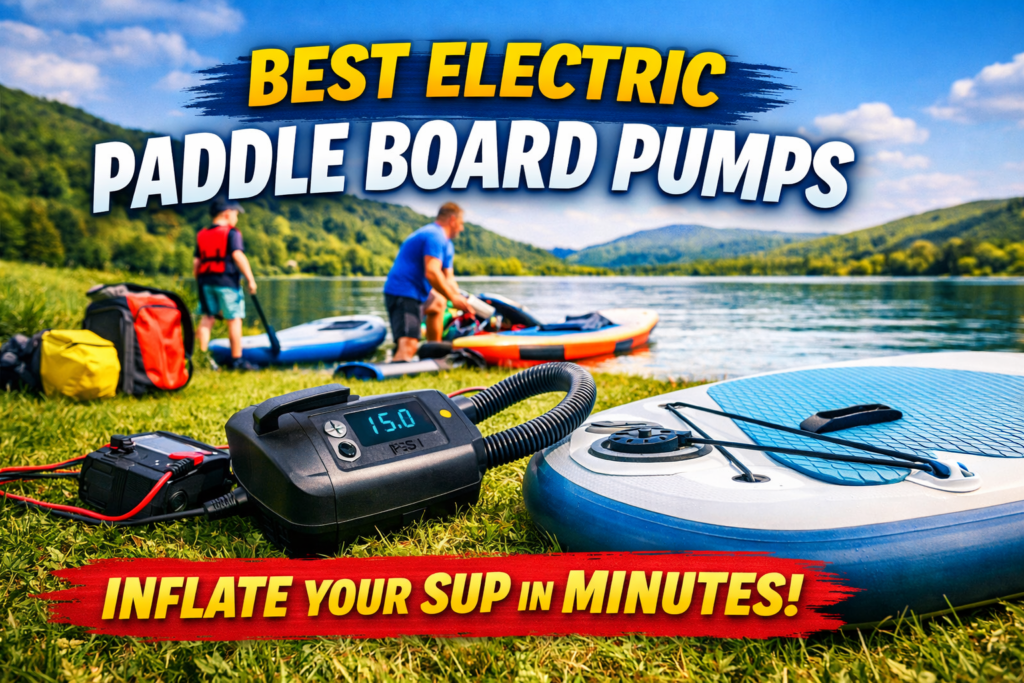
The first season we had paddle boards, we pumped them up by hand every single time. It took 15 to 20 minutes per board, left you sweaty before you’d even touched the water, and meant that by the time both boards were inflated the kids were already bored waiting on the shore.
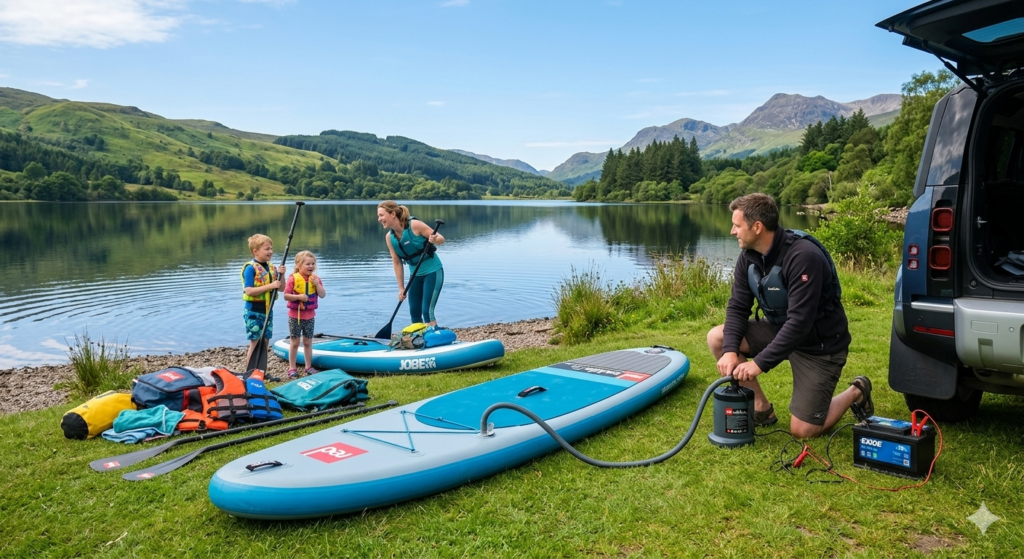
We bought an electric pump before season two and it changed the whole morning. You connect it, set the pressure, get the wetsuits on, sort the dry bags, put the kids’ buoyancy aids on — and the board is ready before you’ve finished the checklist. It costs nothing in effort and nothing in time you’d rather be spending elsewhere.
If you own an inflatable paddle board and you’re still using the manual pump that came with it, this is the one upgrade worth making before your next session. Everything else we use on the water — boards, paddles, wetsuits, dry bags — is covered in our Summer Fun & Water Hub.
What to Look for in an Electric SUP Pump
Rechargeable battery vs 12V car connection
This is the first and most important decision. Electric SUP pumps come in two types:
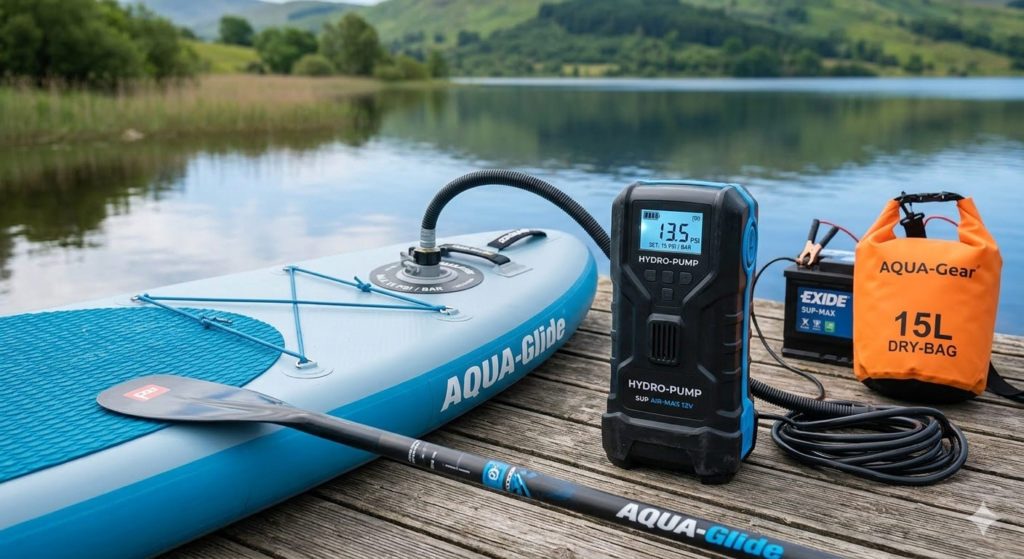
12V car-powered pumps plug into your car’s cigarette lighter socket. They’re cheaper, reliable, and never run out of charge — but you need to be within cable distance of your car to use them. If your car parks at the water’s edge, this is fine. If you carry your boards down a beach path, across a field, or to a remote loch launch point, the cable limits you.
Rechargeable battery pumps inflate anywhere, independently. You charge the pump at home before you go, carry it to the water, and inflate without needing the car nearby. For families who paddle varied locations where the car doesn’t always reach the waterside, rechargeable is significantly more practical. If you’re still deciding on a board, inflatable paddle boards are far and away the most practical choice for UK family paddling. The trade-offs are cost — rechargeable pumps are more expensive — and the discipline of charging before you go.
For most UK families paddling in varied locations, a rechargeable pump is worth the extra investment. Both types are covered below.
Inflation speed
Most electric pumps inflate a standard 10’6″ board to 15 PSI in 7 to 12 minutes. Premium rechargeable pumps get that down to 4 to 6 minutes. For a single board, the difference is manageable. For a family with two boards, the difference between 8 minutes per board and 4 minutes per board is a quarter of an hour standing in a car park.
PSI range and auto shut-off
Most inflatable paddle boards need 12–15 PSI. Any pump that reaches 15–20 PSI covers this comfortably. The auto shut-off feature is important — you set the target pressure and the pump stops when it reaches it. Without this, you need to watch the gauge and turn it off manually, which is easy to forget when you’re also managing children and gear.
Deflation function
Packing down is just as important as inflation. A pump with a deflation function pulls the air out of your board quickly, making it significantly easier to roll tightly and fit back into the bag. Not all pumps include this — worth checking before buying.
Number of boards per charge
For families with two boards, a pump that inflates only one board per charge is immediately inconvenient. Look for a minimum of two full inflations at 15 PSI. The better rechargeable pumps handle three to five standard boards on a single charge.
Noise
All electric pumps are audible — there’s no quiet option. They sound like a reasonably loud vacuum cleaner during the high-pressure stage. This is worth considering if you’re inflating early morning near a campsite or a quiet car park, but it’s not a reason to avoid an electric pump.
How Dual-Stage Inflation Works
Every quality electric SUP pump uses a two-stage inflation process, and understanding this helps you understand why some pumps are faster than others.
Stage one — rapid fill: The pump pushes high volumes of air quickly at low pressure. This is the fast, louder stage that takes the board from flat to roughly 1 PSI. At this point the board looks fully inflated but is still soft.
Stage two — high pressure: The pump switches to a slower, higher-pressure mode to bring the board to its target PSI (12–15 for most boards). This is the quieter, more technical stage and the one that makes the board genuinely rigid and paddleable.
Budget pumps handle both stages but slowly. The faster, more expensive pumps have more powerful motors at both stages. That’s where the speed difference comes from.
Why Your Board Loses Pressure in Cold UK Water
This is something that catches out a lot of UK paddlers and is worth understanding before you head to the water.
When a paddle board is inflated in a warm car or at room temperature and then placed on cold loch or sea water, the air inside contracts. This follows basic physics — air pressure drops as temperature drops. A board inflated to 15 PSI at 20°C in a car park can read 12–13 PSI after ten minutes on cold Scottish water.
The board hasn’t deflated. Nothing is wrong with it. The pressure has simply dropped in response to the cold water cooling the air inside.
Two practical implications: first, it’s worth inflating to the top end of your board’s recommended range (typically 15 PSI) rather than the lower end, so that when pressure drops slightly in the cold water you’re still within the working range. Second, keep the manual pump accessible for a quick top-up if the board feels softer than expected mid-session. The electric pump stays in the bag — a few strokes of the manual is enough.
The Pumps Worth Buying
Best budget 12V pump — under £50
PEAK 12V Electric SUP Pump
If your car parks at or very close to the water and budget is the priority, a 12V pump is the most straightforward option. The PEAK 12V plugs into your car’s cigarette lighter socket, inflates to 20 PSI with auto shut-off, includes nozzles for all standard boards, and costs a fraction of rechargeable alternatives.
It’s not fast — expect around 10–12 minutes to reach 15 PSI — and the cable length limits where you can inflate. But it’s reliable, never runs out of charge, and for families who always launch directly from a car park it removes the need to charge anything.
The limitation is simple: if you paddle any location where the car doesn’t reach the water, a 12V pump doesn’t work. For those situations, one of the rechargeable options below is the right choice.
Best value rechargeable — under £80
TOPUMP TPS260 20PSI Rechargeable SUP Pump
The entry point into rechargeable pumps at a price that makes the upgrade from manual accessible. Dual-stage inflation to 20 PSI, auto shut-off, deflation function, and nozzles compatible with all standard inflatable paddle boards and kayaks. LCD display shows real-time pressure throughout the inflation.
Battery capacity handles two boards at 15 PSI on a single charge — enough for most family sessions. Not the fastest pump on this list, but at this price it performs honestly and has consistently good reviews from UK paddlers.
The honest limitations: it’s on the louder side during stage two, and battery capacity won’t stretch comfortably to three or four boards. For a family with two boards who charges after every session, it does the job reliably.
Best mid-range rechargeable — around £110-120
AIRBANK Puffer Pro 20PSI Rechargeable SUP Pump
The lightest pump on this list at 1.26kg, and the one that fits most easily into a paddle board bag alongside the rest of your gear. That weight advantage is more significant than it sounds when you’re already carrying boards, paddles, wetsuits, and a dry bag to the water’s edge.
5200mAh battery inflates up to four boards at 15 PSI on a single charge. Dual-stage inflation, auto shut-off, deflation function, LED display with accurate pressure reading (±0.2 PSI), carry bag included, and USB-C charging in around two hours.
Build quality uses nylon and fibreglass components rather than standard plastic — it handles heat better than cheaper alternatives during consecutive inflations and feels noticeably more durable. Two-year warranty.
The main limitation: inflation speed is around 7–9 minutes to 15 PSI, which is solid rather than fast. If speed matters most, the Shark 3 is the step up. If portability and battery life matter more — particularly for remote loch launches where you’re carrying everything from the car — this is the better choice.
Best high-capacity rechargeable — around £90-£100
TOPUMP TPS300 20PSI Rechargeable SUP Pump
The choice for families who regularly inflate more than two boards, or who want the security of a large battery without paying Shark 3 prices. The 7800mAh battery is substantially larger than most pumps at this price — rated for seven boards at 12 PSI or five at 15 PSI on a single charge.
Dual-stage inflation with active cooling system, 20 PSI maximum, auto shut-off, deflation function, and seven nozzles. The LCD display is clear and easy to read outdoors. Charges via both AC mains and 12V car connection — useful if you arrive with a lower battery than expected and can top it up on the drive.
The trade-offs compared to the AIRBANK: heavier and bulkier. Compared to the Shark 3: slower inflation at around 8–10 minutes. What you get is the largest battery capacity in the mid-price range and the dual charging flexibility that the others don’t offer.
UK real-world reviews consistently highlight battery performance as the standout feature, which is the main reason to choose it over the alternatives at this price.
Best premium pump — around £140–150
OutdoorMaster Shark 2 Rechargeable SUP Pump
The Shark 2 is the benchmark. It inflates a standard 10’6″ board to 15 PSI in under 4 minutes — three times faster than most electric pumps. For context: two boards inflated and ready in under ten minutes from turning the pump on. That’s the difference between a long car park wait and being on the water before the morning light changes.
74Wh rechargeable battery handles four boards at 15 PSI per charge. Dual compressors and a patented active cooling system mean it runs consecutive inflations without overheating — genuinely useful when you have multiple boards to inflate back to back. Three inflation modes (SUP, kite, mat), pressure memory function, auto shut-off, deflation in 80 seconds, and a USB-C output port for charging your phone from the pump.
Eight nozzles cover all standard inflatable boards. Compatible with Red Paddle Co, Bluefin, Decathlon Itiwit, Aqua Marina, and every other major UK board brand.
The honest downsides: it’s the heaviest and most expensive option on this list, and the LCD display can be difficult to read in direct sunlight. We saw one in use at a loch near us last season — board inflated and the family already walking to the waterline before we’d finished our second board manually. The speed difference is not subtle.
If you’re inflating two boards every session across a full UK summer, the time saved over a season is significant. If you want the best pump available and intend to use it for years, this is it.
At a Glance: Which Pump for Which Paddler
| PEAK 12V | TOPUMP TPS260 | AIRBANK Puffer Pro | TOPUMP TPS300 | Shark 2 | |
|---|---|---|---|---|---|
| Price | Under £50 | Under £80 | ~£110–120 | ~£90-100 | ~£140–150 |
| Power source | 12V car | Rechargeable | Rechargeable | Rechargeable + 12V | Rechargeable |
| Boards per charge | Unlimited | 2 | 4 | 5–7 | 4 |
| Inflation speed | ~10–12 min | ~10 min | ~8–9 min | ~8–10 min | ~4 min |
| Weight | Light | Medium | Lightest (1.26kg) | Heavier | Heaviest |
| Best for | Budget, car park launches | Budget rechargeable | Portability | High capacity | Speed |
Do You Still Need the Manual Pump?
Yes — keep it. The manual pump that came with your board is worth storing in the board bag even after you’ve bought an electric pump.
First, it’s a backup if the electric pump loses charge, breaks, or gets left behind. It happens. Second, it’s the right tool for mid-session top-ups when the board softens slightly in cold water — a few strokes of the manual is faster than unpacking the electric pump for a minor pressure adjustment.
Electric pump for inflation at the start of the day. Manual pump as backup and for quick top-ups. Keep both.
Looking After Your Electric Pump
An electric pump is a meaningful investment and worth treating as one.
After each session: Wipe the pump down with a dry cloth if it’s been near salt water. Salt accelerates corrosion on connectors and nozzle fittings. Rinse nozzles with fresh water if they’ve been in sea spray.
Storage: Store in a dry location away from direct sunlight. Don’t leave it in a hot car boot for extended periods — heat degrades lithium batteries faster than use does.
Battery storage between seasons: Don’t store a fully charged or fully depleted battery for months. The ideal storage charge for lithium batteries is around 50–60%. If you’re packing the pump away for winter, charge it to roughly half before storing and check the charge level once mid-winter if it’s been sitting for more than three months.
Nozzle care: Keep nozzles stored in the bag rather than loose in a dry bag or pocket. Lost nozzles are the most common pump-related frustration and replacements are fiddly to source for specific models.
Cold weather use: Electric pumps work in cold conditions but motors are slightly less efficient at very low temperatures. In winter paddling sessions, give the pump an extra minute — it will reach the target PSI, just slightly slower than in summer.
Frequently Asked Questions
Can I use any electric pump with my paddle board?
Most electric pumps include a Halkey Roberts nozzle — the standard valve type used on the vast majority of inflatable paddle boards including Decathlon Itiwit, Bluefin, Aqua Marina, and Red Paddle Co. The pumps on this list all include multiple nozzles and are compatible with all major UK board brands. Check the valve type on your specific board if you’re unsure — it’s usually shown in the manual or on the valve itself.
What PSI should I inflate my paddle board to?
Most inflatable paddle boards recommend 12–15 PSI for paddling. Check your board’s manual for the specific figure. In cold UK water, inflate to the top of the recommended range — 15 PSI — so that when temperature causes the air inside to contract you’re still within the working pressure. All the pumps on this list reach 20 PSI, comfortably above what any standard board requires.
How long do rechargeable SUP pumps take to charge?
Most rechargeable pumps charge fully in 2–3 hours via USB-C or AC mains. The TOPUMP TPS300 can also charge from a car’s 12V socket — useful for a partial top-up on the drive if you forgot to charge at home. The simplest habit is charging immediately after every session rather than the night before — the pump is always ready and you never arrive with a flat battery.
Will an electric pump work at remote locations away from the car?
A rechargeable pump works anywhere regardless of proximity to the car. This is the main practical advantage for families paddling Scottish lochs, remote beaches, or any location where the launch point is a walk from the car park. The AIRBANK Puffer Pro’s light weight makes it the best specific option for carrying to remote launch points.
Can electric SUP pumps inflate kayaks too?
Yes. All the pumps on this list come with nozzles compatible with inflatable kayaks. They also work on inflatable tents, air mattresses, paddling pools, and most other high-volume inflatables. Useful if you’re running both boards and an inflatable kayak — paddle boards and kayaks make a good combination for family water days. The versatility makes them useful kit well beyond paddle boarding.
What happens if I over-inflate my paddle board?
Most boards have a safety pressure release valve that opens if pressure exceeds the safe maximum. That said, over-inflation in hot conditions is worth being mindful of — a board inflated to 15 PSI in a cold car park and then left in direct sunlight can see pressure increase as the air inside warms. Don’t leave inflated boards in direct sun when not in use. All the pumps on this list have auto shut-off, which eliminates the risk of over-inflation during the pump cycle itself.
Related Guides
More paddle boarding gear guides and family water sport advice in our Summer Fun & Water Hub .
About The Author – Andrew Marshall
Andrew Marshall is the creator of Simple Days Outside and a UK parent of three who regularly camps, walks, and explores outdoor activities with his family. His guides focus on practical gear, realistic family adventures, and simple ways to help families enjoy the outdoors across the UK. The recommendations on this site are based on real-world use, research, and the kind of equipment families actually rely on for weekend trips and everyday outdoor fun.