

Written by Andrew Marshall
UK parent of three sharing practical advice to help families enjoy camping, walking, garden play, and simple outdoor adventures across the UK.
Creator of Simple Days Outside.
We own both. Two inflatable paddle boards and two sit-on-top kayaks, and between them they’ve covered more Scottish lochs and rivers than we can count. Every summer someone asks us which one to get first — and the honest answer is that it depends on who’s asking and what they’re planning to do with it.
Both are genuinely brilliant for family days out on the water. Both are accessible for beginners. Both have ended up being used every single season. But they’re not the same thing, they don’t suit the same people, and buying the wrong one first is a frustration that’s easy to avoid.
This is what we’ve actually found out from using both — on lochs above Loch Lomond, on river sections in Argyll, and on enough family water days to have a clear view of what works and what doesn’t. If you’re still building out your family water kit, our Summer Fun & Water Hub covers everything from first days on the water to what to pack.
The Short Answer
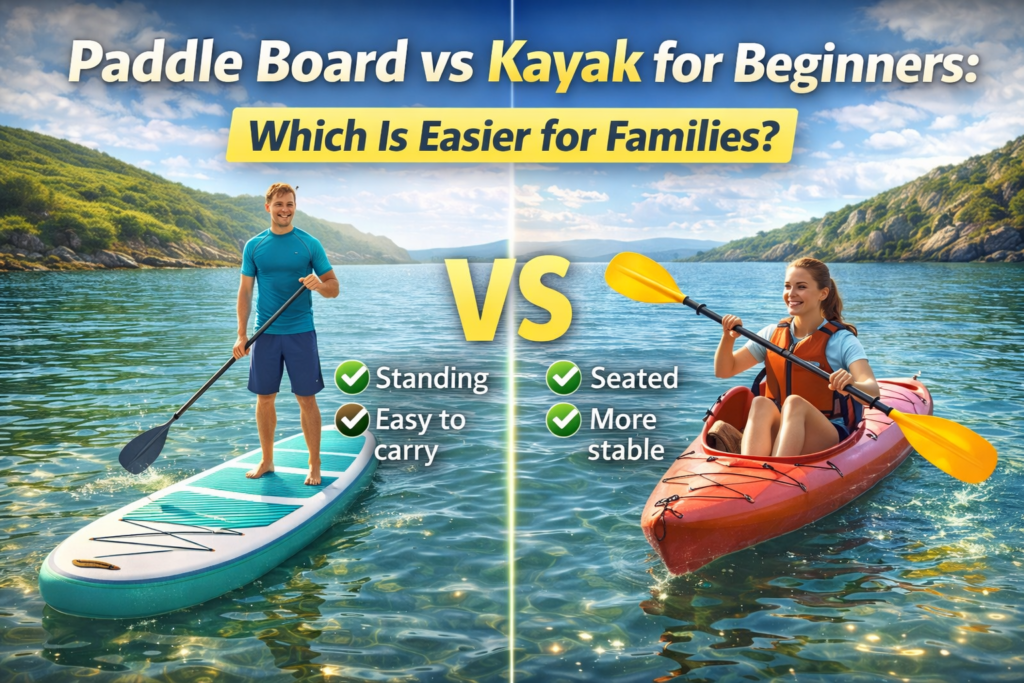
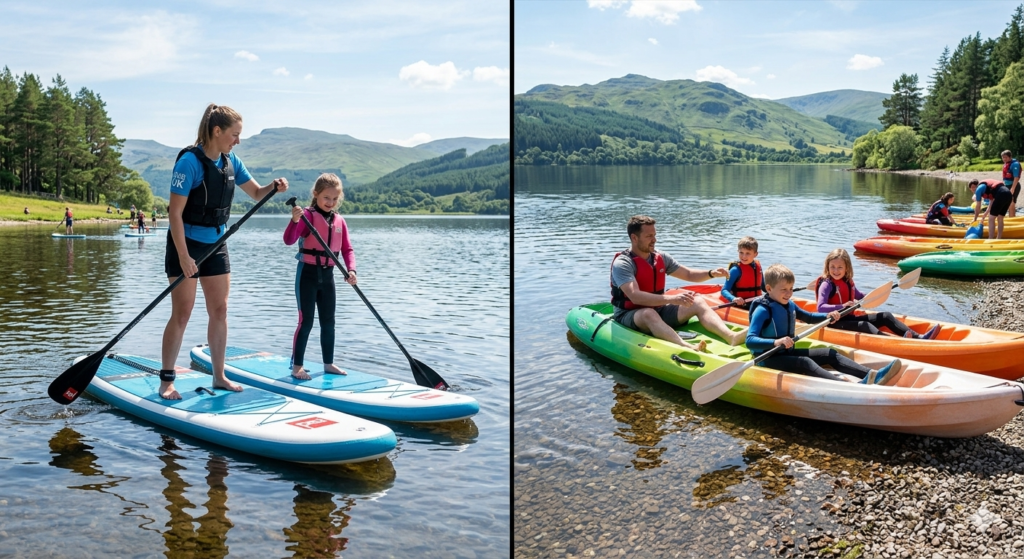
Kayaks are easier to learn, more stable from the first minute, and better suited to covering distance, paddling in wind, and keeping younger children secure and comfortable.
Paddle boards have a steeper learning curve but reward you with a completely different experience — standing on the water, full view of your surroundings, and a freedom of movement that kayaks can’t match.
For most families with younger children — kayak first. For older kids and adults who want the full open-water experience — paddle board. For families who want the most from both — eventually, you want one of each.
At a Glance: Paddle Board vs Kayak
| Paddle Board | Kayak | |
|---|---|---|
| Learning curve | Moderate — balance takes time | Low — most beginners confident quickly |
| Stability | Good on calm water | Excellent from the start |
| Suitable age | 8+ independently, younger with adult | 5+ in sit-on-top, younger with adult |
| Fitness demand | Higher — full body standing | Lower — seated, arm-focused |
| Storage | Deflates to rucksack size | Bulky — needs roof rack or large storage |
| Transport | Car boot | Roof rack or large van |
| Best water | Flat lochs, coastal bays, calm rivers | Lochs, rivers, coastal, more versatile in wind |
| Fun factor | Unique, freeing, active | Exploratory, relaxed, adventure feel |
| Cost entry level | £150–500 complete | £100–600 complete |
Learning Curve — Which Is Easier to Start?
Kayaking
Kayaking wins on immediate accessibility. You sit down, you’re low to the water, and the kayak — particularly a wide sit-on-top — is stable almost from the first moment. Most beginners feel competent enough to paddle confidently within the first twenty minutes.
The technique is intuitive. Alternating paddle strokes on each side moves you forward. Paddling harder on one side turns you. There’s no balancing act required and falling in is less likely and less dramatic than on a paddle board.
For younger children especially, kayaks click quickly. They’re seated, low to the water, and can focus on paddling rather than staying upright.
Paddle Boarding
Paddle boarding has a genuine learning curve that kayaking doesn’t. Standing on a floating platform in open water requires balance adjustment that most people don’t expect, and the first session usually involves at least one fall — especially in any kind of chop or current.
Most beginners start on their knees and work up to standing. That progression is part of the experience, but it means the first session often involves more water and more laughing than actual paddling distance covered.
The good news: once you find your balance — which for most adults happens within the first hour on calm water — the feeling of standing on a paddle board is unlike anything kayaking offers. You can see further, move more freely, and there’s an immediacy to being upright on open water that becomes genuinely addictive.
What we found
Our kids took to both at about the same pace, which surprised us. The kayaks felt more immediately secure, but the paddle boards caught up quickly once confidence built. If anything, the kids were more motivated to crack the paddle board because standing up felt like a challenge worth solving. That attitude — treating the wobbles as something to overcome rather than a reason to give up — made a real difference.
Stability — the Real Difference on the Water
Kayaks are more stable. That’s not an opinion — it’s physics. A seated paddler with a lower centre of gravity in a wide kayak is inherently more stable than a standing paddler on a board.
For families with young children, nervous beginners, or anyone paddling on water that gets choppy, the stability of a kayak is a real practical advantage.
Paddle boards are stable enough for beginners on calm water — a quality wide inflatable paddle board at 32–34 inches is genuinely forgiving. But in wind, current, or chop, the stability difference becomes more noticeable. A kayak pushes through conditions that would have a beginner sitting down on a paddle board and waiting for things to calm down.
One practical note: many inflatable paddle boards come with a kayak seat attachment and a convertible paddle that turns into a double-bladed kayak paddle. This converts the board into a sit-down paddling experience — less elegant than a proper kayak, but useful when conditions make standing difficult or when a younger child needs to sit down safely.
Fitness and Physical Demand
Paddle boarding
Paddle boarding standing up is a full-body workout in a way that kayaking isn’t. Your core is engaged continuously for balance. Your legs absorb constant small adjustments. Your arms and shoulders drive the paddle. A long session on a paddle board leaves you aware of muscles you hadn’t noticed before.
For adults who want exercise alongside the outdoor experience, this is a genuine benefit. For families where younger children are involved, or for anyone who wants to cover distance without tiring, it’s worth factoring in.
Kayaking
Kayaking is primarily arm and shoulder work, with significantly less demand on the core and legs. It’s easier to maintain over longer distances and less fatiguing for less fit paddlers. You can cover more water in less time and arrive at the other end without the same level of physical effort.
We’ve done long loch sessions in the kayaks where the paddle boards would have been too tiring for the kids to sustain over the distance. And we’ve had short active sessions on the boards where the physical engagement was exactly what we wanted. Different tools for different days.
Storage and Transport — the Practical Reality
Inflatable paddle boards
The storage and transport advantage of inflatables is significant. Deflated, a paddle board packs into a rucksack and fits in a car boot. Two boards, two bags, alongside wetsuits, paddles, and all the gear a family day requires — it fits in a standard hatchback without any roof rack.
Storage at home is equally straightforward. Two boards take up about the same wardrobe space as a couple of large rucksacks.
Hard kayaks
Hard kayaks are bulky, full stop. They require a roof rack or a van, outdoor storage, and a loading process that adds meaningful time to every session. We have sit-on-top kayaks and they live in the garage on wall mounts. They go on the roof rack to get anywhere. It works, but it’s a more committed operation than pulling paddle board bags from the cupboard and throwing them in the boot.
Inflatable kayaks — the middle ground worth knowing about
Inflatable kayaks deserve more attention than they usually get in this comparison. They solve the transport and storage problem that makes hard kayaks impractical for many UK families, while still delivering the seated, stable kayaking experience.
A quality inflatable kayak deflates and packs into a bag — not as compact as a paddle board, but manageable in a car boot without a roof rack. The Intex Explorer K2 is the most recognised entry point: a two-person inflatable with adjustable seats, a removable skeg for directional stability, and a carry bag, all at an accessible price. Good for lakes and calm rivers — exactly the type of water most UK beginner families are paddling.
If you want something a step up in rigidity and performance, the Sevylor Colorado and Sevylor Tahiti are consistently recommended for UK conditions.
If transport and storage are real constraints — and for most UK families they are — either inflatable paddle boards or inflatable kayaks make more practical sense than hard kayaks. The roof rack requirement alone rules hard kayaks out for a significant proportion of families.
Which Is Better for Different Types of Water?
Flat lochs
Both work brilliantly on flat loch water in calm conditions. Paddle boards are at their best here — gliding on still water with full views above the surface is the experience that makes people fall in love with the sport. Kayaks cover the same water more efficiently and handle wind better when conditions change.
Our best paddle board days have been on still Scottish lochs on clear mornings. Our best kayak days have been on the same lochs when the wind came up in the afternoon.
Coastal and sea paddling
Kayaks handle coastal conditions more confidently than paddle boards for beginners. Wind, swell, and tidal movement are all more manageable from a seated position. Sea kayaking is a well-developed sport for good reason. Paddle boards can be used in coastal conditions, but beginners need calm days and sheltered bays.
We’ve paddle boarded on west coast sea bays on good days and it’s among the best experiences we’ve had on the water. We wouldn’t recommend it as a starting point for beginner families — get comfortable on the board first, then take it to sea.
It’s also worth checking what the water temperature will actually be before you commit to a session — Scotland’s coastal water is cold enough year-round to make wetsuit choices matter.
Rivers
Rivers suit kayaks better at the beginner level. Current, obstacles, and the need to manoeuvre quickly all favour the lower, more stable kayak. We’ve paddled gentle river sections in Argyll in the kayaks and it’s a completely different experience to loch paddling — more technical, more engaging, more demanding.
Paddle boards can be used on gentle rivers but require more confidence and technique. White water is not beginner paddle board territory.
Reservoirs and flat water
The ideal beginner environment for either. Calm, usually sheltered, predictable conditions. Both shine here and either is a good starting point for a first session.
Cost Comparison — Real Numbers
Paddle boards
Entry level (£150–200): The Decathlon Stand Up Paddle Inflatable Pack 10’6″ — Decathlon’s complete beginner package including board, paddle, pump, leash, and bag. Solid construction, rated for up to 130kg, and available in store if you want to see it before buying. One of the best-value complete packages available.
Mid-range sweet spot (£300–350): The Aqua Marina Fusion 10’10” — Drop Stitch Light Technology construction, 6″ thick, 150kg capacity, complete package with paddle, dual-action pump, leash, fin, and carry bag. One of the most consistently recommended beginner boards in the UK. Wide enough for nervous first-timers, stable enough for an adult and child together, and light enough to carry to the water without it becoming a task. Currently £329 on Amazon.
Premium (£600+): The Red Paddle Co Ride 10’6″ — the benchmark for inflatable paddle boards in the UK. MSL construction, noticeably more rigid than double-layer alternatives, and built to last a decade of regular use. If you’re buying one board for the long term, this is it.
Kayaks
Budget inflatable (£80–130): The Intex Explorer K2 — a two-person inflatable kayak with aluminium oars and pump included. Good for occasional use on calm lakes and gentle rivers. The most accessible entry point into inflatable kayaking and the one most families start with.
Mid-range inflatable (£150–300): Sevylor inflatable kayaks — the Colorado and Tahiti models offer better rigidity and performance than budget inflatables. More suitable for regular use on varied water.
Hard sit-on-top (£300–600): If you have the storage and transport sorted, a quality hard sit-on-top at this price level offers better tracking and performance than inflatables. Worth buying from a specialist kayak retailer who can advise on sizing.
The honest cost comparison: For a family buying two of either, the total outlay is broadly similar at equivalent quality levels. Cost alone shouldn’t be the deciding factor — fit for purpose matters more than price.
With Kids — What Actually Works by Age
Under 6
Kayak every time. Young children need to be a passenger with a parent rather than paddling independently, and a tandem sit-on-top or inflatable kayak is the safest way to do that. On a paddle board, a very young child can sit at the front while you paddle — which works on calm days — but in a kayak they’re properly contained and secure.
Look for a two-person kayak with good weight capacity and a proper children’s buoyancy aid.
Ages 6–8
Still kayak-first for independent paddling. A junior sit-on-top or the smaller seat in a tandem inflatable suits this age well — they can paddle genuinely, covering ground and feeling the independence of controlling their own boat. Paddle boards are manageable for this age on their knees, but standing confidently takes more core strength and balance than most children this age have reliably developed.
Ages 8–12
Both work well and both are worth trying. In our experience, the paddle board tends to motivate this age group more — the challenge of standing up and cracking it is the kind of thing an eight to twelve year old will work at. Kayaking at this age is more immediately rewarding but sometimes feels less exciting once the novelty wears off.
A standard adult wide inflatable paddle board works well for this age group — they can manage it and will grow into it.
Teenagers
Paddle boards tend to win with teenagers. The freedom of movement, the physical challenge, and the social element of standing on the water lands better than the more contained kayak experience. Teenagers also have the core strength and balance to pick up paddle boarding quickly once they commit to it.
A standard adult inflatable SUP in the 10’6″–10’8″ range is the right call — they’ll use it for years.
The Quick Decision Guide
Still not sure? Use this:
Choose a kayak first if:
- Your children are under 8
- You want to cover distance on the water
- You paddle in wind or chop regularly
- Stability matters more than adventure
- You have storage and transport sorted for a hard kayak
Choose a paddle board first if:
- Your children are 8 and above
- You want an active, physical experience
- You have limited car boot space and no roof rack
- You want the board to fit in a cupboard at home
- The challenge of learning something new is part of the appeal
Consider an inflatable kayak if:
- You want kayaking but can’t manage hard kayaks in your vehicle
- You want the seated stability of a kayak without the storage commitment
- Budget is a consideration — the Intex Explorer K2 starts lower than most quality SUPs
Gear You Need for Each
Paddle board essentials
- Inflatable paddle board — complete package including paddle, pump, leash, and bag
- Electric SUP pump — buy alongside the board, not after your first manual pump session
- Paddle board leash — attaches board to ankle, essential on open water
- Wetsuit — non-negotiable for Scottish water year-round
- Waterproof dry bag — for phone, keys, snacks
- Buoyancy aid — for children, strongly recommended for adults on open water
Kayak essentials
- Inflatable kayak or sit-on-top kayak
- Kayak paddle — usually included; worth upgrading if not
- Buoyancy aid / PFD — essential, particularly for children
- Wetsuit — for Scotland, assume you’ll get wet at some point
- Waterproof dry bag — same need as paddle boarding
Frequently Asked Questions
Which is safer for children — paddle board or kayak?
For younger children, kayaks are generally safer. The seated, lower position is more stable and less likely to result in an unexpected swim. For older children and teenagers who can manage balance, both are equally safe with appropriate supervision and buoyancy aids. In Scottish water temperatures, keeping younger children dry is a genuine safety consideration — kayaks do this more reliably.
Can you use a paddle board as a kayak?
Many inflatable paddle boards come with a kayak conversion kit — a seat attachment and a convertible double-bladed paddle. This isn’t a substitute for a proper kayak but it gives you a seated option when conditions make standing difficult. Worth checking whether the board you’re considering includes or supports this. The Bluefin Cruise range has this option.
Which is better for exploring — paddle board or kayak?
Kayaks cover distance more efficiently and handle a wider range of conditions. Paddle boards offer a uniquely immersive experience on calm water that kayaks can’t replicate. For longer exploratory trips, kayak. For shorter sessions where the experience itself is the point, paddle board.
Can beginners paddle board on the sea?
Yes, but conditions matter. A sheltered bay on a calm day is manageable for a confident beginner. Open coastal water with wind and swell is not beginner territory on a paddle board — a kayak handles those conditions much more forgivingly.
What age can children kayak independently?
Most children can paddle a sit-on-top kayak independently from around age 6–7 with supervision. Younger children are better as passengers in a tandem. Age varies significantly by child — confidence, coordination, and water comfort matter more than the number.
Do you need a licence to kayak or paddle board on UK rivers and lochs?
In Scotland, the Land Reform Act gives the right of responsible access to most inland water for non-motorised watercraft — no licence required. In England and Wales, river access rights are more restricted and vary by waterway — check before you go. No licence is required for either activity on open coastal water anywhere in the UK.
What’s the difference between a sit-on-top and sit-inside kayak for families?
Sit-on-top kayaks are better for families and beginners. You sit on the surface rather than inside a cockpit, which means getting on and off is easier, falling in is less dramatic, and younger children can be managed more easily. Sit-inside kayaks are more efficient and better in cold or rough conditions but are less beginner-friendly for family use.
Which Would We Actually Choose First?
If we were starting from scratch with young children and could only buy one — kayaks first. The immediate accessibility, the stability for young children, and the ability to cover more water more comfortably wins out for family use with kids under ten.
Once the older kids were confident on the water and comfortable with the idea of getting wet, we added paddle boards — and they’ve ended up being the ones that get used most often now. The experience of standing on open water on a calm Scottish morning is something kayaking simply doesn’t replicate.
The real answer, after a few years of using both: they’re not competing products. They complement each other. Kayak days and paddle board days feel completely different — in what you do, how hard you work, and how you feel at the end. If you’re serious about family water days, eventually you want both.
But if the question is which one first — start with kayaks for young families, paddle boards if your children are older and the balance challenge is part of the appeal.
Related Guides
If you’re planning family water days, these are worth reading before you go.
More family water sport advice, gear guides, and day out ideas in our Summer Fun & Water Hub.
About The Author – Andrew Marshall
Andrew Marshall is the creator of Simple Days Outside and a UK parent of three who regularly camps, walks, and explores outdoor activities with his family. His guides focus on practical gear, realistic family adventures, and simple ways to help families enjoy the outdoors across the UK. The recommendations on this site are based on real-world use, research, and the kind of equipment families actually rely on for weekend trips and everyday outdoor fun.