


Written by Andrew Marshall
UK parent of three sharing practical advice to help families enjoy camping, walking, garden play, and simple outdoor adventures across the UK.
Creator of Simple Days Outside.
Last Updated: April 2026
The sleeping mat is the piece of camping kit that most families underinvest in and then regret by midnight. The tent gets researched carefully. The sleeping bags get chosen thoughtfully. The mat gets grabbed from a supermarket impulse display or borrowed from a neighbour’s loft, and nobody thinks about it until they’re lying awake on a cold tent floor at 2am wondering why their back hurts and whether camping is actually something they enjoy.
We’ve made that mistake. The trip where everyone had good sleeping bags, a solid tent, and a mat that turned out to be a 2.5cm foam pad that might as well have been cardboard — that was the trip that established the rule in our family that the mat gets as much thought as anything else. A good self-inflating mat changes the camping experience more than almost any other single upgrade, and it’s often the last thing families get around to buying properly.
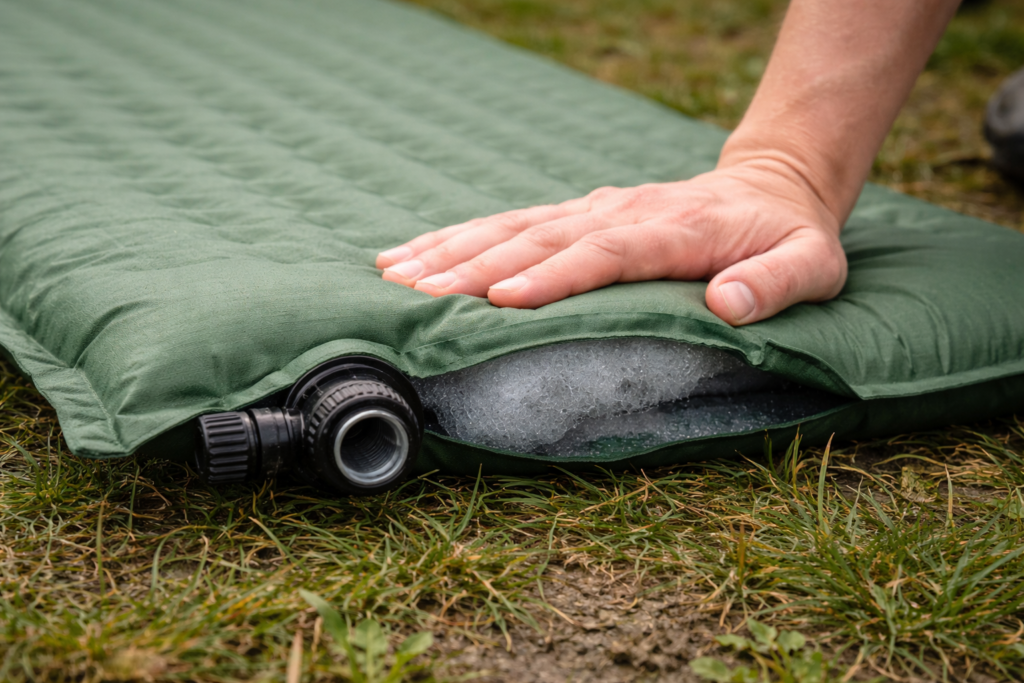
A self-inflating mat uses open-cell foam inside a sealed shell. Open the valve, unroll it, and the foam expands drawing air in automatically. A few extra breaths firms it to your preferred pressure. The foam provides insulation and structure even if some air escapes in the night, which is what makes them more reliable than pure air beds for regular camping in the UK. They don’t require a pump, don’t go flat if they get a minor puncture, and pack down smaller than most airbeds. This covers the five worth buying on Amazon UK right now, what actually matters when comparing them, and the things that make a real difference to a family sleeping in a tent.
More family outdoor kit across the Family Camping hub — including sleeping bags, tents, and everything else that determines whether the family wakes up happy or doesn’t.
What to Know Before Buying
A few things genuinely determine whether a mat is the right choice for your family, and they connect to each other rather than sitting as separate considerations.
Thickness — the depth of the mat when fully inflated — is the most visible number on any listing and the most intuitive guide to comfort. For a family car camping in the UK, anything under 5cm tends to feel thin after the first night. Ten centimetres is where most adults sleep comfortably without feeling the ground through the mat. Above 10cm you’re into genuine luxury territory — the kind of mat where the difference between camping and sleeping at home narrows considerably. The thickness decision connects directly to how much the UK ground affects your sleep, which is more than people expect. Even on a well-managed campsite pitch, UK soil in spring and autumn is cold. Loch-side ground in particular sits several degrees below air temperature — the ground is effectively drawing heat away from you regardless of air temperature, which is why sleeping bag ratings alone don’t explain why some people are cold in a tent even in summer.
This is where R-value matters. It’s the insulation rating — how much the mat resists heat transfer from your body to the ground. A higher number means warmer. For three-season UK camping — April through October — an R-value of 2.5 or above is the minimum worth considering. R4 or above handles UK autumn camping comfortably. Camping beside a Scottish loch or on any exposed highland ground, aim for R4.4 or higher even in July. Most families doing regular summer and shoulder-season camping in the UK are well served by the R3–5 range. The mat is only part of the warmth equation on a UK camping night — staying warm without overpacking covers the sleeping bag and layering side of the same problem.
The valve design is the thing most buying guides skip and the thing that determines how frustrating the mat is to use in practice. A good valve opens for inflation, closes cleanly to hold pressure, and switches to a deflation mode that allows air to escape without pulling it back in as you roll the mat up. The AFC valve used by Outwell and the Cyclone valve used by Vango are both significantly better than the generic valves on budget mats. This matters most on the final morning of a trip when everyone wants to pack up and get home — a mat that fights you during deflation and rolling is a minor misery that compounds across every camping trip you take.
Store your mats correctly between trips and they will inflate more fully and perform better across every season you use them. Self-inflating mats should be stored open, unrolled, and with the valve open rather than compressed in their carry bag. Compressing the foam long-term degrades its ability to self-inflate — the mat takes longer and longer to reach full depth. Leave it unrolled in a dry space between camping trips and the first use of the following season will inflate properly without you wondering why it’s not reaching its rated depth. This single habit makes more difference to long-term performance than any feature in the product description.
One question families regularly ask: should children have children’s mats or adult-size mats, and can mats be linked together? Children genuinely don’t need the same thickness or R-value as adults for three-season UK camping — they sleep warmer and move around less consciously during the night. A 5cm mat is perfectly adequate for most children across a UK summer. For mats that can be joined, look specifically for models with joining clips or connection systems — the Outwell Dreamcatcher and Vango Shangri-La both offer double versions, and several budget mats include side clips for joining two singles. For families who prefer everyone sleeping on separate mats placed side by side, any mat with a non-slip base prevents them sliding apart in the night.
The 5 Self-Inflating Mats Worth Buying
1. Vango Shangri-La II 10cm — Best Overall for Family Camping
Vango is one of the most trusted names in UK camping and the Shangri-La II is the mat at the top of their self-inflating range for a reason. The 10cm thickness with vertical wall construction — meaning the sides of the mat maintain a flat sleeping surface rather than tapering away at the edges — is what separates it from thinner alternatives at the same price. The soft elastic stretch fabric on the top surface is genuinely comfortable to sleep on directly rather than requiring a sheet layer. The memory foam core draws air in more completely than standard open-cell foam, so the mat arrives close to full firmness without extensive top-up breathing required.
The Cyclone valve is the operational feature that earns its place in the family kit. Open it and the mat inflates. Switch to the deflation setting and air escapes as you roll without being pulled back in — the thing that turns packing up from a five-minute frustration into a two-minute routine. This matters more after three nights in a tent than it does on the product page.
The mat comes in single Grande size (198 × 64cm) and double versions. The Grande single is wide enough for most adults to sleep without feeling cramped, and the consistent quality across the range means buying multiple mats for a full family is straightforward without one mat performing significantly differently from another.
The honest note: the Shangri-La II packs to a larger roll than some competing mats at the same price point. For a family loading multiple mats into a car boot this is manageable, but worth knowing before ordering four of them.
2. Outwell Dreamboat Single 16cm — Best for Adults Who Struggle to Sleep Camping
The Dreamboat exists because some people simply don’t sleep well on mats thinner than a proper mattress, and no amount of telling themselves camping is supposed to feel different changes that. At 16cm thick with an R-value of 6.6 and Outwell’s heat-regulating foam construction, the Dreamboat Single is as close to a domestic mattress experience as a self-inflating mat gets. The 86cm width is noticeably generous — wider than most single mats — and the soft stretch polyester means sleeping bag and bedding don’t slide off in the night.
The AFC valve design is excellent — fast inflation, clean closure, and a separate deflation opening that allows air out without re-admission. Rolling the mat up in the morning is quick rather than a prolonged squeeze-and-reopen process. For parents who are already tired and just want to pack up and get home, this matters considerably.
We’ve had family camping trips where the children slept perfectly on thinner mats and the adults lay awake wishing they’d brought something better. The Dreamboat ends that particular camping compromise — not cheaply, but definitively. If the mat is the reason someone isn’t sleeping, the Dreamboat removes the mat as a variable entirely.
The trade-off is size and cost. The Dreamboat packs to a substantial roll and the price reflects the premium specification. Pairing a good mat with the right sleeping bag for UK three-season camping is what actually determines whether adults sleep properly on a camping trip — and the Dreamboat handles the mat side of that equation as well as any passive solution at this price point.
3. Outwell Dreamcatcher Single 10cm — Best Mid-Range for Adults
The Dreamcatcher is the mat that most UK family campers who’ve done their research end up buying — not the premium Dreamboat, but not a budget mat either. Same Outwell build quality and AFC valve, at a price that makes buying two adult mats for a couple genuinely sensible rather than a reluctant compromise.
The wavy foam profile is the design detail worth understanding. Standard open-cell foam in cheaper mats is uniform throughout — fine for insulation but less effective at distributing pressure across different body shapes. The wavy profile provides varying density across the mat surface, which means hip and shoulder pressure points are better supported for side sleepers than on a flat-foam mat of equivalent thickness. After a few nights on a Dreamcatcher, the first night back on a budget mat feels like going backwards — the difference in how pressure is distributed is something you notice within the first hour of lying down.
The AFC valve inflates cleanly — open it, leave it for three to five minutes, add a few breaths to reach preferred firmness. Deflation is equally straightforward. The mat rolls to a manageable pack size with a carry bag included. The Outwell Dreamcatcher camping mat is the honest recommendation for adults who want quality insulation and comfort without paying Dreamboat prices for every mat in the tent.
4. Vango Odyssey Grande 10cm — Best Value with Better-Than-Budget Valve
Here’s the thing about the Odyssey that makes it worth knowing about: it uses the same reversible valve design as the much more expensive Shangri-La. The valve rotates between inflation and deflation modes, meaning you can roll the mat up in the morning without air rushing back in against you — and once you’ve used a valve that works this way, going back to a standard open/closed valve feels like a step backwards. For a mat at the Odyssey’s price point, this is the feature that makes it punch above what the numbers suggest.
At 10cm with a soft-touch flocked finish on the upper surface — the kind that holds the sleeping bag in place rather than letting it slide off — and a non-slip base, the Odyssey Grande sits at 198 × 63cm. The flocked top surface is more useful than it sounds: on UK camping trips where nights involve turning over in a sleeping bag, the difference between a surface that grips and one that slides is the difference between waking up half-off the mat or not. Families who’ve camped on budget smooth-surfaced mats and then switched to a flocked surface notice the difference within the first night.
The Odyssey is the mat to recommend when a family is buying a complete set and the full Shangri-La or Dreamcatcher budget for every member isn’t realistic. For adults who want the reversible valve and decent thickness without premium pricing, and for older children who’ve outgrown the need for a children’s mat, it covers the gap well.
5. Trail Self-Inflating Memory Foam Mat 5cm — Best for Children
Trail is a UK brand and the 5cm memory foam self-inflating mat makes specific sense for children’s camping kit — where the criteria are genuinely different from adults. Children sleep warmer, move around less consciously in the night, and don’t need the same ground insulation that an adult requires for comfort. A 5cm mat is perfectly adequate for most children across a UK three-season camping window.
The memory foam core is what earns this mat its place rather than the even cheaper closed-cell roll mats at the budget end of the market. Closed-cell foam roll mats are flat, uniform, and provide minimal cushioning — they’re the option you take backpacking when weight matters more than sleep quality. The Trail mat self-inflates to a genuine 5cm, provides real cushioning and meaningful ground insulation, and packs back into its carry bag without excessive difficulty.
For families buying two or three children’s mats alongside adult mats, the Trail is the rational choice — quality where it matters for the actual user, budget preserved for the adult mats where the investment makes more difference. Children genuinely sleep well on these. If you’re sorting the children’s sleeping setup more broadly, the camping beds worth buying for kids in the UK covers the full range of options beyond just mats.
Making Them Last
The single most important maintenance habit is the one most families ignore: store mats open, unrolled, and valve-open between trips rather than compressed in their carry bags. Compressing the foam for months degrades its ability to self-inflate — by the third season a poorly stored mat takes far longer to reach full depth than it should. Leave it in a spare room or loft unrolled and it will inflate properly and quickly every time.
Clean with a damp cloth rather than soaking or machine washing. Forcing moisture into the foam degrades the cell structure over time. Wipe the surface down after a trip, leave valve-open to air dry completely, then store open. A camping mat repair kit is worth keeping alongside the camping kit — self-inflating mats are more puncture-resistant than pure air beds because the foam provides structure even with some air loss, but a slow leak is a solvable problem rather than a replacement scenario if caught early.
The same careful approach applies to the rest of your camping kit — drying and storing everything properly after a wet trip is what separates kit that lasts five seasons from kit that lasts two.
Which Mat for Your Family
For adults who genuinely don’t sleep well camping and want the closest experience to a domestic mattress — Outwell Dreamboat 16cm. The investment is justified if it’s the difference between sleeping and lying awake. Pair it with a quality sleeping bag and the mat stops being a variable in the sleep equation entirely.
For adults who want proper comfort without the full Dreamboat cost — Vango Shangri-La II 10cm or Outwell Dreamcatcher 10cm. Both are excellent three-season mats. The Shangri-La has a marginally better valve and the memory foam core. The Dreamcatcher is wider in the single configuration and has the same AFC valve quality at a slightly lower price point. Either is a genuine upgrade over budget alternatives.
For families on a realistic total budget buying multiple mats — Vango Odyssey Grande for adults who want the reversible valve and decent thickness without premium pricing, Trail 5cm for children who sleep warm and don’t need adult-spec insulation.
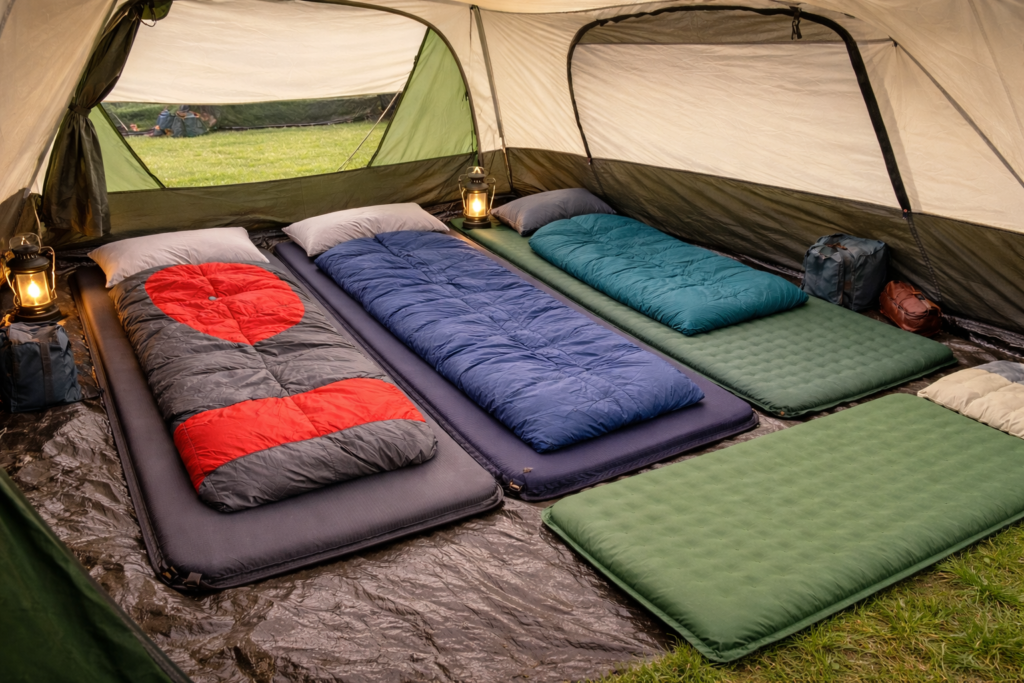
For a complete family of four: two Dreamcatchers or Shangri-Las for the adults, two Trail 5cm mats for the children. This gives every family member a quality night’s sleep without spending full premium prices across all four mats. It’s the kit combination that ends the “camping is exhausting” morning conversation and replaces it with something closer to an actual rest.
Related Guides
About The Author – Andrew Marshall
Andrew Marshall is the creator of Simple Days Outside and a UK parent of three who regularly camps, walks, and explores outdoor activities with his family. His guides focus on practical gear, realistic family adventures, and simple ways to help families enjoy the outdoors across the UK. The recommendations on this site are based on real-world use, research, and the kind of equipment families actually rely on for weekend trips and everyday outdoor fun.