

Written by Andrew Marshall
UK parent of three sharing practical advice to help families enjoy camping, walking, garden play, and simple outdoor adventures across the UK.
Creator of Simple Days Outside.
Last Updated: 24th March 2026
At some point on almost every family camping trip, the question comes up — usually around 10pm when someone is trying to get comfortable and failing. Is it the mattress? Is it the bed? Should we have bought something different?
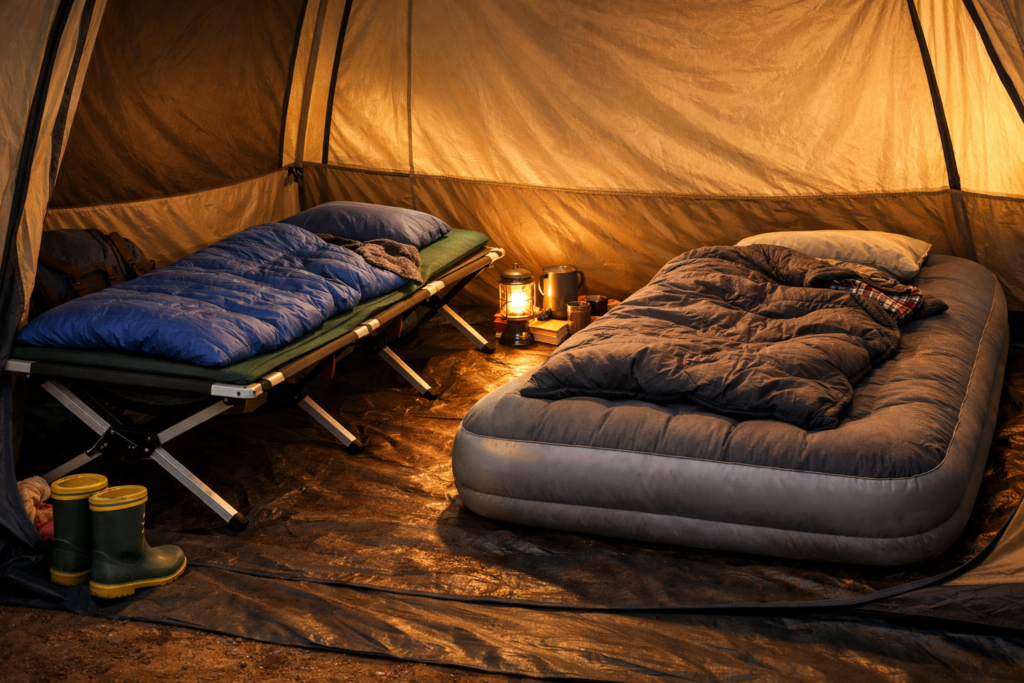
Camping beds and air mattresses are the two most common sleeping solutions for UK family campers who want to get off the ground, and they suit genuinely different situations. Neither is universally better. But understanding which suits your family’s camping style makes the decision straightforward — and means you stop waking up stiff at 3am wondering if there’s a better way.
For everything else on building a comfortable family camping sleep setup, the Family Camping & Short Trips section of the site covers mattresses, sleeping bags, and the full kit picture in one place.
What We’re Actually Comparing
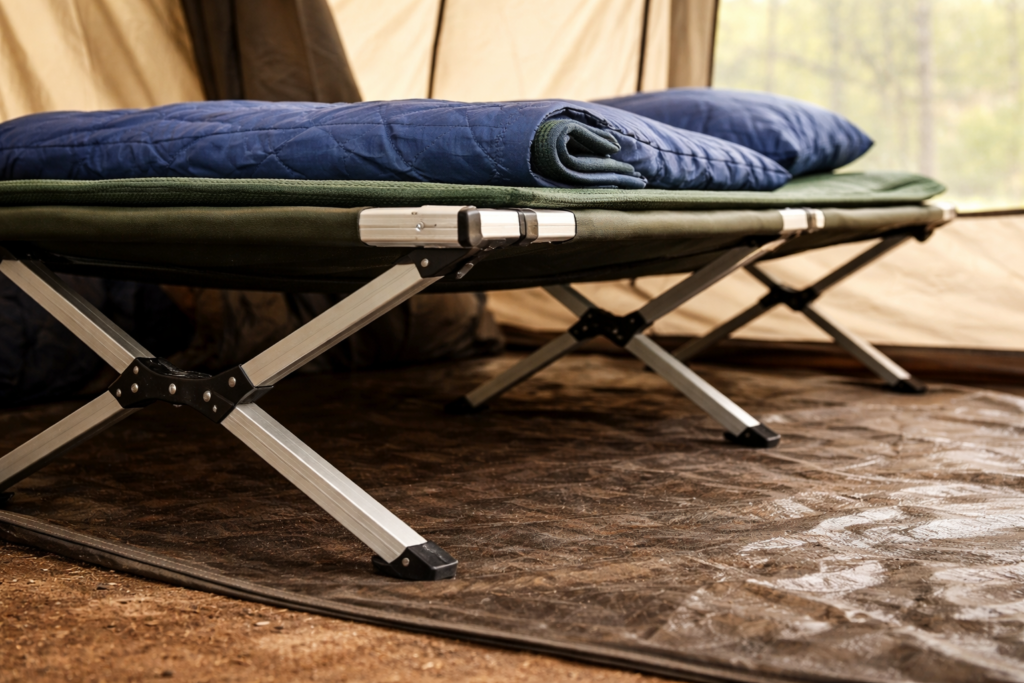
To be clear about what this article covers: a camping bed here means a rigid raised folding bed — the kind with a metal or aluminium frame, a fabric or sprung sleeping surface, and legs that lift you 20–40cm off the ground. Sometimes called camp cots. The kind your grandparents probably had and which have quietly become much better in the last ten years.
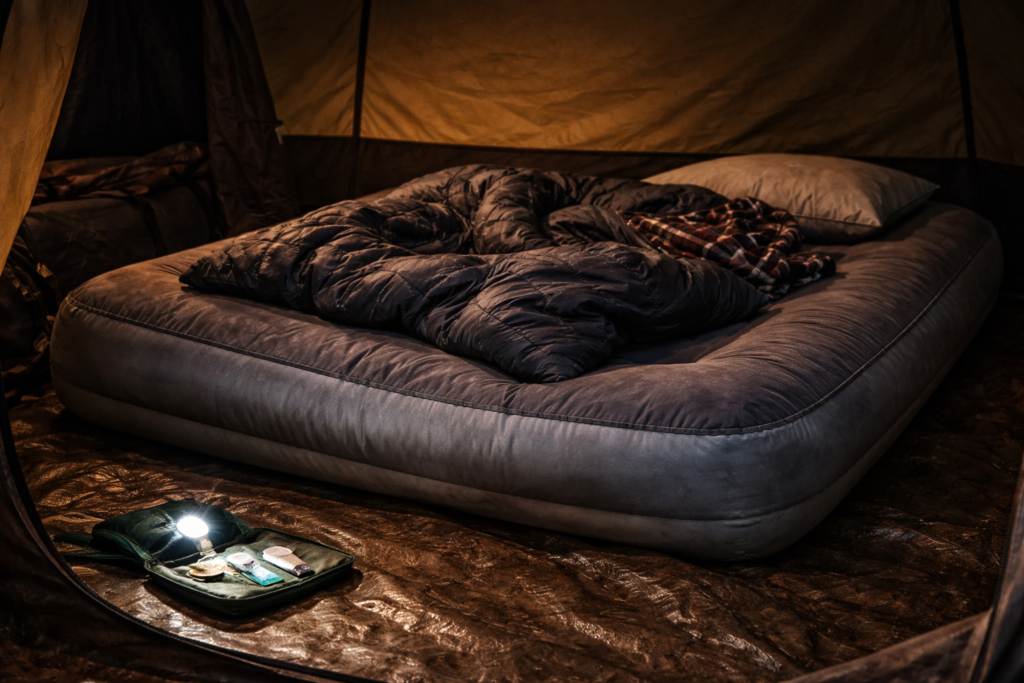
An air mattress here means a pure inflatable bed — no foam, entirely air-filled, typically inflated with a built-in or separate electric pump. Not self-inflating mats, which are a different product with different characteristics covered separately.
Both get you off the cold ground. Beyond that, they take quite different approaches to how they do it.
Camping Beds — What They Do Well
The sleep surface is consistent every night. The single biggest practical advantage of a camping bed is that it doesn’t change. A rigid frame with a taut sleeping surface gives the same firmness on night five of a trip as night one — there’s no air pressure to manage, no slow deflation to deal with, no waking up gradually closer to the ground as the night goes on.
We switched to camping beds for the older two kids after one trip where their air mattresses had both visibly deflated by day three of a five-night stay in Argyll. Neither child complained — they’d both adapted to sleeping on what was essentially a very thin floor cushion — but watching them crawl out of bags that were practically flat on the groundsheet was enough to make the switch permanent.
They’re genuinely warmer than air mattresses. This surprises people. Being raised off the ground sounds warmer, but the air inside an air mattress equilibrates toward ground temperature overnight — you end up sleeping on a bag of cold air rather than a bag of warm air. A camping bed lifts you above that problem entirely. A camping mat or sleeping pad on top of the frame traps your body heat between the surface and your sleeping bag in a way a cold-filled mattress simply doesn’t manage. On a Scottish October night, that difference is tangible within the first hour.
Setup and pack-down is predictable. A camping bed unfolds, legs click out, done. Pack down is the reverse. The first time I set one up properly it took under three minutes — compared to the fifteen-minute inflation and topping-up ritual of an air mattress plus the ten-minute deflation wrestling match at pack-down. For families moving between sites or camping for one or two nights, that speed adds up across a trip.
They last longer. A quality camping bed has no air chambers to puncture, no valves to fail, no fabric to stretch and lose firmness over time. A decent aluminium frame camping bed used regularly for ten years is entirely realistic. The same can’t usually be said for an air mattress used at the same frequency.
Air Mattresses — What They Do Well
The comfort ceiling is higher. A good air mattress — fully inflated, on the first night of a trip — is more comfortable than most camping beds for most sleepers. The full-body support of an air-filled surface at 30–46cm height genuinely approaches the feel of sleeping at home in a way that a camping bed’s fabric surface doesn’t quite replicate. My partner tried a friend’s high-end air mattress on a trip to Loch Lomond last summer and immediately started researching them for our own setup — the first-night comfort was that noticeably different.
They pack flat and small. A deflated air mattress folds into a surprisingly compact package. A camping bed — particularly a full-size model — folds down but never gets truly small. The aluminium frame takes up meaningful boot space regardless of how efficiently it’s packed. When you’re loading a family of five’s entire kit into one car, that difference matters more than it sounds.
Lower entry cost. Decent air mattresses start at a lower price than decent camping beds. For families who camp once or twice a year and want a comfortable night’s sleep without significant outlay, an air mattress is an accessible starting point. A electric pump makes inflation effortless and adds very little to the overall cost — worth buying alongside rather than relying on lung power for anything above a single.
More flexible sizing. Air mattresses come in double and queen sizes that provide a genuine shared sleeping surface for couples or a parent and young child. A standard single camping bed simply can’t do this. For families where the sleeping arrangement involves sharing, an air mattress gives options that rigid beds don’t.
Where Each One Falls Down
Camping beds have honest limitations worth knowing.
Pack size is the main one. A full-size camping bed takes up significant boot space when folded — more than any air mattress at the same sleeping area. A roof box or roof bag helps manage this for families where boot space is already stretched, but it adds cost and faff that air mattress users don’t have to think about.
The sleeping surface on a basic camping bed can feel firm in a way that suits some sleepers and frustrates others. A self-inflating sleeping mat laid on top of a camping bed significantly improves the feel and adds insulation — budget for this as part of the total cost rather than treating the bed frame alone as the complete solution.
Most camping beds are also sized for one person. Double camping beds exist but they’re bulkier, more expensive, and less versatile than double air mattresses or double self-inflating mats. For couples who want to share a sleeping surface, a camping bed is rarely the right answer.
Air mattresses have their own limitations that are worth being honest about.
Reliability over multiple nights is the core issue. Even a good air mattress loses some pressure over the course of a week-long trip as the PVC material stretches and temperature changes affect air volume. The difference between night one and night five on an air mattress that cost under £50 can be significant. And a puncture on day three of a seven-day camping trip with no replacement is a memorable experience for entirely the wrong reasons — we’ve been there, on a site in the Highlands with three children and nothing to sleep on at midnight. A puncture repair kit in the kit bag is non-negotiable if you rely on an air mattress.
If you’re weighing up the full sleep system picture rather than just the mattress question, staying warm camping without overpacking covers ground cold, layering, and the full setup in one place — useful context alongside any sleeping surface decision.
Air mattresses are also colder than their height suggests. The air inside equilibrates toward ground temperature overnight, which means a thick air mattress on a cold night can feel colder to sleep on than a self-inflating mat at half the height. A camping duvet or an extra layer underneath the sleeping bag compensates — but it’s additional kit that camping bed users don’t need to account for.
Which Works Better for Children?
For younger children — roughly under eight — air mattresses present a rolling-off risk that camping beds don’t. Our youngest went through a phase of migrating to the absolute edge of any surface he was on within twenty minutes of falling asleep. A camping bed with a raised edge rail stopped that entirely. On an air mattress at floor level, the same behaviour just meant he ended up on the groundsheet — which was fine in August and significantly less fine on a cold October weekend.
For older children who sleep relatively still, both work adequately. The camping bed wins on reliability — same surface every night, no maintenance, nothing to check or top up. The air mattress wins on pack size if space is tight.
A single camping bed paired with a sleeping bag liner and a correctly rated sleeping bag is a complete, warm, reliable sleep system for a child that requires no maintenance across a week’s camping. That simplicity has genuine value when you’re managing multiple people’s sleeping arrangements simultaneously. If you’re specifically researching what children sleep on, the best camping beds for kids covers the specific options worth considering for different ages — including the low-profile raised-edge designs that work well for younger children.
A Note on Cost Over Time
This is worth considering before buying purely on upfront price.
A quality camping bed at £80–120 used ten or fifteen times a year for five to seven years costs roughly £1–2 per night of use. An air mattress at £40–60 that needs replacing every two to three years due to stretching, valve failure, or puncture costs more per night over time despite the lower upfront price.
For families who camp seriously and regularly, the camping bed is almost always the better long-term investment. If you’re building the kit list from scratch and trying to work out what to prioritise spending on, what you actually need for a first family camping trip helps put the sleeping surface question in the context of everything else you’re deciding at the same time.
For families who camp once or twice a year, the air mattress’s lower entry cost may well be the right answer — there’s no point investing in longevity for kit that rarely comes out of the shed.
The Specific Situations Where Each One Wins
Choose a camping bed if you camp regularly across spring, summer, and autumn rather than just peak summer. You stay on one site for multiple nights. Boot space isn’t critically constrained. Reliability across a long trip matters more than maximum comfort on night one. You have younger children who move around in their sleep.
Choose an air mattress if you camp primarily in summer for one or two nights at a time. Boot space is at a premium. You want a shared double sleeping surface. You’re doing occasional camping rather than regular trips and want the lowest possible entry cost. You have a large tent on a fixed pitch for the duration of the trip.
Neither answer is wrong — they’re just right for different camping styles.
What We Actually Use
Our setup is a mix — which is probably the most honest answer for a family with children at different ages and different sleeping needs.
The adults use a self-inflating double mat — if that’s the direction you’re leaning rather than a camping bed or air mattress, the double mattress options worth considering for UK family camping covers the specific products across different budgets and sleep needs. The older children use single camping beds with a self-inflating sleeping mat on top. The youngest uses a low-profile camping bed with raised edges — the one that solved the midnight migration problem for good.
If we were forced to choose between a camping bed and a pure air mattress for adults specifically, the camping bed would win on every trip from September through to May. For July and August camping in a large tent on an established site, a higher-end air mattress is genuinely tempting for the first-night comfort. The honest recommendation for most UK families: camping beds for children and for any trips that involve variable weather, an air mattress for couples doing summer-only camping where pack size and shared surface matter more than long-term reliability.
FAQ
Are camping beds warmer than air mattresses?
Generally yes — particularly on cold nights. A camping bed elevates you above the ground and the sleeping surface doesn’t absorb ground cold the way air inside a mattress can. A camping mat on top of a bed frame adds further insulation. Air mattresses can feel cold to sleep on in lower temperatures because the air inside equilibrates toward ground temperature overnight.
Do camping beds hurt your back?
A basic camping bed with no additional mat can feel firm. Most people who find camping beds uncomfortable are sleeping on a bare frame without a mat on top. A self-inflating sleeping mat laid on top of a camping bed changes the sleep surface significantly and solves most comfort complaints. A memory foam camping mat topper cut to size is worth considering for anyone with specific back issues.
How long does an air mattress stay inflated?
A quality air mattress on the first few uses should hold air overnight without noticeable loss. Over extended use as the PVC material stretches, some top-up is typically needed every few days on a longer trip. Temperature drops overnight also cause air volume to contract slightly — this is normal and not necessarily a leak. A battery-powered air pump for top-ups during a trip avoids the need to find a mains socket.
Can children use camping beds safely?
Yes — most camping beds designed for children have low profiles and raised edge rails that reduce rolling-off risk. For children under five, a low-profile camping bed or a floor-level self-inflating mat is safer than a full-height camping bed or a high air mattress. Always check the weight limit before buying for a child.
What goes on top of a camping bed to make it more comfortable?
A self-inflating sleeping mat or a folded fleece blanket between the frame and the sleeping bag makes a significant difference to both comfort and warmth. A camping pillow completes the system. For anyone with back issues, a memory foam topper cut to size is worth the small extra investment.
Is an air mattress suitable for UK spring and autumn camping?
With the right sleeping bag and an additional layer underneath, yes — but it requires more management than a camping bed or self-inflating mat in the same conditions. The cold-air problem is more pronounced below 10°C. For regular spring and autumn camping, camping beds or self-inflating mats are more consistently comfortable with less effort.
Related Guides
About The Author – Andrew Marshall
Andrew Marshall is the creator of Simple Days Outside and a UK parent of three who regularly camps, walks, and explores outdoor activities with his family. His guides focus on practical gear, realistic family adventures, and simple ways to help families enjoy the outdoors across the UK. The recommendations on this site are based on real-world use, research, and the kind of equipment families actually rely on for weekend trips and everyday outdoor fun.