
Last Updated: 18th March 2026
If you’re standing in a toy shop trying to decide, or your child has been on stabilisers for six months and still isn’t getting it — here’s what nobody told you before you bought the first one.
The honest answer is that balance bikes are better. Not because stabilisers are useless, but because they skip the one thing that actually makes learning to ride hard. And once you understand what that one thing is, the whole decision becomes obvious.
If you’re building up your child’s outdoor kit more generally, the Garden & Outdoor Play hub covers everything from first bikes to garden games worth having.
The Thing Nobody Tells You About Learning to Ride
Most parents assume the hardest part of learning to ride a bike is pedalling. Or steering. Or just finding the nerve to go. It’s none of those things.
The hardest part is balancing — that instinctive, almost subconscious ability to feel the bike tipping and correct it before you fall. Everything else is learnable in an afternoon. Balancing takes time, repetition, and crucially — practice. You can’t learn it by being propped up. You learn it by nearly falling and not quite falling, over and over, until your body just knows what to do.
Stabilisers solve the pedalling and steering problem beautifully. They let a young child sit on a bike, push the pedals, steer around the garden, and feel like they’re riding. For a while that feels like progress — and for a parent watching, it looks like progress too. The problem is that the whole time they’re doing it, they’re not learning to balance at all. The stabilisers are doing that job for them. And when the stabilisers come off, the child discovers that the skill they needed most is the one they never actually practised.
What I Actually Noticed With My Own Kids
I ride myself — have done for years — and when my kids were young I wanted to get them started early. We tried stabilisers first, like most parents do.
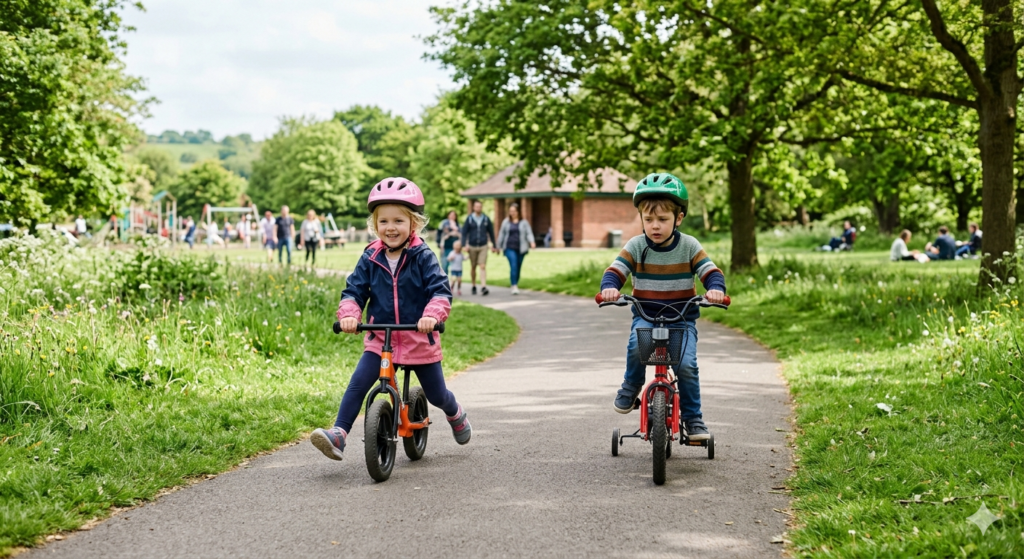
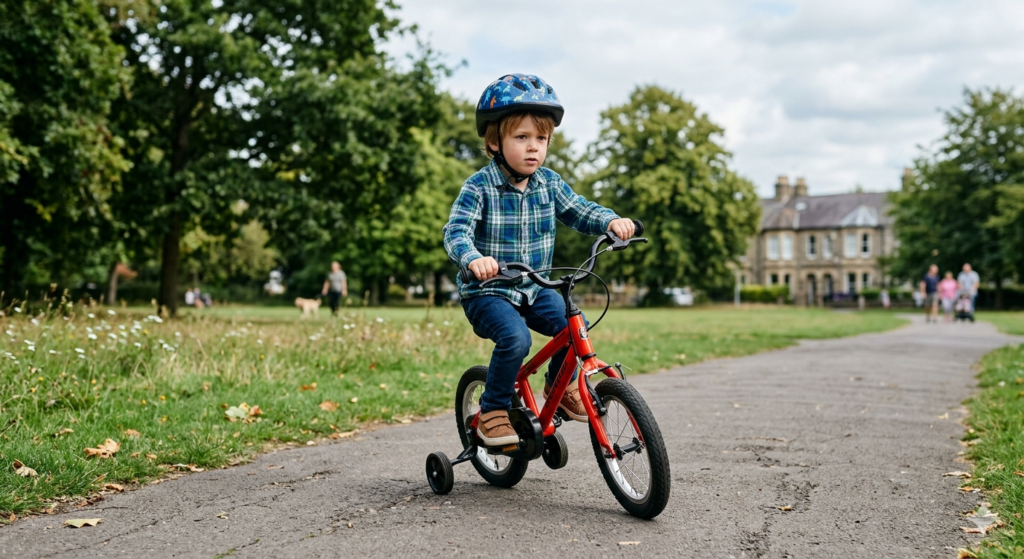
And here’s the thing I noticed that nobody had mentioned: on stabilisers, kids rock. Left, right, left, right — the bike tips onto one stabiliser, then the other, then back again with every pedal stroke. There’s a rhythm to it but it’s the wrong rhythm. They’re not balancing. They’re just rocking between two metal supports, completely unaware that the actual skill — the one that will matter when those supports are gone — is nowhere in the picture.
We ended up at Glasgow Green one day — big flat open park, plenty of space, no pressure. Tried the stabilisers there, watched the familiar rocking, and thought there had to be a better way. We’d heard about balance bikes and decided to try one. Same child, same park, same day.
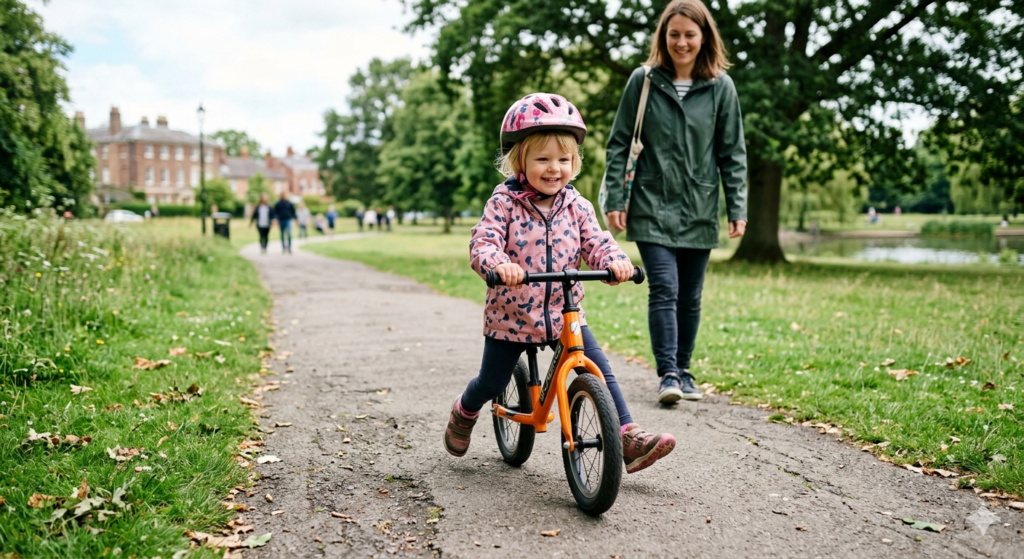
Within twenty minutes they were gliding. Feet off the ground, rolling along the path, completely relaxed. Not because we’d taught them anything new — but because the bike was letting them figure out balance naturally, on their own terms, at their own pace. That moment when a child realises they’re balancing and nobody is holding on is something you don’t forget. There’s no drama to it on a balance bike. It just quietly happens.
After a good while on the balance bike we put them back on the stabiliser bike — but with the stabilisers removed. They used it like a balance bike at first, feet along the ground, gliding just like they’d been doing. Then the confidence came and they started pedalling. That was genuinely it. No weeks of someone running alongside holding the saddle. No wobbling and crying. They just rode. When that moment comes and they’re ready for a proper pedal bike, getting the size and weight right makes more difference than most parents realise.
Why Balance Bikes Work — The Actual Reason
A balance bike has no pedals. The child sits on it, pushes along the ground with their feet, and glides. That’s the whole thing. It sounds almost too simple to matter — and yet it’s the approach that’s replaced stabilisers for most parents who’ve tried both, for good reason.
Because the child’s feet are always close to the ground, falling feels manageable rather than frightening. They push, they glide, they put their feet down. Over time — faster than most parents expect — the glides get longer. Then longer still. Then they’re lifting their feet for several seconds at a time, their body naturally adjusting, weight shifting without thinking about it. That’s balancing. And they’re learning it completely naturally, without anyone explaining it, without any equipment propping them up.
The body learns balance by nearly losing it. Balance bikes create exactly that situation, safely and repeatedly, until the skill is just there.
The Transition — Where Balance Bikes Win Completely
When a child who’s spent time on a balance bike gets on a proper pedal bike for the first time — no stabilisers — they already know how to balance. Pedalling is straightforward. Steering they’ve been doing all along. The only thing that stops most children riding immediately is that they’ve never balanced before. Balance bike children have. The transition is fast, often surprisingly so.
With stabilisers alone it’s a different story. When the stabilisers come off, the child is starting from scratch on the most important skill. Some manage fine — children are adaptable — but the process is longer, there’s more frustration involved, and honestly there’s more crying than there needs to be. The child isn’t failing because they’re not trying. They’re failing because they were never given the chance to learn the right thing.
The Guilt Nobody Talks About
There’s a version of this story that a lot of UK parents know but don’t say out loud. The child has been on stabilisers for months. Other kids at the park are already riding without them. The stabilisers are still on because taking them off leads to wobbling and upset, and it’s easier to leave them on a bit longer. And somewhere underneath all of that is a quiet parental anxiety — am I doing this wrong? Should I have started differently?
If that’s where you are — you haven’t done anything wrong. Stabilisers are what most people start with because that’s what’s available and what’s familiar. But if progress has stalled, it’s almost certainly because the balance skill is missing rather than anything else. Taking the stabilisers off the existing bike and letting the child glide on it like a balance bike is worth trying before anything else. It costs nothing and it works more often than people expect.
Where Stabilisers Still Have a Place
This isn’t an argument that stabilisers are worthless — they’re not.
For very young children who aren’t ready for balance work, a stabiliser bike gives them something to do on a bike before they have the leg strength or coordination for gliding. For anxious children who need a very gradual, secure introduction to bikes, the stability of four wheels genuinely helps. And for families who already own a stabiliser bike, the good news is that most can have the stabilisers removed and be used as a balance bike — which is exactly what we did, and it worked.
The issue with stabilisers isn’t that they’re harmful. It’s that they delay the most important skill by making it unnecessary. Use them with that in mind — as a brief introduction, not a long-term method — and they’re a reasonable starting point.
Rain, Mud, and Scottish Conditions
Worth saying because no article written from a warm office in the south of England is going to mention this — balance bikes in wet conditions are a different experience to a sunny day at the park.
On a wet Glasgow path in October, a balance bike still works well because the child’s feet are always available as a natural brake. They feel the surface change and respond to it instinctively. Stabilisers on wet grass or gravel are genuinely more difficult — the stabilisers catch and drag, the bike lurches unpredictably, and the child loses confidence rather than building it.
If you’re in Scotland or anywhere with regular rain — which is most of the UK — a balance bike handles the conditions better in practice. Get them a decent kids waterproof jacket and some wellies and don’t wait for a dry day. Learning to ride in all weathers is part of the point.
Age and Sizing — Getting It Right
Balance bikes work best from around 18 months to 5 years depending on the child’s size and confidence. The most important thing is fit — the child should be able to sit on the seat with both feet flat on the ground comfortably. If they’re stretching to reach the floor the bike is too big and the whole benefit is undermined.
Most balance bikes come in 10 inch and 12 inch wheel sizes. A 10 inch suits children from around 18 months to 3 years. A 12 inch suits 3 to 5 year olds. When in doubt, size down — a balance bike they can control confidently is far better than one that feels unstable and puts them off.
For stabiliser bikes the stabiliser height matters more than most parents realise. They should be set so the bike sits level. A common mistake is leaving one stabiliser slightly higher than the other, which creates an uneven rocking motion and makes the whole experience more chaotic than it needs to be.
If you’re thinking about what else to add to the garden alongside a bike, a climbing frame is the obvious next step for most families.
What to Actually Buy
For a balance bike, the Strider 12 Sport is the one worth starting with. Lightweight at just 3kg — light enough that a small child can actually manoeuvre it without it feeling like a struggle — adjustable seat height, and no tools needed to resize it as they grow. I’d spend the money on the Strider over a cheaper alternative because the weight difference is real and a heavy balance bike defeats the purpose. Typically around £90–£100.
If budget is tight, the Kriddo at around £50 is a solid alternative. Slightly heavier but well built and a sensible choice if you’re not sure how much use it’ll see.
For a stabiliser bike that converts properly — the Isla Bikes Cnoc 14 is worth knowing about. It’s a genuine lightweight kids’ bike rather than a toy, and removing the stabilisers to use it as a balance bike works properly rather than just theoretically. More expensive but it grows with the child.
A kids cycling helmet is worth sorting before the first ride — fit matters more than price, so try before you buy if possible, or check the sizing guide carefully when ordering online.
FAQs
What age should a child start on a balance bike? Most children are ready from around 18 months as long as the bike fits and their feet reach the ground flat. Some start closer to 2. Follow the child rather than the age on the box.
How long does it take? Most children are gliding confidently within a few sessions. The transition to a pedal bike typically happens between 3 and 5 and is usually faster than parents expect — often within a single afternoon once the balance is there.
Can you convert a stabiliser bike to a balance bike? Often yes — remove the stabilisers and the pedals and you have a functional balance bike. Works better with lighter bikes. Worth trying before buying a separate balance bike if you already own one.
My child is already on stabilisers — should I switch? If they’re under 4 and haven’t yet transitioned to riding without them, removing the stabilisers and letting them glide is worth trying first. A lot of children take to it quickly and you won’t need to buy anything new.
Are balance bikes safe? Yes — because the child’s feet are always close to the ground, the risk of a serious fall is low. They’re generally considered safer for young children than stabiliser bikes precisely because the child is always in control of stopping.
What’s the best surface to start on? Flat, smooth, and open. A path through a park is ideal — Glasgow Green, a local playing field path, anywhere with space and no traffic. Avoid uneven grass or gravel to begin with. Once confidence builds, varied surfaces are fine.
The Honest Call
Balance bike, without question — and I say that having used both with my own kids.
Stabilisers teach pedalling and steering. Balance bikes teach balancing — the actual hard part. Once a child has the balance, everything else follows naturally and quickly. If you already own a stabiliser bike, take the stabilisers off before you buy anything new. Let them glide on it. You might be surprised how quickly something clicks.
The goal is a child who rides confidently and enjoys it. Balance bikes get there faster, with less frustration, and with a transition to a proper bike that feels almost effortless when the time comes.
Standing on Glasgow Green watching your child glide along on their own for the first time — feet up, completely balanced, not even thinking about it — is one of those small moments that stays with you.