

Written by Andrew Marshall
UK parent of three sharing practical advice to help families enjoy camping, walking, garden play, and simple outdoor adventures across the UK.
Creator of Simple Days Outside.
Last Updated: 3rd April 2026
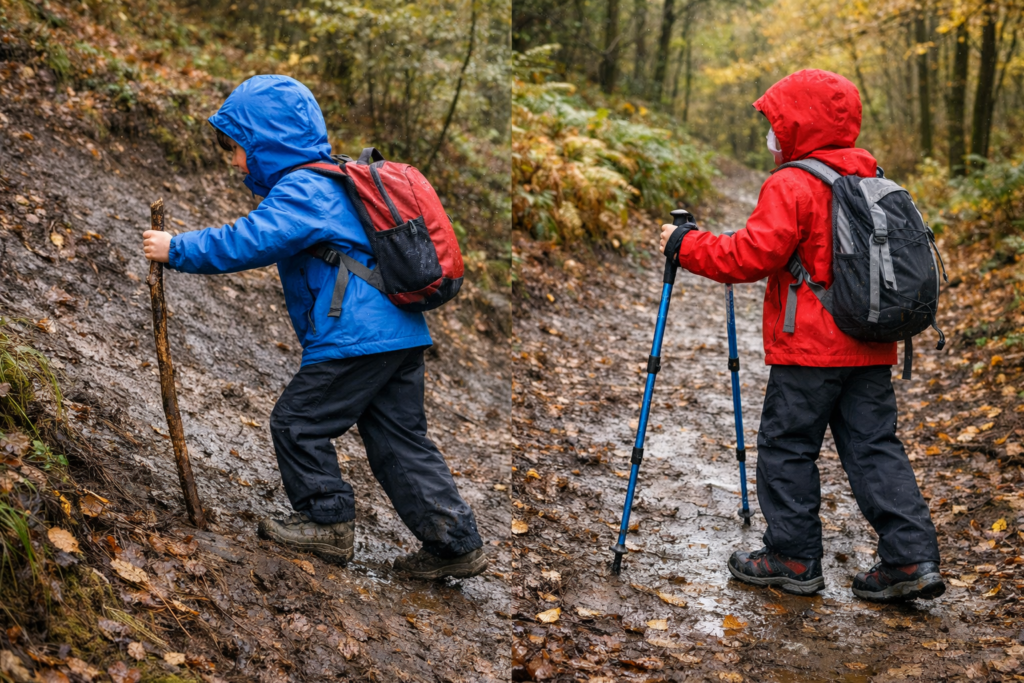
Our youngest spent an entire autumn walking season with a stick they’d found near Balloch — absolutely convinced it was better than any pair of poles money could buy. On the flat paths by the water they were probably right. It made no meaningful difference either way.
Then we did a longer walk with a proper descent on a wet path. The stick was handed to us to carry before we were halfway down. By the end of the walk they were asking for poles.
That experience captures the hiking poles versus walking sticks question better than any comparison. A stick works fine — until the walk gets interesting. Here’s where the difference actually lies.
If you’ve already decided poles are the right call and want to know which ones to buy, lightweight kids hiking poles worth considering covers the confirmed UK options across different ages and budgets.
More family walk gear and planning is in our Family Walking & Easy Hiking Hub.
What These Things Actually Are
Before the comparison makes sense, it helps to clarify the terminology — because it gets muddled constantly.
A walking stick is typically a single piece of wood or carved staff, fixed length, no adjustability. It might be a hazel stick picked up from a woodland floor, a traditional crook-handled shepherd’s staff, or a purchased wooden stick with a rubber ferrule on the bottom. It gives one point of support. It doesn’t collapse. You can’t shorten it for uphill sections or lengthen it for descents. It is, for most purposes, a very long stick.
Hiking poles — also called trekking poles — are a pair of lightweight adjustable poles, usually aluminium, with wrist straps, interchangeable tips, and locking mechanisms that let you set the height precisely for the terrain. They give two points of support on either side simultaneously. They collapse to fit in a pack. They’re what most family walkers end up using once they’ve tried them on a real hill.
When most parents search this question what they’re actually asking is: does my child need proper adjustable poles, or can they grab a stick from the hedgerow? That’s the question worth answering honestly.
What a Wooden Walking Stick Actually Does Well
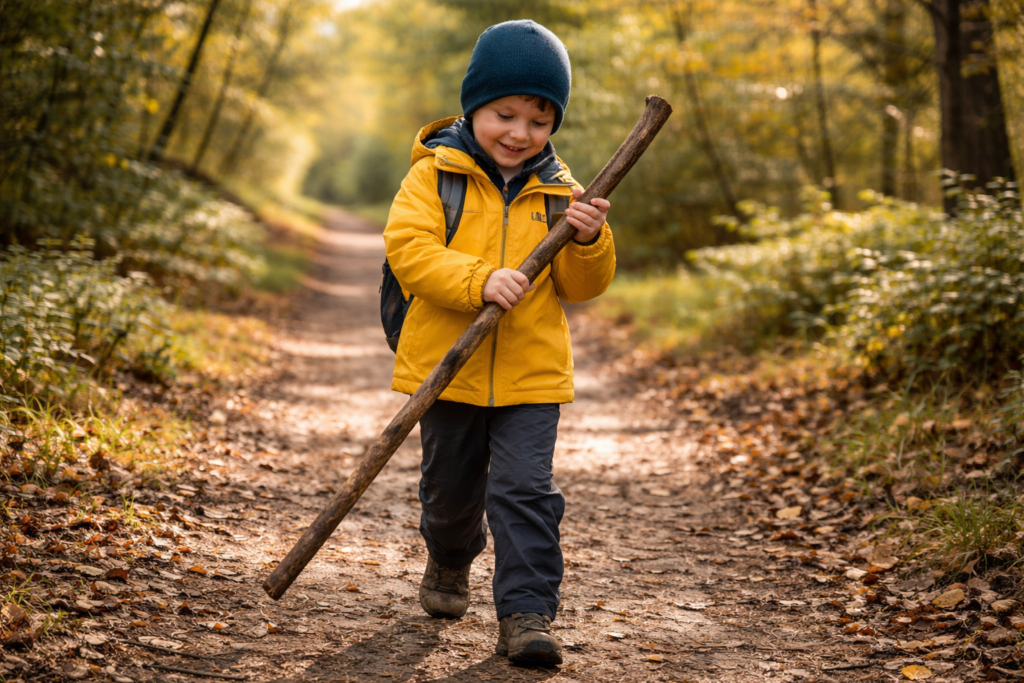
A stick found on the path — or a proper purchased wooden staff — isn’t useless. Children have been walking uphill with hazel sticks for as long as there have been hills and children, and it genuinely works for basic balance support on easy ground.
For a short, easy family walk on a dry maintained path, a wooden stick does most of what a child needs. It provides something to lean on, something to probe muddy puddles with, something to feel purposeful about. The primitive satisfaction of carrying a proper stick on a walk is something that doesn’t need explaining to any child who has ever done it — there’s an imaginative quality to a found stick that a pair of bright aluminium poles doesn’t quite replicate.
It costs nothing. A straight stick found on the path is immediately available and immediately replaceable if lost, dropped in a burn, or left behind at the car park. There’s no investment anxiety, no worry about losing it, no upset if it gets snapped on a boulder scramble.
And it works adequately on easy terrain. For flat or gently rolling ground in reasonable conditions, a stick provides sufficient single-point balance support for most children.
Where Walking Sticks Fall Short
On anything beyond moderate ground, the limitations of a single fixed-length stick become apparent fairly quickly.
No height adjustment. A walking stick is whatever length it is. On uphill sections the ideal pole length is shorter. On downhill sections it’s longer. A stick doesn’t change — it’s always at the wrong height for at least some of the walk, which reduces its effectiveness and can make it more awkward than helpful on steep terrain.
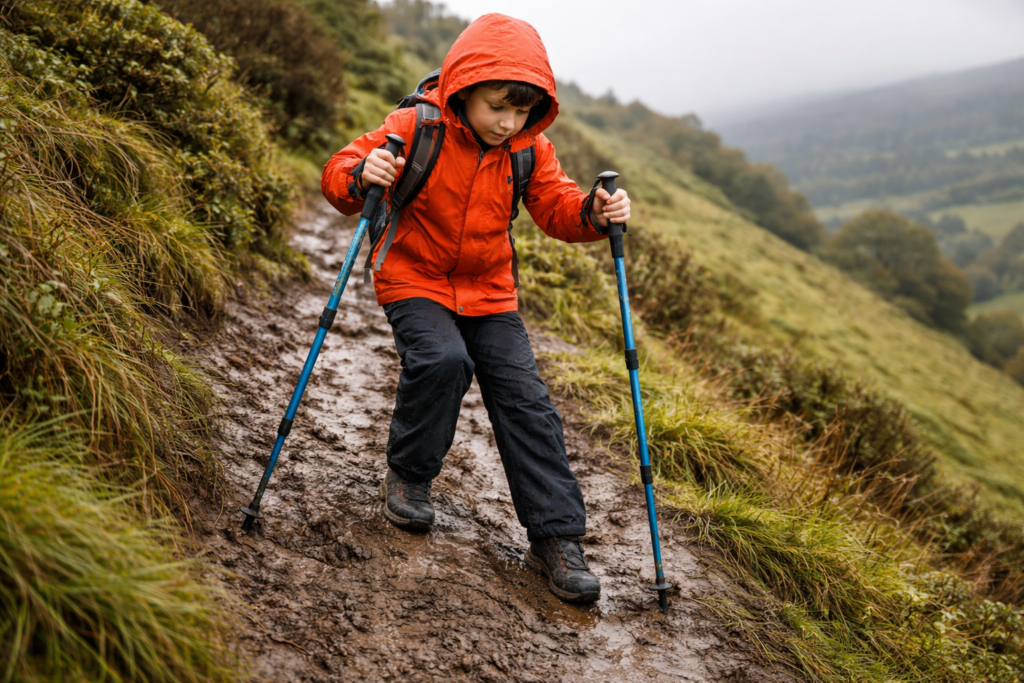
Single point of support. Two poles provide four points of contact with the ground when both are planted — considerably more stability than two feet and one stick on genuinely uneven or slippy surfaces. On muddy descents, rocky paths, or stream crossings, the difference between one support point and two is significant. Footwear makes a meaningful difference here too — waterproof walking boots that keep kids’ feet dry on slippy terrain work alongside poles rather than instead of them.
We’ve watched children navigate a boggy section of path — the type that looks firm and isn’t — with much more confidence when they have a pole on each side to brace against than when they have one stick and one free hand. The single stick works for the obvious hazard. It’s the unexpected one that catches children out.
Can’t shorten for storage. A walking stick that’s the right height for walking is too long to carry when not needed, too awkward to stow in a pack, and too long to manage on narrow or crowded paths. Hiking poles collapse to 50–65cm and fit down the side of a daypack.
Less effective specifically on descents. Proper hiking poles lengthen for descent and plant ahead of the body as a brake. A fixed-length stick can’t be used with the same technique. On any significant descent in wet conditions — the ones that most often end with someone sitting on the path unexpectedly — poles are meaningfully more effective.
The Gap Only Shows Up in Specific Situations — But Those Are the Ones That Matter
The difference between a stick and proper poles only really shows up clearly in specific situations — but those situations are the ones that make or break a family walk.
Adjustability means the poles work correctly for the specific gradient at any point. Shorter for uphill so the elbows stay at the right angle and you push efficiently rather than reaching awkwardly. Longer for downhill so the poles can plant ahead and act as a brake. On any hill with proper gradient this isn’t a marginal difference — it’s the main reason experienced family walkers use proper poles rather than sticks on anything beyond easy terrain.
Bilateral support means two poles, one on each side, creating a four-point contact system when both are planted. Research on trekking poles consistently shows they reduce knee joint loading by 12–16% on downhill sections — relevant for adult knees over long descents and for children who fatigue in their legs more quickly than they’d admit. One stick and two feet doesn’t achieve the same distribution.
Terrain versatility means the poles work correctly with mud baskets for boggy ground, rubber tips for hard paths, and tungsten tips for rocky trails. A wooden stick works adequately on one type of ground and not especially well on the others.
We’ve done enough walks where the conditions changed mid-route — dry path turning to churned mud, a crossing that turned out deeper than expected, a descent considerably more challenging on the return than it looked on the way out — to appreciate having adjustable poles rather than a collection of sticks of varying usefulness.
The Honest Middle Ground
There are situations where a walking stick is genuinely the more appropriate choice for a family walk.
Very young children aged 3–5 are often better served by a found stick than by proper poles. The coordination required to use poles effectively isn’t fully developed at this age, and a stick that can be abandoned, left behind, or replaced costs nothing. Let the child find their own stick and carry it how they want to.
Easy flat walks where the terrain doesn’t require adjustable height or bilateral support. A stick is adequate and the additional investment in poles doesn’t return much benefit. If you’re planning a first family walk and unsure how much terrain to take on, realistic walking distances for kids by age helps set expectations before committing to a route where poles would genuinely earn their place.
Children who actively resist poles but will carry a stick. The psychological difference matters more than the technical one in this case. A child who walks an extra two kilometres because they found an impressive stick is more valuable than a child who refuses poles and whose poles end up being carried by a parent. Participation in the walk matters more than the technical superiority of the equipment.
Children who start with sticks and then try proper poles for the first time on a real hill almost always prefer the poles once they’ve felt the difference on a descent. The conversion tends to happen naturally rather than needing to be engineered. Once they’re using poles, how to use them properly on hills covers the technique adjustments for uphill and downhill that make the biggest difference.
What About a Hiking Staff?
Worth briefly addressing because it sits between these two categories and causes its own confusion.
A hiking staff is a single pole, typically longer than a walking stick and designed specifically for trail use — usually with a rubber or carbide tip, sometimes with a basic handle. Some are adjustable, many aren’t. They’re more capable than a found stick but less versatile than a pair of poles.
We’ve tried a single staff on moderate terrain and it’s fine — better than a found stick, less useful than two poles. For family walks where children are the primary users, the bilateral support of a pair wins. A staff is probably better suited to an adult who wants single-sided support on a lower-gradient walk and doesn’t want to manage two poles. For anything where the children are walking significant hills or wet terrain, a proper pair does the job more effectively.
The Practical Verdict
For families who walk regularly on anything with gradient, mixed terrain, or typical British weather — proper adjustable hiking poles are the right choice over walking sticks. The adjustability, bilateral support, and terrain versatility justify the cost on any walk that goes beyond a flat country park circuit.
For occasional easy walks, for very young children, or for households where a found stick provides all the engagement and support needed — a walking stick is absolutely fine and costs nothing.
The walking stick versus hiking poles debate only really matters on the walks where it matters — steep descents in wet conditions, stream crossings, long routes with significant elevation. On those specific walks, poles win clearly. On everything else the difference is marginal and a stick works fine.
Frequently Asked Questions
Can children use a walking stick safely on hills? Yes, with appropriate expectations. A stick provides single-sided balance support which is useful on moderate terrain. On steep, wet, or rocky descents the limitations of a fixed-length single stick become apparent — proper poles are considerably more effective in those specific conditions.
Is it safe to let children use found sticks on walks? Generally yes for easy to moderate terrain. A found stick should be checked for stability — a rotten or hollow stick that snaps unexpectedly while weight is on it is a fall hazard. Solid hardwood sticks are fine. Anything that bends or feels hollow under pressure shouldn’t be trusted for support.
What age should children move from sticks to proper poles? Around 6–7 is the natural transition point for most children — the coordination for poles develops around then. Below this age a stick or nothing at all is often more practical on easy terrain.
Are adjustable hiking poles worth the cost over a walking stick? For families who walk regularly on any terrain beyond flat maintained paths — yes. A decent pair of kids’ poles costs £15–25 and lasts several seasons. The adjustability alone, allowing height to be set correctly for both ascent and descent, makes them more useful on any walk with meaningful hills than any fixed-length stick.
Can adults use a walking stick instead of hiking poles for family walks? For easy to moderate terrain, yes — a single quality walking stick gives reasonable benefit. On longer walks with significant descent, the bilateral support and adjustability of proper poles protects adult knees considerably better. Most adults who try proper poles on a long descent don’t go back to a single stick voluntarily.
Related Guides
About The Author – Andrew Marshall
Andrew Marshall is the creator of Simple Days Outside and a UK parent of three who regularly camps, walks, and explores outdoor activities with his family. His guides focus on practical gear, realistic family adventures, and simple ways to help families enjoy the outdoors across the UK. The recommendations on this site are based on real-world use, research, and the kind of equipment families actually rely on for weekend trips and everyday outdoor fun.