

Written by Andrew Marshall
UK parent of three sharing practical advice to help families enjoy camping, walking, garden play, and simple outdoor adventures across the UK.
Creator of Simple Days Outside.
Last Updated: April 2026
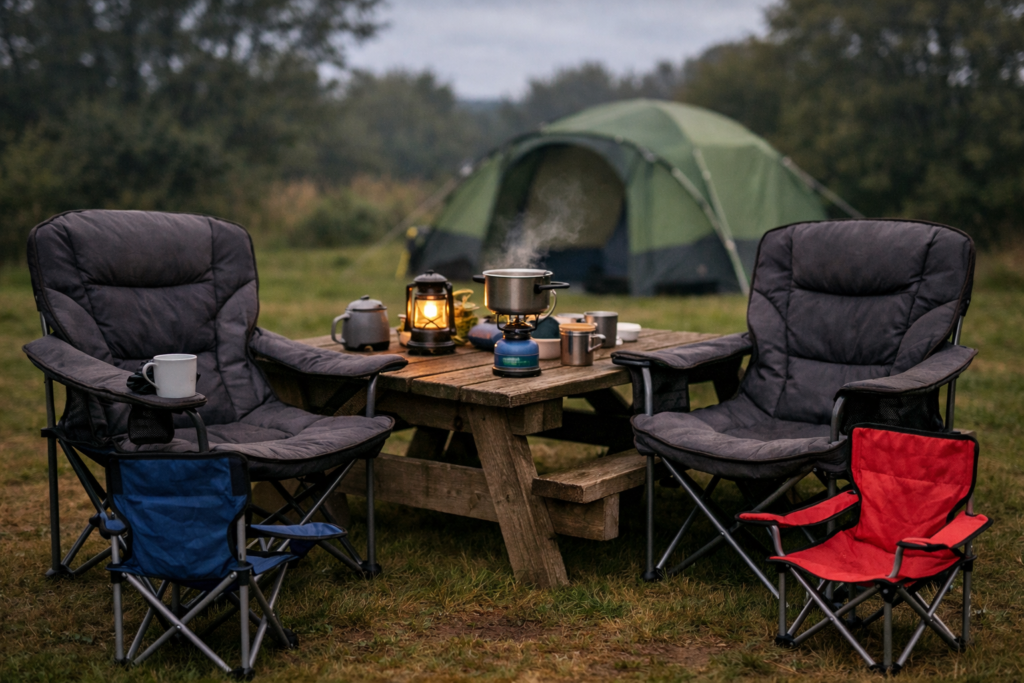
Camping chairs are the piece of kit that separates a campsite from an outdoor living room. Get them right and the evening after a day walking, swimming, or chasing children around a field becomes genuinely restorative — adults sitting comfortably around the camp stove, children eventually settling, everyone actually relaxing. Get them wrong and you spend the evening perched at an angle, back aching, trying to find a position that doesn’t feel like a mild form of punishment.
We learned this the hard way at a campsite near Loch Venachar several years ago. Four adults, four children, four cheap folding chairs that had seemed perfectly adequate in the garden, and by 9pm two of the chairs had developed a lean and one had lost a leg entirely. We ended up sitting on the cool box. The replacement chairs the following season cost more, weighed more, and took up more boot space — and were unequivocally worth every trade-off. Nobody mentioned their back. Nobody stood up after an hour to find somewhere more comfortable to sit. The evening felt like a proper evening rather than a test of endurance. Chairs are just one of the things that don’t get mentioned before a first family camping trip — but they’re one of the most immediately felt when they go wrong.
More family outdoor kit across the Family Camping hub — including everything else worth bringing on a short trip.
Why Most Families Get This Wrong
The mistake most families make with camping chairs is buying the same kind of chair they’d buy for a one-off garden party and expecting it to work for three evenings in a row at a campsite. A flimsy folding chair is fine when you’re going to stand up every twenty minutes anyway. It’s a different proposition when you want to actually sit down after dinner and stay there for two hours without your back announcing its unhappiness by 9pm.
The specific things that matter for family camping — back height that reaches the shoulders, a seat wide enough to shift position in, a frame that handles being loaded wet into a car boot and unloaded damp at the other end — are all things that cheap chairs skimp on. None of these are obscure requirements. They’re the things that every experienced UK family camper eventually learns matter, usually after at least one trip where the chairs were the problem.
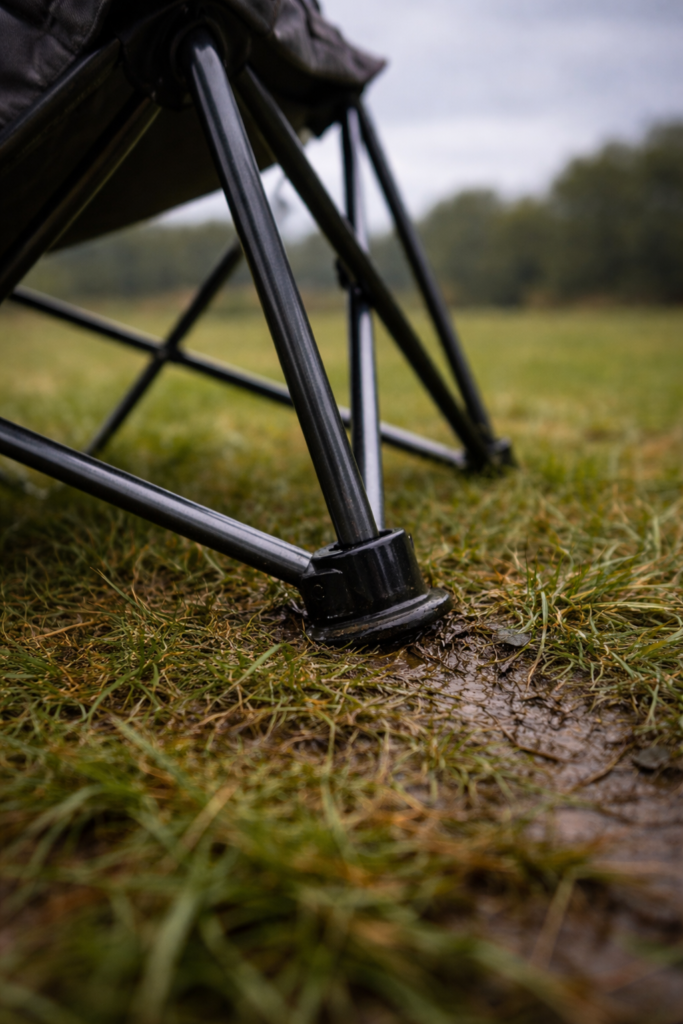
There’s also a UK-specific issue that most camping chair articles written for other markets miss entirely: soft ground. UK campsite grass after rain — which is most UK campsite grass for most of the camping season — is soft enough that thin-legged chairs sink. Not dramatically. Just gradually, through the course of an evening, until you’re sitting at a slight angle that gets progressively more uncomfortable. Chairs with wider feet, rubber-capped legs, or a broader leg spread sit more stably on wet Scottish grass. It’s the detail that separates chairs that work at UK campsites from chairs that work in dry conditions.
The Chairs Worth Buying
1. Vango Titan 2 Oversized Chair — Best Overall for Family Camping
The Vango Titan 2 camping chair won The Telegraph’s Best Buy Camping Chair for 2024 and having used one through a full UK camping season — including two trips in the west coast rain and one weekend in the Cairngorms where the temperature dropped sharply by 8pm — the award feels accurate rather than promotional. The DuoWeave padded fabric is genuinely different from the fabric on any budget chair: thicker, softer to sit against, and more resistant to the rough treatment that family camping delivers without showing it. The steel frame supports up to 180kg, the padded seat is wide enough to sit cross-legged or sideways, and the high-sided construction provides meaningful wind protection on exposed pitches.
The back height is what earns it the top spot for adults. It reaches the shoulders and head rather than ending at mid-back like most folding chairs — the difference between sitting and actually resting your whole body. On a camping evening when everyone has been outside all day and genuinely wants to decompress, this matters considerably. The wider foot spread compared to standard folding chairs also handles soft Scottish ground better than anything else at this price point.
The honest note: the Titan is difficult to get back into its carry bag without practice. The first two or three trips involve a slightly ungainly rolling and squeezing process before it becomes routine. Worth knowing before the first trip home when everyone is tired and just wants to pack the car.
If you’re building the full kit list for the trip, working through everything the family actually needs before departure prevents the gaps that only show up on Friday evening at the campsite.
2. KingCamp Oversized Chair with Lumbar Support — Best for Backs
The KingCamp camping chair with lumbar support exists because some adults genuinely can’t sit comfortably for two hours in a standard camping chair regardless of how good the fabric or frame is — their lower back simply needs more targeted support than even a well-padded seat provides. The adjustable lumbar strap on this model positions support exactly where it’s needed rather than providing generic back padding. You tighten or loosen it until it sits at the right point, which sounds like a minor feature until the first evening it means someone who usually gives up and goes to bed early stays sitting at the campsite for another hour.
The construction earns its place alongside the comfort features: 22mm thickened steel frame — noticeably more substantial than the standard 19mm on cheaper chairs — 600D Oxford fabric that handles repeated wet packing and unpacking without degrading, and 160kg weight capacity. The seat is 60cm wide, which is one of the broader single-person camping chairs available in the UK. The insulated cooler pocket in the armrest keeps a drink cold for a surprisingly long time beside a campfire, which sounds gimmicky until it becomes the thing everyone asks about.
The KingCamp also comes in a reclining version with three backrest positions — standard upright, relaxed lean, and almost flat. For parents who want to actually lie back and look at the sky after the children have gone to bed, the reclining version is worth the additional cost. It’s the chair that camping eventually ends up being about once the active part of the day is finished.
The honest note: the carry bag is slightly undersized relative to the chair. Getting it fully packed requires more force than feels appropriate. For a fixed pitch where the chair stays out for the duration of the trip, this doesn’t matter. For a setup where chairs travel in and out of the car daily, it’s the minor frustration worth knowing about in advance.
3. Coleman Forester Series Deck Chair — Best Mid-Range for Adults
Coleman has been making camping furniture for over a hundred years and the Forester Deck Chair is the product that justifies the brand’s longevity in the market. The no-assembly folding design — open it and it’s ready, close it and it’s packed, nothing to connect or thread or wonder where it goes — is genuinely appreciated at the end of a long camping day when fiddling with poles holds no appeal whatsoever. This is the chair you hand to a family member at the campsite and they’re sitting in it thirty seconds later without asking how it works.
The steel frame supports 113kg, the polyester fabric handles a full season of UK camping without showing significant wear, and the oversized cupholder fits a camping mug or a large water bottle rather than exclusively standard cans — a small detail that stops being small after the third trip where a standard-size cupholder fails to hold the actual container you’re using. The rigid armrests provide real support when getting in and out of the chair, which matters more as an evening progresses and core muscles progressively disengage.
The Forester’s honest limitation is the foot design — standard thin caps rather than the wider feet of the Titan. On dry ground it’s completely stable. On soft wet grass, positioning it on a slightly firmer section of the pitch is worth the ten seconds it takes. Once positioned correctly it doesn’t move.
4. Vango Goliath Padded XL Chair — Best Value Oversized Option
The Goliath is Vango’s Amazon-exclusive XL chair — the one that makes sense when the Titan is the right kind of chair but buying two Titans for two adults plus children’s chairs puts the total chair budget somewhere the rest of the camping kit can’t support. We’ve used both brands across different trips and the honest difference between the Goliath and the Titan for most adults who camp a few times a year is smaller than the price gap suggests. The seat is wider than a standard folding chair, the padding is meaningful rather than decorative, and the Vango build quality means it handles the same rough treatment the Titan handles without the fabric tearing or the frame weakening after a couple of seasons.
The drinks holder is integrated into the armrest rather than clipped on separately — the distinction matters because clip-on accessories on camping chairs have a specific lifespan measured in trips rather than years. The seat depth is generous enough to shift position during a long evening without feeling constrained. For two adults buying their first proper camping chairs together, a pair of Goliaths is the combination that delivers real comfort without the full Titan commitment, and leaves the children’s chair budget intact.
5. Trail Folding Camping Chair — Best for Children
Children need a chair that’s their size, that they can get in and out of independently without asking for help, and that handles being dragged, tipped backwards, sat on sideways, and occasionally left outside overnight without deteriorating after one season. They do not need lumbar support. They do not need a 180kg weight capacity. They do not need an insulated armrest cooler.
The Trail lightweight folding camping chair for kids meets exactly the criteria children actually have. It’s the correct size for a child, it self-packs into its carry bag without a parent’s help once they’ve done it once, and it sits at the right height for children aged roughly 5–12 to use comfortably. Around age 12–13, most children are ready for an adult-size chair — at that point a Goliath or Coleman Forester works better than a children’s chair, and treating the upgrade as a milestone tends to be received well by that age group.
Our youngest managed three camping trips in the same Trail chair before declaring it her favourite piece of camping kit — partly because it’s hers specifically rather than shared family equipment. That ownership quality is worth more than most product specifications capture. Sorting the children’s chairs is one part of the picture — the camping beds worth buying for kids in the UK covers the sleeping side of the same question.
The UK Conditions Section — Things Nobody Mentions
Soft ground is the issue most UK camping chair articles don’t address. Standard camping chair feet are thin metal caps, usually 1–2cm in diameter. On dry ground they’re fine. On UK campsite grass after rain — which is most UK campsite grass across most of the camping season from April to October — they sink. Not dramatically on arrival, but gradually across an evening until the chair has developed a lean and one side is a centimetre lower than the other. A campfire conversation at a slight angle is fine. After ninety minutes it isn’t.
The fix is either chairs with wider foot spread — the Titan handles this better than most — or the habit of checking the pitch before setting up. The firmest section of most pitches is around the edges and near the access path. Setting chairs up there rather than in the middle of the softer grass makes a real difference across a long evening. In genuinely soft conditions, placing a square of cut-down closed-cell foam or the carry bag under each foot distributes the load and stops the sink. It takes thirty seconds and is the kind of thing you do automatically after the first trip where the chairs leant.
Wet packing and mildew is the maintenance issue that costs families chairs earlier than they should need replacing. A chair packed into its bag while still damp from rain develops mildew in the fabric folds within a few weeks, particularly in the compressed sections that don’t get air circulation. The smell transfers to clothing and sleeping bags when the chair is near them in the car. The fix is simple: after any wet trip, leave the chairs open and unfolded somewhere with air movement for 24 hours before bagging them. A garage, a utility room with a window, even the car with the windows open on a dry day. Dry before bag, every time.
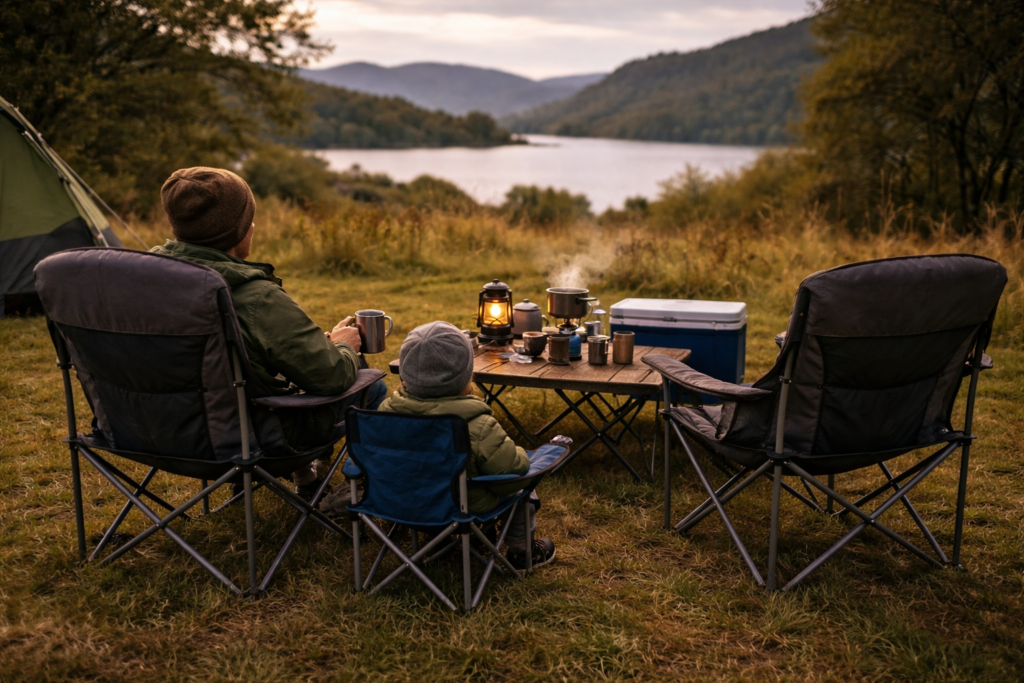
Campsite positioning is the thing that takes a collection of camping chairs and turns them into an outdoor living room — and it’s almost never discussed in any camping chair article because it’s not about the chairs themselves. The arrangement matters as much as the quality of the chairs. An arc facing the camp stove and the main activity area, with each chair positioned so you can reach the food table and talk to the person next to you without turning fully around, makes the camp feel inhabited rather than assembled. The specific angle depends on the pitch, but the principle is: face the view or the fire, keep the stove in reach, leave a gap for people to come and go without climbing over seated adults.
We’ve camped in pitches where the setup took five minutes of rearranging chairs and the table and turned a pleasant site into somewhere that felt genuinely comfortable from arrival to lights out. Same chairs, same tent, different arrangement. The same careful setup thinking applies to the camp kitchen — where the cool box sits relative to the stove, and how accessible both are from the seated position, determines whether cooking feels like a chore or part of the evening.
Building the Full Family Setup
The complete picture for a family of four — two adults and two children — is two proper adult chairs and two children’s chairs. Which adult chairs depends on what matters most.
For adults who want the best possible evening comfort and have the boot space for it: two Titan 2 chairs. The Telegraph award is deserved. They’re the chairs you stop thinking about replacing.
For adults with lower back issues, or anyone who finds that camping evenings are limited by back discomfort rather than anything else: the KingCamp with lumbar support, or its reclining version for anyone who wants to fully lean back after the children are asleep.
For families on a realistic combined chair budget where two premium adult chairs would crowd everything else out: a pair of Goliath Padded XL chairs. Real comfort, real Vango quality, room for the children’s chairs in the same budget.
For adults who want a no-nonsense reliable chair from a brand with a century of outdoor furniture behind it: the Coleman Forester. Opens in seconds, lasts for seasons, handles UK conditions without complaint.
For the children: Trail folding chairs until around age 12–13, then an adult-size chair as the natural upgrade.
That combination — whatever version of it fits the family’s budget and priorities — is what makes a camping evening feel like it was worth the drive.
Related Guides
About The Author – Andrew Marshall
Andrew Marshall is the creator of Simple Days Outside and a UK parent of three who regularly camps, walks, and explores outdoor activities with his family. His guides focus on practical gear, realistic family adventures, and simple ways to help families enjoy the outdoors across the UK. The recommendations on this site are based on real-world use, research, and the kind of equipment families actually rely on for weekend trips and everyday outdoor fun.