

Written by Andrew Marshall
UK parent of three sharing practical advice to help families enjoy camping, walking, garden play, and simple outdoor adventures across the UK.
Creator of Simple Days Outside.
Last Updated: 4th April 2026
Getting the backpack size right for a child makes a surprising difference to how much they enjoy a walk. Too big and it shifts around, pulls them backward, and becomes something they resent wearing within twenty minutes. Too small and it either can’t carry what they need or fits so snugly it restricts movement. Neither produces a happy child on a trail.
The good news is that children’s backpack sizing is more straightforward than adult sizing once you understand the key measurements involved — and most families overthink it. A few simple checks and the right size becomes obvious. For more on gear and routes for family walking across the UK, the Family Walking & Easy Hiking section covers everything from kit recommendations to walk suggestions in one place.
Why Children Need Different Backpacks From Adults
It’s tempting to put a small adult pack on an older child or a scaled-down version of whatever works for you. Both approaches tend to produce the same result — a pack that sits wrong, distributes weight poorly, and makes the walk noticeably less comfortable than it should be.
Children’s backs are proportionally shorter than adults, their shoulder width is narrower, and their centre of gravity is higher. A pack designed for an adult — even a small one — has a torso length that typically runs too long for a child, which means the hip belt sits in the wrong place and the shoulder straps don’t follow the right line from the child’s back. The result is a pack that hangs rather than hugs, and one that loads weight onto the shoulders rather than transferring it to the hips.
A pack sized correctly for a child does the opposite. The torso length matches, the hip belt sits on the iliac crest rather than the waist or ribs, and the pack stays close to the body rather than swaying away from it. For short walks this matters less. For anything over a couple of hours it matters considerably.
The Key Measurement — Torso Length Not Height
Most parents size children’s backpacks by age or by the child’s height. Both are useful starting points but neither is the measurement that actually determines fit.
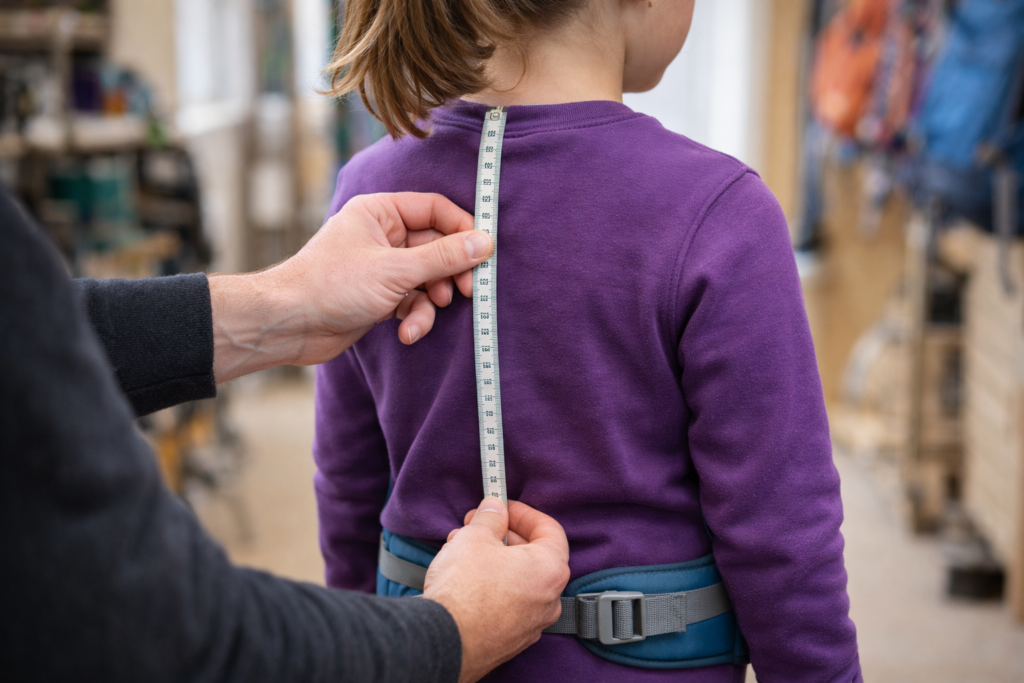
Torso length — the distance from the prominent vertebra at the base of the neck to the top of the hip bones — is what backpack sizing is based on. Two children of the same height and age can have noticeably different torso lengths, which means one comfortably fits a pack the other would swim in.
Measuring torso length is straightforward: have the child stand upright and tilt their head slightly forward. Find the prominent bone at the base of the neck — the C7 vertebra. Measure from there down the spine to the point where the iliac crest of the hip begins, which is roughly level with where the hands rest naturally at the sides. That measurement in centimetres is the torso length you’re fitting to.
Most children’s backpacks list a recommended torso length or body height range rather than an age range — the torso length is the more reliable guide of the two.
Backpack Sizes by Age and Torso Length
These are approximate ranges — individual children vary considerably, particularly across growth spurts, and a child in the middle of a growth phase may size up earlier than expected.
Toddlers and Pre-School (Ages 2–4)
Torso length typically 20–28cm. Pack capacity 5–8 litres.
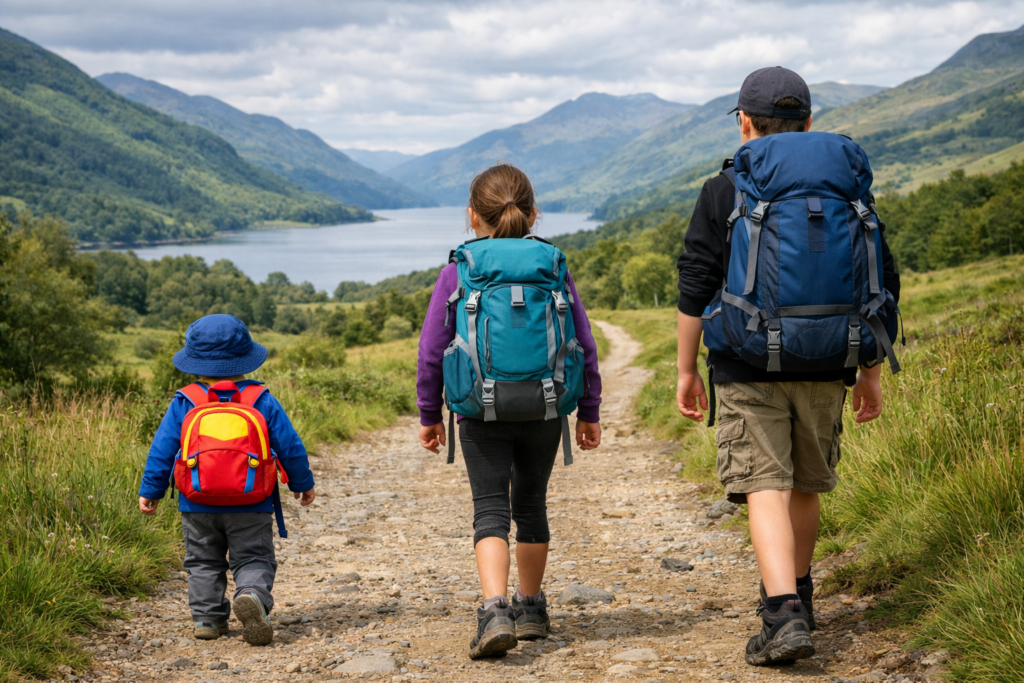
At this age a backpack is more about independence and enthusiasm than carrying anything useful. The right pack for a two or three-year-old is small enough to sit entirely on the upper back without reaching below the hips, light enough that the child genuinely can’t feel it as a burden, and fun enough that they want to wear it.
Our youngest went through a phase at three where he refused to start any walk without his small pack — it contained a snack, a water bottle, and a small toy, and the sense of ownership it gave him over the walk was disproportionate to its actual size. He’d run ahead of the rest of us on the trail at Loch Lomond just to demonstrate that he was carrying his own things. Small children carrying their own snacks is also, in our experience, one of the most effective ways to ensure they keep walking. If you’re still working out what else to pack for a first walk with young children, what to bring on a 2–3 hour UK trail with the family covers the full kit picture for short family walks — useful alongside the backpack decision.
A toddler backpack at this age should have padded shoulder straps, a chest clip to stop the straps slipping off, and nothing more complicated than that. Hip belts are unnecessary at this size — the pack is light enough that shoulder carrying is entirely appropriate.
Primary School Age — Younger (Ages 5–7)
Torso length typically 28–36cm. Pack capacity 8–15 litres.
This is the age where children start to carry genuinely useful kit — a water bottle, a snack, a waterproof layer, maybe a small first aid kit or a nature journal. An 8–15 litre pack covers all of that without encouraging overpacking.
The fit becomes more important at this stage because the loads are starting to be real rather than token. A padded back panel makes a noticeable difference to comfort on longer walks. The hip belt on packs for this age group tends to be thin and more of a stabilising strap than a load-bearing one — which is appropriate, as the loads are still light enough to carry primarily from the shoulders.
A kids hiking backpack at this age should have a hydration sleeve or external bottle pockets — a child who can get to their water bottle without taking the pack off drinks more regularly, which matters on warm days and longer walks. We found this out on a warm September walk in the Trossachs where one of the children had a pack without accessible side pockets — they simply stopped drinking rather than going through the process of taking the pack off every time, which made for a tired and slightly dehydrated afternoon. External bottle pockets are now a non-negotiable on any pack we buy for this age group.
Primary School Age — Older (Ages 8–11)
Torso length typically 36–44cm. Pack capacity 15–25 litres.
At this stage children can carry a meaningful load without it being a burden — waterproofs, snacks, water, a layer, sunscreen, and a small first aid kit all fit comfortably in a 15–20 litre pack. A 25 litre pack suits bigger days out or situations where the child is carrying some of the family’s shared kit.
This is the age group where a properly fitting hip belt starts to matter. A youth hiking pack with a functioning hip belt transfers load off the shoulders and onto the hips, which makes sustained carrying significantly more comfortable over a full day of walking. The hip belt needs to sit on the iliac crest — measure this carefully when fitting rather than assuming the pack’s size alone will position it correctly.
Our eldest moved into this size range at around nine and the upgrade from a smaller pack without a hip belt to a properly fitted youth pack made a noticeable difference on longer days — less fidgeting, less complaint about the pack feeling heavy, more attention available for the actual walk. If you’re thinking about what distance a child this age can realistically manage, how far children can walk at different ages is worth reading alongside the backpack question — the two decisions are connected.
Back panel ventilation channels become worth looking for at this stage — a pack that allows airflow between the back panel and the child’s back is considerably more comfortable on warm days than one that creates a single sweaty contact point.
Secondary School Age (Ages 12–16)
Torso length typically 44–54cm. Pack capacity 20–35 litres.
By this age many children can fit into small adult packs — but it’s worth checking the torso length rather than assuming. A twelve-year-old who measures 44cm torso length needs a youth or small adult pack, not a standard adult one. The tendency to size up into adult packs too early is one of the most common backpack fitting mistakes for this age group.
Our middle child is approaching this territory now and the temptation — particularly when the adult packs in the outdoor shop look similar in size — is to buy adult to save replacing it in eighteen months. It’s a false economy. A youth pack that fits correctly for the next two years produces a better walk experience than an adult pack that technically holds everything but never quite sits right. The discomfort of a poorly fitting pack over a full day on a Scottish hill is worth more than the cost of a correctly-fitted youth pack.
A 20–25 litre pack suits day walks and easy hikes. A 30–35 litre pack covers longer days, multi-stop walks, and situations where a child is carrying a fair share of shared family kit. A junior hiking pack at this age should have a load-lifter strap at the top of the shoulder straps, a sternum strap, and a functioning hip belt with padded wings that wrap the hips rather than just a thin stabilising strap.
How Much Weight Should a Child Carry?
The general guideline used by walking organisations and outdoor educators is that a child should carry no more than 10–15% of their body weight on a day walk. For a 30kg eight-year-old, that’s 3–4.5kg. For a 50kg fourteen-year-old, that’s 5–7.5kg.
These are maximums rather than targets. A younger child carrying 10% of their body weight will feel that load in a way an adult carrying the same proportion wouldn’t — children fatigue differently and carry differently. For younger children especially, erring toward the lower end of the range produces a better walking experience.
Water is the heaviest single item most children carry. A kids water bottle of 500ml weighs around 500g when full — already a meaningful proportion of a young child’s total carrying capacity. On one family walk on the Campsie Fells we weighed the children’s packs before setting off and discovered our seven-year-old was carrying over 15% of his body weight without anyone having noticed — most of it water and a packed lunch that could have been distributed between the adults. Worth knowing before packing anything else.
For families thinking about how to make longer walks work without children flagging under the weight of their own kit, how to make family walks fun without complaints covers the broader picture of keeping children engaged and comfortable on the trail. A practical approach: the adults carry the shared kit, the children carry their own water and snacks, and anything else in the children’s packs is optional rather than essential.
Getting the Fit Right
Buying the right size is half the process. Fitting it correctly is the other half — and it’s the step most families skip because it seems straightforward and isn’t.
Loosen everything before putting the pack on. All straps — shoulder, hip, chest, load lifters if present — should be fully loosened before the child puts the pack on. Trying to adjust a pack that’s already partially tightened produces a fitting that’s never quite right. We made this mistake in an outdoor shop car park before a family walking trip to Glentress and spent ten minutes wondering why the pack still looked wrong — it was because we’d started tightening from an already partly-adjusted position rather than from scratch.
Settle the hip belt first. If the pack has a hip belt, position it on the iliac crest before tightening the shoulder straps. The hip belt should sit roughly at the natural waistline — not on the hips themselves and not on the ribs. For children this often means the belt sits higher than you’d expect relative to the base of the pack.
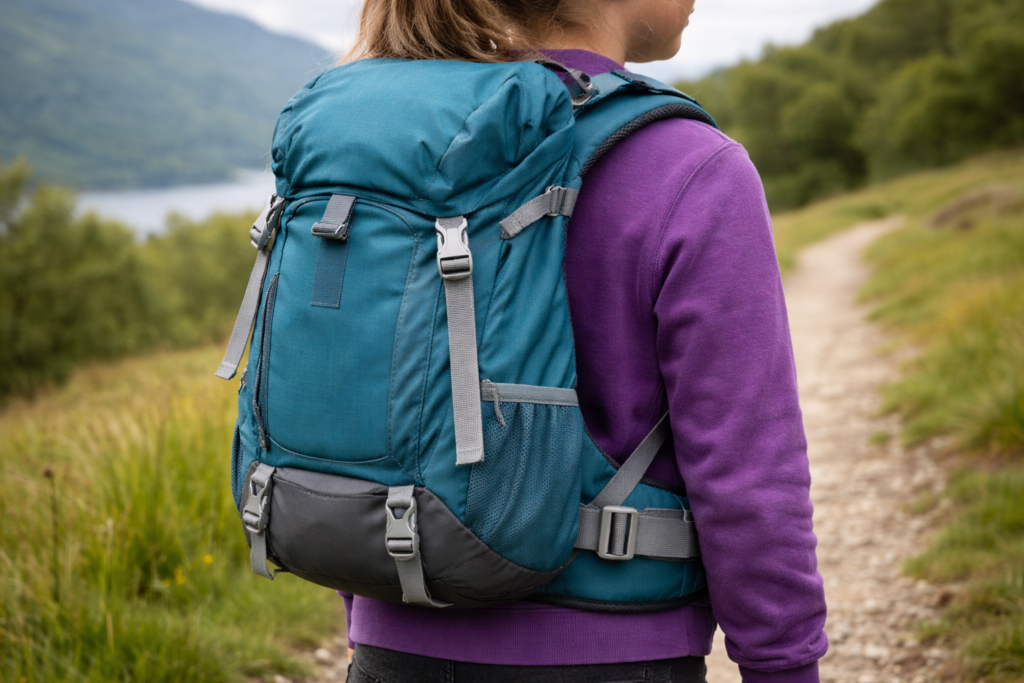
Tighten the shoulder straps until the pack sits close to the back. There should be no gap between the top of the shoulder straps and the shoulders — the straps should follow the line of the shoulders rather than pulling away from them. If the straps stand away from the shoulders, the torso length is too long for the child.
Clip and snug the chest strap. The sternum strap — if present — should sit roughly 2–3cm below the collarbone. Its job is to stop the shoulder straps sliding outward rather than to carry any weight. Don’t over-tighten it.
Check the load lifter straps last. On packs with load lifter straps — the short straps running from the top of the shoulder strap attachment to the top of the pack — these should angle upward at roughly 45 degrees when correctly fitted. If they angle downward the pack torso is too short. If they pull forward too aggressively the pack torso is too long.
Signs a Backpack Doesn’t Fit
Even after fitting, a few minutes of walking reveals whether the pack is right.
The pack sways side to side when walking — usually means the hip belt isn’t engaging or the pack is too large for the child’s torso. We noticed this with our youngest on a muddy Loch Lomond trail — the pack was swaying noticeably with every step and within twenty minutes he was complaining it felt heavy despite being nearly empty. The torso length was simply too long for him at that point.
The shoulder straps gap away from the shoulders — the torso length is too long. Try a smaller pack or adjust the torso length if the pack has an adjustable back system.
The child is leaning forward to compensate for the pack — the pack is too heavy for the child’s current fitness and carrying ability, or the weight is loaded too high in the pack. Heavier items should sit close to the child’s back and as low as possible in the main compartment.
The hip belt sits on the ribs or stomach — the torso length is too short or the hip belt position needs adjusting upward. A hip belt that sits in the wrong place transfers no load off the shoulders and makes the pack feel heavier than it is.
The child keeps shrugging or adjusting the pack during the walk — something isn’t right. Stop, loosen everything, and refit from scratch rather than making small adjustments to an already poorly-fitted pack.
A Few Things Worth Knowing Before Buying
Adjustable torso length is worth paying for on youth packs. Children grow fast — a pack with an adjustable back system can last two or three years through a growth phase rather than needing replacing when the child moves up a size. Several brands offer this on their youth ranges and it’s one of the more worthwhile features at the mid-range price point.
Bright colours are practical not just decorative. A child in a brightly coloured pack is easier to spot on a trail, in a car park, or at a busy starting point than a child in a neutral colour. On a busy Saturday on the West Highland Way near Balloch, losing sight of a child in a dark green pack for thirty seconds in a crowd of other walkers was enough to make us switch to a bright red one for the next trip. It sounds like a minor thing until it isn’t.
Waterproof or water-resistant matters in the UK. A pack that soaks through in a shower means everything inside gets wet — which on a UK walk is a realistic rather than edge-case scenario. A waterproof pack cover as a backup for a non-waterproof pack is a useful addition to any family walking kit and takes up almost no space.
Fit in the shop if possible. Online buying is convenient but children’s packs fit differently enough that trying before buying — particularly for the 8+ age group where load-bearing fit starts to matter — is worth the trip to an outdoor shop. Many outdoor retailers will fit a pack properly for you if you ask. If you’re buying a family walking backpack for the adults at the same time, the family walking backpacks worth considering for day trips covers the adult options that pair well with the children’s packs covered here.
Quick Reference by Age
| Age | Torso Length | Capacity |
|---|---|---|
| 2–4 | 20–28cm | 5–8 litres |
| 5–7 | 28–36cm | 8–15 litres |
| 8–11 | 36–44cm | 15–25 litres |
| 12–16 | 44–54cm | 20–35 litres |
These are starting points — always measure torso length rather than relying on age alone.
FAQ
Can a child use an adult backpack?
Not comfortably in most cases until the torso length matches. Many teenagers fit small adult packs by fifteen or sixteen, but younger children in adult packs almost always end up with a pack that sits wrong — too long in the torso, hip belt in the wrong place, weight carried from the shoulders rather than the hips. The difference in comfort on a full day’s walking is significant.
How do I measure my child’s torso length at home?
Have the child stand upright with their head tilted slightly forward. Find the prominent bone at the base of the neck — you can feel it easily by running a finger down the vertebrae. Measure from there to the top of the hip bones on each side — roughly where the hands rest naturally. That measurement in centimetres is the torso length to match against pack specifications.
Should a child’s backpack have a frame?
For day walks and easy hikes, no — a frameless or semi-structured pack is lighter and more comfortable for children than a framed pack. Internal frames become useful on longer trips with heavier loads, typically for older children carrying 25 litres or more. For most family walking a well-padded frameless pack is the right choice.
What should go in a child’s walking backpack?
For younger children: water bottle, snack, waterproof jacket, small first aid kit. For older children: all of the above plus a spare layer, sunscreen, map if they’re old enough to navigate, and a share of any family kit. The general rule — no more than 10–15% of body weight — applies regardless of what’s in the pack.
At what age can a child carry their own backpack on a walk?
From around two or three for a small token pack with a snack and a water bottle. From around five or six for a genuinely useful pack carrying their own kit. The progression from symbolic to practical happens gradually and depends more on the individual child’s enthusiasm and stamina than any fixed age.
How should the shoulder straps feel when correctly fitted?
The straps should follow the curve of the shoulders closely without digging in. There should be no gap between the top of the strap and the shoulder. The straps should pull the pack toward the body rather than the pack pulling the straps away from the shoulders. Any gap at the top of the shoulder strap indicates the torso length is too long.
Related Guides
About The Author – Andrew Marshall
Andrew Marshall is the creator of Simple Days Outside and a UK parent of three who regularly camps, walks, and explores outdoor activities with his family. His guides focus on practical gear, realistic family adventures, and simple ways to help families enjoy the outdoors across the UK. The recommendations on this site are based on real-world use, research, and the kind of equipment families actually rely on for weekend trips and everyday outdoor fun.