
Written by Andrew Marshall
UK parent of three sharing practical advice to help families enjoy camping, walking, garden play, and simple outdoor adventures across the UK.
Creator of Simple Days Outside.
Last Updated: 18th March 2026
The Carerra Vengeance I bought for my oldest child got passed down to my daughter, then to my youngest son. Three kids, one bike, years of trail use across Scottish woodland tracks and proper trail centres. Getting them started young on two wheels — even before trail bikes — makes that progression to proper trails much smoother, and how you start them off makes more difference than most parents expect.
I’ve ridden mountain bikes seriously for years. Fort William, Innerleithen, Glen Coe, Laggan Wolftrax, Forest of Ae, Glentress — done most of the major Scottish trails at various points. These days I get out to the local hills and up to the reservoirs rather than chasing the big descents, but the knowledge of what makes a trail bike work properly stayed with me when it came to buying for the kids.
The two things that matter most are weight and fit. Get those right and a child rides confidently. Get them wrong and they’ll struggle, lose confidence, and decide they don’t like mountain biking before they’ve given it a fair chance. Everything else — brand, colour, spec — comes after.
If you’re building up your child’s outdoor kit more generally, the Garden & Outdoor Play hub covers everything from first bikes to outdoor games worth having alongside a trail bike.
Why Mountain Bikes Specifically — Not Just Any Bike
A kids mountain bike gives a child gears and suspension. On flat tarmac those features don’t matter much. On an off-road trail — roots, rocks, loose gravel, short climbs, descents through woodland — they make a significant difference to both safety and enjoyment.
Gears mean a child can get up a climb without grinding to a stop or having to push. Suspension absorbs the jarring from roots and rocks that would otherwise transmit straight through the handlebars and seat. That constant jarring is what makes younger riders tense up, grip too tight, and lose their rhythm. A child who’s comfortable on the bike rides better. A child who’s fighting it doesn’t.
There’s a track through the woods near us that some local kids built themselves — berms, rollers, a few small drops. I take my kids along there regularly. On a rigid hybrid the experience is noticeably harder work. On a proper kids mountain bike with even basic suspension it flows. Keeping them wanting to come back is the whole point — and if trail riding sparks a wider love of being outdoors, turning your garden into somewhere they can practise and play between trail days keeps that momentum going.
Understanding Trail Grades — For Parents Who Are New to This
If you’re not a mountain biker yourself and you’re planning a first trail centre visit, the grading system is worth understanding before you go.
Green trails are the starting point for children — wide, smooth, well-maintained, with gentle gradients and no technical features. Jumps and drops are either absent or easily avoided. Glentress near Peebles has excellent green trails and they’re the right place to start with a child who’s new to trail riding.
Blue trails introduce more varied terrain, steeper sections, and some technical features. A child who’s confident on green trails for a full season is usually ready to try blue. Not before.
Red trails are for experienced riders comfortable with technical terrain, steeper descents, and features that require commitment. Black is expert level. Neither is relevant for a child starting out and there’s no rush to progress — a child riding green trails confidently and happily is doing exactly the right thing.
The Glentress Experience — What It Taught Me About Getting Kids Started
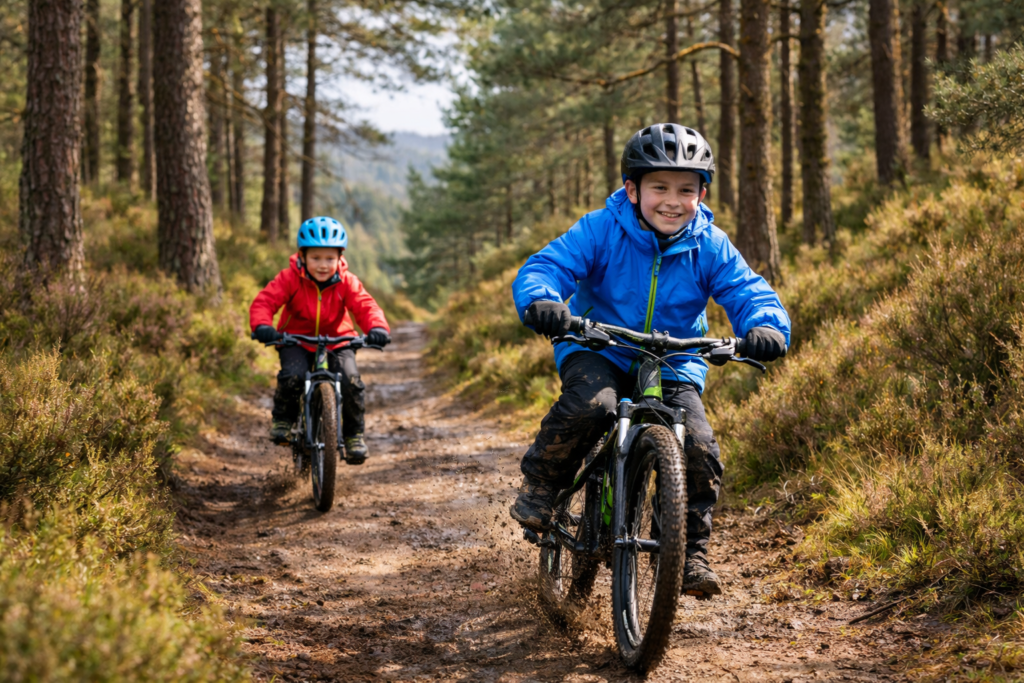
Glentress near Peebles is one of the best places in Scotland to introduce a child to trail riding. The green and blue trails are genuinely flowy — wide, well-surfaced, with berms and rollers that give a child the feeling of proper mountain biking without the exposure of serious drops or technical features. The bigger jumps can be ridden around. The trail still makes complete sense without them.
What stays with me is watching the wobbles turn to confidence. First run down a trail section a child is gripping too tight, braking too much, shoulders up around their ears. Then something shifts. You watch it happen in real time — the grip loosens, the shoulders drop, the speed increases naturally, and then the grin appears. They’re not thinking about balance anymore. They’re just riding. That transition from anxious to flowing is one of those small parenting moments that genuinely stays with you, and it happens faster than you’d expect when the bike fits properly and the trail is right for their level.
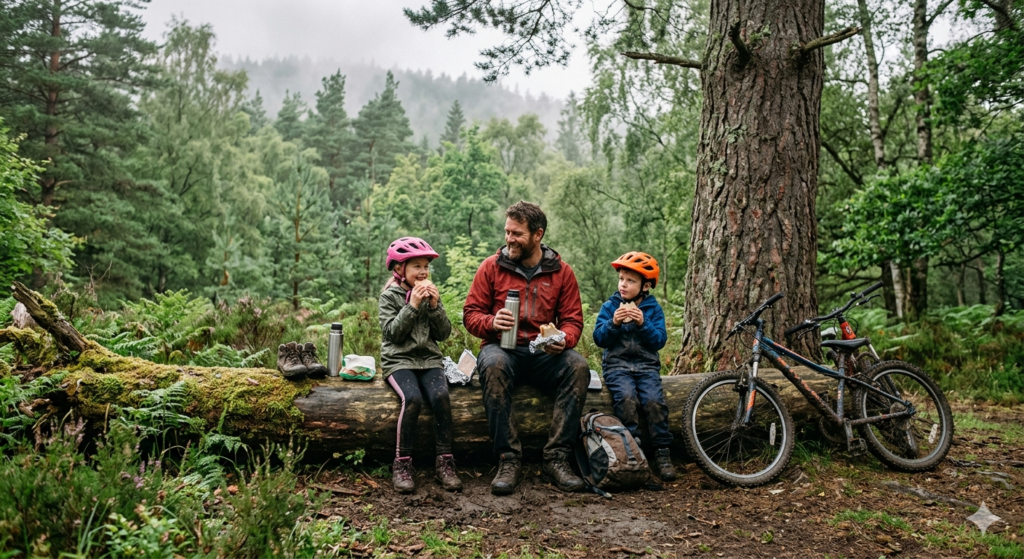
Mid-afternoon, somewhere in the forest with the bikes propped against a tree — tomato soup from a flask and a few sandwiches. It sounds like a small thing. It’s not. That’s the moment that makes the whole day feel like a proper adventure rather than just exercise, and it’s the moment they’ll talk about on the way home. The riding is part of it. The whole experience is the thing.
Taking them on a properly set-up bike makes that experience dramatically different. On the right bike a child comes off the Glentress green trail buzzing. On the wrong bike they come off it tired and shaken. The bike matters more than anything else on that list.
Getting the Size Right — The Most Important Decision You’ll Make
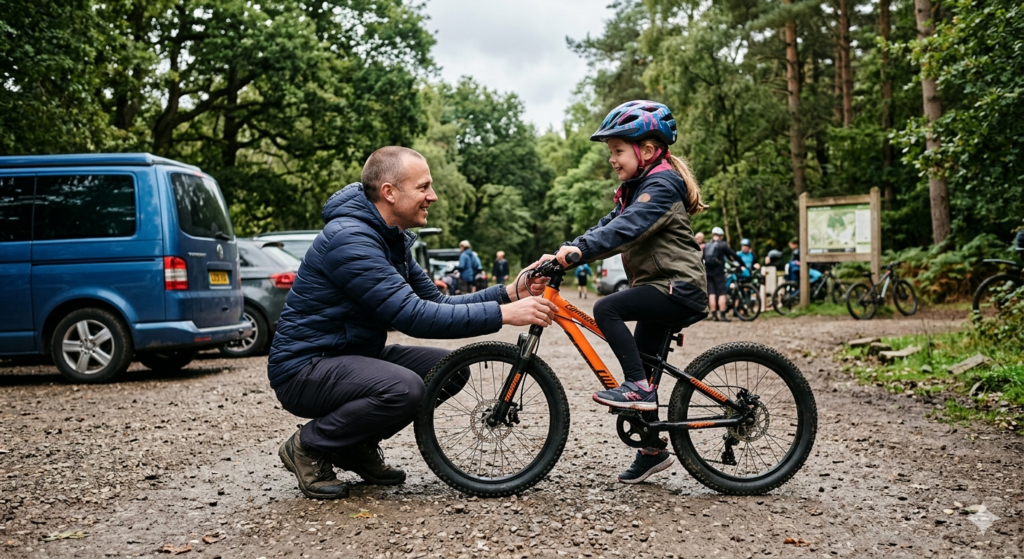
Wrong size is the single biggest reason children lose confidence on trails. Too big and they can’t put their feet down confidently or reach the brakes properly. Too small and they’re cramped, can’t put power through the pedals, and will outgrow it within months.
Wheel size is the starting point but standover height and reach matter just as much.
| Age | Wheel Size | Typical Height |
|---|---|---|
| 5–7 years | 20 inch | 105–120cm |
| 7–9 years | 24 inch | 115–135cm |
| 9–12 years | 26 inch | 130–150cm |
| 12+ years | 27.5 inch | 145cm+ |
These are starting points not rules. A tall 8 year old might suit a 26 inch wheel. A smaller 10 year old might still be better on a 24. The test that actually matters: child sits on the saddle at the correct height, both feet should touch the ground with a slight bend in the knee. Stretching to reach the floor means the bike is too big. Completely flat-footed means the saddle is too low.
Two children of the same age can also be at completely different places in terms of trail confidence. A cautious 9 year old needs a more confidence-inspiring setup — lower standover, easier brake reach — than a fearless one who throws themselves at everything. Don’t size purely by age. Watch how they ride and fit accordingly.
Weight — Why It Makes More Difference Than Most Parents Expect
A heavy bike on flat road is a minor inconvenience. A heavy bike on a trail climb genuinely puts children off continuing. A child working twice as hard to get up a hill because their bike weighs 14kg will enjoy it less and give up sooner. I’ve watched it happen on trail days where one child on a lighter bike is halfway up the climb while another is grinding to a stop and getting off to push.
The rough target for a kids trail bike is under 10kg for smaller sizes and under 12kg for larger ones. Department store bikes frequently come in at 13-16kg. That difference is felt on every climb, every time the child lifts the bike over an obstacle, every time they carry it back to the car.
Lighter bikes cost more — that’s the real trade-off. But a lighter bike a child rides enthusiastically is better value than a heavier cheap one that sits in the garage after three outings.
Start Cheap or Invest Properly?
My honest take after going through this with three kids is to start at a sensible mid-point rather than either extreme.
A very cheap bike — anything under about £150 — will almost certainly be too heavy, have poor brake feel, and have components that don’t handle trail use reliably. Cheap brakes in wet Scottish woodland are not confidence-inspiring. Gears that slip or crunch put a child off before they’ve given the trail a proper chance. The bike becomes the enemy rather than the vehicle.
But spending £500+ before you know whether the child is committed is also unnecessary. A well-chosen bike in the £200-350 range — from a brand that makes bikes rather than a supermarket that sells bikes alongside kettles and garden furniture — hits the right balance. Light enough, decent components, handles trail use properly, and holds resale value when they grow out of it. When they do grow out of it and you’re looking at what comes next, the step up to a bike without stabilisers is where most families land before moving to trail bikes.
The upgrade conversation makes sense once a child has ridden regularly for a year and is asking for more capability. Before that, a solid mid-range bike is exactly right.
Suspension — What Kids Actually Need
Most kids trail bikes have front suspension only. For the kind of trails most UK children ride — green and blue grade trail centres, woodland tracks — front suspension is completely adequate. Full suspension adds weight, cost, and maintenance that isn’t justified until a child is riding red grade trails consistently.
Fork quality matters more than fork presence. I learned this watching a child on a cheap suspension fork that bobbed uselessly on flat ground and bottomed out on every root — worse than a decent rigid fork in practice. You want a fork that’s active on roots and rocks but not wallowing on smooth sections.
Five minutes setting the suspension sag correctly for your child’s weight before you leave the car park makes a genuine difference. Most forks have a pressure guide on the stanchion. Too much air and every root comes straight through. Too little and it bottoms out on larger impacts. Get it roughly right before the first descent rather than after it. A bike pump with pressure gauge is worth keeping in the car for trail days — setting sag properly on the day rather than guessing from home makes a noticeable difference.
Brakes — The Feature Most Parents Overlook
On a descent a child needs to modulate braking — apply progressive pressure to control speed rather than grabbing and locking the wheel. Cheap rim brakes with poor modulation make trail descents more frightening than they need to be. On a wet October descent at Glentress they’re genuinely unpredictable — wet rims, degraded pads, inconsistent feel at exactly the moment you need the opposite.
Disc brakes — hydraulic or mechanical — give better modulation, work consistently in rain, and don’t degrade as the rim wears. On a trail bike for a child riding in the UK they’re worth prioritising.
Short reach brake levers are something most parents never think to check and should. Adult-sized levers require a full hand to operate properly. A child gripping the end of a standard lever has poor leverage and tires quickly on longer descents. If buying second-hand with adult-sized levers, adjustable reach levers are inexpensive and make an immediate difference.
Gears — How Many Do Kids Actually Need
Fewer than most bikes come with in most cases. A simple 1x drivetrain — one chainring at the front, multiple sprockets at the rear — is easier to operate, harder to get wrong, and needs less maintenance than a front and rear derailleur setup. A child who doesn’t have to think about front shifting focuses on the trail rather than the controls — exactly where their attention should be.
For younger children on easier trails 7-speed is enough. For older children tackling longer climbs 8-10 speed rear gives adequate range.
The most important gear consideration for Scottish trail riding is having a low enough gear for the climbs. Glentress green trail has steady climbs that a child in the wrong gear finds hard work fast. I’ve seen children get off and push on a gradient that should be perfectly manageable simply because their lowest gear was too high. Check the lowest gear ratio before buying — you want something they can spin up a moderate climb without grinding.
Buying Second-Hand — A Genuinely Good Option
Kids mountain bikes from quality brands get passed between families constantly. Children outgrow them quickly, parents sell them on, and a well-looked-after bike second-hand is significantly better value than a new budget alternative. If they’ve already been through the balance bike stage and you know they’re committed to riding, second-hand is even better value at this point.
Where to look: Facebook Marketplace, local cycling club groups, school parent WhatsApp groups, Gumtree. Both Islabikes and Frog run official second-hand programmes on their own websites because they know how frequently their bikes change hands.
What to check: suspension fork moves freely and isn’t seized, brake pads have life remaining, gears shift cleanly through all speeds, frame has no cracks particularly around the head tube and bottom bracket. A five-minute check covers all of it.
What to avoid: cheap bikes second-hand. A heavy poorly-specced bike doesn’t improve with age. Second-hand is excellent for quality brands. For budget bikes it’s rarely worth the saving over buying new at the same price point.
Scottish Weather and Trail Conditions
Scottish trail riding with children is wet more often than it’s dry. Glentress in November is a different experience to Glentress in July. Mud, puddles, persistent drizzle, midges in summer — these are the actual conditions you’re riding in and if you’re not prepared for them the day falls apart fast.
A waterproof jacket is the baseline. Kids waterproof jacket that actually breathes rather than just being water-resistant is the difference between a child who’s comfortable an hour into a ride and one who wants to go home. Get it right and wet days are part of the appeal. Get it wrong and they’re miserable by the second trail.
Mudguards keep mud out of the face on every wet descent. Clip-on mudguards are inexpensive and make wet trail riding significantly more pleasant for a child — and for the parent riding behind them.
Tyres with adequate tread matter more in Scottish mud than anywhere else. A worn tyre on a wet rooty descent slides when it should grip. Check tyre condition before any trail ride. Kids mountain bike tyres with proper knobbly tread make a genuine difference in autumn and winter conditions.
The Bikes Worth Buying
Carerra Vengeance Junior 26″ — the one I started my own kids on
Three kids, one bike, years of trail use. That’s not something you get from a supermarket alternative. The Vengeance Junior has a lightweight aluminium frame, 16-speed Shimano Altus trigger shifters, front suspension, and all-weather disc brakes — technology filtered down directly from the adult Vengeance which is Carerra’s best-selling bike. Suits ages 9-12 between 136-154cm and comes with Kenda Kadre tyres with puncture protection. Not the lightest bike on this list at 14.9kg, but it’s durable, trail-capable, and serviced through Halfords nationwide which makes warranty and maintenance straightforward. The bike that passed through three children and came out the other side still rideable says everything about the build quality. Around £300-345.
Decathlon Rockrider EXPL 500 24″ — best value starter trail bike for ages 9-12
Decathlon’s own MTB line designed specifically for trail use. The EXPL 500 suits children aged 9-12 between 135-150cm, with a front suspension fork, 7-speed gearing simple enough for younger riders to operate without thinking about it, and knobbly tyres designed for grip on loose and uneven surfaces. The steel frame is heavier than aluminium alternatives but the bike handles real trail use properly at a price — around £120-150 — that’s hard to argue with as a first proper trail bike. Decathlon also runs a buy-back scheme so when they outgrow it you can trade it in toward the next size. Worth visiting in-store so the child can sit on it properly and you can check the fit before buying.
Glerc Skyline Kids Mountain Bike 20″/24″ — best Amazon option for younger trail riders
The Glerc Skyline comes in 20 and 24 inch wheel sizes, with a 21-speed drivetrain, front suspension fork, and disc brakes on both wheels. The high carbon steel frame is built for durability, brake cables are partially hidden to reduce wear, and the bike arrives 85% pre-assembled which makes getting it road-ready straightforward. The disc brakes at this price point are the standout feature — in wet Scottish trail conditions they outperform rim brakes significantly and give a child more confidence on slippery descents. Available in multiple colours which matters when a child has opinions about what their bike looks like, and they always do. Well reviewed on Amazon UK and dispatched quickly. Around £130-160 depending on size and colour.
Huffy Marker Full Suspension Mountain Bike — best for committed older riders aged 12+
The only full suspension option on this list — front and rear — which sets it apart for older children riding more demanding terrain. 21-speed thumbshift gearing, mechanical disc brakes on both wheels, and all-terrain tyres for traction on dirt, gravel, and roots. The 24 inch wheel version suits riders around 142-168cm, covering the 12-15 age range comfortably. For a child who’s riding regularly on technical trail sections and finding the limitation of a hardtail, the rear suspension makes a genuine difference on rooty and rocky descents — it absorbs the jarring that transmits straight through a hardtail frame and lets the child focus on line choice rather than hanging on. Around £250-270 on Amazon UK. Shimano gears, dual disc brakes, and full suspension at that price is strong value for a committed older rider.
Your First Trail Day — What to Actually Expect
Start in the skills area if the trail centre has one. Glentress has a good one. Ten minutes there gives a child a feel for the bike, the brakes, and basic trail features before committing to a full loop. Don’t skip this step — it makes the trail itself feel familiar rather than daunting.
Start on green. Even if your child is confident, start on the easiest trail available. Green trails at quality centres like Glentress are genuinely enjoyable at any level — they’re not just for beginners, they’re for anyone who wants to flow through the forest without fighting the terrain.
Don’t push for blue on day one. The goal of the first trail day is for the child to come home wanting to go again. That’s the only measure of success. If they’re buzzing on the green trail that’s a perfect day. Blue can wait for the second or third visit when the confidence is there naturally.
Bring proper food. Mid-afternoon in the forest with the bikes against a tree — tomato soup from a flask, a few sandwiches. It sounds small but it’s what makes the day feel like a proper adventure. Children who are warm and fed ride better in the afternoon. And that moment sitting in the trees eating lunch with muddy bikes is often the thing they talk about on the way home more than the trails themselves.
Expect the first descent to feel scary even on the right bike. That’s normal and it’s fine. The second descent is better. The tenth is effortless. Watch for the moment the shoulders drop and the grin appears — that’s when you know they’re hooked.
Helmets and Kit
A standard road cycling helmet is not adequate for trail riding. A trail or MTB helmet has extended rear coverage for the kind of fall that happens off-road.
Kids MTB helmet with MIPS — prioritise fit and MIPS technology over brand. The helmet that fits correctly is the right helmet. For green and blue trails a trail helmet is sufficient. For anything more technical a full-face is worth considering.
Kids cycling gloves — help with grip and protect hands in a fall. Worth having on any trail ride.
Kids knee pads — add confidence on descents for younger riders without being uncomfortable. Worth having for the first few trail sessions at minimum.
Kids bike repair kit — a basic multi-tool, tyre levers, and a spare inner tube in a small bag under the saddle. Trail punctures happen and being prepared means the day doesn’t end early because of a flat tyre.
Bike water bottle and cage — staying hydrated on a trail day matters more than most children remember. A bottle cage on the frame means they can drink without stopping and keep riding.
FAQs
What age can a child start mountain biking on trails? Most children are ready for easy green trails from around 5-6 years old on a correctly sized bike. Start on appropriate terrain for their confidence rather than pushing progression. Glentress green trail is a genuine benchmark — if they can handle that comfortably and come off it wanting more, they’re ready to progress.
How much should I spend on a first kids trail bike? £200-350 from a reputable brand. Under £150 and weight and component quality work against the child. Over £400 before you know they’re committed is unnecessary. The Carerra Vengeance sits in the right zone and proved its worth across three children in our house.
Should I buy new or second-hand? Second-hand is genuinely good value for quality brands. Check the fork moves freely, brakes have pad life, gears shift cleanly, and frame has no cracks. Avoid second-hand cheap bikes — the components won’t have improved with age.
How do I know when they’ve outgrown their bike? Saddle at maximum height and their leg still isn’t extending on the downstroke. They’re cramped reaching the handlebars. They’re riding with more confidence than the bike can keep up with — asking for steeper terrain and faster speeds. That last sign is the best one.
Is full suspension worth it for kids? Not for most children on most UK trails. Front suspension is adequate for green and blue grade riding. Full suspension isn’t justified until a child is consistently riding red grade trails and noticing the limitation of their setup. The Huffy Marker is the option to consider when that point arrives.
What about riding in rain? In Scotland you ride in rain or you don’t ride. A waterproof jacket, mudguards, and tyres with tread are the basics. Get the kit right and wet days are part of the appeal rather than a reason to stay home.
The Honest Call
The right kids mountain bike is the one that fits correctly, weighs sensibly for the child’s size, and has components that handle trail use without letting them down on a wet descent through Scottish woodland.
For most families starting out — the Carerra Vengeance is the bike I’d point toward first. Reliable, durable, trail-capable, and proven across three kids. For families on a tighter budget, the Decathlon EXPL 500 or the Glerc Skyline on Amazon both deliver genuine trail capability at a price that doesn’t require a big commitment before you know whether the child is serious. For older committed riders who want more from technical terrain, the Huffy Marker’s full suspension is the step up that makes a real difference.
Get the fit right. Make sure the brakes work for smaller hands. Take them somewhere the trails are genuinely fun without being scary — Glentress flows beautifully and a child who comes off it wanting to go round again is a child who’s going to keep riding.
Watch the wobbles turn to confidence. That transition — grip loosening, shoulders dropping, grin appearing — is the whole point of it. Everything else is just getting them to that moment.
Related Guides
About The Author – Andrew Marshall
Andrew Marshall is the creator of Simple Days Outside and a UK parent of three who regularly camps, walks, and explores outdoor activities with his family. His guides focus on practical gear, realistic family adventures, and simple ways to help families enjoy the outdoors across the UK. The recommendations on this site are based on real-world use, research, and the kind of equipment families actually rely on for weekend trips and everyday outdoor fun.