

Written by Andrew Marshall
UK parent of three sharing practical advice to help families enjoy camping, walking, garden play, and simple outdoor adventures across the UK.
Creator of Simple Days Outside.
Last Updated: April 2026
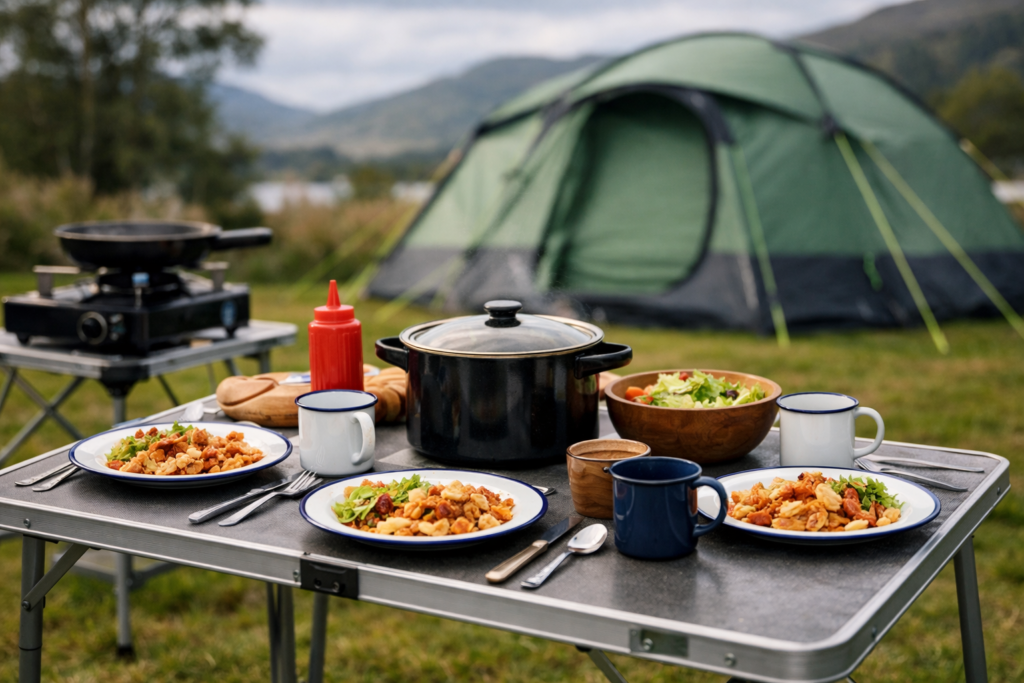
On the first evening of a camping trip to Argyll a few years back, we arrived at the pitch, got the tent up, got the stove going, and then stood looking at the cool box, the cooking pots, the four plates, the sauce bottles, and two children asking where the ketchup was — with nowhere to put any of it. We ate balanced on our knees that night. The following morning, before the second breakfast, we drove to the nearest outdoor shop and bought a table. It then lived in the boot on every single trip for the next four years.
A camping table is one of those purchases that sounds optional in the planning stage and becomes obviously essential about thirty minutes after arriving on the pitch. This covers the five worth buying for UK family camping right now — and the specific things that actually determine whether a table works for a family of four eating outdoors on an unpredictable Scottish campsite.
More family outdoor kit across the Family Camping hub — including chairs, stoves, and everything else that turns a campsite into somewhere you actually want to spend an evening.
What Actually Matters
Most camping table decisions go wrong in the same ways. The table is too small for four people eating simultaneously. The legs don’t adjust independently so the table sits at a permanent angle on a sloped pitch. The packed dimensions don’t actually fit in the remaining boot space. Understanding these three things before buying removes the majority of campsite disappointments.
Surface area is the one you can’t compromise on. A table for a family of four needs to fit four plates, four cups, the sauce bottles, and whatever serving dish the meal came out of at the same time. That requires at minimum 80cm × 80cm of usable surface — ideally more. Before ordering any table, measure out that footprint on your kitchen table at home with masking tape. We did this before buying our second table and immediately ruled out two options that looked adequate in photographs. If it looks tight with four place settings at home, it will be tight at the campsite where the conditions are less forgiving and you have less patience for the shuffle.
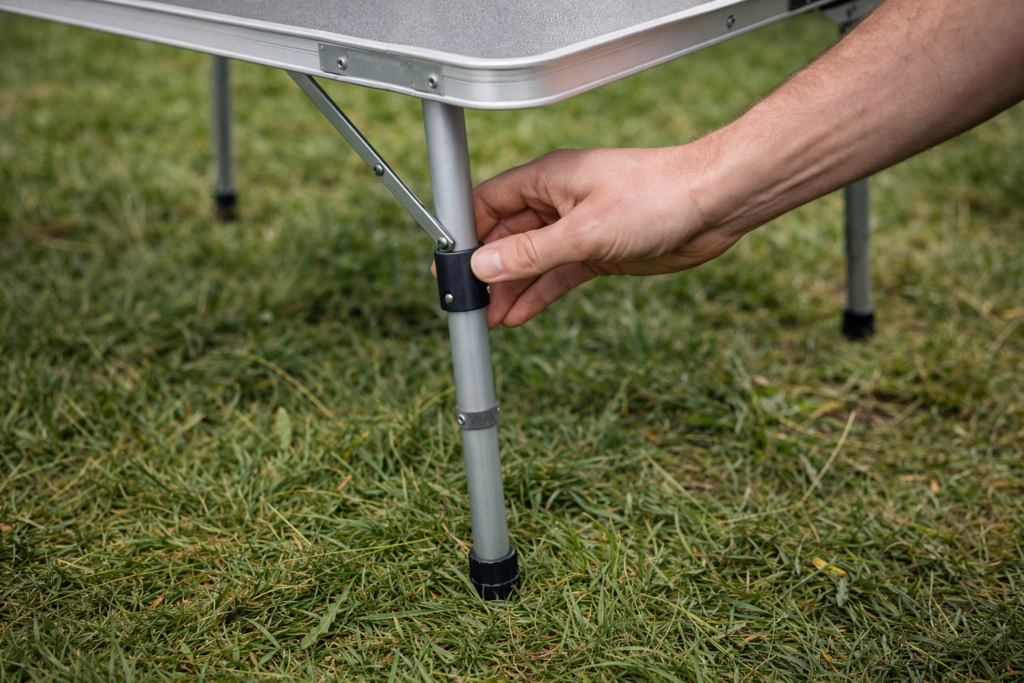
Independent leg adjustment is the UK-specific requirement that most camping table articles aimed at other markets don’t mention. UK campsite ground is rarely flat. Pitches slope. The grass is uneven. A table with fixed legs sits at an angle that slides plates toward one end within thirty seconds of serving dinner. Tables with a single height-adjustment mechanism that moves all four legs together are only marginally better — they raise or lower the table uniformly but can’t compensate for ground that drops differently at each corner. Independently adjustable legs — where each leg sets at its own height — solve this completely and are worth specifically looking for. It’s one of those details that nobody mentions before a first family camping trip but becomes obvious about twenty minutes after arriving on a sloped pitch.
Pack size, stability, and the stove question round out the practical considerations. Know your packed boot dimensions before ordering — a table that rolls to a cylinder fits differently from one that folds flat, and the wrong shape for your remaining space causes real problems on departure day. Stability on soft UK ground is determined by foot diameter, leg spread, and cross-bracing rather than the weight capacity number. And on the stove question: most folding camping tables are not rated for having a camp stove placed directly on them — the legs and frame tolerate the weight but the surface material can be damaged by direct heat over time. Position the stove on a separate stand or a dedicated heat-resistant surface beside the table rather than on it. The table height matters here too — most folding camping tables sit at around 70cm, which is standard dining height and works with most camping chairs. If you’re pairing the table with lower camp chairs, check the seat height before ordering: eating with your elbows above the table surface across a long dinner is less comfortable than it sounds.
The 5 Tables Worth Buying
1. Coleman Roll-Top Aluminium Camping Table — Best Overall for Family Use
The Coleman folding camping table earns the top spot because it removes all the friction that camping tables usually involve. The aluminium slat top rolls out flat to provide a smooth, wipe-clean surface — thirty seconds to clean after a dinner involving children, including the ketchup incident. The steel frame pulls apart from opposite ends and snaps together in a single straightforward motion: watch it done once and you can replicate it confidently at 6pm on a wet Friday arrival without looking for instructions. It comfortably seats four people at meals, handles the weight of a full family dinner, and packs into a cylindrical carry bag that slides into almost any remaining boot space after the rest of the kit is loaded.
The aluminium construction handles UK weather without the corrosion that appears on cheaper steel-framed tables after a couple of wet seasons. Rubber-capped feet provide meaningful grip on soft grass rather than sinking progressively through a wet evening. The surface is durable enough for real use across multiple seasons without showing wear that undermines the structural integrity of the table.
The honest note: the table height is fixed at around 70cm — dining height, works with most camping chairs, but not adjustable for different scenarios. If pairing with lower camp chairs or wanting flexibility for children’s activities at a lower surface, the KingCamp below handles that better. If you’re pairing the table with a camp stove, the stoves worth buying for UK family camping covers which setups work best alongside a standard folding table and which need a dedicated surface.
2. KingCamp Bamboo Folding Camping Table — Best for Uneven Ground
The KingCamp bamboo camping table is the answer to the specific problem that standard aluminium tables don’t solve: genuine independent leg adjustment on sloped UK campsite ground. Each leg adjusts separately through a sawtooth mechanism that locks firmly at the chosen height. On a trip to Loch Tulla where the pitch had a noticeable slope toward the water, this was the feature that turned dinner from a logistics exercise into a normal meal. Without independent adjustment, everything on the table migrates quietly toward the low end. With it, the surface is level, the plates stay where they’re put, and nobody notices the slope the table is compensating for.
The bamboo surface is warmer to touch than aluminium on a cold morning — a minor detail that becomes noticeable when everyone’s eating breakfast at 8°C and the table surface is the thing hands are resting on between bites. It wipes clean easily, doesn’t show scratches across a season the way aluminium does, and has enough visual warmth to look decent at a campsite rather than purely functional. The four-fold design packs to a compact rectangle and the aluminium alloy legs resist corrosion through multiple wet UK camping seasons. The table accommodates four to six people at full dimensions.
The honest note: heavier than the Coleman. For a family where boot space and total kit weight are the limiting factors, the Coleman is the more practical choice. For families who camp regularly on variable UK ground and want a level surface without shimming legs with flat stones, the KingCamp earns its weight.
3. Vango Birch Folding Table — Best Mid-Range from a Trusted UK Brand
Vango camping furniture has a specific quality consistency that shows up over time rather than on first inspection — the hinges don’t loosen, the surface doesn’t delaminate in wet storage, the legs don’t develop a wobble after the second season. The Birch table is the one that demonstrates this. We’ve seen Vango tables in use on Argyll campsites that were clearly several seasons old and still functioning without the flex and movement that cheaper tables develop once the frame starts to fatigue. That long-term reliability is what earns it the third spot rather than just brand loyalty.
The steel frame with independent leg adjustment handles the same uneven ground problem as the KingCamp. The hardtop work surface is durable and cleans properly — scrubbing rather than just wiping — without the surface material degrading. Setup is straightforward: unfold, adjust legs to level the surface, it’s ready. The table folds flat to a manageable pack size that fits between camping chairs in the boot without needing dedicated space.
The honest note: the Birch is functional rather than attractive. If the table pulls double duty as garden furniture between camping trips, the KingCamp bamboo looks considerably better. If the table is purely camping kit that lives in the boot and earns its keep on the pitch, the Birch is the more honest choice.
4. Regatta Malun Folding Table — Best for Tight Boot Space
On a trip to the Trossachs a couple of years ago, the boot was so full by the time everything was loaded that the standard roll-top table — which packs to a cylinder roughly the length of a baseball bat — simply didn’t fit anywhere. We ended up sitting it across the back seat, which was tolerable for a forty-minute drive and would have been genuinely problematic on a longer trip. The Malun solves this specific problem. The tabletop folds in half to a flat briefcase unit with a built-in carry handle — no separate carry bag, no cylinder that rolls into other kit, just a flat rectangle that slides into the gap beside the cool box or behind a row of seats without negotiation.
At two adjustable height settings it covers both dining height and a lower activity height, which makes it useful across different scenarios on a family trip — dinner on the first evening, activity surface for the children the next morning, drinks table beside the chairs in the afternoon. The steel frame is robust enough for family use without the heavyweight construction that makes some camping tables feel like catering equipment.
The honest note: the Malun’s surface is smaller than the Coleman and KingCamp. For four people eating together it works. For five or six wanting plates and serving dishes on the table simultaneously, a larger table is the more comfortable choice.
5. Trail Aluminium Roll-Top Table — Best First Table on a Budget
When a family is buying complete camping kit for the first time and the chair, table, stove, and sleeping kit budgets are all competing for the same total spend, the Trail aluminium roll-top is the table that makes the budget work. The construction mirrors the Coleman at a lower price — aluminium slat top, collapsible frame, carry bag, rubber-capped feet. For two or three camping trips a year on reasonably flat ground, it performs the job a camping table needs to perform without apology.
The Trail camping table is the right first table for a family that isn’t sure yet how often it will actually camp or what it needs from its kit. If camping becomes a regular habit — four, five, six trips a season — the upgrade to a Coleman or KingCamp becomes natural and justified. If it turns out two trips a year is the right frequency, the Trail has done its job without committing significant budget to kit that doesn’t get heavy use. That’s a sensible way to start, and there’s nothing wrong with starting there.
The honest note: fixed single height, and the leg adjustment is less refined than the KingCamp or Vango. On flat ground it’s completely adequate. On the sloped pitches that UK west coast camping regularly produces, a folded piece of cardboard under the short leg is the fix — functional, and the kind of thing you only do a couple of times before deciding the KingCamp’s independent adjustment is worth the upgrade.
The Two-Table Setup
The insight that changes how most families think about camping tables isn’t about which table to buy — it’s that one table is rarely enough for a family camping trip, and the solution costs far less than most people expect.
A single table always ends up occupied by something when you need it for something else. Here’s what actually happens across a typical family camping day. Breakfast: the main table holds plates and cups, the stove sits beside it on its own stand or the cool box lid. Mid-morning: the children want a surface for drawing, crafts, or a board game — the table is still covered in breakfast things or has become the staging area for lunch preparation. Lunch: the table works fine, everyone eats, but the cool box is now blocking the access path because there was nowhere else to put it. Afternoon: the stove comes out for tea, the table is covered in lunch detritus and drying items. Evening: dinner is served, but the stove has nowhere obvious to go because the table is being used as the dining surface, and the camp chairs are positioned three feet away from the only flat surface where drinks could sit.
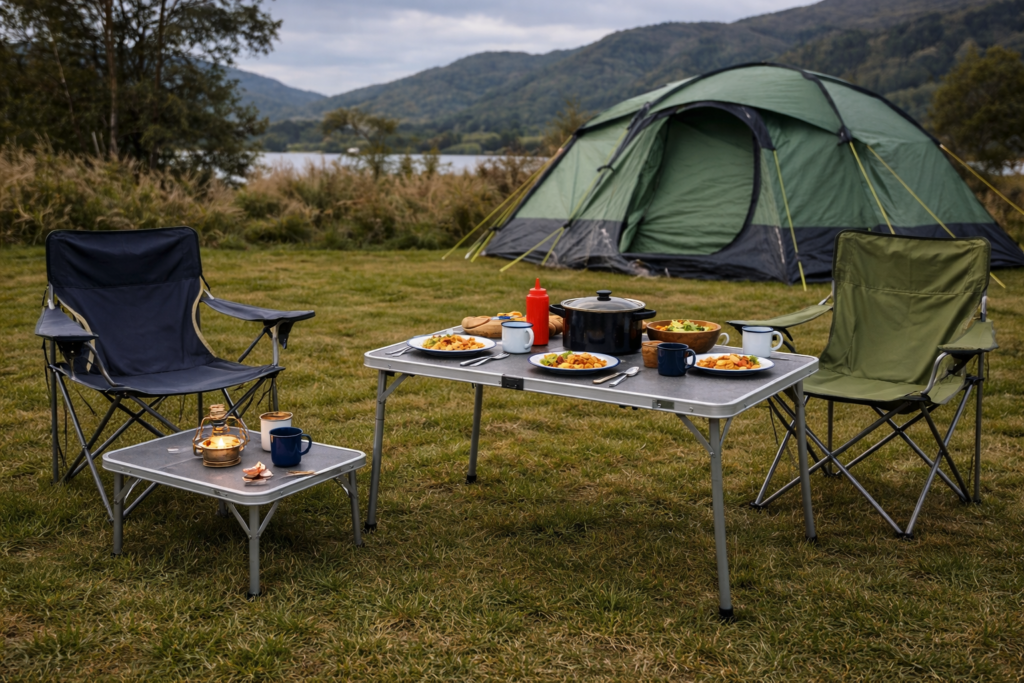
The fix is a small folding side table — a lightweight folding camping side table costing £15–20 that lives beside the chairs as the permanent drinks and small items surface. The main table handles meals and food preparation. The side table takes the stove when breakfast is being made, holds drinks in the evening, and gives the children their own working surface during the day. With two surfaces, everything has a place, nothing has to be moved before the next activity can happen, and the campsite feels arranged rather than improvised.
How you position both tables relative to the chairs determines whether the camp feels like an outdoor living room or a collection of equipment that happens to be in the same field. Main table at the centre of the activity area, side table beside the chairs at arm’s reach, cool box accessible from the seated position at the main table, stove close enough to the main table to move dishes without walking. The chairs worth buying for UK family camping covers the seating side of the same setup question — the arrangement of chairs and tables together is what makes the difference. For a one-night trip where boot space is at its most constrained, a practical packing plan that actually works helps you work out which tables make the cut before you’re standing in the driveway rearranging.
Which Table for Your Family
For a family of four wanting the most reliable all-round table from a trusted brand: the Coleman Roll-Top. Fast setup, proven construction, handles UK weather across multiple seasons without developing the corrosion and wobble that cheaper alternatives show by year two.
For families camping regularly on sloped or uneven pitches: the KingCamp Bamboo. The independent leg adjustment is the feature that earns it, and the bamboo surface is genuinely pleasant to use across a full camping season.
For families with existing Vango kit wanting matched mid-range reliability: the Vango Birch. Long-term build quality that earns the recommendation over time rather than on first inspection.
For families where the boot is genuinely full and pack shape matters as much as pack size: the Regatta Malun. The briefcase fold solves a specific problem that cylinder-pack tables don’t.
For families buying complete first camping kit on a realistic combined budget: the Trail Roll-Top. A sensible starting point that performs the job without overcommitting to kit before you know how often you’ll actually use it.
And alongside whichever main table you choose: a small side table. It costs very little, takes almost no boot space, and earns its place on every single trip once you’ve spent one morning negotiating with your family over who gets the only flat surface on the campsite.
Related Guides
About The Author – Andrew Marshall
Andrew Marshall is the creator of Simple Days Outside and a UK parent of three who regularly camps, walks, and explores outdoor activities with his family. His guides focus on practical gear, realistic family adventures, and simple ways to help families enjoy the outdoors across the UK. The recommendations on this site are based on real-world use, research, and the kind of equipment families actually rely on for weekend trips and everyday outdoor fun.