

Written by Andrew Marshall
UK parent of three sharing practical advice to help families enjoy camping, walking, garden play, and simple outdoor adventures across the UK.
Creator of Simple Days Outside.
Last Updated: 24th March 2026
Ask most families what the hardest part of camping is and the answer isn’t the weather, the cooking, or even getting the tent up. It’s the sleeping. More specifically, it’s the gap between how tired everyone is after a full day outdoors and how long it actually takes to fall asleep — and then stay asleep — on an unfamiliar surface in an unfamiliar environment.
The good news is that sleeping well in a tent is a skill, and most of the things that get in the way of it are fixable. Not all of them — a cockerel that starts at 4:30am on a Scottish campsite is beyond the scope of any advice — but the majority of camping sleep problems come down to a handful of specific things that are entirely within your control. The Family Camping & Short Trips section of the site covers the full sleep system and everything else you need for comfortable family camping in one place.
Start With the Sleep Surface — Everything Else Builds On This
No amount of good sleeping bags, blackout eye masks, or pre-bed routines will compensate for a bad sleep surface. It’s the foundation of the whole system and it’s the thing most families underinvest in, particularly on early camping trips where the assumption is that being tired enough will fix everything.
It won’t. Tired enough helps you fall asleep. It doesn’t keep you asleep when a hip or shoulder is pressing against inadequate cushioning at 2am.
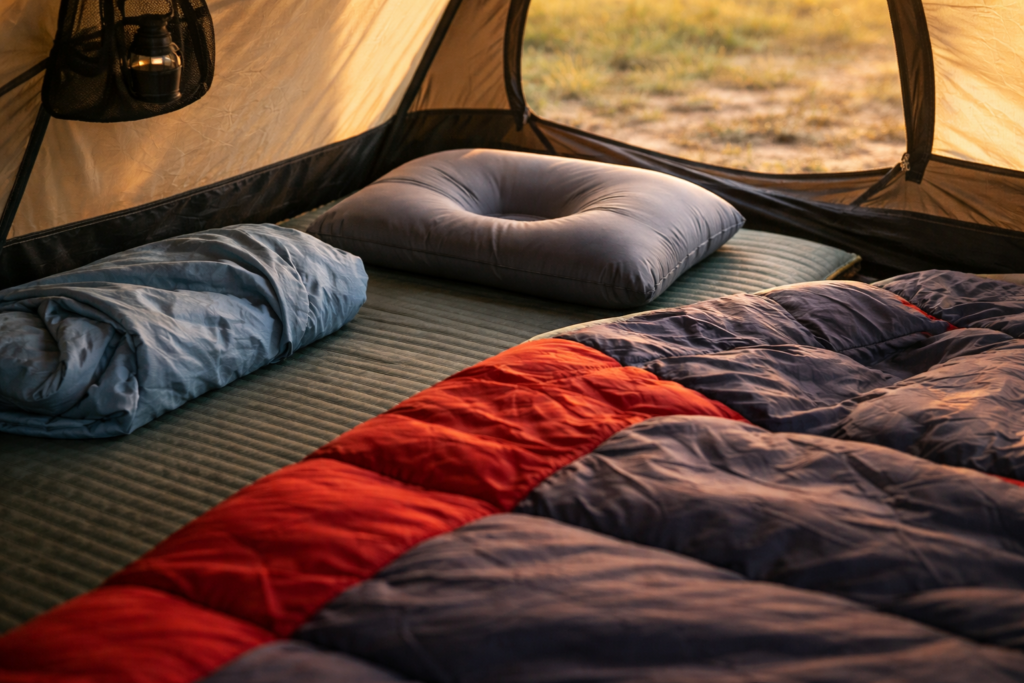
The surface needs to do three things: get you off the cold ground, cushion pressure points, and stay consistent through the night. A basic foam roll mat does the first adequately and the other two poorly. A quality self-inflating camping mat does all three well. A rigid camping bed with a mat on top does all three very well and adds the benefit of a defined sleeping area that doesn’t shift or deflate overnight. If you’re weighing up which sleeping surface suits your family best, the full comparison of camping beds versus air mattresses covers the practical differences in detail — including which suits children of different ages and which holds up better over a week-long trip.
The single most effective sleep improvement most families make is upgrading from a thin mat to something with genuine cushioning and ground insulation. We did this after our second camping season and the difference was immediate enough that we wondered why we’d waited. The children noticed too — the younger two stopped complaining about not being able to get comfortable within a week of the upgrade.
For a double setup, a double self-inflating mat at 10cm or above gives couples and families sharing a surface the combination of cushioning and insulation that makes multi-night camping genuinely comfortable rather than something you endure.
Get the Sleeping Position Right
This sounds obvious until you consider how many people spend the first night of a camping trip lying in whatever position they normally sleep in at home and wondering why it’s not working.
Camping sleep surfaces are firmer than most home mattresses. Side sleepers in particular feel this — the hip and shoulder take the pressure that a soft mattress would normally distribute across a wider area. A thicker sleep surface addresses this structurally, but position adjustments help alongside it.
A proper inflatable camping pillow or a compressible foam version gives the neck the support it needs for side sleeping in particular. The alternative — a rolled-up fleece or a jacket stuffed into a stuff sack — works in a pinch but produces neck stiffness by morning at a rate that a proper pillow doesn’t. We used the jacket method for two seasons before someone pointed out the obvious solution. The camping pillow that cost less than a takeaway meal solved the problem immediately — one of those purchases that makes you annoyed you waited so long.
For side sleepers specifically, a thin rolled camping blanket or a spare sleeping bag liner tucked between the knees reduces hip pressure significantly. It sounds like something from a physio leaflet but it genuinely works — our eldest started doing this on a trip to Loch Lomond last summer after complaining about hip discomfort the previous season and hasn’t mentioned it since. The alignment it creates on a firmer surface makes a real difference to whether you wake up stiff.
Back sleepers generally find camping surfaces more comfortable than side sleepers — weight is better distributed and pressure points are less of an issue. If you’re a back sleeper who still finds tent sleeping uncomfortable, the surface itself almost always needs upgrading rather than the position changing.
Sort the Tent Environment Before You Try to Sleep
The physical sleep surface is the biggest factor — but the tent environment is a close second and it’s the one most families ignore until they’ve had a few bad nights and start looking for causes.
Light is the main problem in summer. UK summers mean it’s light by 4:30am or earlier in Scotland in June and July, and a standard tent does almost nothing to block it. We experienced this properly on our first Argyll trip in late June — the children were awake at 4:45am on the first morning, completely unrested, and the day that followed was one of the harder ones of the trip. A camping eye mask per person costs very little and solves the problem immediately for adults.
For children, a blackout inner in the sleeping pod makes a more dramatic difference than almost anything else on this list for improving how long children actually sleep. Some tents have them built in — others can be retrofitted. If your current tent doesn’t have a blackout inner and early wake-ups are a consistent problem, it’s worth considering when you next replace it. If you’re at the point of thinking about a new tent anyway, the family tents worth considering for weekend camping covers the options with blackout inners alongside everything else worth knowing before buying.
Noise is the second issue. Campsites are noisier than most people expect — other families, dogs, birds, the general ambient noise of an outdoor environment that a house’s walls normally filter out. Foam earplugs are the simplest solution for adults who are sensitive to noise. For children, a familiar white noise from a phone or small speaker running quietly in the tent replicates the background sound environment of home better than silence does — which sounds counterintuitive until you’ve tried it on a child who genuinely struggles to settle in a new place.
Ventilation matters more than most people account for. The instinct on a cold night is to close everything. The problem is that two or three people breathing in an enclosed tent produces significant condensation within a couple of hours — the tent starts to feel damp and slightly stuffy, which makes sleep uncomfortable in a way that’s hard to identify but very easy to feel. Keep a small amount of ventilation open even on cold nights. The small drop in temperature is worth the improvement in air quality.
The Sleep Setup for Children Specifically
Getting children settled and sleeping in a tent involves different challenges from getting adults comfortable, and solving them makes the entire trip better for everyone involved.
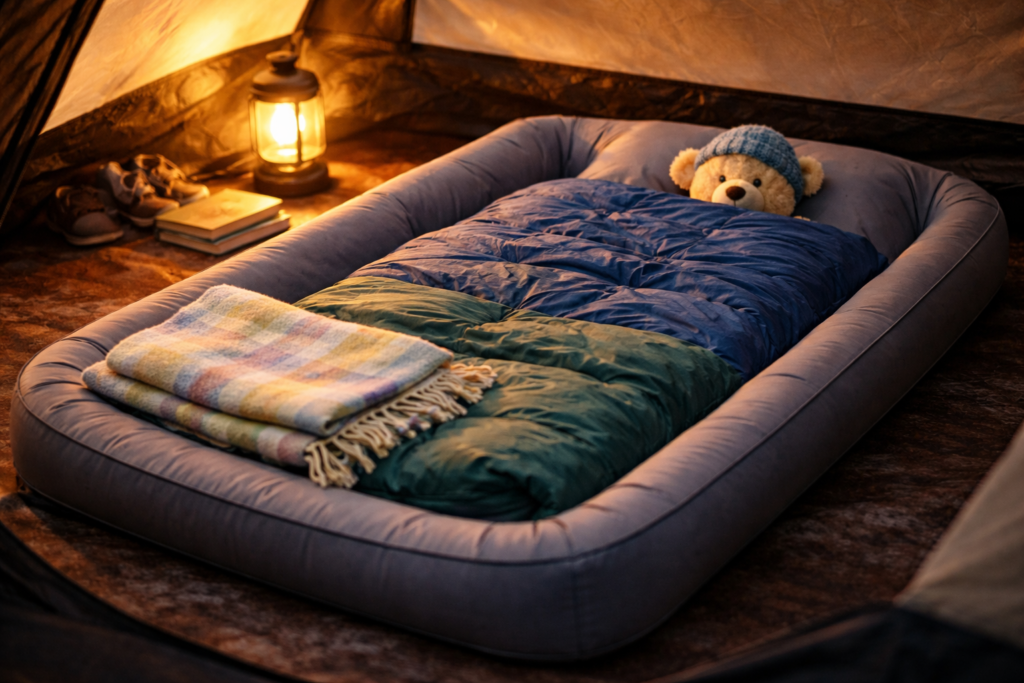
Familiar objects matter enormously for younger children. The same soft toy, the same small blanket from home, the same bedtime book if there’s light enough to read it — anything that signals sleep time works the same way in a tent as at home. We bring a specific small blanket for the youngest that lives in the camping bag permanently and goes in the sleeping bag with him every single trip. He’s never once gone to sleep without it on a camping trip, and we’ve never once had a problem getting him settled. It costs nothing and it works every time.
The physical setup for children needs to feel secure. A low-profile children’s camping bed with raised edges gives younger children a defined sleeping space that feels bounded rather than open — which helps with settling, particularly for children under seven who are used to the sides of a cot or the walls of their own bed. A child on a floor-level mat in a large tent can feel slightly at sea in the open space, which doesn’t help with falling asleep. If you’re specifically looking at what’s available for children at different ages, the best camping beds for kids covers the options worth considering — from toddler-appropriate low profiles through to older children’s sizes.
Timing the wind-down correctly is as important as the kit. Children who are overtired are significantly harder to settle than children who are tired but not past the point of easy sleep. The pattern on most camping trips is that the day is exciting and active, the children are clearly exhausted by early evening, and the temptation is to let them stay up later because it’s camping and the evenings are pleasant. That almost always backfires. A wind-down routine starting earlier than you’d do at home — warm drink, quieter activity, into the sleeping bag before the second wind hits — produces reliably better results than hoping exhaustion does the work.
Getting children settled earlier also means adults get a couple of hours of proper evening camp time without managing tired children, which makes the whole trip feel more like a holiday for everyone.
Small Things That Make a Bigger Difference Than Expected
Some of the most effective sleep improvements on camping trips come from things that cost very little and take almost no space.
Warming the sleeping bag before you get in. Rather than relying on body heat to warm a cold bag from scratch — which takes a surprisingly long time on the first night of a trip when the bag hasn’t been used recently — put a hot water bottle inside for ten minutes before getting in. The difference in how quickly you actually fall asleep in a pre-warmed bag is significant. This is different from the warmth-through-the-night benefit covered elsewhere — this is specifically about sleep onset, which on a cold first night is often the biggest problem.
Earplugs for adults, without fail. A campsite that seems perfectly quiet in the afternoon can be surprisingly alive at 5:30am. Foam earplugs in a small bag, packed without exception, cost pennies and prevent the specific misery of lying awake at dawn listening to someone else’s children while your own are still asleep. We forget them occasionally. We always regret it.
A small lantern rather than a head torch for night movement. The instinct is to use a head torch for everything in the tent, but a small camping lantern positioned low creates ambient light that allows movement without directing a bright beam into sleeping faces. The first time you need to find something at midnight in a tent full of sleeping children without waking them, the difference between a lantern and a head torch becomes permanently clear.
Dedicated sleep clothing. Camping in the layers worn during the day produces worse sleep than a clean, dry sleep layer. A set of thermal pyjamas or base layers worn only for sleeping — familiar, clean, associated with bed rather than activity — signals sleep time in the same way it does at home. On a trip to Argyll last April where the overnight temperature dropped sharply, the children in their usual pyjamas slept through. The adults who’d stayed in their outdoor layers were restless by 2am. The difference was noticeable enough to change the packing list permanently.
When Camping Sleep Genuinely Doesn’t Work — What to Check
If sleep quality is consistently poor despite reasonable kit, it’s usually one of the following:
The sleep surface is inadequate. This is the cause in the majority of cases. On a trip to Loch Venachar a couple of seasons ago, one of the children was waking up multiple times every night despite seeming comfortable at bedtime. The culprit turned out to be a mat that had lost its self-inflation ability from being stored compressed — it looked fine but was providing a fraction of its rated cushioning. Replacing it immediately fixed the problem. If someone is waking up stiff or uncomfortable, the surface needs upgrading or replacing before anything else is addressed.
The sleeping bag is wrong for the temperature. Too cold is obvious. Too warm is less so — a sleeping bag rated significantly below the actual overnight temperature produces sweaty, restless sleep that leaves people feeling unrested even if they technically slept through. If you’re unsure which rating suits which family member for UK three-season camping, the full breakdown of sleeping bag options covers the comfort ratings and what they actually mean in practice.
The pillow situation hasn’t been solved. Neck discomfort from an inadequate pillow creates sleep fragmentation that feels like general restlessness rather than an identifiable cause. If everything else seems right and sleep is still poor, try a proper camping pillow before adjusting anything else. It’s the cheapest potential fix on this list.
The tent is pitched on uneven ground. Surprisingly common and surprisingly impactful. A slight slope that seems negligible when pitching becomes very obvious by midnight when everyone has rolled toward one side. Spend a few minutes finding the flattest available pitch — it’s worth the extra effort every time.
FAQ
Why can’t I sleep in a tent even when I’m exhausted?
Usually one of three things — an uncomfortable sleep surface producing physical discomfort that prevents deep sleep, an unfamiliar environment keeping the brain lightly alert in a way it wouldn’t be at home, or temperature issues in either direction. Address the surface first, then the environment. Most people adapt to camping sleep within two or three nights once both are properly sorted.
How do I stop waking up at dawn on camping trips?
Light is almost always the cause in UK summer camping. A camping eye mask solves it for adults immediately. For children, a tent with a blackout inner makes a significant difference. Pitching with the tent door facing away from the direction of sunrise also helps where the pitch allows it.
Is it better to sleep in a sleeping bag or with a duvet in a tent?
A correctly rated sleeping bag is more practical than a duvet for most tent situations — it stays with you when you move, manages temperature better in variable UK conditions, and doesn’t fall off in the night. A duvet suits large fixed-pitch setups in settled summer conditions where pack size and movement aren’t concerns.
Why do I wake up stiff after sleeping in a tent?
Almost always the sleep surface — specifically inadequate cushioning at the hip and shoulder for side sleepers. A self-inflating mat below 7cm for an adult side sleeper produces this reliably. Upgrading to 10cm or above, or using a camping bed with a mat on top, resolves it in the majority of cases. A sleeping mat repair kit is worth carrying if you rely on a self-inflating mat — a slow leak producing gradual deflation overnight is a common and easily missed cause of morning stiffness.
How do I get children to sleep in a tent?
Familiar objects, earlier wind-down than at home, and a physical setup that feels secure and bounded. A camping bed with raised edges for younger children, a familiar soft toy and small blanket from home, and starting the wind-down before the overtired second wind arrives. The first night is always the hardest — most children settle into the routine by night two or three.
Does tent ventilation affect sleep quality?
Yes — significantly. A closed tent with two or three people sleeping builds condensation and stuffiness within a couple of hours that affects sleep quality in ways that are easy to feel but hard to identify. A small amount of ventilation even on cold nights produces noticeably better sleep than a warmer but stuffier closed tent.
Related Guides
About The Author – Andrew Marshall
Andrew Marshall is the creator of Simple Days Outside and a UK parent of three who regularly camps, walks, and explores outdoor activities with his family. His guides focus on practical gear, realistic family adventures, and simple ways to help families enjoy the outdoors across the UK. The recommendations on this site are based on real-world use, research, and the kind of equipment families actually rely on for weekend trips and everyday outdoor fun.