

Written by Andrew Marshall
UK parent of three sharing practical advice to help families enjoy camping, walking, garden play, and simple outdoor adventures across the UK.
Creator of Simple Days Outside.
Last Updated: 4th April 2026
Getting children to drink enough water on a walk is one of those parenting challenges that sounds simple until you’re actually doing it. A child who has to stop, take their pack off, fish out a bottle, drink, put the bottle away, and put the pack back on will drink less than a child who can sip from a tube without breaking stride. That much is straightforward.
What’s less straightforward is whether a hydration pack is actually the right solution for family walks — or whether a decent water bottle in an accessible side pocket does the job just as well without the extra faff of cleaning a bladder at the end of the day.
Both have their place. Which one suits your family depends on the age of the children, the type of walks you do, and — frankly — how much you value a snack at the top. For more on family walking kit and routes across the UK, the Family Walking & Easy Hiking section of the site covers everything in one place.
What’s the Actual Difference?
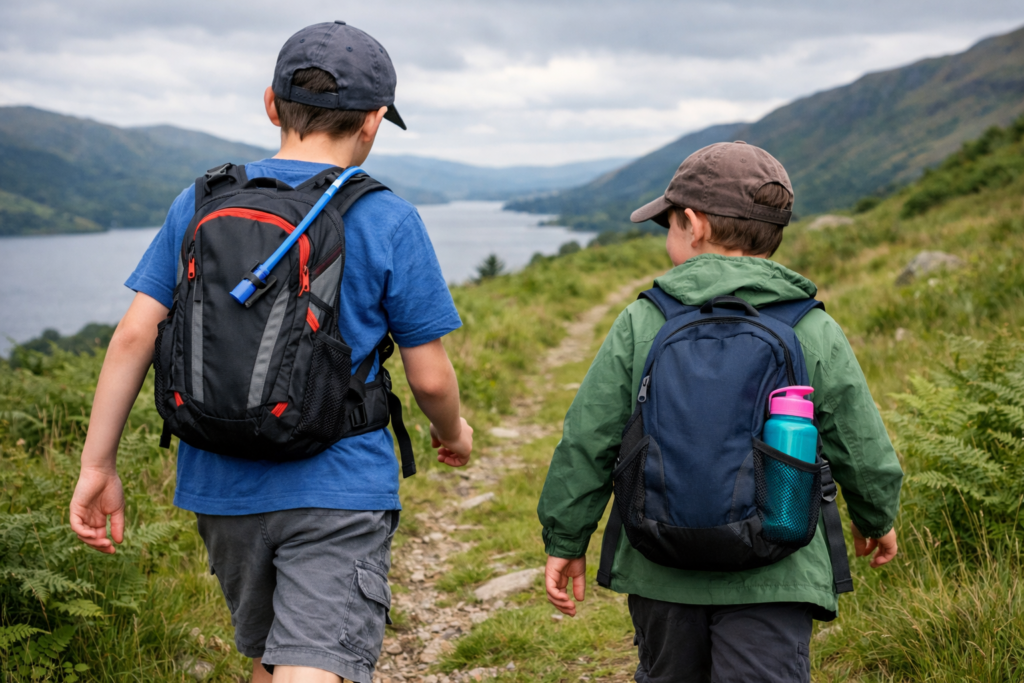
A hydration pack is a backpack — or a vest-style pack — with a built-in reservoir, usually called a bladder, that holds water. A tube runs from the bladder to the front of the pack where it clips to a shoulder strap. The child drinks by biting and sipping from the mouthpiece without stopping or removing the pack.
A water bottle is a water bottle — typically carried in a side pocket of a regular backpack, accessible without removing the pack if the pockets are positioned correctly.
The practical difference comes down to three things: how easily the child can access water during movement, how much the pack can carry alongside the water, and how easy the whole system is to clean and maintain.
The Case for Hydration Packs
Continuous sipping without stopping. This is the headline benefit and it’s real. Children who can sip from a tube while walking tend to stay better hydrated than children who have to stop and retrieve a bottle. For longer walks — anything over two hours — this matters. Consistent small sips throughout a walk beat occasional large drinks, and the hands-free access encourages the former.
I used hydration packs extensively when mountain biking — the ability to drink without slowing down was genuinely useful on a technical descent at Fort William or Innerleithen where stopping wasn’t an option. The pack stayed full, I stayed hydrated, and I never had to think about it. On family walks the dynamic is slightly different — stopping is entirely possible and often welcome — but the principle holds. A child who can drink without interrupting their walking rhythm is more likely to stay on top of hydration without being reminded every twenty minutes.
No bottle to fish out. A child who has to remove their pack to access a water bottle often simply won’t bother — particularly at the age where independence matters more than sense. The tube removes that friction entirely.
Capacity. A hydration bladder typically holds 1.5–2 litres — more than most children’s water bottles and enough for a full day’s walking on most UK trails without refilling. For older children on longer days this is relevant.
Better for active movement. Water inside the pack rather than in a side pocket means no sloshing weight on one side and a lower more central centre of gravity. For older children on hillier or more technical terrain, this makes a small but noticeable difference to how the pack feels in motion.
The Case for Water Bottles
A water bottle done properly — in a well-positioned side pocket, the right size, the right lid — solves the hydration problem for most family walks without creating any new ones. That’s worth saying clearly before listing the individual reasons, because it gets lost in comparisons that treat the water bottle as the lesser option by default.
You can see how much they’ve drunk. A transparent or semi-transparent kids insulated water bottle tells you at a glance whether a child has been drinking. A hydration bladder doesn’t — the water is inside a sealed reservoir and there’s no visible indication of remaining volume unless the pack has a gauge, which most don’t. For parents monitoring younger children’s hydration on a longer day, this visibility matters more than any amount of tube convenience.
Side pocket accessibility works well enough. A backpack with well-positioned external bottle pockets allows a child to access water without removing the pack — not as seamless as sipping from a tube, but close enough for most family walks where stopping occasionally is perfectly fine. If you’re still working out which backpack to pair with the water bottle, the small backpacks worth considering for kids on walking days covers the options with well-positioned bottle pockets across different age ranges.
Easier to refill and share. On a walk with a stream, a tap, or a café mid-route, refilling a water bottle takes ten seconds. Refilling a hydration bladder requires removing it from the pack, opening it, filling it, sealing it, and re-routing the tube — a significantly more involved process that most children won’t manage independently and most adults won’t bother with mid-walk.
Simplicity and no maintenance regime. A water bottle requires a rinse. A bladder requires a cleaning routine. For families who walk occasionally and then store the pack for six weeks between outings, the maintenance difference matters considerably — more on this below.
More room for the important things. This is the point that settled it for me on family walks, and it took an embarrassingly specific situation to make it clear. A walk in the Cairngorms, loaded up with a hydration pack that held two litres of water and approximately one cereal bar. By the time we reached the top, I would have happily traded the entire reservoir for a sandwich. The hydration was excellent. The snack situation was a disaster. A regular pack with a water bottle in the side pocket keeps the main compartment free for the things that actually make a family walk enjoyable.
Storage — The Factor Most Reviews Don’t Mention
This is worth its own section because it’s the thing that most hydration pack comparisons gloss over and the thing that most determines whether a hydration pack actually works for family walking rather than solo activities.
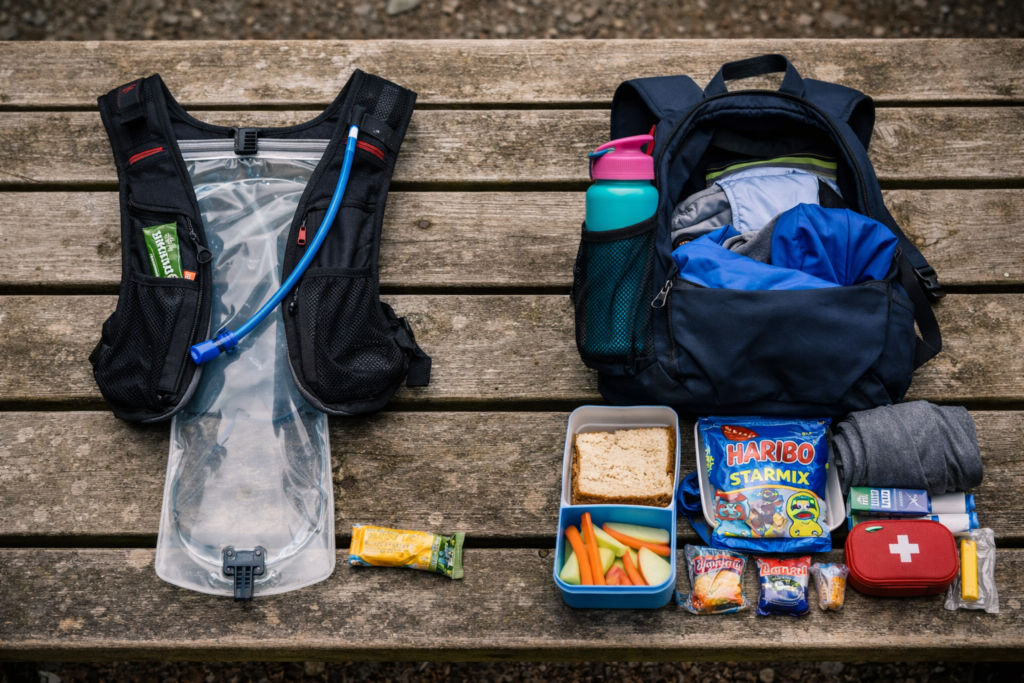
A pure hydration vest or minimalist hydration pack — the kind designed for trail running or mountain biking — carries the water and very little else. Great for a solo activity where the kit list is minimal. Not great for a family walk where you need waterproofs, snacks, a first aid kit, a spare layer, and whatever treasure the children have decided to collect on the way back down.
Some hydration packs — particularly the larger 10–15 litre versions — combine a hydration bladder with a decent main compartment and additional pockets. These are significantly more useful for family walking because they carry the water and everything else without compromise. If hydration packs appeal to you or your children, this is the category worth looking at rather than the minimalist vest-style options.
The practical test: can this pack carry 1.5 litres of water plus two children’s packed lunches, four waterproof layers, a first aid kit, and a bag of Haribo for the summit? If yes, it’s worth considering for family walking. If no, a regular pack with a water bottle is the more practical solution regardless of how good the hydration system is. If you’re also thinking about which backpack the adults carry on the same walks, the family walking backpacks worth considering for day trips covers the adult options — useful for working out how to split the kit load before deciding what the children’s packs need to carry.
Which Works Better for Different Ages?
Toddlers and under-fives — water bottle without question. A hydration pack for a child this age is more kit than they need, the tube and mouthpiece require a level of coordination that very young children find unreliable, and the added complexity isn’t worth it. A toddler water bottle with a flip-top or straw lid in a side pocket of their small pack is entirely sufficient.
Ages five to eight — water bottle remains the simpler and more practical choice for most family walks. Our middle one went through a phase at around six of wanting a hydration pack because an older child at school had one — we tried it on a walk along the Loch Lomond shores and while he was enthusiastic about the tube for approximately the first twenty minutes, the novelty faded quickly and the maintenance fell entirely to us. A bottle in a side pocket he could reach himself turned out to work better in practice than the more exciting-seeming alternative. The child manages the bottle independently. The parent doesn’t have to think about it.
If you’re planning a first proper walk with children this age and working out the full kit picture, what to pack for a 2–3 hour UK trail with children covers the whole list — the hydration question sits naturally alongside everything else on it.
Ages nine to twelve — this is the age group where hydration packs start to make genuine sense for children who do regular longer walks. The child is old enough to manage the system independently, the pack capacity at this age is large enough to accommodate a bladder alongside real kit, and the hands-free drinking benefit on longer hillier days is more relevant. A kids hydration pack at 10–15 litres with a 1.5 litre bladder and proper main compartment is the configuration worth looking for — not the minimalist vest style that compromises on storage.
Teenagers — personal preference, same as adults. Many older teenagers who walk or hike regularly prefer hydration packs for longer days. Others find water bottles sufficient. At this age the decision is theirs to make based on their own experience.
Cleaning and Maintenance — The Honest Reality
Hydration bladders need cleaning after every use. A bladder that isn’t dried properly between uses develops mould — not immediately obvious from outside an opaque reservoir — which then makes the water taste unpleasant and eventually makes the system unusable.
We discovered this after a family camping and walking trip to Argyll where the hydration pack was packed away damp in the kit bag and then sat in a cupboard for five weeks. When we opened it for the next walk, the inside of the bladder had developed a visible bloom of mould and the tube smelled of something that had no business being near drinking water. The whole system needed a deep clean with tablets before it could be used again — and the walk that morning waited while we sorted it out, which nobody was grateful for.
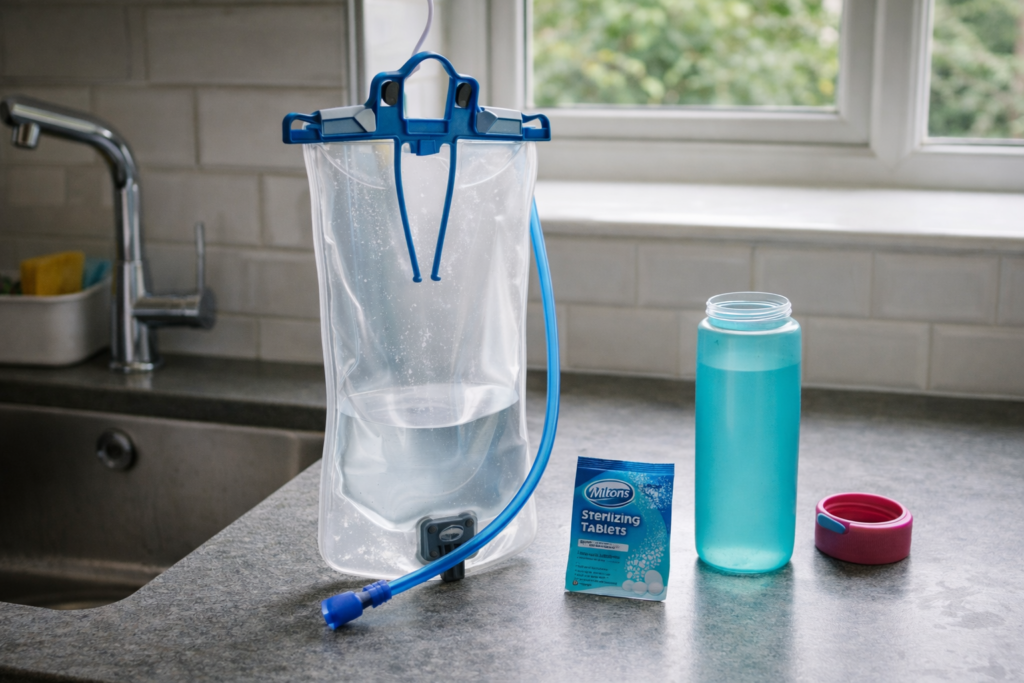
Cleaning a bladder properly involves rinsing, drying thoroughly with the bladder hung open, and occasionally running a cleaning tablet through the system. Hydration bladder cleaning tablets are worth keeping alongside any bladder system as standard kit rather than an afterthought. A Hydration bladder drying kit — typically a hanger that holds the bladder open while it dries — makes the drying process significantly more reliable than trying to prop it open over a tap.
Water bottles require no such regime. Rinse, leave to air dry, done.
The Verdict for Most UK Families
For families thinking about how far children of different ages can realistically walk before hydration becomes a performance issue rather than just a comfort one, the realistic walking distances for children by age puts the hydration decision in useful context — the answer to the bottle versus pack question changes depending on the length and type of walk you’re planning.
For the majority of family walks — particularly with children under ten, on routes under three hours, and in the UK where stopping regularly for snacks, views, and the occasional impromptu puddle investigation is part of the experience — a water bottle in a well-positioned side pocket is the more practical, more versatile, and less maintenance-intensive solution. It works, it’s simple, and it leaves room in the pack for everything else that makes a family walk work.
The hydration pack earns its place for older children doing longer walks where continuous hydration matters more than stopping rhythm, and where the pack is large enough to carry both the bladder and real storage for everything a family day out requires. That combination — proper bladder plus proper storage — is what to look for. An insulated hydration bladder is worth considering for summer walks where water temperature becomes a factor — a bladder that’s been sitting against a warm back for two hours in July doesn’t produce water anyone wants to drink.
If you’re considering hydration packs, look for options with at least 10 litres of usable storage alongside the bladder. Anything smaller and you’re compromising the snack situation — which, as anyone who has reached the top of a Scottish hill with a hungry child and insufficient food will confirm, is not a compromise worth making. The Haribo goes in the pack. Non-negotiable.
FAQ
At what age can a child use a hydration pack?
From around five or six for basic use with parental help on the maintenance side. From around nine or ten for independent use where the child manages the system themselves. Younger children can use hydration packs but the maintenance falls entirely to the parent and the pack capacity at younger ages is usually too small to make it genuinely worthwhile.
Are hydration packs hard to clean?
They require more attention than water bottles but the process itself isn’t complicated — rinse after every use, dry thoroughly with the bladder hung open, use a cleaning tablet periodically. The issue is consistency. A bladder that’s occasionally left damp develops mould that a water bottle never would. If regular post-walk cleaning isn’t realistic for your household, a water bottle is the more reliable long-term choice.
How much water should a child carry on a walk?
As a general guideline, children need roughly 150–250ml of water per hour of activity depending on temperature and exertion. For a three-hour walk on a mild UK day, 500–750ml is usually sufficient with the option to refill at a stream, tap, or café. For longer or hotter days, 1–1.5 litres is a more comfortable margin.
Can you put drinks other than water in a hydration bladder?
Water only for long-term use. Juice, squash, or sports drinks leave residue in the tube and bladder that’s significantly harder to clean and accelerates mould growth. Some children refuse to drink plain water on walks — in which case a water bottle with their preferred drink is more practical than a bladder that requires intensive cleaning after every use.
Do hydration packs keep water cold?
Standard hydration bladders don’t insulate — the water reaches ambient temperature during the walk, which on a warm day means lukewarm water by mid-morning. An insulated hydration bladder addresses this but adds cost. An insulated water bottle maintains temperature significantly better than a standard bladder for the same money, which is another reason bottles suit younger children particularly well.
What’s the best way to get a child to drink more on walks?
Accessible water is the biggest factor — a bottle in a side pocket they can reach without removing the pack, or a hydration tube they can sip from without stopping. Beyond the system itself, making water breaks part of natural walk stops rather than a separate prompt works better than reminding children every twenty minutes. Our eldest drinks consistently when we frame stops as “water and snack” moments rather than just hydration checks — combining the drink with something enjoyable means he actually looks forward to them. For younger children who reject plain water, a very light squash in the bottle often solves the problem entirely without the maintenance complications of flavouring a bladder.
Related Guides
About The Author – Andrew Marshall
Andrew Marshall is the creator of Simple Days Outside and a UK parent of three who regularly camps, walks, and explores outdoor activities with his family. His guides focus on practical gear, realistic family adventures, and simple ways to help families enjoy the outdoors across the UK. The recommendations on this site are based on real-world use, research, and the kind of equipment families actually rely on for weekend trips and everyday outdoor fun.